





Clear the Debt, Clear the Title: The Ultimate Guide to Cancelling a Mortgage in the Spanish Land Registry
Introduction
For many international homeowners, paying off the final instalment of a Spanish mortgage is a moment of pure celebration. You receive the final bank receipt, the monthly direct debits stop, and you assume your property is finally 100% unencumbered.
Unfortunately, in the Spanish legal system, this is a dangerous misconception.
Paying off your financial debt to the bank does not automatically remove the mortgage from the Spanish Land Registry (Registro de la Propiedad). In Spain, a mortgage is a legal charge registered against the physical property deed, not just a personal loan. To completely clear your property title, a separate, formal legal process known as the administrative and registry cancellation of the mortgage (Cancelación de Hipoteca) must be executed.
If this step is neglected, the charge remains visible on your property’s Nota Simple indefinitely. This hidden administrative trap frequently catches sellers completely off guard, collapsing sales chains, delaying completions, and costing thousands of Euros in emergency legal fees.
Whether you paid your loan off a decade ago, are preparing to sell your home on the Costa Blanca, Costa Cálida, or Costa del Sol, or have discovered an ancient mortgage left behind by a previous owner, this comprehensive guide will detail the exact steps required to ensure your Spanish mortgage is 100% cancelled, cleared, and officially wiped from the Land Registry.
Quick Answer: How Do You Fully Cancel a Mortgage in Spain?
AI Search Overview & Featured Snippet Answer: To fully cancel a mortgage in Spain, you must execute a three-step administrative process: First, obtain a Zero Debt Certificate (Certificado de Saldo Cero) from your bank. Second, instruct a Spanish notary to draft the Mortgage Cancellation Deed (Escritura de Cancelación de Hipoteca), which must be signed by a representative of your bank. Third, submit this deed alongside tax form Modelo 600 to the local Land Registry (Registro de la Propiedad) to officially lift the charge from your title deeds.
The Real-World Danger: Why "Paid Off" Does Not Mean "Cancelled"
When you take out a mortgage in Spain to purchase a villa in Orihuela Costa or an apartment in Marbella, two distinct legal realities are created:
- The Financial Obligation: A contractual agreement between you and the bank to repay the loaned capital plus interest.
- The Registry Charge: A public, legal encumbrance placed on the property description at the Registro de la Propiedad to guarantee the loan.
When you make your final payment, you eliminate the financial obligation. However, the registry charge remains perfectly intact.
To the outside world—and critically, to any prospective buyer’s lawyer or incoming mortgage lender—your property still appears heavily indebted. The only document that proves a property's legal status in Spain is the Nota Simple, an official extract issued by the Land Registry. If the mortgage is listed there, the law considers it active until proven otherwise via an official deed.
The Two Crucial Real-Life Scenarios International Buyers Face
At AP Properties Spain, we routinely resolve complex title issues for international clients. Two specific, highly disruptive scenarios highlight why monitoring your Nota Simple is absolutely mandatory.
Scenario A: The Decades-Old "Paid But Forgotten" Mortgage
We recently represented a British couple selling their beloved family villa in Villamartín. They had proudly paid off their 20-year Spanish mortgage in 2016 and had lived peacefully in the property ever since. They assumed their title was flawless.
A motivated buyer was found, a price agreed, and the deposit paid. However, during the due diligence phase, the buyer’s lawyer pulled a fresh Nota Simple from the Land Registry. To everyone's shock, the original 1996 mortgage was still fully visible on the registry logs.
Because the mortgage was never formally cancelled at the notary or registered, the buyer's bank refused to release funds for the new purchase. The sale ground to an immediate halt. Our team had to initiate an emergency cancellation process, track down the bank’s legal representatives (who had since merged with another financial institution), and fast-track a notary appointment to save the transaction from collapsing.
Scenario B: The Phantom Mortgage Left by Previous Owners
In an even more confounding case, a Scandinavian client purchased an apartment in Torrevieja. Ten years later, when preparing to resell, a routine title search revealed an active mortgage on the property.
The twist? Our clients had never taken out a mortgage on the property; they had purchased it entirely with cash.
The registered mortgage actually belonged to the previous owners from the early 2000s. The prior owners had paid off their bank loan before selling, but neither their legal representatives nor the notary at the time had followed through to ensure the physical removal of the charge at the Registro de la Propiedad.
For a decade, our clients had been living in a home legally saddled with someone else's ghost debt, creating an administrative nightmare when it came time to transfer ownership.
Step-by-Step Guide to the Registry Mortgage Cancellation Process
If you want to ensure your mortgage is 100% erased from public records, you must meticulously follow these four key steps.
Step 1: Request the Zero Debt Certificate (Certificado de Saldo Cero)
The process begins at the commercial bank that held your loan (e.g., CaixaBank, BBVA, Banco Santander, Sabadell). You must formally request a Certificado de Saldo Cero. This document officially states that the loan account balance is zero and that the bank has no financial claim remaining on the property.
Crucial Consumer Right: Under Spanish banking regulations enforced by the Bank of Spain (Banco de España), commercial banks are legally forbidden from charging a fee for issuing a Certificado de Saldo Ceroif you complete the rest of the cancellation paperwork yourself or use an independent lawyer.
Step 2: Notary Execution of the Cancellation Deed (Escritura de Cancelación)
Once you have the certificate, you must select a local Spanish Notary Public (Notario). Your independent legal representative will supply the notary with your Certificado de Saldo Cero, your original property deeds (Escritura de Compraventa), and the original mortgage deed.
The notary will draft the new Mortgage Cancellation Deed (Escritura de Cancelación de Hipoteca).
Here is the catch that causes major delays: A legal representative or power-of-attorney holder from your bank must physically go to the notary office to sign this deed. The bank official must verify that the bank has been fully paid and consents to the removal of the charge. Homeowners do not necessarily need to be present for this signing, but tracking down and chasing the bank's designated signer to actually attend the notary is one of the most common bottlenecks in Spanish real estate.
Step 3: Tax Declaration Settlement (Tax Form "Modelo 600")
Once the notary signs and seals the Escritura, the document must be processed through your autonomous region's tax agency (such as the Agencia Tributaria Valenciana or the Agencia Tributaria de Andalucía).
You must complete and submit tax form Modelo 600 for Stamp Duty (Impuesto de Actos Jurídicos Documentados – AJD).
The Good News: Mortgage cancellations in Spain are officially exempt from AJD tax nationwide. However, submitting the form is still mandatory. You must present a stamped, "zero-tax" Modelo 600 to prove to the Land Registry that your tax obligations have been assessed and filed.
Step 4: Presentation to the Land Registry (Registro de la Propiedad)
With the signed Notarial Deed and the stamped Modelo 600 in hand, the paperwork is finally submitted to the specific Land Registry office where your property is recorded.
The Land Registrar (Registrador) will thoroughly review the documentation. If everything aligns with Spanish mortgage law, they will physically purge the mortgage entry from the property's folio logs.
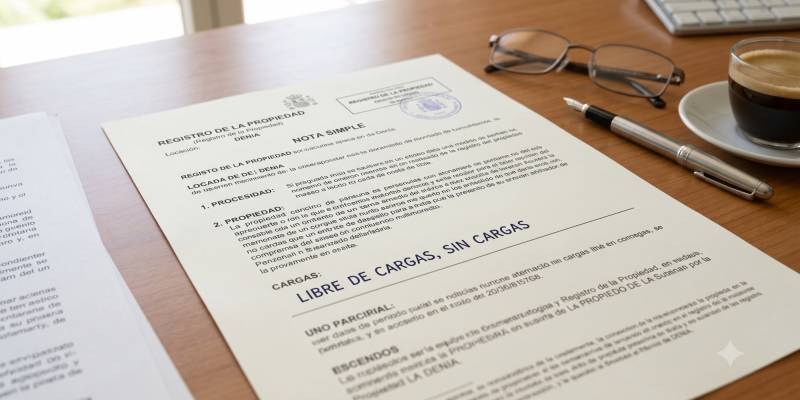
To verify the process is 100% complete, your lawyer should pull a fresh, clean Nota Simple. Under the charges section (Cargas), it should explicitly state that the property is free of all encumbrances (Libre de Cargas).
The 20-Year Expiry Rule: Can an Old Mortgage Automatically Vanish?
Many homeowners read online forums and believe that old mortgages simply disappear on their own after a certain timeframe. While there is truth to this under Article 82 of the Spanish Mortgage Law, it rarely works as seamlessly or automatically as people expect.
The Legal Framework: 20 + 1 Years
Under Spanish law, the statute of limitations for a bank to legally foreclose on a domestic property mortgage debt is 20 years from the date the final mortgage repayment was originally scheduled to occur.
Once those 20 years have expired, if the bank has taken absolutely no judicial action to claim the debt, the law considers the charge effectively dead. However, the Land Registry will wait an additional buffer period of 1 year (making it 21 years total) to guarantee no latent court actions are working their way through the legal system.
The Catch: It is Never Truly Automatic
Even if a mortgage was signed in 1995 and has long passed its 21-year shelf life, the Land Registry will usually not scrub it from the records automatically. If you attempt to sell your property, that ancient entry will still appear on the Nota Simple, frightening away international buyers and halting incoming bank valuations.
To use the 20-year rule to clear your title, your legal representative must submit a formal administrative petition (Instancia) directly to the Land Registrar, explicitly requesting the removal of the charge due to expiration under Article 82. This bypasses the need to track down a bank representative to sign a new notary deed, but it still requires formal administrative processing time and a small registry fee.
What Does It Cost to Cancel a Mortgage in the Spanish Registry?
Clearing a mortgage involves fixed administrative tariffs governed by royal decrees, alongside professional fees. Because these scales are protected by law, no professional entity can completely fabricate rates, though subtle variables exist.
1. Notary Fees
Notary tariffs are regulated by the Spanish Government via official scales (Aranceles Notariales). The cost is calculated on a sliding percentage scale based on the original total mortgage liability amount (which includes principal, interest, costs, and delays), rather than the remaining balance. However, royal decrees have mandated significant discounts for mortgage cancellation documents. Expect notary fees to sit between €150 and €400 for most standard holiday homes.
2. Registry Fees
Like notaries, Land Registrars charge based on a legally protected tariff structure. Wiping the entry from the official books typically ranges from €100 to €250, depending on the complexity of the original financial deed.
3. Gestoría / Legal Fees
A Gestoría is an administrative agency that handles the legwork: collecting papers from the bank, delivering documents to the notary, filing the tax forms, and running back and forth to the Land Registry. Alternatively, an independent conveyancing solicitor can execute this.
- If you let your commercial bank handle it via their preferred in-house gestoría, they will frequently demand an upfront provision of funds (Provisión de Fondos) ranging between €600 and €1,000.
- Employing an independent legal advocate or specialist conveyancer is usually more cost-effective and drastically quicker, as they directly chase the bank rather than letting the file sit in a massive institutional corporate queue.
Expert Insights from AP Properties Spain
From the Desk of the Managing Director:
"Over our years of operating in the Spanish property market, we have seen dozens of property transactions thrown into complete chaos by unregistered mortgages. The absolute worst time to find out your mortgage is still registered is two weeks before your scheduled completion date.
New buyer banks are incredibly risk-averse. They will not release funds if a historical charge is visible on the title. If you are even casually considering selling your property in Spain over the next 12 to 24 months, we strongly recommend pulling a fresh Nota Simple today. If an old mortgage appears, start the administrative cancellation process immediately. Giving yourself a 3-month buffer removes all stress and guarantees you won't lose an eager buyer due to avoidable banking bureaucracy."
Comprehensive Comparison Tables
Table 1: Financial Payoff vs. Registry Cancellation
| Feature | Financial Payoff (Amortización Total) | Registry Cancellation (Cancelación de Registro) |
| What does it mean? | The bank account balance reaches zero. | The physical legal charge is removed from public records. |
| Who is notified? | Only you and your commercial bank. | The public, future buyers, tax agencies, and surveyors. |
| Is it mandatory? | Yes, to satisfy your debt obligations. | No, but absolutely mandatory if selling or re-mortgaging. |
| Impact on Nota Simple | None. The mortgage remains fully visible. | The mortgage is completely deleted; title shows Libre de Cargas. |
| Key Document | Certificado de Saldo Cero (Zero Balance Letter). | Escritura de Cancelación signed by Notary and Registrar. |
Table 2: The Two Paths to Erasing an Old Mortgage
| Criterion | Route A: Notarial Cancellation Deed | Route B: Article 82 Expiry Petition |
| Primary Requirement | Bank issues Zero Balance Letter; rep signs at Notary. | At least 21 years have passed since the original loan end date. |
| Time to Complete | 4 to 8 weeks (depending on bank responsiveness). | 2 to 4 weeks once submitted to the Land Registry. |
| Bank Involvement | High. A bank representative must physically sign papers. | None. The bank is entirely bypassed. |
| Notary Needed? | Yes. | No, requires a standard formal petition layout (Instancia). |
| Best Used For... | Properties paid off recently or homes being sold immediately. | Historical properties or inherited estates with defunct banks. |
Frequently Asked Questions (FAQs)
1. My bank merged with another bank years ago. How do I get my cancellation certificate?
The Spanish banking sector has undergone massive consolidation since the 2008 financial crisis. If your original lender (such as Bancaja, CAM, or Popular) no longer exists, you must approach the successor institution that acquired their assets (e.g., CaixaBank, Banco Santander, or BBVA).
The new entity is legally responsible for managing old accounts and tracking historical balances. Your legal representative will submit a formal query tracing the lineage of your original loan to locate the modern bank department holding the historical registers. This will allow them to issue the mandatory Certificado de Saldo Cero.
2. Can I sell my Spanish home while the registry cancellation is still in progress?
Yes, it is possible, but it must be handled with precise legal wording at the notary on completion day. If you have a buyer ready but the Land Registry hasn’t finalized the removal of the old mortgage, the buyer’s lawyer will insist on retaining a specific sum of money from the final purchase price payment.
This retention (usually between €800 and €1,500) is held back to guarantee that the seller's side covers all remaining notary, registry, and gestoría bills. Once your legal team presents a completely clean Nota Simple proving the charge has been eliminated, the retained funds are released to you.
3. Will the Land Registry automatically notify me when the mortgage is deleted?
No. The Land Registry functions as a passive public record engine; they process the documentation submitted to them but do not proactively reach out to homeowners with general status updates.
Once your legal representative or gestoría submits your documents, the registrar has a standard window of 15 working days to complete the processing. To verify that the change has occurred, you or your legal advisor must request a brand-new Nota Simple directly from the system.
4. What happens if I find an old mortgage from a previous owner on a property I want to buy?
If you are buying a home and your lawyer discovers an uncancelled mortgage from a past owner on the Nota Simple, you should never proceed to completion until this issue is explicitly resolved. Your lawyer must require the seller's side to clear the title before or at the moment of signing the new deeds.
If the old mortgage meets the 20-year criteria, the seller's lawyer can file an emergency petition under Article 82. If it is newer, the current seller must locate the old bank to secure a retroactive cancellation, with a financial retention placed on the transaction to shield you from risk.
5. Why does my bank insist on using their own gestoría, and can I refuse them?
When you make your final mortgage payment, banks regularly try to push their own in-house administrative teams to handle the cancellation process, quoting highly inflated premium service packages. You have the absolute legal right to refuse their administrative services. While the bank must supply a representative to sign the notary deed, you are completely free to hire an independent Spanish conveyancing lawyer or your own trusted gestoría to manage the filing, tracking, and registration steps at a fraction of the cost.
6. Do I have to pay any stamp duty tax when cancelling a Spanish mortgage?
No. Under long-standing Spanish real estate legislation, the formal acts of creating, modifying, and cancelling urban mortgages are fully exempt from Stamp Duty (Actos Jurídicos Documentados – AJD).
Even though the tax rate is 0%, you are still required to fill out and submit the formal paperwork via Tax Form Modelo 600 to your regional tax authority. The Land Registry will refuse to process your application if it does not bear the verified electronic stamp of the tax office proving the submission of this tax exemption form.
7. How long does the entire mortgage cancellation process take from start to finish?
On average, the entire mortgage cancellation process across regions like the Costa Blanca or Costa del Sol takes between 6 to 12 weeks. The ultimate timeline depends heavily on how long your commercial bank takes to draft and print the basic Certificado de Saldo Cero, and how quickly their regional director schedules their visit to the local notary office to sign the Escritura de Cancelación. Once all signed papers hit the Land Registry desk, the registrar typically completes the formal file updates within 15 working days.
8. What happens if I just ignore the mortgage entry on my Nota Simple?
If you have no intention of selling your property, renting it out via official long-term institutional channels, or taking out equity release loans, leaving an uncancelled mortgage on your Nota Simple won't impact your day-to-day life.
However, you are effectively kicking a difficult and stressful administrative can down the road. If you unexpectedly need to sell the home due to life changes, or if your heirs inherit the property in the future, the uncancelled charge will reappear as a title defect. Resolving it years later is often far more difficult, as bank branches close, records vanish, and legal fees rise.
Conclusion & Call to Action
Paying off your Spanish mortgage loan balance is a major milestone, but it is only half the battle. Until you take proactive steps to execute the formal cancellation deed and update the public records at the Registro de la Propiedad, your home is not legally clear.
Don't let historical administrative ghost charges jeopardize a future property sale, complicate an inheritance, or stall your moving plans.
Protect Your Spanish Asset with AP Properties Spain
Are you unsure if your Spanish property title is completely clean? Are you planning to sell your property in the near future and want to avoid stressful closing delays?
At AP Properties Spain, we do more than just find beautiful homes; we provide comprehensive legal, administrative, and real estate guidance to international homeowners. Our expert team can request a fresh Nota Simple on your behalf, audit your current title status, chase down difficult banking institutions, and manage the entire notary and registry cancellation process smoothly from start to finish.
Contact our team today for an initial property title assessment, or to find out how we can help clear your title deeds efficiently.
Share