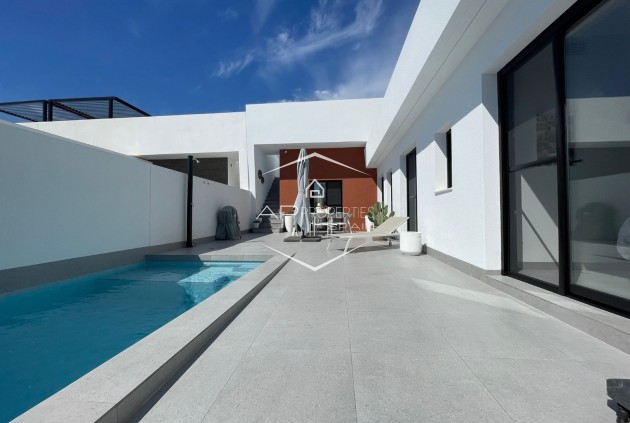






Holiday Villas in Spain: Your 2026 Buying Guide
You're probably starting where most overseas buyers start. You've spent months saving listings, comparing terrace views, and picturing long stays with family rather than another hotel booking with check-in times, crowded pools, and no privacy. The dream is easy to understand. A villa in Spain promises space, sun, and a base you can return to year after year.
The hard part starts when the search moves from lifestyle to ownership. That's when buyers realise that holiday villas in Spain aren't a single market, and they're not a simple purchase. Costa Blanca and Costa Cálida each behave differently. New-build and resale come with different cost structures. Summer demand can work for you, but only if the property, the location, and the management setup fit the market.
That practical lens matters because Spain's tourism ecosystem is large and established. IBISWorld projects Spain's Hotels & Holiday Accommodation industry at €18.9 billion in 2026, with 29,361 businesses operating in the sector in 2025. For buyers, that doesn't mean every villa is a good investment. It means the underlying demand base is real, and the job is to buy the right property in the right coastal micro-market.
I advise clients around this part of Spain with one rule in mind. Buy for the life you'll live, then test whether the numbers still work. If you reverse that order, you often end up with a property that looks good on a portal and disappoints in practice.
From Dream to Reality Your Spanish Villa Journey
Holiday villas in Spain attract buyers for obvious reasons. Private outdoor space, better privacy, room for children and guests, and a much easier rhythm for long stays all beat the usual short-term holiday setup. On the Costa Blanca and Costa Cálida, that appeal is even stronger because many buyers want more than a few peak-season weeks. They want a place that can work for family holidays, remote periods abroad, and possible rental use in between.
The mistake is treating that ambition as if it were only a property search. It isn't. It's a sequence of decisions about location, legal setup, ownership costs, furnishing, management, and how often you'll use the home.
Start with your real brief
Before viewing anything, define the property in operational terms.
- Usage pattern: Will you use it mainly in school holidays, shoulder season, or for longer winter stays?
- Guest profile: Do you need enough bedrooms for extended family, or would a smaller villa suit you better?
- Ownership model: Is this primarily a private retreat, or do you expect it to work as a short-stay asset too?
- Management tolerance: Are you comfortable overseeing cleaners, maintenance and guest issues, or do you need a full management structure from day one?
These questions sound basic, but they eliminate a lot of unsuitable stock quickly.
Practical rule: If you can't describe how you'll use the villa over a normal year, you're not ready to choose the property.
Think like an owner, not a holidaymaker
Buyers often fall in love with views and forget logistics. In practice, access matters. So does year-round liveability. A villa that feels perfect during a sunny inspection can become awkward if parking is poor, amenities are too seasonal, or the layout doesn't work for older relatives and children.
For coastal buyers in Alicante and Murcia, the strongest purchases usually balance four things well:
- A clear location identity
- A layout suited to family or group stays
- Outdoor features people use
- A realistic cost structure after completion
That's where the dream becomes durable. Not when a property looks impressive for ten minutes, but when it still makes sense after you've tested the practical details.
Choosing Your Location Costa Blanca vs Costa Cálida
Location is where many buying decisions are won or lost. Buyers often say they want “a villa in Spain by the sea”, but that's still far too broad. For holiday villas in Spain, Costa Blanca and Costa Cálida appeal to similar buyers for very different reasons.

Costa Blanca suits buyers who want depth of market
Costa Blanca is the more established and varied of the two. In the north, towns such as Jávea and Dénia tend to attract buyers who want a stronger residential feel, more architectural variety, and a broader lifestyle mix beyond peak summer. In the south, areas such as Guardamar and Orihuela Costa often appeal to buyers who prioritise accessibility, convenience, and an easier lock-up-and-leave model.
That variety is useful. It lets you choose between a more polished, internationally known market and a more price-sensitive, practical one.
What usually works well in Costa Blanca:
- North Costa Blanca: Better for buyers who care about character, hillside views, mature neighbourhoods, and a more established villa culture.
- South Costa Blanca: Better for buyers who want straightforward holiday use, easy airport reach, and communities with strong year-round services.
- Broader resale choice: Helpful if you're open to renovation or want to compare older villas with newer stock.
What often doesn't work is buying purely by postcode reputation. Even within the same town, one urbanisation may be strong for personal use and weak for rentals, while another performs the other way round.
Costa Cálida suits buyers who want a quieter profile
Costa Cálida tends to feel less saturated and more understated. Buyers who choose it usually aren't chasing status. They want calmer surroundings, a more local atmosphere in many areas, and a holiday base that doesn't feel over-engineered.
This coast often appeals to people looking for wellness, sailing, marina access, golf-linked living, or a slower family routine. It can also suit buyers who want a villa that feels more like a personal retreat than a high-turnover rental product.
Some buyers choose Costa Blanca because it gives them more market liquidity. Others choose Costa Cálida because they want less noise, less density, and a different pace. Both can be sensible. The right answer depends on how you plan to use the home.
Match the coast to your objective
A useful way to decide is to rank your priorities.
| Priority | Costa Blanca | Costa Cálida |
|---|---|---|
| Established international demand | Stronger in many prime areas | More selective by location |
| Range of villa stock | Broader | Narrower but often more focused |
| Local atmosphere | Varies widely by town | Often quieter and more traditional |
| Renovation opportunity | Common in mature areas | Available, but stock profile differs |
| Pure holiday-home feel | Strong in many zones | Strong, often with a calmer tone |
If you want a broad search with lots of comparables, Costa Blanca usually gives you more options. If you want a lower-key coastal lifestyle with a different buyer profile, Costa Cálida often deserves closer attention than it gets.
Understanding the Full Financial Picture
Buyers who focus on the asking price alone routinely underestimate their cash requirement by 12 to 15 percent, and sometimes by more once furnishing, pool setup, and mortgage costs are added. I see this most often with international buyers comparing Spanish villas to purchases in their home market and assuming the same cost pattern applies.
For holiday villas in Spain, the budget needs to be split into three parts. Acquisition costs, annual holding costs, and seasonality risk. If one is missing, the numbers are incomplete.
What sits on top of the purchase price
The first distinction is simple. A new-build and a resale do not carry the same tax treatment, and that changes the total funds you need ready for completion.
For a new-build villa, buyers should usually budget for:
- VAT: Commonly 10 percent of the purchase price
- Stamp duty: Often around 1.5 percent, depending on region
- Notary fees: Usually a modest but real completion cost
- Land registry fees: Payable to register title
- Legal fees: For independent due diligence and contract review
- Banking and mortgage costs: Valuation, opening fees if applicable, and lender administration
- Furnishing and setup: Frequently underestimated in newly delivered homes
The tax rules differ on resales, where transfer tax normally replaces VAT and stamp duty. The principle is the same. Build the full entry figure before you negotiate, not after you reserve.
Sample villa purchase budget
Below is a realistic planning model for a €500,000 new-build in Costa Blanca or Costa Cálida. It is illustrative, but it reflects the kind of numbers buyers should expect to see in an itemised estimate.
| Cost Item | Percentage | Estimated Amount |
|---|---|---|
| Purchase price | N/A | €500,000 |
| VAT on new-build | 10% | €50,000 |
| Stamp duty | 1.5% | €7,500 |
| Notary fees | Approx. 0.2% | €1,000 |
| Land registry fees | Approx. 0.15% | €750 |
| Legal fees | 1% plus VAT | €6,050 |
| Mortgage-related costs if applicable | Allowance | €2,000 |
| Furnishing, snagging, setup and connections | Allowance | €25,000 |
| Estimated total cash required | Approx. 18.5% above price | €592,300 |
That final figure is what matters. A buyer who plans around €500,000 but really needs close to €592,000 is underfunded from the start.
Seasonality changes the maths
Seasonality affects value in a very practical way. In both Costa Blanca and Costa Cálida, the villa may look highly rentable on paper, but income is usually concentrated into a limited peak window rather than spread evenly across the year.
That has two consequences. Peak summer weeks carry the highest personal-use value, and they are also the weeks with the strongest rental potential. Every owner has to choose how many of those weeks to keep and how many to monetise.
Buyers often make poor assumptions. They look at an August weekly rate and project it across the year. A better method is to cost the property across twelve months, then test whether likely occupancy in shoulder and low season still supports the model after management, cleaning, utilities, laundry, licensing, and guest support are deducted.
The useful question is not, “What can this villa achieve in August?” It is, “What does it cost to own for a full year, and does that still make sense if occupancy is uneven?”
Don't ignore running costs
After completion, the regular outgoings usually include IBI, rubbish tax, insurance, utilities, community fees if the villa sits within an urbanisation, pool and garden maintenance, repairs, deep cleans, and keyholding. If you plan to rent, add booking management, guest handovers, linen service, and compliance costs linked to regional holiday-let rules.
Some costs are fixed whether you visit or not. Others rise sharply with guest use.
That distinction matters because a villa can feel affordable when empty and much less efficient when heavily occupied. Owners in coastal Spain need to track four categories closely. Purchase taxes and fees, setup costs, annual fixed charges, and variable operating costs tied to use or rentals. If those figures are clear before you commit, the investment decision becomes far easier to judge.
A Strategic Framework for Renting vs Buying
Many buyers approach this as an emotional decision. It's better handled as a strategic one. Renting gives flexibility. Buying gives control. The right choice depends less on aspiration and more on repeated use, timing, and willingness to carry responsibility.

Renting works when your pattern is still changing
If you're still testing locations, family routines, or travel seasons, renting is often the smarter first step. It keeps your capital free and lets you compare north versus south Costa Blanca, or Costa Blanca versus Costa Cálida, without a long-term commitment.
Renting is also useful if:
- You travel irregularly: Some years you may visit often, some hardly at all.
- Your group size changes: Children grow up, parents travel differently, friends stop joining.
- You're still learning the coast: You may like an area as a visitor but not as an owner.
Buying starts to make more sense when use becomes predictable
Ownership becomes stronger when your behaviour is consistent. If you know you want the same area, similar dates, enough bedrooms for family stays, and the ability to return without competing for availability, buying solves a real problem.
Club Villamar notes that top Spanish villa areas can book out months in advance. That's highly relevant to this decision. Prime dates and better family-sized properties often disappear early, which leaves renters with less choice and less control.
The three-pillar test
I use a simple framework with buyers.
- Usage
If you'll return often and want the same standard each time, ownership gains practical value quickly. - Purpose
If the villa is part lifestyle asset, part family base, and part income-producing property, buying may align better than repeated renting. - Commitment
If you don't want to deal with maintenance, compliance, furnishing, or management oversight, renting may still be the better fit even if you can afford to buy.
Owning is strongest when certainty is high. Renting is strongest when flexibility is still worth more than control.
The biggest mistake is buying to avoid rental frustration before you've proved that the region, budget, and ownership model fit your life.
The Spanish Purchase Process Step by Step
Buying a villa in Spain from abroad usually feels manageable at the offer stage. The pressure tends to arrive later, when deadlines tighten, money has to move across borders, and buyers realise a holiday home purchase also involves tax, registration, utility setup, and long-term compliance.

In Costa Blanca and Costa Cálida, the process itself is not unusually complex. The risk comes from handling steps out of order, relying on assumptions from your home market, or treating legal review as paperwork rather than risk control. That matters even more if the villa may be rented out later, because planning status, community rules, and licence position can affect income potential as much as the purchase price.
The core steps in order
A standard purchase usually follows this sequence:
- Get your NIE
This is your foreign identification number for legal and financial activity in Spain. - Open a Spanish bank account
You will need it for deposits, completion funds, direct debits, taxes, and ongoing property costs. - Agree the offer and sign a reservation agreement
Once terms are accepted, the property is commonly taken off the market subject to the agreed conditions. - Carry out legal due diligence
Your lawyer checks title, debts or charges, planning position, ownership status, and the property documents supplied by the seller. - Sign the private purchase contract
This sets the price, payment schedule, deadlines, and consequences if either side fails to complete. - Complete before a notary
The escritura is signed, funds are transferred, and the sale is formally executed. - Register the property and pay the relevant taxes
Completion day is not the end. Registration and tax filing are part of finishing the purchase properly.
The documents that deserve close attention
International buyers do not need to become Spanish property lawyers, but they do need to understand what each document does.
- Nota Simple: A registry summary showing ownership and certain recorded charges.
- Reservation agreement: The document that records the basic terms of the reservation and the conditions attached to it.
- Private purchase contract: The binding agreement covering price, parties, deadlines, and completion obligations.
- Escritura: The public deed signed before a notary at completion.
Each paper serves a different purpose. A reservation agreement does not protect you in the same way as a lawyer's due diligence report. The escritura confirms formal completion, but it does not replace earlier checks on legality, debt, or use restrictions.
Where overseas buyers usually make mistakes
The common problems are practical rather than dramatic. Buyers pay a reservation deposit before their lawyer has reviewed the property file. They assume a pool, extension, or guest annex is properly documented because it has existed for years. They budget for the price and taxes, then overlook exchange-rate movement, setup costs, insurance, key holding, and the work involved if they want the villa ready for rentals next season.
I also advise buyers to check who will deal with the property after completion. For a villa in Moraira, Jávea, Orihuela Costa, or the Mar Menor area, ownership often depends on local support. Someone needs to inspect the property, coordinate maintenance, manage arrivals, and respond when a leak or power issue appears while you are in another country.
Why coordinated support matters
A good buying team reduces friction and catches issues early. A consultant with experience in coastal villa transactions can flag whether a property suits private use only, occasional family lets, or a more structured short-stay model before you spend money on surveys, legal work, or furnishing plans.
That is especially relevant in the larger villa segment. Spain-Holiday reports that 48% of luxury villas in Spain have at least four bedrooms, which reflects strong family and multi-generational demand. For buyers in that category, layout, bathroom count, parking, pool compliance, and outdoor usability all affect management workload and future resale appeal.
AP Properties Spain works across Costa Blanca and Costa Cálida and coordinates with lawyers, notaries, banks, and renovation contacts as part of the buying process. For overseas buyers, that joined-up support helps keep legal, financial, and practical decisions aligned instead of leaving each adviser to work in isolation.
A Spanish purchase runs well when the legal checks, banking, timing, and post-sale admin are handled with discipline. That is what prevents expensive surprises.
Maximising Your Villa's Value and Enjoyment
The purchase is only the midpoint. After completion, owners usually face the more important question. How do you make the villa work well for your own lifestyle without weakening its market appeal?
The answer is rarely about making the property more luxurious in a generic sense. It's about improving the parts of the villa that people consistently value and removing friction from ownership.
Renovate with use in mind
A smart renovation should solve real problems. Poor outdoor flow, dated kitchens, weak storage, awkward bedroom layouts, and high-maintenance finishes all affect owner experience and rental appeal.
The strongest upgrades usually improve one or more of these areas:
- Outdoor living: Better terraces, shaded dining, practical lounging space, and easy movement between inside and outside.
- Family functionality: Bedroom distribution, bathrooms where they're needed, and durable finishes.
- Low-friction ownership: Materials and systems that are easier to maintain when the owner is abroad.
- Arrival quality: Entrance, lighting, and first impressions, which matter for both personal enjoyment and guest perception.
Focus on what the market already values
For premium holiday villas in Spain, certain features pull more weight than others. Luxury Villa Collection listings heavily market private pools, concierge or housekeeping-style services, and proximity to the beach, which reflects how buyers and renters assess value in coastal Spain.
That gives owners a clear signal. If you're choosing where to invest after purchase, put more effort into features tied to outdoor privacy, coastal convenience, and easy holiday living than into cosmetic upgrades that look expensive but don't improve use.
Management is part of the investment
A villa used only a few weeks a year still needs oversight. Keys, utilities, inspections, cleaning, pool care, garden maintenance, repairs, and guest coordination don't organise themselves.
Owners generally do best when they decide early which model they want:
- Private-use focused: Minimal guest turnover, simple maintenance programme, emphasis on reliability.
- Rental-active: Professional marketing, calendar control, housekeeping coordination, maintenance response, and guest communication.
- Hybrid: Owner use in key periods, managed rentals around that schedule.
This is also where expectations need to stay realistic. A villa can be both a pleasure asset and a managed property, but only if the setup is operationally sound. The homes that perform best over time are usually the ones that are easy to enjoy, easy to maintain, and clearly positioned in the local market.
Your Essential Spanish Villa Buyer Checklist
A good purchase usually looks calm from the outside. Behind that calm is preparation. Use this checklist before you commit to any villa search in Costa Blanca or Costa Cálida.

The shortlist that keeps buyers on track
- Define your real use case: Family holidays, long winter stays, rental use, or a mix. If this isn't clear, the property choice won't be clear either.
- Choose the coast deliberately: Costa Blanca and Costa Cálida suit different buyer profiles. Don't treat them as interchangeable.
- Set a full budget: Include acquisition costs, setup costs, and annual running costs, not just the asking price.
- Check the layout against actual demand: Larger villas often suit family and multi-generational use better than smaller holiday formats.
- Prepare your paperwork early: NIE, bank account, proof of funds, and legal representation should be in place before you negotiate seriously.
- Use independent legal due diligence: Title, permissions, charges, and documentation all need proper review.
- Assess management before exchange: Know who will handle maintenance, guest logistics, and routine oversight.
- Prioritise usable value: Outdoor living, privacy, pool quality, and beach access usually matter more than decorative extras.
Holiday villas in Spain can be a rewarding purchase when the decision is grounded in how the property will be used and managed. Buyers get into trouble when they chase the image and ignore the mechanics.
If you're weighing holiday villas in Spain and want clear guidance on Costa Blanca or Costa Cálida, AP Properties Spain can help you assess locations, compare new-build and resale options, and coordinate the buying process with the right legal and practical support.
Share