






Buy House in Spain: A Foreign Buyer's Complete Guide
You've found the villa. You know the asking price, the terrace faces south, and the agent says another buyer is interested. You're still waiting for your NIE, haven't checked the title, and aren't certain whether the advertised price includes every cost. That's the point at which international buyers make expensive decisions.
To buy a house in Spain successfully, you need more than enthusiasm and a good viewing itinerary. You need an organised sequence covering the market, your location, legal checks, financing, taxes, contracts, and registration. Coastal Spain is liquid and internationally competitive, particularly around Alicante and the Costa Blanca, so speed matters. Unstructured speed is dangerous.
Why So Many International Buyers Choose Spain
A couple lands in Alicante in March with a shortlist already memorised. They've compared villas in La Romana, apartments near the coast, and townhouses close to daily services. By the time they arrive, one property has disappeared from the market and another has received multiple offers. Their experience isn't unusual. It reflects a housing market where foreign demand is a permanent part of the transaction.
In 2025, non-Spanish buyers completed almost 97,300 home purchases in Spain, representing 13.8% of all transactions and roughly 5% more than in 2024, when foreign buyers purchased close to 93,000 homes, according to recent Spanish foreign-buyer market coverage. The percentage share has eased from 15% in 2023 to 14.6% in 2024 and 13.8% in 2025, but the absolute number reached a new record. That distinction matters. Foreign participation remains structurally strong even when the percentage changes.
Why demand concentrates on the coast
Spain combines factors that are difficult to replicate elsewhere. Buyers from Northern Europe often see attractive lifestyle value, while the Costa Blanca offers established international communities, airports, healthcare access, golf, marinas, and a broad resale market. Coastal urbanisations also support different ownership plans, from personal use to longer-term letting, subject to regional and local rules.
The buyer mix reinforces the international character of the market. More than half of foreign purchases in 2025 came from EU citizens, and over 60% came from European buyers when the UK is included, as reported in the same market analysis. In Alicante, the concentration is much sharper than the national picture.
Region | Foreign buyer share | Primary source markets |
|---|---|---|
Spain, 2025 | 13.8% | EU buyers, UK and wider Europe |
Valencian Community, 2024 | 28.9% | European buyers and other international purchasers |
Alicante, 2024 | 43.29% | European buyers and other international purchasers |
Málaga, 2024 | 32.80% | European buyers and other international purchasers |
Balearic Islands, 2024 | 29.86% | European buyers and other international purchasers |
The regional figures are set out in Spain's property price history and foreign-buyer data. Alicante's 43.29% foreign-buyer share tells you exactly why attractive Costa Blanca homes can attract competition from buyers who aren't local residents.
Practical rule: the difficult part isn't finding a Spanish property. It's completing the legal and financial sequence before competition forces you into a contract you haven't properly understood.
The framework is straightforward: choose the right area, obtain your NIE and banking arrangements, complete due diligence, prepare your offer and finance, budget the full tax burden, sign at the notary, and register ownership. Follow that order and you preserve your position. Ignore it and the reservation deposit can become the first expensive mistake.
Choosing the Right Region and Area
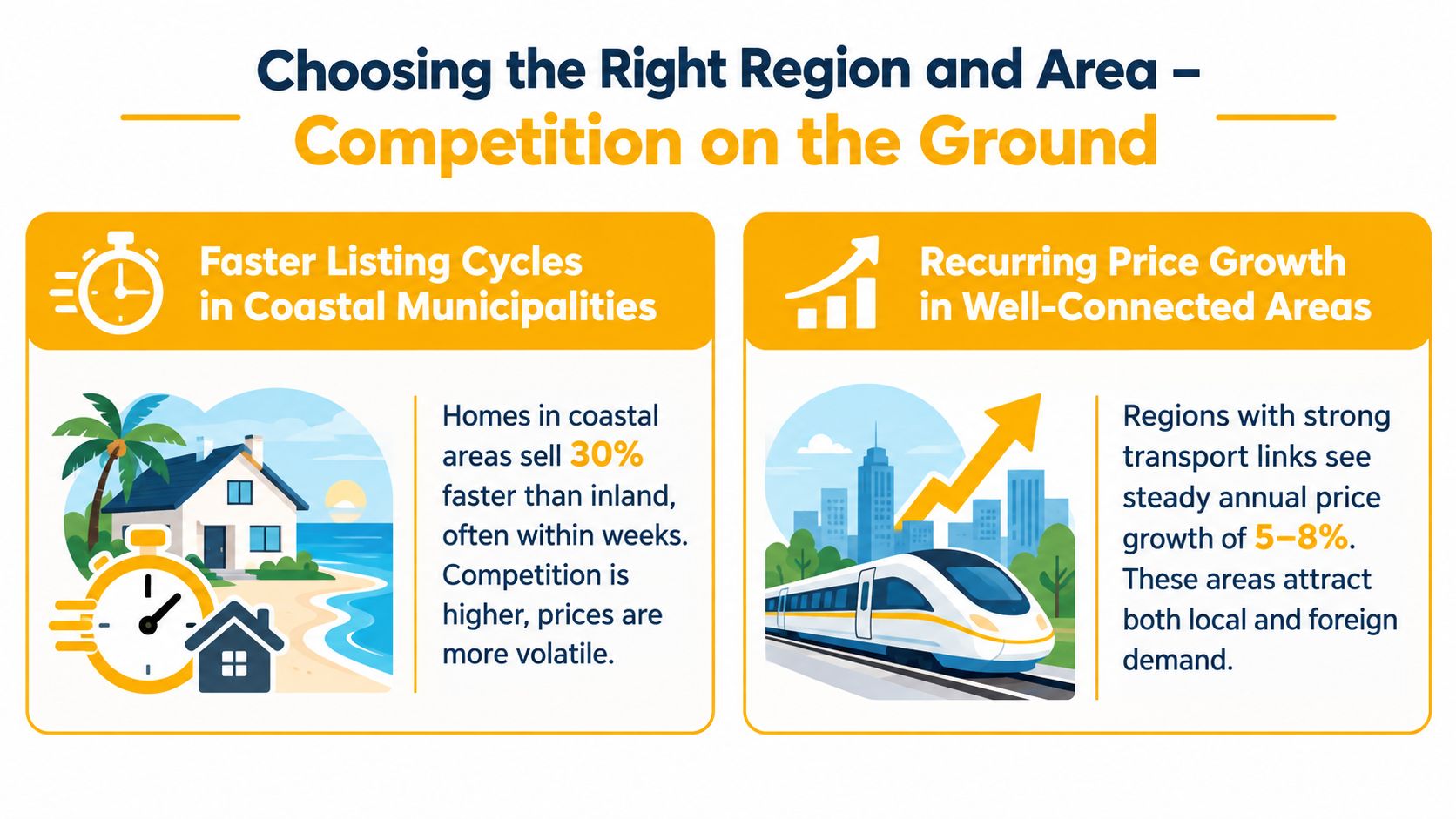
The right location isn't the one with the most attractive listing. It's the one that fits how you'll live, how you'll travel, and how easily you'll resell. Spain's foreign demand is concentrated in coastal markets, and the Valencian Community illustrates the point. Foreign buyers accounted for 28.9% of transactions in 2024, while Alicante reached 43.29%, according to regional property market data.
That concentration creates two opposing conditions. International demand can provide liquidity and a deep pool of future buyers. It can also mean that popular coastal areas already reflect foreign preferences in their pricing, especially where sea views, established services, and limited supply coincide.
Use case comes before postcode
Start with the purpose of the purchase.
- Relocation: prioritise year-round services, healthcare, schools, transport, internet, and a functioning town centre over resort aesthetics.
- Holiday home: focus on access from the airport, lock-up-and-leave practicality, security, orientation, and maintenance.
- Investment: test the legal rental route, realistic operating costs, seasonality, community rules, and exit demand before you compare projected income.
The Costa Blanca offers an unusually broad range within one recognisable international market. Alicante city provides urban services. Coastal areas such as Jávea, Calpe, Guardamar, Torrevieja, and Orihuela Costa offer different combinations of beaches, urbanisations, amenities, and international demand. Inland locations around La Romana can offer more space and a different rhythm, but you must test access, utilities, healthcare, and year-round liveability rather than assuming a lower asking price equals better value.
The Costa del Sol, Balearics, Valencia, and Málaga each have their own demand profiles, but the same discipline applies. Don't compare regions by lifestyle language alone. Compare the actual micro-location, travel time, services, property condition, and resale audience.
Avoid the three location traps
The cheapest inland listing may need costly legal or building checks. The fashionable resort may be easy to sell but priced for intense foreign demand. A coastal urbanisation may look ideal for two weeks and feel isolated for the rest of the year.
Visit at different times of day if possible. Check noise, road access, slope, drainage, mobile coverage, parking, nearby construction, and the practical route to shops and medical care. A technically attractive house can become a poor purchase if daily life requires a car for every basic errand.
My recommendation is firm. View at least three comparable properties in two different micro-areas before committing. Compare like with like, then ask why one home is cheaper. The answer may be a genuine opportunity, or it may be legal status, orientation, access, community costs, renovation risk, or weak year-round demand.
Legal Prerequisites Every Foreign Buyer Needs
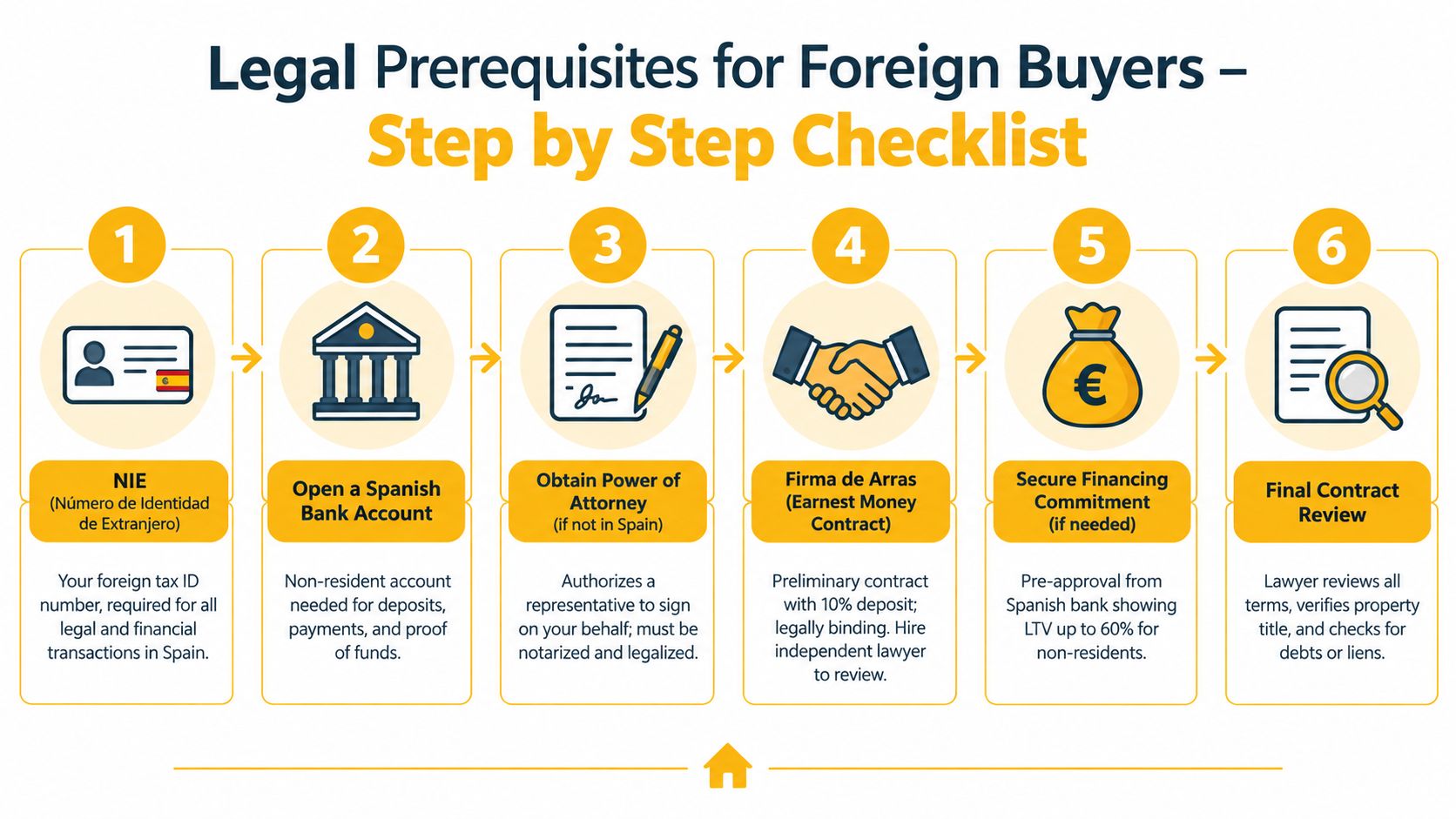
Foreign buyers should treat the purchase as a sequence, not a collection of paperwork. The first step is the NIE, or Número de Identificación de Extranjero. You'll need it for the legal and tax side of the purchase, and it's normally required for practical arrangements such as banking and utilities.
Apply early through the appropriate Spanish consular or police channel, or authorise a lawyer to assist. Processing times vary, so don't wait until you've found the perfect property. If you're buying jointly, each buyer needs an individual identification number.
Banking and authority to act
Open a Spanish non-resident bank account once the NIE process is underway or complete. It provides a practical route for deposits, completion funds, utilities, insurance, community charges, and local tax payments. The bank may request identity, address, tax-residency, income, and source-of-funds documents, so prepare a complete file rather than sending documents piecemeal.
If you won't attend completion, arrange a carefully drafted poder notarial, or power of attorney. It should give your representative enough authority to complete the agreed transaction, but not create unnecessarily broad powers.
Title checks before money moves
Your independent Spanish lawyer should obtain and review the Nota Simple from the Registro de la Propiedad. It should confirm the registered owner, property description, mortgages, liens, embargoes, easements, and other registered burdens. The lawyer should also compare the registry information with the Catastro and the physical property.
That review needs to extend beyond the title extract. Request confirmation of community fees, IBI status, planning compliance, relevant licences, the energy certificate, occupancy documentation where applicable, and any restrictions affecting intended use. Rural property requires extra attention to boundaries, buildings, access, water, and outbuildings. Coastal property requires a specific review of applicable coastal restrictions.
The rule is simple: lawyer first, documents second, money third.
The most common error is paying a substantial reservation or arras deposit before an independent lawyer has reviewed the Nota Simple, community debt certificate, energy certificate, and planning position. The seller's agent can coordinate documents, but the agent isn't your buyer-side legal adviser. Before making an offer, have your lawyer ready, your funds documented, and your intended use clearly defined.
Making an Offer and Securing the Property
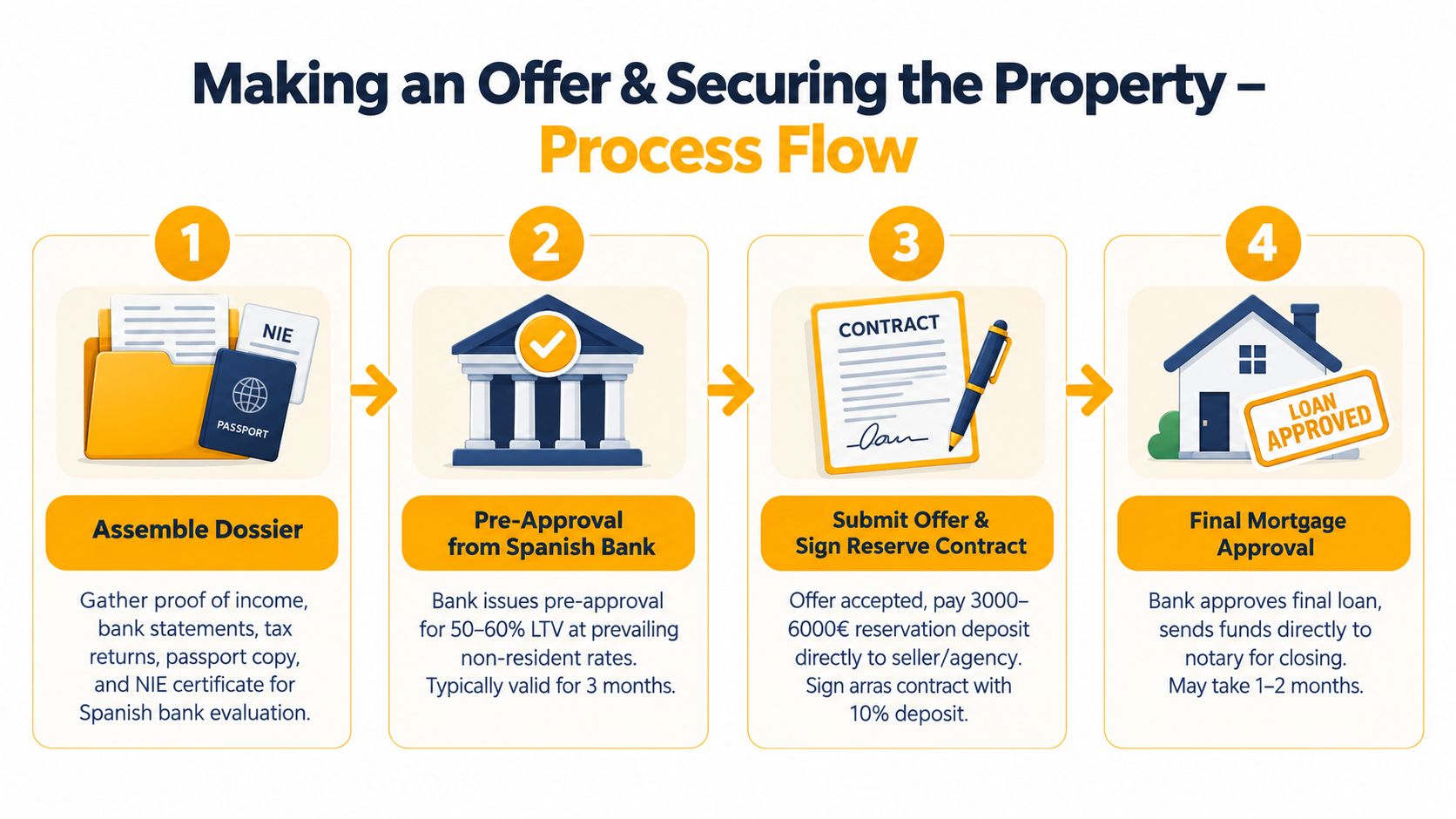
Non-resident financing requires preparation. Spanish lenders assess income, liabilities, tax returns, bank statements, assets, identity documents, and the source of the funds used for the purchase. Their valuation of the property also matters, because the loan is linked to the bank's assessment rather than the agreed price.
Start with a finance dossier before you negotiate seriously. Include your passport, NIE certificate, income evidence, tax records, bank statements, details of existing debts, and proof of deposit funds. A pre-approval won't guarantee final lending, but it gives the seller a credible buyer and exposes affordability issues before a contract deadline.
The offer sequence
The normal commercial sequence is a verbal discussion, a written offer, a reservation agreement, and then the private contrato de arras. Reservation deposits are commonly €3,000 to €6,000, according to the foreign-buyer purchase process described by Idealista. Treat this payment as potentially binding. Read the refund, expiry, withdrawal, and seller-default clauses before transferring anything.
Arras contracts need precise drafting. The main forms are:
- Arras penitenciales: usually allow the buyer to withdraw by losing the deposit, while the seller may have to return double if the seller withdraws, provided the contract is correctly drafted.
- Arras confirmatorias: operate as evidence of commitment and part payment, with default remedies rather than an automatic withdrawal mechanism.
- Arras penales: establish a penalty for breach and can preserve the right to seek further remedies depending on the wording.
The deposit is often 10% of the purchase price, although the agreed amount can vary, as explained in the detailed guide to buying a home in Spain. Don't sign a contract that leaves the mortgage position unclear. Include conditions dealing with finance, title, planning status, occupation documentation, completion timing, included contents, and the seller's obligation to deliver the property free of agreed charges.
Where buyers lose leverage
The dangerous moment is the rush between “the seller has accepted” and “send the deposit now”. If the Nota Simple hasn't been reviewed, if the seller's authority is unclear, or if the property's physical condition and legal description don't match, the deposit can put you on the defensive.
Reserve only after your lawyer has reviewed the reservation wording. Sign arras only when the core due diligence is complete and your finance route is credible. The contract isn't a formality. It's the point at which the transaction becomes a financial commitment with consequences for both sides.
Taxes Purchase Costs and Annual Ownership Costs
The headline price is only the start of the cash calculation. A resale property in Spain is generally subject to ITP, or Transfer Tax. A new-build purchase is generally subject to IVA, or VAT, plus AJD, or Stamp Duty. The difference is particularly important in the Valencian Community, which includes Alicante and the Costa Blanca.
Reported guidance places used-home ITP in Valencia at about 9%, while a new build commonly carries 10% VAT plus AJD, as outlined in the regional property tax overview for non-residents. The exact taxable base and applicable rate must be checked for the property and transaction date.
Purchase costs by property type
Cost item | Resale, ITP | New build, IVA plus AJD |
|---|---|---|
Main purchase tax | About 9% in Valencia | 10% IVA |
Stamp duty | Not the main resale tax | AJD applies |
Notary and registry | Additional | Additional |
Legal and transaction administration | Additional | Additional |
Reference-value risk | Relevant | Different treatment may apply |
Neutral purchase-cost guidance places typical total costs at about 11% to 13% for resales and 7% to 11% for new builds, depending on region, property, and transaction details, as set out by ThinkSpain's explanation of Spanish property taxes. Don't rely on a national average for a Costa Blanca purchase. Ask for a transaction-specific completion statement before signing.
The tax authority may also use the official cadastral reference value rather than the declared price. Since 1 January 2022, where the Cadastre's reference value is higher than the declared purchase price, the tax base can be assessed using that higher value, as explained in this guide to Spanish purchase-tax costs. Your lawyer should check the reference value early, not after you've agreed the funds required.
Costs that continue after completion
Non-resident ownership creates annual obligations. A non-resident owner must file IRNR, or Non-Resident Income Tax, even when the property isn't rented. For EU/EEA residents, the imputed-income tax rate is 19%, while for non-EU/EEA residents it is 24%. The imputed base is typically linked to 1.1% of cadastral value where the cadastral value has been revised recently, according to guidance on buying a Spanish home.
Budget for IBI, municipal rubbish charges, insurance, utilities, community fees, maintenance, and property management. If you buy from a non-resident seller, the buyer normally retains 3% of the purchase price as an advance against the seller's capital gains tax, a point covered in the tax guidance for international buyers. Your lawyer should confirm how that retention is handled in the completion statement.
Closing at the Notary and Taking Ownership
The notary is a neutral public official, not your personal lawyer. The notary verifies identity, capacity, formal documentation, and the deed process, but doesn't negotiate commercial terms or replace independent due diligence.
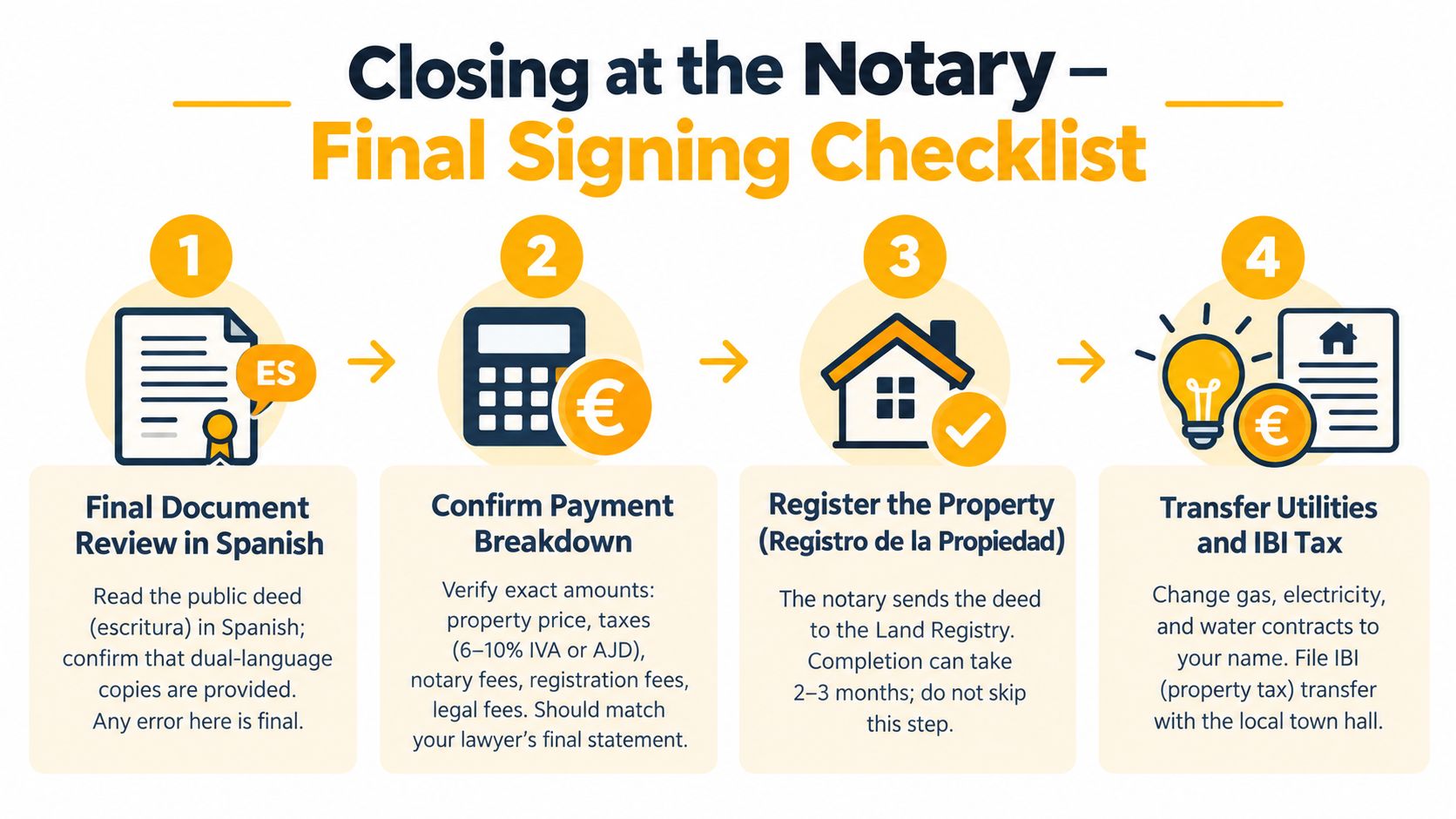
Before signing, your lawyer should reconcile the final deed with the agreed contract, the property description, payment arrangements, included items, charges, and completion conditions. If you're not fluent in Spanish, arrange an explanation and suitable translated or dual-language documentation before signing day. Don't treat comprehension as an administrative detail.
What happens on signing day
The balance of the purchase price is paid through the agreed banking method, and the escritura pública is signed before the notary. The seller's existing mortgage or other agreed charges are settled as part of completion arrangements. Keys and possession are handed over according to the deed and contract.
The notary signing is a major milestone, but it isn't the end of the process. The deed must be submitted to the Registro de la Propiedad, where registration protects your ownership in the public record and confirms the legal chain of title. Your lawyer, gestor, or authorised representative should track the submission, tax settlement, registration, and return of the registered documentation.
Turn the deed into a usable home
Handover has a practical side that buyers often underestimate. Transfer electricity, water, and gas contracts, notify the community of owners, activate insurance, and arrange the appropriate IBI and rubbish-tax administration. If you're relocating, register locally where required and confirm how your banking and tax correspondence will be managed.
Property ownership doesn't automatically create a right to live in Spain. Review your immigration position separately, and monitor tax residency. Spending 183 days in Spain can be relevant to tax-residency analysis, so obtain personal tax advice before your use pattern changes. Keep a first-year calendar for IRNR, local taxes, insurance renewals, and any rental reporting obligations.
A signed deed gives you a property. A completed registration and organised administration give you control of it.
Practical Checklist and Final Tips for Your Move
Print this sequence and use it as your transaction control sheet:
- Secure the NIE: Obtain an NIE for every buyer before contracts and tax arrangements.
- Open a Spanish bank account: Prepare identity, address, tax-residency, income, and source-of-funds documents.
- Confirm your status: Separate ownership from residence and establish the tax position that applies to you.
- Order the Nota Simple: Check ownership, charges, mortgages, embargoes, and property description.
- Obtain finance approval: Get a credible mortgage assessment before making an offer if borrowing is required.
- Review the reservation contract: Have your lawyer check the deposit, deadlines, refund terms, and seller obligations.
- Complete due diligence: Reconcile the registry, Catastro, physical property, community records, planning documents, certificates, and intended use.
- Sign arras carefully: Choose the appropriate form and document finance, title, completion, and default conditions.
- Prepare completion funds: Include purchase tax, legal fees, notary, registry, banking costs, and ongoing ownership reserves.
- Complete before the notary: Verify the deed and payment statement before signing.
- Register title: Track submission and registration at the Registro de la Propiedad.
- Set up ownership administration: Transfer utilities, insurance, IBI, rubbish charges, community records, and any management arrangements.
Boutique guidance changes outcomes where the market becomes highly local. A useful adviser can compare micro-markets around the Costa Blanca, test whether a property's price reflects its condition, coordinate legal, banking, technical, and notarial deadlines, and identify renovation costs before they become negotiation surprises. AP Properties Spain is one option that provides area guidance, property search, negotiation support, legal coordination, and completion assistance for international buyers across the Costa Blanca and nearby Spanish regions.
Pause before committing on three decisions. Will you use this location throughout the year? Is the property legally suitable for the intended use, including any rental plan? Can you fund the full purchase and ownership cost without relying on optimistic currency movements, rental projections, or a quick resale?
AP Properties Spain helps international buyers compare Costa Blanca and Costa Cálida locations, coordinate the legal and financial purchase sequence, and manage the path from property search to completion. Visit AP Properties Spain to discuss your requirements and arrange informed guidance before you send a reservation deposit.
Share