






Finca for Sale Spain How to Find Your Rural Retreat
You've saved a collection of finca listings, compared stone houses with olive groves, and started imagining slow lunches beneath a pergola. Perhaps you're looking from abroad, wondering whether a rural home near La Romana is a peaceful retreat, a sensible investment, or a renovation project that could become all three.
The word finca sounds simple, but it can describe very different properties. One listing may offer a finished country house with legal utilities. Another may show agricultural land with an old building that cannot legally become a home. The distance between those two purchases can be much greater than the listing photographs suggest.
This guide approaches a finca for sale in Spain as a practical decision rather than a romantic browsing exercise. You'll learn how rural property is classified, how the market works across the Costa Blanca, Costa Cálida and Costa de Almería, which costs deserve attention, and how to check land, buildings, water and access before committing money.
From La Romana, AP Properties Spain works with buyers who want a clearer route through that process. Local knowledge matters because rural planning, municipal tax treatment and utility arrangements can change from one municipality to the next. A good search starts with the life you want to lead, then tests whether the property can legally and financially support it.
Introduction Your Finca Dream Starts Here
You arrive near La Romana with a clear picture: privacy, wide views, olive trees and a Spanish house with character. Then the listings introduce four different possibilities, a traditional finca, a detached country villa, agricultural land, or an older property requiring careful restoration. The right choice depends less on the photograph than on what you expect the property to do.
A finca might suit weekend stays, permanent living or agricultural use. Services can vary just as widely. One property may have mains electricity and reliable water, while another depends on a private supply, septic tank and an unpaved access route. These arrangements need professional checks before you treat the property as a finished home.
Start by choosing its role:
- A home: Check lawful habitation, dependable services and practical year-round access.
- An investment: Test the resale, rental or renovation plan against local rules and actual costs.
- A working asset: Examine soil, irrigation, water rights, access and permitted agricultural use.
- A lifestyle retreat: You may accept distance and maintenance, but the legal position should still be clear.
Spain's rural-property market is substantial. In 2024, sales of fincas rústicas reached 155,876 purchase transactions, representing 12.6% of all property purchases in Spain, with activity up 4.3% year on year, according to La Vanguardia's rural-property market coverage. Those national figures provide context, not a guarantee about a particular property near Alicante.
Practical rule: Let the documents, planning status, utilities and access make sense before you fall in love with the landscape.
A sensible search follows that order. Define the property's role, compare Costa Blanca locations, confirm the land and building classifications, and estimate running costs. Legal and technical checks come before signing. Renovation and financing follow because both depend on what the finca is legally allowed to be. AP Properties Spain can help buyers in La Romana work through these local questions with a clearer plan.
What a Finca Really Means in Spain
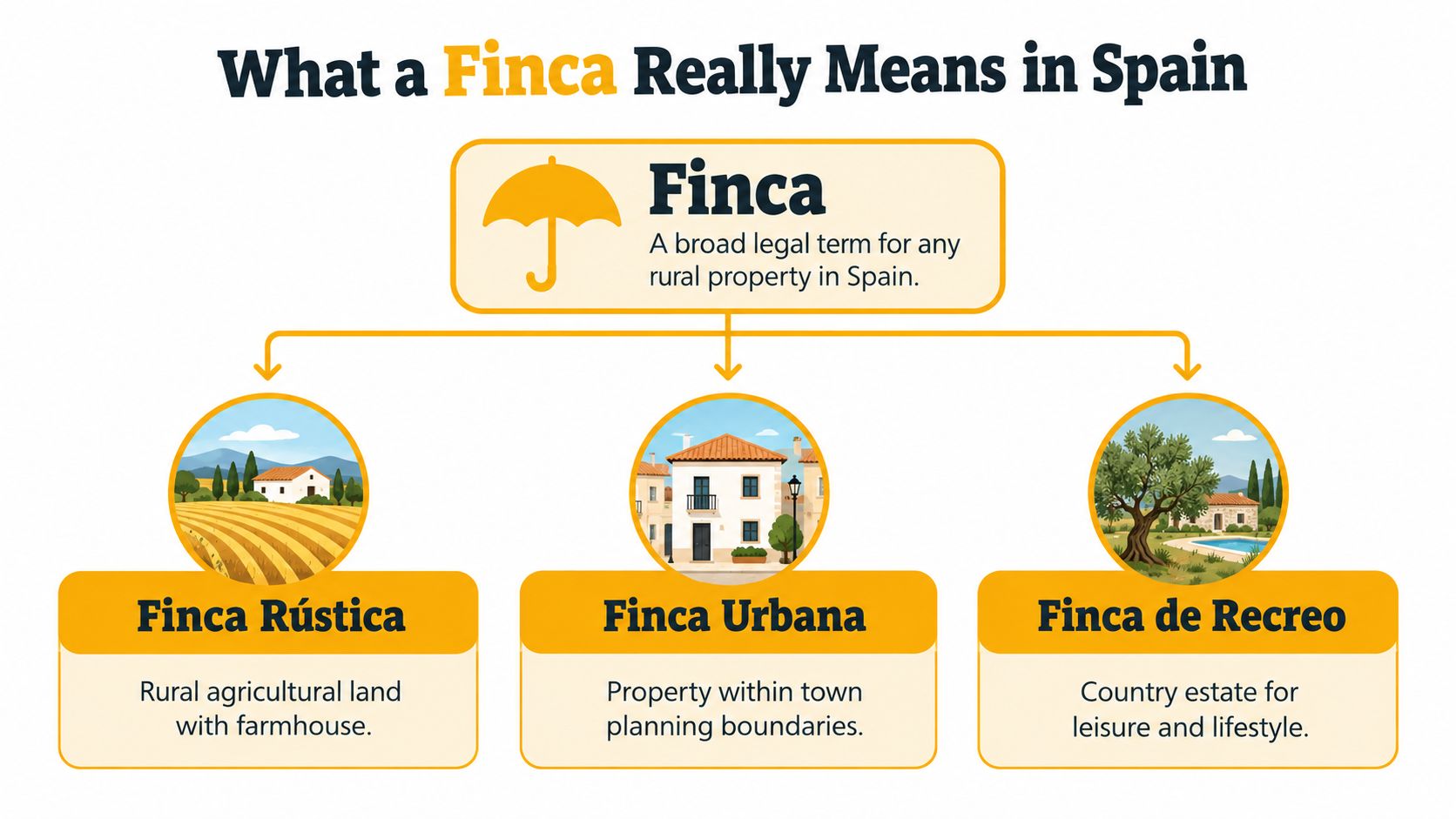
A buyer viewing a country home near La Romana may see one house, a few outbuildings and several hectares. Spanish records may describe that same purchase as a finca, a registered property unit rather than a specific style of house. It can be rural or urban and may include a dwelling, agricultural buildings, undeveloped land or several parts together.
A listing can therefore use “finca” for:
- Finca rústica: Rural land normally associated with agriculture, nature or countryside use.
- Finca urbana: Property within an urban planning environment, where building and use rules are generally different.
- Finca de recreo: A leisure-oriented country estate, often marketed for lifestyle rather than farming.
The land classification comes first
The difference between suelo rústico and suelo urbano affects what you may build, extend, replace or change. Suelo rústico usually carries tighter development controls, particularly in the Valencian Community. A house with walls, a roof and utility connections is not automatically a lawful home.
Suelo urbano also has limits. Local planning rules still control extensions, swimming pools, annexes, business uses and renovation. The property's appearance gives you clues, but only planning records establish what is permitted.
Read the documents as three different views
Use three records to build a reliable picture:
- Parcela: The physical plot or parcel of land.
- Catastro: The technical and tax register describing physical, economic and legal attributes such as area, use, cadastral value and cadastral holder.
- Escritura and Property Registry: The ownership deed and legal registration records.
The INE cadastral data resource helps explain the Cadastre's role in rural-property checks. Compare its map and description with the title registry, the deed and the boundaries you can inspect on foot.
The comparison may expose a boundary mismatch, a different land-use description, an unregistered extension or an ownership issue. Those differences matter whether your aim is a home, an investment or a working asset. A planned renovation may fail if the building is not recorded correctly. Agricultural use may depend on land classification, access or other permissions.
Treat the finca as a set of legal, physical and practical facts, not just a scenic listing. Establish what exists, what is recognised and what can change before judging the property's potential.
Where to Find a Finca and What the Market Looks Like
A finca search becomes clearer once you decide what the property must do. Are you buying a home, an investment, or a working agricultural asset? Spain's rural market is not uniform. Inland provinces often offer larger holdings connected to crop production, while Mediterranean areas attract buyers who want countryside living near coastal services, airports, international communities and year-round amenities. National transaction patterns, noted earlier, support that regional difference.
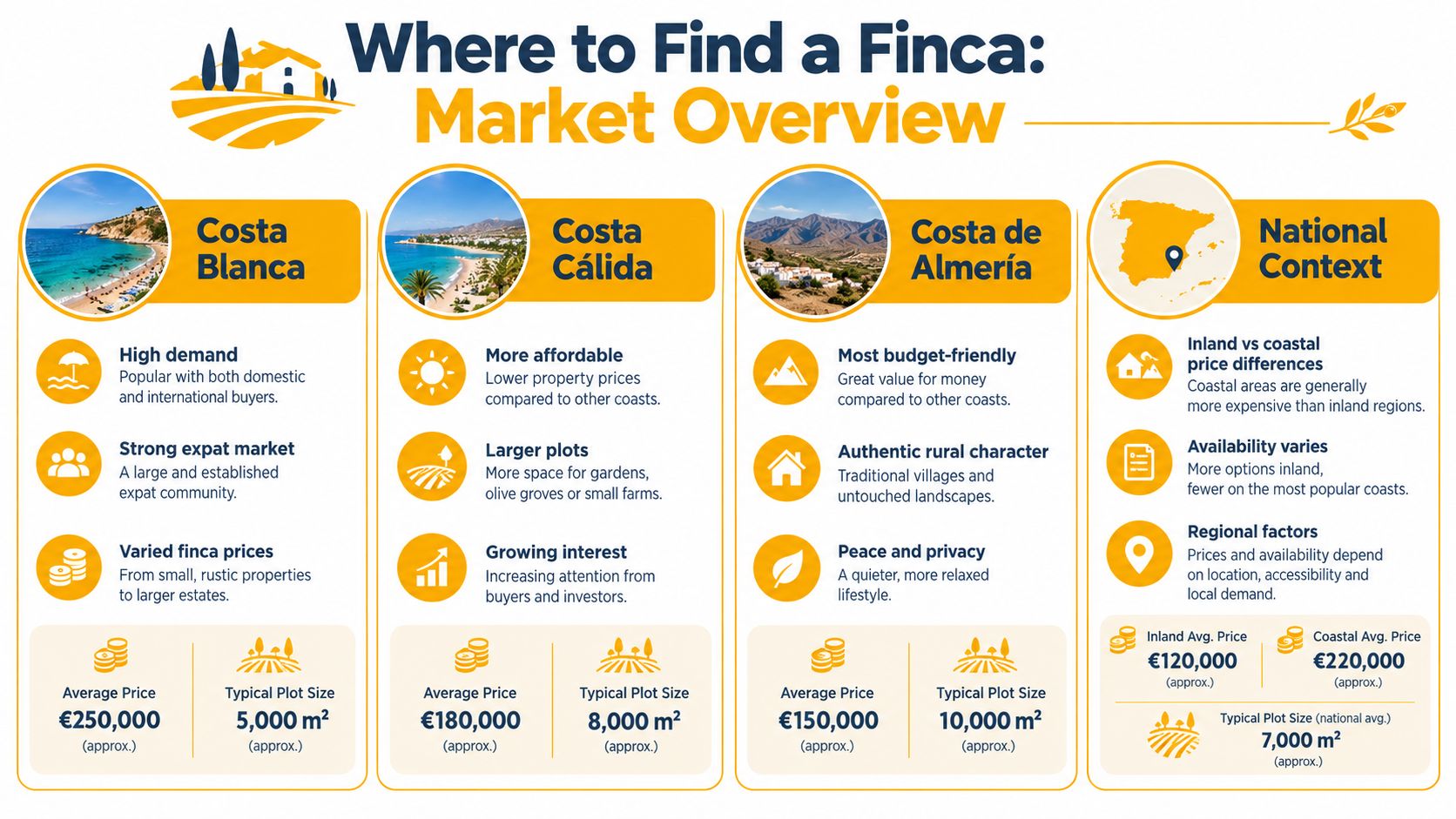
Comparing the southeastern coasts
On the Costa Blanca, opportunities appear throughout Alicante province, including La Romana, Aspe, Pinoso and nearby inland areas. Listings may include traditional agricultural properties, renovated country homes and plots with vineyards, almond trees or mountain views. For an international buyer, distance to the coast is only one part of the decision. Check road access, electricity, water arrangements and the local planning position before treating a view or low asking price as an advantage.
The Costa Cálida can suit buyers seeking a quieter rural setting and more land. The Costa de Almería often appeals to people looking for a more rugged, agricultural character. These are broad tendencies, not guarantees. A smaller finca with a finished, lawfully usable home, reliable access and established services may work better than a larger plot that is difficult to reach or costly to connect.
Why size doesn't tell the whole story
Land value depends on more than the size of the house. Soil, water, irrigation, tree condition and productive potential matter for a working asset. Access, electricity, planning status and the building's condition matter for a home or investment. A national agricultural-land average can provide context, but it cannot value a finca near La Romana on its own. Gesvalt reported average agricultural land prices of €10,248 per hectare in 2024, compared with €9,967 per hectare in 2023, a year-on-year rise of 2.8%, in its Gesvalt rural-property report.
Recent rural-market coverage places countryside asking prices at roughly €1,450 per square metre, compared with €2,900 nationally in urban markets, according to The Olive Press. The difference may look attractive, yet major structural work, uncertain habitation status or expensive off-grid utilities can change the calculation quickly. Fall in love with the property after the documents, planning position and running costs make sense.
Understanding Prices Land Sizes and Ongoing Costs
A finca budget needs two columns. The first is the amount needed to buy the property. The second covers the cost of holding, repairing, connecting and legally using it.
Land value often sits at the centre of the calculation. Spain's agricultural-land average provides useful historical context, but a hectare of irrigated productive land isn't equivalent to dry agricultural land, and neither is equivalent to a small plot surrounding a finished house. The value of a rural property comes from the relationship between land, buildings, services and permitted use.
In the Valencian Community, a new dwelling on rustic land generally requires a minimum plot of 10,000 square metres, and may also require a special authorisation such as a Declaración de Interés Comunitario, according to Valencian rural-property legal guidance. Another regional summary describes a common 2% building-footprint limit, meaning a 10,000-square-metre plot could allow about 200 square metres of building area where planning permission is available.
Those rules don't create an automatic building right. Classification, municipal planning and administrative approval still decide what can happen.
Finca versus urban ownership
A standalone finca usually isn't part of a shared residential complex, so independent Alicante-region guidance says it generally carries zero community fees, unlike an apartment or managed development. That saving can be useful, but rural owners take direct responsibility for roofs, driveways, wells, septic systems, walls, gardens and private access.
Cost Factor | Standalone Finca on Rustic Land | Urban Apartment or Villa |
|---|---|---|
Community fees | Usually none when the property stands alone | Common in shared developments |
IBI | Depends on cadastral value and municipality | Depends on cadastral value and municipality |
Utilities | May require private systems or connection work | Usually connected to established networks |
Maintenance | Owner manages land, access and exterior structures | Shared elements may be managed collectively |
Planning | Rural restrictions can limit changes | Urban rules still apply, but development context differs |
Resale considerations | Buyers inspect land and legality closely | Buyers focus more on building, location and community records |
Alicante's IBI ordinance illustrates why you shouldn't assume one Spanish rate. It sets rustic property at 0.7315% of the taxable base, while urban property is set at 0.62795%, as shown in the Alicante IBI ordinance. Your municipality and cadastral value determine the actual bill.
Legal Checks Planning Rules and Due Diligence Essentials
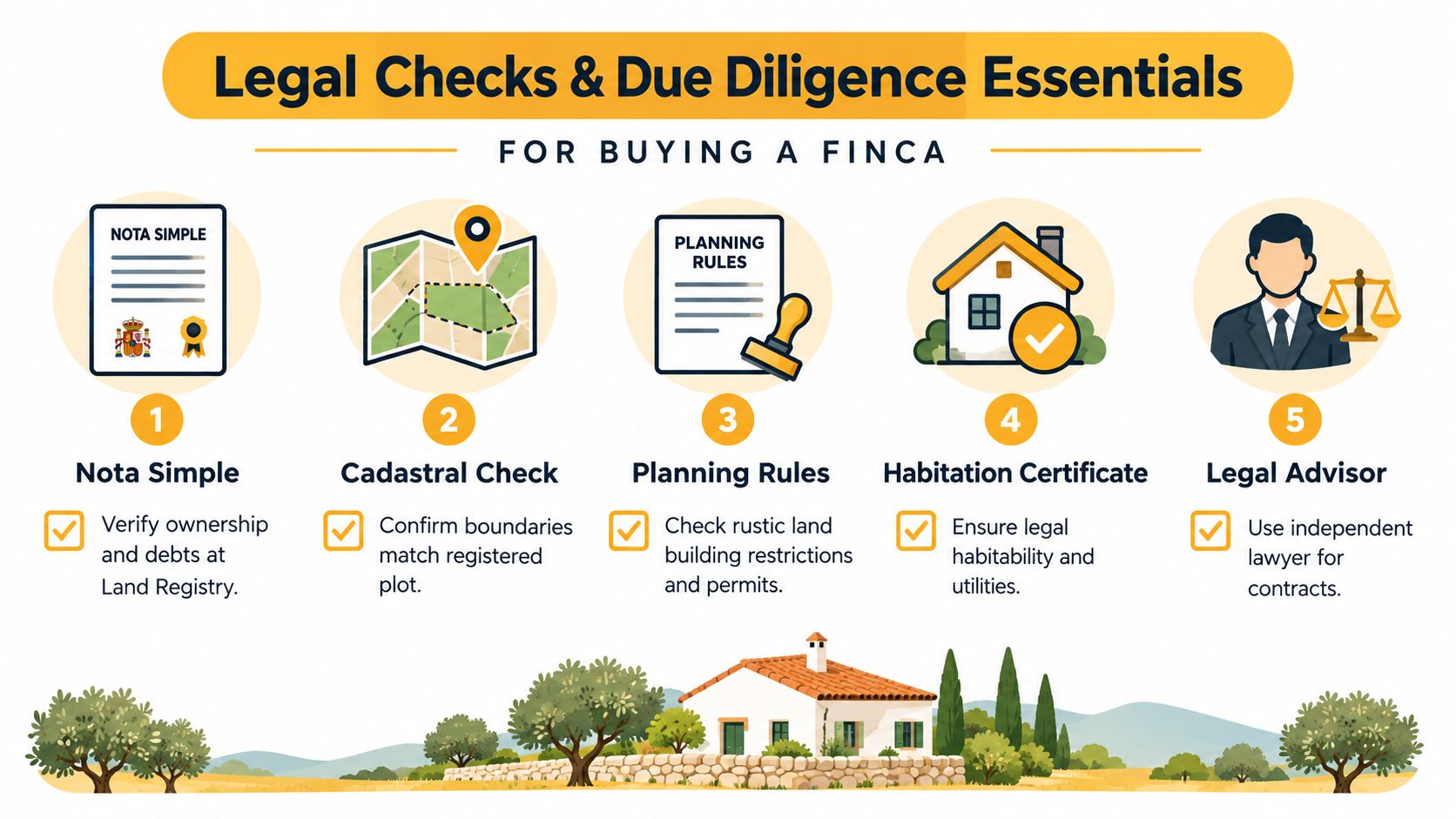
A finca can feel perfect during a viewing, yet its paperwork may describe a different property. Treat due diligence like matching a house's identity card to its physical features. Begin with the records, then test whether the home, land and intended use agree with them.
Begin with ownership and physical identity
Request a current nota simple from the Property Registry. It should show the registered owner and recorded burdens. Your independent lawyer can compare it with the escritura, the Cadastre, the cadastral map and the property itself.
The Cadastre's official role in describing rural property makes this comparison useful. Check the land area, boundaries, classification, buildings, pools, outbuildings and cadastral holder. A mismatch does not automatically end the purchase, but it needs a clear explanation and, where required, a regularisation plan.
Test the planning position
A rustic plot is not a blank canvas. Ask the municipality or a qualified architect to confirm:
- Land classification: Establish whether the parcel is rustic, urban or subject to special protection.
- Existing dwelling: Confirm that the house is legally recognised and can be used as intended.
- Extensions: Check terraces, garages, pools, annexes and storage buildings separately.
- Future works: Request written guidance on renovation, expansion, rebuilding and change of use.
- Authorisations: Find out whether a Declaración de Interés Comunitario or another approval is required.
A house may be usable today while rejecting the extension you planned for tomorrow. Ask which works the municipality can legally authorise on that land before treating the property as a home, investment or working asset.
Verify access and services
Physical access needs a legal foundation. If the route crosses another owner's land, your lawyer should check for a registered easement or another enforceable right.
Water requires the same care. “Own well” in a listing does not prove extraction rights, quality, capacity or responsibility for maintenance. Confirm the source, permits and documents. Check electricity, drainage, internet, rubbish collection and emergency access as separate practical questions.
Before signing: Your lawyer should explain what is registered, what is authorised, what is connected and what remains uncertain.
Renovation Utilities and Financing Your Finca Purchase
A finca near La Romana may look ready for weekends or rental use, yet a failing roof, weak drainage, limited electricity or an undocumented water supply can change the budget quickly. Start with a technical inspection and a practical cost plan, not with finishes or decoration.
Build a realistic services map
Follow every service from its source to the property:
- Water: Mains supply, documented well, depósito or another arrangement.
- Wastewater: Mains drainage, septic tank or private treatment system.
- Electricity: Existing connection, available capacity and any planned upgrade.
- Internet: Fixed connection, wireless service or another local option.
- Access: Road condition, ownership, easements and year-round usability.
These details work like the finca's basic operating system. If one part is unreliable, the house may be attractive but unsuitable as a home, investment or working asset. Ask qualified local professionals to inspect the property and provide written estimates. Separate structural repairs, planning compliance, utility work and cosmetic improvements, because each follows a different approval route and carries a different financial risk.
Allow for the Costa Blanca realities of rural ownership. A private road may need regular maintenance, a well may require documented rights and testing, and a remote property may have fewer connection options than a village home. Confirm how each service operates before comparing renovation quotes.
Finance a rural asset on its own terms
Rustic mortgages form a smaller specialist part of the lending market. INE mortgage statistics record mortgaged rustic buildings separately from urban buildings, with rural lending volumes generally much lower than urban housing finance.
Banks may examine the land classification, registered floor area, lawful habitation, access, utilities and later improvements. A building that looks complete but is not correctly recorded may be difficult to finance, even if you intend to regularise it after purchase.
Reported rural-property financing data for 2024 included 9,387 mortgages on rural properties, with an average mortgage amount of €192,096, according to reported rural-property financing data. Treat an initial lending indication as conditional until the bank reviews the specific finca and its documents.
Match the application to the property's role. A home needs dependable habitation. An investment needs lawful, realistic income potential. A working asset needs suitable land, water and agricultural viability. Each purpose presents a different case to the lender.
How AP Properties Spain Helps You Buy and Renovate with Confidence
A finca search becomes more manageable when one local team connects the practical decisions. Based in La Romana, AP Properties Spain helps international buyers search across the Costa Blanca, Costa Cálida and Costa de Almería, including fincas and plots for different lifestyle, investment or working purposes.
Start with a clear brief. Decide whether the property is mainly a home, an investment or a working asset. Then record your preferred area, access needs, land requirements, renovation tolerance and distance from village services. This turns browsing into a testable plan, like a measuring tape for each property.
The team can arrange focused viewings, compare options and support negotiations, while buyers work with independent legal and technical professionals. That separation matters because an agent can coordinate the process, but a lawyer and qualified technician must assess legal status and building condition.
Renovation adds another set of decisions. AP Properties Spain can connect buyers with architects and builders, helping assess the existing structure, plan works, monitor progress and work towards a turnkey result. The aim is to keep the purchase, permits, budget and construction sequence connected.
Its service is multilingual, which can simplify communication with Spanish documents, municipal departments, lenders and contractors from abroad. Its boutique approach has been recognised by Luxury Lifestyle Awards as Best Luxury Boutique Real Estate Consultancy in Costa Blanca for 2024 and 2025, as announced by Luxury Lifestyle Awards.
Write down your criteria before contacting an agent. A precise brief gives the agent, lawyer, architect and lender something concrete to check.
AP Properties Spain can help you find and assess a finca for sale in Spain across the Costa Blanca, Costa Cálida and Costa de Almería, with local guidance from search through legal coordination and renovation. Visit AP Properties Spain to share your criteria and begin a practical rural-property search from La Romana.
Share