






Best Place to Buy in Spain: A Region-by-Region Guide
Most guides trying to identify the best place to buy in Spain produce a predictable list of famous names, then assume every buyer wants the same thing. That approach is wrong. A retirement apartment in Orihuela Costa, a holiday home in Jávea, a family house near Murcia and a yield-focused flat in Almería are different purchases with different costs, risks and resale markets.
The southeast gives international buyers a more useful choice. Alicante province offers the deepest foreign-buyer liquidity, Costa Cálida combines lower entry prices with strong lifestyle demand, and Costa de Almería can deliver value where the buyer accepts a thinner resale market. Inland areas, including La Romana and the surrounding Alicante countryside, can suit buyers who prioritise space, privacy and long-term liveability over immediate holiday-let demand.
Buyer profile | Strongest starting point | Main reason | Main compromise |
|---|---|---|---|
Holiday-home buyer | Costa Blanca South or Jávea | Beaches, restaurants and established international demand | Premium pricing in the most liquid towns |
Retiree | Orihuela Costa or Mazarrón | Healthcare access, services and manageable coastal living | Community and running costs need careful checking |
Family relocator | Alicante metropolitan fringe or Murcia hinterland | Schools, services and year-round life | Less direct holiday appeal |
Yield-focused investor | Costa Cálida or selected Almería locations | Lower purchase basis and potential rental demand | Resale can take longer outside proven coastal pockets |
Why There Is No Single Best Place to Buy in Spain
The most popular advice treats Spanish property as a ranking exercise. It asks whether Alicante, Málaga, Valencia or Murcia is number one, as though a buyer's priorities disappear once a region reaches the top of a list. They don't. The right purchase depends on the use case first, and the postcode second.
Foreign demand makes this distinction particularly important. In the second quarter of 2026, foreign buyers represented 15.98% of residential purchases in Spain, more than 26,800 homes, even as total sales fell quarter on quarter, according to Idealista's analysis of foreign demand. That demand isn't evenly distributed. Alicante, the Balearic Islands, Málaga and Santa Cruz de Tenerife attract especially high international interest, while cheaper inland provinces depend more heavily on domestic buyers.
Four buyers, four different definitions of value
A holiday-home buyer wants a pleasant arrival, walkable restaurants, reliable airport access and a property that can be used immediately. A retiree gives more weight to healthcare, flat terrain, local services and the quality of life outside the summer season.
A family relocator needs schools, commuting options, supermarkets and year-round community. A yield-driven investor cares about acquisition basis, tenant demand, licensing, maintenance and the number of realistic buyers at resale.
Advisor's rule: Never compare a coastal apartment and an inland villa on price alone. Compare the income use, annual cost and likely exit buyer.
Marketing also distorts the conversation. Marbella and the Costa Blanca's most heavily promoted southern resorts receive enormous attention, but attention isn't the same as suitability. Alicante, Murcia and Almería deserve separate analysis because they offer different combinations of foreign demand, affordability and lifestyle. The question isn't which region wins in the abstract. It's which micro-location gives your money the best fit.
Mapping the Spanish Regions Worth Comparing
The southeast is easier to understand when you follow the coast from north to south. Costa Blanca North includes Dénia, Jávea and Moraira. These towns combine established international communities with attractive coastlines, restaurants and a more refined, low-density feel, although prime locations carry a higher purchase premium.
Further south, Costa Blanca South runs through Alicante, Santa Pola, Guardamar del Segura, Torrevieja and Orihuela Costa. This is the broadest market in the comparison. Buyers can choose between city apartments, golf communities, beach developments, established urbanisations and inland villages, while international services and resale demand are easier to find than in less developed coastal areas.
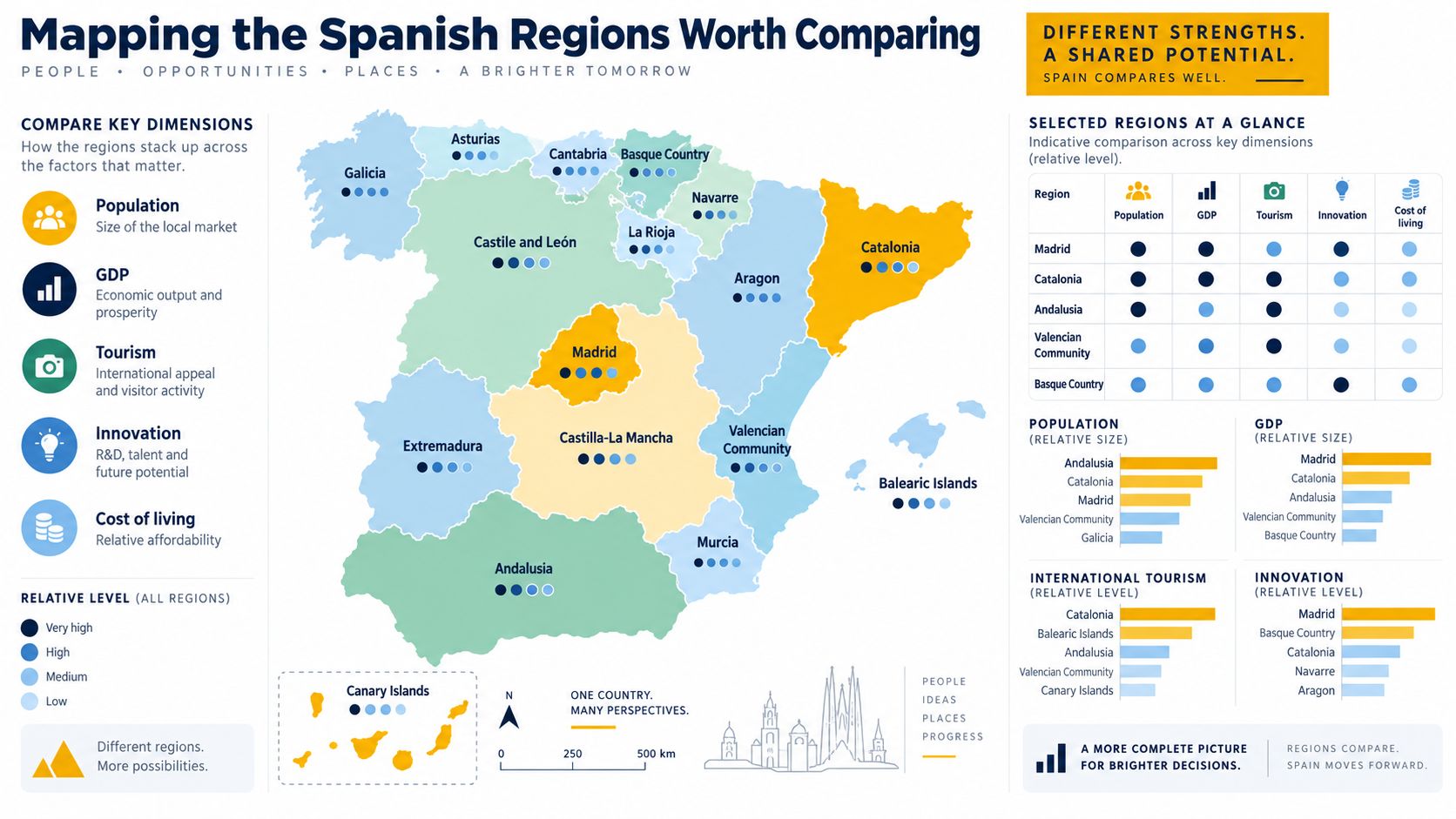
Follow the coast, then check the climate pocket
Costa Cálida covers the Murcian coastline around Mazarrón and Águilas, with Murcia capital and its surrounding hinterland adding a stronger urban and family dimension. The region suits buyers who want a Mediterranean setting but don't need the deepest international ecosystem found around Alicante.
Costa de Almería includes Mojácar, Vera, Roquetas de Mar and Almerimar. It generally offers a drier, semi-arid environment and a lower entry point, but buyers must be more selective about the exact community and its year-round occupancy.
Three climate bands matter:
- Mediterranean coastal: Milder winters, sea access and strong second-home appeal.
- Semi-arid southeast: Drier conditions and, in some areas, lower purchase costs, but water management deserves attention.
- Mountain-influenced inland: More seasonal variation, larger plots and quieter living, often with less foreign-buyer liquidity.
Alicante-Elche Airport is the main access point for Costa Blanca. Murcia-Corvera serves Costa Cálida, Almería Airport supports the local Almería coast, and Málaga is relevant for the far eastern edge of Andalucía, although journey times increase. The AP-7 and A-7 form the practical road corridor linking much of this comparison.
Costa del Sol is deliberately outside this analysis. It may be the most searched coastal region, but search volume doesn't make it the best fit for buyers focused on the Costa Blanca, Costa Cálida or inland Alicante.
Prices, Spreads and Yields Across the Southeast
The southeast isn't one price market. It contains premium Alicante-city and northern Costa Blanca locations, more accessible southern coastal towns, and lower-cost areas in Murcia and Almería. Official market data reported the national registered-sales average at approximately €2,429 per square metre in Q1 2026, while market reporting placed the Comunitat Valenciana at around €2,826 per square metre. Murcia was reported between €1,380 and €1,876 per square metre, depending on methodology, as summarised by Euronews' coverage of Spanish resale prices.
Alicante province remains a high-demand market. Asking prices reached around €3,116 per square metre in August 2026, with annual growth of 8.84%, while Alicante city was listed at €2,802 per square metre, according to Indomio's Alicante market data. These are asking benchmarks, not guaranteed completion prices.
The spread is where experienced buyers create value
The most useful negotiation reference is the difference between asking and completed-sale prices. A 2026 Costa Blanca market report showed average notary-deed transaction prices of €1,978 per square metre, compared with provincial asking levels of approximately €2,759 to €2,811 per square metre.
That gap doesn't mean every property is overpriced by the same amount. Prime, correctly priced homes can attract immediate interest, while dated resales, awkward locations and properties with legal or community issues provide more negotiating room. Use completed transactions as an anchor, then adjust for orientation, plot, condition, views, parking and distance to daily services.
Region | Avg €/m² | Asking-to-sold spread | Gross yield, long-let | Gross yield, holiday let |
|---|---|---|---|---|
Costa Blanca | Varies by micro-location, Alicante province asking benchmark around €3,116 | Material gap between asking and transaction benchmarks | Depends on town and property type | Depends on licensing and seasonal demand |
Costa Cálida | Lower than many Costa Blanca locations | Varies by resort and resale condition | Stronger potential in selected urban stock | Resort and marina demand can support seasonal use |
Costa de Almería | Generally lower entry pricing | Thinner evidence outside established towns | Can suit value-focused long-let buyers | More location-sensitive |
The main conclusion is simple. Don't confuse a low asking price with a high yield, and don't confuse a high yield with easy resale. A cheaper property can require more management, have weaker winter demand or attract fewer future buyers.
Costa Blanca, Costa Cálida and Costa de Almería Compared
These three coastal regions all offer Mediterranean living, but they don't deliver the same buyer outcome. Costa Blanca is the strongest all-rounder for international purchasers. Costa Cálida is the value-and-momentum choice. Costa de Almería is the affordability play for buyers who accept a narrower resale audience.
Criterion | Costa Blanca | Costa Cálida | Costa de Almería |
|---|---|---|---|
Lifestyle and services | Deepest choice of beaches, restaurants, healthcare and international services | Strong golf, marina and coastal lifestyle, with more variation by town | Attractive beaches and dry climate, but thinner service depth in some areas |
Airport access | Alicante-Elche provides the broadest international reach | Murcia-Corvera is useful, with Alicante also relevant for northern areas | Almería Airport serves the coast; Málaga may be needed for wider routes |
Climate reliability | Strong Mediterranean appeal, with meaningful micro-climate differences | Warm, dry and particularly attractive around established coastal pockets | Among the driest coastal options, but climate risk and water use require scrutiny |
Foreign-buyer liquidity | Strongest of the three, especially in Alicante province | Good in proven resorts, less consistent outside them | More selective, with slower exits in weaker micro-locations |
Costa Blanca wins on depth
Foreign demand is not a niche feature here. In 2024, foreigners accounted for 50.6% of Costa Blanca property transactions, representing 30,290 purchases and more than €6 billion in sales, according to The Olive Press' report citing Spanish registry data. By the third quarter of 2025, foreign citizens represented 43.29% of home sales in Alicante province, with British, German, Dutch, French and Italian buyers among the leading groups in the reported breakdown.
That breadth matters when you sell. A property that appeals to several international markets generally has a wider exit audience than one that depends on a single local buyer segment.
Costa Cálida offers the sharper value proposition
Murcia's housing market showed 15% annual growth in Q3 2025, and the region remained among Spain's fastest-growing areas in the following quarter, according to the INE Housing Price Index release. Buyers get more space for their budget in many locations, while golf, marinas and coastal resorts create identifiable demand pockets.
Costa de Almería comes third for liquidity, not necessarily for lifestyle. Mojácar, Vera and Roquetas can work well for buyers who value sunshine, space and entry price. The mistake is buying purely because the property looks cheap. If international resale depth matters, established coastal communities deserve priority over isolated inland stock.
Matching Regions to Holiday Home, Retirement, Family and Investment Buyers
The best place to buy in Spain changes as soon as the buyer explains how the property will be used. I wouldn't advise the same area to a couple seeking winter retirement and to an investor targeting flexible holiday income.
Buyer profile | Recommended region | Best town or area | Typical price and yield |
|---|---|---|---|
Holiday-home buyer | Costa Blanca South or Costa Blanca North | Torrevieja, Jávea or Guardamar del Segura | Premium varies sharply by town, with rental potential dependent on licensing and exact location |
Retiree | Costa Blanca South or Costa Cálida | Orihuela Costa or Mazarrón | Prioritise practical services, healthcare access and manageable annual costs |
Family relocator | Alicante metropolitan area or Murcia hinterland | Alicante fringe, Murcia surroundings or La Romana | Choose schools, commuting and daily services before looking at holiday appeal |
Investment buyer | Costa Cálida or selected Almería locations | Resort apartments near established demand | Lower entry basis can improve gross yield, but exit liquidity varies |
Holiday-home buyers
For a property you'll use regularly, convenience beats theoretical return. Torrevieja offers a broad range of beaches, restaurants and established international services. Jávea suits buyers who want a more premium setting and accept higher pricing. Mojácar works for buyers drawn to a drier climate and a distinctive coastal environment.
A holiday home should be easy to lock up, easy to reach and pleasant outside peak summer. A beautiful property that requires a car for every meal is less useful than a slightly smaller home near shops and the beach.
Retirees
Orihuela Costa is the practical choice for many international retirees because services, healthcare access and established expatriate networks are easier to organise. Mazarrón provides a calmer alternative, with a different price profile and a strong connection to the Costa Cálida lifestyle.
Inland Alicante, including La Romana, suits retirees who prefer space, views and a quieter rhythm. It works best when the buyer is comfortable driving and has confirmed healthcare, shopping and social needs rather than assuming the coast is automatically more convenient.
Families and investors
Families should examine Alicante's metropolitan fringe and Murcia's urban hinterland before committing to a resort. Year-round schools, commuting routes and activities matter more than a sea view used only during holidays.
Yield-focused buyers can investigate Costa Cálida resort apartments and selected Almería stock. The affordability case is strongest when the property has proven tenant demand, controlled community costs and a clear licensing position. Capital-preservation buyers should stay closer to established Costa Blanca demand, even if the initial purchase price is higher.
Taxes, Transaction Costs and Negotiation Leverage
Buying costs can change the result more than a small difference in the advertised property price. In the Valencian Community, the general resale property transfer tax, or ITP, fell from 10% to 9% for most purchases from 1 June 2026, while properties valued above €1,000,000 face an 11% rate, according to BH Property Law's explanation of the Alicante ITP change.
That rule should be checked against the exact completion date, property value and buyer circumstances. New-build purchases follow a different tax structure from resales, so never apply a resale calculation to a developer contract.
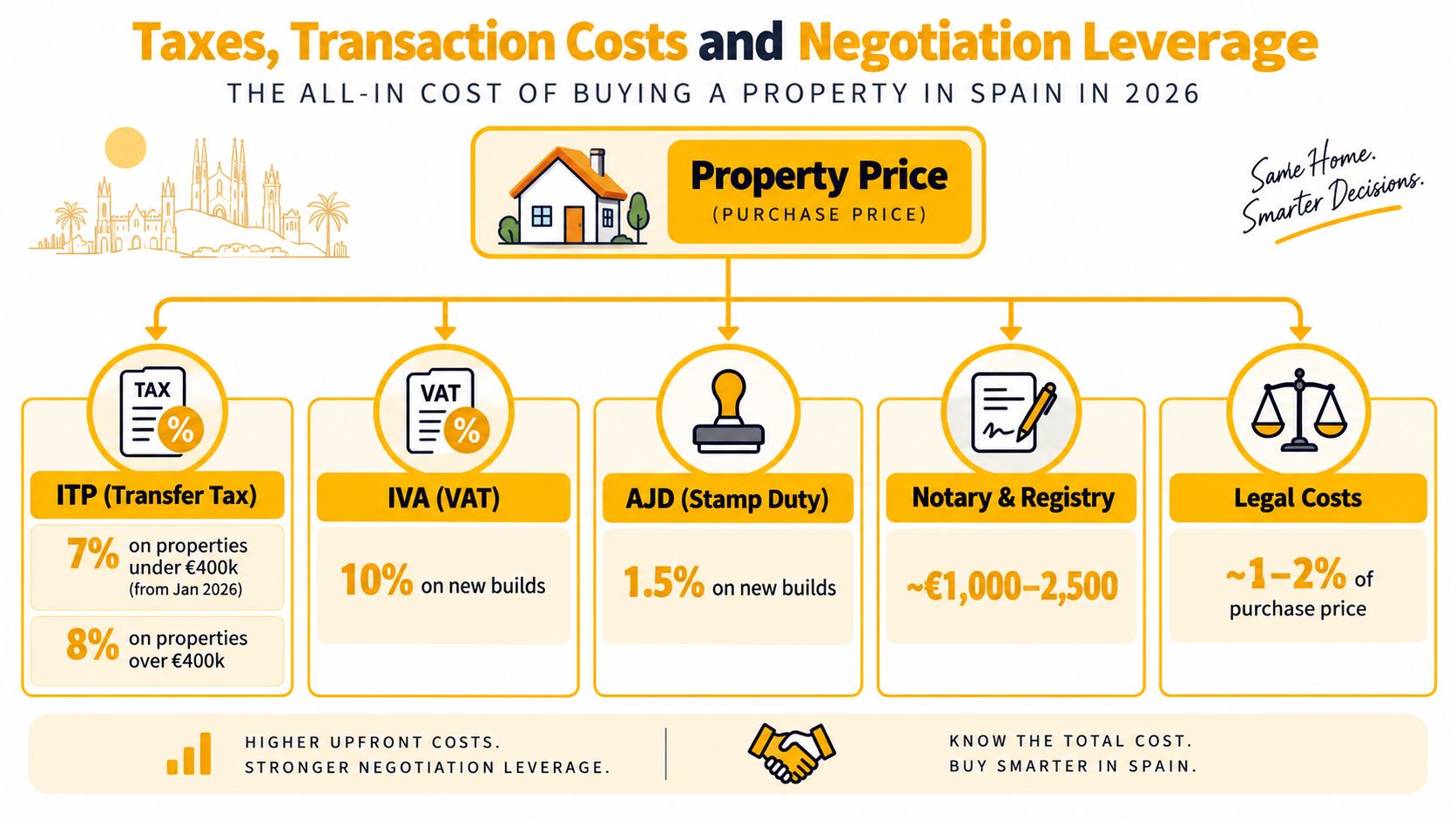
Budget the complete transaction
Your solicitor should separate the following items before you sign:
- Transfer tax: Applies to resale property and depends on the applicable regional rules.
- New-build taxes: VAT and stamp duty are calculated differently from ITP.
- Notary and registry: Necessary for formal completion and registration.
- Legal review: Covers title, planning, debts, licences and contract terms.
- Ongoing exposure: Community fees, insurance, utilities, local taxes and maintenance affect the cost of ownership.
A buyer also needs to consider non-resident tax obligations and potential wealth-tax exposure for higher-value holdings. Those questions belong in a tax consultation, not in a generic online calculator.
Negotiate from evidence, not optimism
The Costa Blanca transaction-versus-asking gap gives buyers a useful benchmark, but it doesn't guarantee a discount. Sellers with clean paperwork, no community arrears and realistic pricing have more influence than owners facing licence problems, unpaid fees or legal irregularities.
Negotiation rule: A discount is only valuable if the property is legally usable, financially manageable and resalable.
Ask for recent completed-sale evidence near the property, not just comparable listings. The right offer reflects the condition and legal status of the specific home.
Which Region Wins for Your Buyer Profile
A useful recommendation should survive contact with a real viewing schedule. My shortlist is practical rather than fashionable: choose one primary region, one backup and two comparable properties, then test both against the same criteria.
Buyer profile | Primary region | Backup region | Example town | Typical price band |
|---|---|---|---|---|
Holiday-home buyer | Costa Blanca South | Costa de Almería | Torrevieja or Mojácar | Broad range, with coastal proximity and condition driving the outcome |
Retiree | Costa Blanca South | Costa Cálida | Orihuela Costa or Mazarrón | Prioritise service access over maximum floor area |
Family buyer | Alicante metropolitan fringe | Murcia hinterland | Alicante outskirts or La Romana | Space and schools often matter more than tourist demand |
Yield investor | Costa Cálida | Costa de Almería | Established resort or Almería area | Select for tenant demand, manageable fees and a credible exit |
The decisive trade-offs
Holiday-home buyers should favour Jávea, Torrevieja or Mojácar according to budget and preferred atmosphere. Jávea offers a more premium lifestyle, Torrevieja offers broader stock and services, and Mojácar can provide stronger value if the buyer accepts a more selective resale market.
Retirees should examine Orihuela Costa, Roquetas de Mar and Vega Baja villages according to healthcare, terrain and transport needs. The right answer isn't the warmest town. It's the place where daily life remains comfortable when visitors leave.
Families need Alicante's metropolitan fringe, Murcia's coastal suburbs or Almerimar only after checking schools, commuting and year-round services. A resort can be enjoyable and still be the wrong base for a full-time household.
Pure yield investors should inspect Murcia and Almería where well-priced stock can offer a more attractive entry point. They must also stress-test vacancy, repairs, community charges, tax and management before accepting any projected return.
Running costs are property-specific. Ask for community budgets, utility history, insurance terms and maintenance records before comparing monthly ownership costs. Then shortlist two properties, one in your primary region and one in your backup, and book viewings in the same week. A head-to-head inspection tells you more than remote listing data.
Frequently Asked Questions About Buying in Spain
Which climate risks should I check?
Don't rely on sunshine or average rainfall. Rising Mediterranean sea temperatures, water-use restrictions and local flood exposure make aquifer-stress maps, flood-zone overlays and drainage history essential checks, particularly in Murcia and Almería. A local solicitor and technical surveyor should review the exact plot and planning position.
Can non-residents obtain Spanish finance?
Spanish lenders commonly assess non-resident buyers more conservatively than residents. You'll need a Spanish NIE, proof of income and a clear deposit strategy, and the final terms depend on nationality, income and the lender's policy. Compare the mortgage offer with currency risk and your existing borrowing rather than looking only at the headline rate.
Does buying property provide residency?
No. Property ownership doesn't automatically grant a visa. Buyers may still explore routes such as the non-lucrative visa or digital-nomad visa, but each has its own eligibility and income requirements, so immigration advice should be obtained separately from the purchase negotiation.
How can I test resale before buying?
Look beyond the development's marketing figures. Review the last 12 months of transactions on the same street, compare completed prices with current listings and identify how many realistic buyer groups would want the property. Walkable urbanisations near Alicante usually offer a broader exit audience than isolated inland Almería stock, but every property needs its own evidence.
AP Properties Spain helps international buyers compare Costa Blanca and Costa Cálida locations, coordinate legal and financing support, and evaluate new-build, resale and renovation opportunities against real lifestyle goals. Visit AP Properties Spain to arrange a focused consultation and shortlist properties that fit your buyer profile, budget and intended exit.
Share