






Sea View Villas for Sale on the Costa Blanca
Spain's coastal housing market recorded 198,995 purchases in 2024, equal to 28% of all property sales nationally, and coastal municipalities averaged €1,848 per m² in Q1 2025. If you're searching for sea view villas for sale, start with one hard truth: a sea view isn't one product. It's at least three different tiers, and each tier carries a different price, legal risk, and resale profile.
Most buyers get bad advice on this subject. They're told to “buy as close to the sea as possible” and sort the rest out later. That's how people overpay for weak sightlines, underestimate Coastal Law restrictions, and end up with a villa that photographs well but resells badly.
I advise buyers across the Costa Blanca and Costa Cálida to treat “sea view” as a classification problem first, not a lifestyle fantasy. Front-line villas, view-corridor villas, and premium hillside villas are not interchangeable. If you don't separate them early, your search filters will be wrong, your budget will drift, and your negotiation position will weaken before you've even booked the first viewing.
What Sea View Really Means on the Costa Blanca
Most listing portals flatten every outlook into the same sales label. That's useless. A proper search for sea view villas for sale starts by deciding which of three view tiers you're willing to buy.
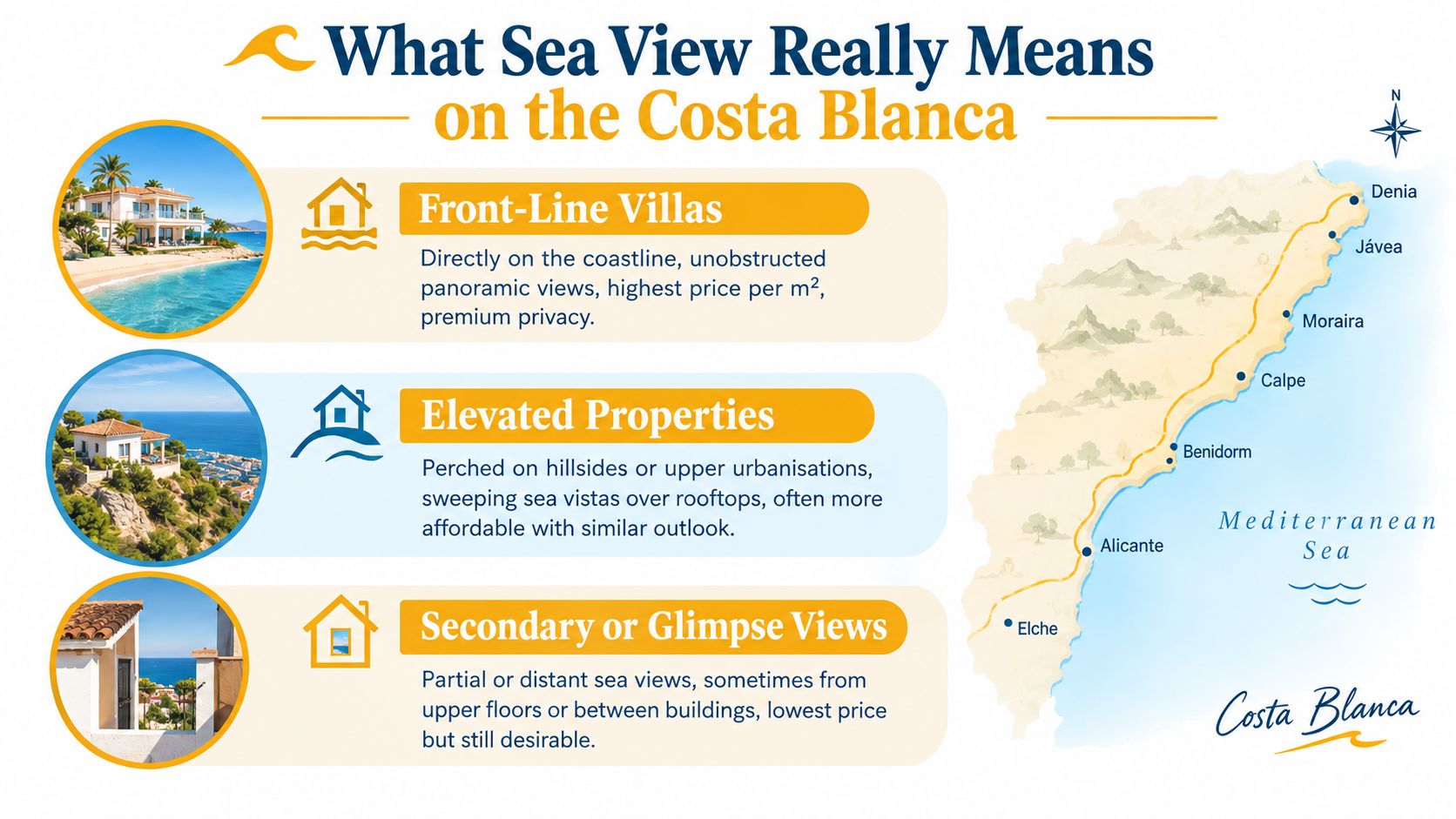
Front-line villas
These sit directly on or immediately above the coastline. The defining feature isn't just proximity. It's uninterrupted visual control of the sea line from the main living spaces and terraces.
They usually command the strongest emotional response and the harshest legal scrutiny. Under the Spanish coastal framework, the public maritime-terrestrial domain covers the beach and shore, with a 100-metre protection zone inlandand a 500-metre influence zone behind it, which can limit building and alterations near the sea, as outlined in this overview of Spanish coastal setback laws.
Elevated villas
This is the tier many buyers should focus on first. These villas sit in hillside urbanisations or upper plots where the house looks over rooftops, vegetation, or lower terrain toward the water.
In practice, these homes often give you the view people think they're buying on the front line, but with fewer compromises on privacy, parking, plot shape, and day-to-day usability. On the Costa Blanca, a well-positioned villa in Altea, Moraira, Jávea, or Cumbre del Sol often makes more financial sense than a compromised coastal-edge property.
Practical rule: If the best part of the property is the view, but the house itself is ordinary, only buy it if the view is hard to lose.
View-corridor villas
This is the category where agents blur the truth most aggressively. A view-corridor villa might see the sea between buildings, above a road, or only from the upper terrace or main bedroom. Sometimes the sea appears from one angle only.
That doesn't make it a bad purchase. It makes it a different product. View-corridor homes can work very well for buyers who care more about light, outdoor space, and occasional sea reference than full panoramic exposure.
How to use the tier system before you visit
- Set the tier first: Decide whether you want front-line drama, a more balanced position, or view-corridor value.
- Budget against the correct market: Don't compare a well-positioned Altea villa with an inland detached house and assume you've found a bargain.
- Filter for resale logic: The broader Spanish coastal market is deep, with 198,995 coastal purchases in 2024 and a 7.2% annual increase, showing demand extends across the shoreline rather than one isolated pocket, according to Tinsa's coastal market report.
The Physical Factors That Drive Sea View Value
A sea view has a price. A usable, durable, protected sea view has a higher one. Buyers who understand the physical drivers stop paying for the label and start paying for the right geometry.
Orientation beats brochure language
A villa facing the right direction for light and terrace use will usually outperform a prettier listing with awkward sun exposure. On this coast, the issue isn't only whether you see the sea. It's whether you can live with that exposure in summer and winter.
Morning glare, late afternoon heat, and poor shading all affect how often owners use the main terrace. If the house forces you indoors during the best hours of the day, the view premium starts to look thin.
Elevation and sightline control
A house can be closer to the sea and still have a worse view. I see this constantly. A lower plot near the coast may look into roofs, roads, or retaining walls, while a higher plot further back gets the broad horizon and more privacy.
That's why urbanisations such as Altea Hills or Cumbre del Sol often justify stronger pricing than less strategic lower positions. The value sits in the stability of the sightline, not just the map distance to the beach.
Factor | Why It Matters | Typical Price Impact |
|---|---|---|
Orientation | Controls glare, heat, winter light, and terrace usability | Better orientation usually supports stronger buyer demand |
Elevation | Protects horizon views and reduces visual interference from neighbours | Higher, cleaner sightlines usually justify a premium |
Plot slope | Affects build footprint, access, drainage, and construction complexity | Steep plots can add cost even when the view is excellent |
Neighbour build height | Determines whether the view is vulnerable to future obstruction | Protected or harder-to-block views hold value better |
Room layout | Decides whether the sea is visible from daily living spaces or only a corner | Full framing from living room and principal suite lifts appeal |
Salt and wind exposure | Increases wear on frames, railings, paintwork, and outdoor systems | Heavy exposure can weaken net value if upkeep is neglected |
Plot shape matters more than buyers expect
Some sea-facing plots look spectacular and function badly. A steep site can restrict pool placement, parking, garden use, and internal flow. Buyers get distracted by the horizon and ignore the fact that the house may need awkward stairs, expensive retaining work, or constant drainage attention.
If you can only enjoy the view from one terrace corner, you're not buying a sea view villa. You're buying a photo angle.
Compare two villas honestly
When you compare options, strip away staging and ask four direct questions:
- From where do you see the sea? Living room, kitchen, main bedroom, pool terrace, or only the top floor?
- Can a neighbour interfere with the sightline?
- Does the plot improve the house, or does the house merely tolerate the plot?
- Will wind, humidity, and salt turn a beautiful property into a maintenance project?
That framework will save you more money than any broad “luxury market” headline.
Best Towns for Sea View Villas Across the Costas
“Sea view” is where buyers get lazy. On the Costa Blanca and Costa Cálida, the smarter question is which view tier you are buying. Front-line, hillside, or view corridor. Each one trades differently, carries different planning risk, and attracts a different resale buyer later.
Town choice sets that framework fast. Altea, Calpe, Moraira, and Jávea are driven by scarcity, slope, and international demand. Benidorm, Villajoyosa, Torrevieja, and much of Orihuela Costa are more mixed. You can still get a good view there, but the premium usually rests on access and holiday appeal rather than long-term shortage of top-tier villa stock.
Costa Blanca North
The north coast is where buyers overpay most often, because the label is strong and the stock is uneven. Foreign buyers accounted for 84% of transactions in Altea, Calpe, Moraira and Benissa, while prices in Calpe's most exclusive areas reached €6,458/m² and stayed near €4,000/m² in Altea Hills and Sierra de Altea, according to Idealista's reporting on international demand in the Valencia region.
That premium is not uniform. In Altea and much of Moraira, buyers are often paying for hillside positioning, privacy, and harder-to-replicate sightlines. In Calpe, some homes command serious money because they combine sea view with proximity and recognisable prime addresses. In Jávea, family buyers often stretch for large villas with broad outlooks, but not every high-ground property has the same resale depth if the house itself is dated or the access is awkward.
For broader budgeting, AP Properties Spain reported Costa Blanca villas in H1 2026 at €1.2 million to €3 million, with that segment carrying roughly a 22% to 28% premium over a regional detached-villa average of €750,000, as noted in this Costa Blanca luxury market article.
Alicante coast and central belt
The central belt needs more discipline from buyers. Alicante province is too varied for blanket assumptions. Asking prices in Alicante province rose 12.2% year on year in April 2026 to €2,764 per m², with Alicante city at €2,549 per m² and the Playas area at €3,767 per m², based on this Costa Blanca pricing update.
Benidorm and Villajoyosa suit a different brief. These are better for buyers who want direct coastal access, easier lock-up-and-leave use, and a lower entry point than the prime northern villa belt. The trade-off is density. Front-line stock can be strong on view and weak on privacy, and corridor views are common enough that some sellers ask front-line money for second-row reality.
Costa Cálida and southern value plays
Southern Costa Blanca and Murcia are where disciplined buyers often do better.
Murcia's coast has long appealed to buyers who want more house for the money. A Tinsa regional report described the coast of Murcia as the most affordable in the Mediterranean Arc, with home-buying effort at 29% of average household income and an average coastal price of €1,380 per m², against a provincial average of about €1,300 per m², according to Tinsa's Murcia coastal report.
That does not make every sea-view villa a bargain. It does mean buyers can often step up from a corridor view to a proper hillside or front-line position without crossing into the pricing bands common in the north. Campoamor sits at the stronger end of the southern market because buyers are paying for a beach-oriented setting and a more established second-home profile. Torrevieja and parts of Orihuela Costa are more practical than prestigious, which is fine if you buy them at the right level and accept that resale depends more on price discipline than cachet.
Town | Region | View Tier | Price Level (€/m²) | Typical Buyer |
|---|---|---|---|---|
Altea | Costa Blanca North | Hillside | Near €4,000/m² in Altea Hills and Sierra de Altea | Lifestyle buyer seeking privacy and established prestige |
Calpe | Costa Blanca North | Hillside and premium coastal | Up to €6,458/m² in exclusive areas | International luxury buyer |
Moraira | Costa Blanca North | Hillside | Premium north-coast pricing | Second-home buyer prioritising discretion |
Jávea | Costa Blanca North | Hillside | Often sits in luxury villa budget bands | Family buyer or lifestyle mover |
Benidorm | Costa Blanca Central | Front-line and dense coastal stock | Provincial and coastal pricing context applies | Holiday-use buyer |
Villajoyosa | Costa Blanca Central | Front-line and corridor views | Mid-market coastal positioning | Buyer seeking coastal access with less prestige premium |
Orihuela Costa | Southern Costa Blanca | View corridor and some hillside stock | Value-driven coastal positioning | Holiday buyer |
Torrevieja | Southern Costa Blanca | View corridor | Value-focused | Practical second-home buyer |
Campoamor | Southern Costa Blanca | Hillside and coastal | Upper end of southern market | Beach-focused second-home buyer |
Murcia coast | Costa Cálida | Front-line and hillside value stock | €1,380/m² average in coastal municipalities | Buyer chasing space and affordability |
Viewing Sea View Villas With a Critical Eye
Sea-view viewings are where buyers lose discipline. They stand on the terrace, look at the water, and stop asking proper questions. That's a mistake.
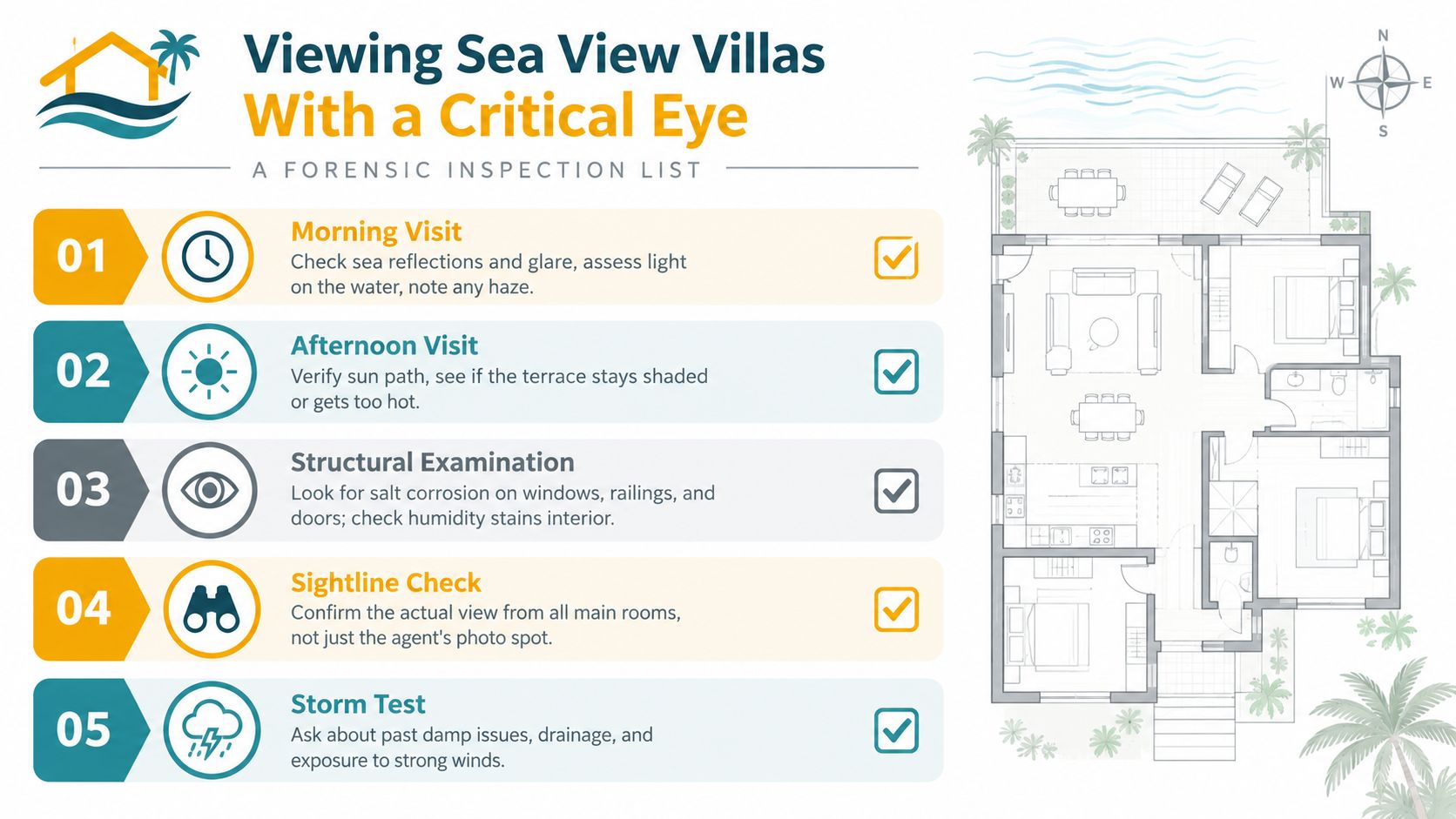
Inspect the view, not the mood
Book two visits if the property is serious. One in the mid-morning. One later in the day. You need to see glare, shadow, privacy, and how the sea sits in the frame when the light changes.
Then leave the terrace and walk the perimeter. Check adjacent plots, rooflines, retaining walls, roads, and anything that could interrupt the sightline or reduce privacy. A villa isn't “panoramic” if a future build on the next plot can take the horizon out of the main living room.
Check the house as hard as the outlook
Inside, test whether the principal rooms are oriented to the sea or whether the agent has positioned you in the one flattering spot. Sit in the living room. Stand at the kitchen island. Open the main bedroom blinds. If the view disappears from normal daily use, the premium is weaker than the asking price suggests.
Look closely at glazing, railings, shutters, exterior paint, and terrace joints. Salt air and exposure leave visible clues. So do interior humidity marks around openings and on seaward walls.
Don't ask, “Does it have a sea view?” Ask, “From which rooms, at which angles, and how secure is it?”
Documents to request before you get attached
Bring discipline into the viewing process with a short due diligence list:
- Cadastral and planning basics: Ask for the cadastral reference and confirmation of urban classification.
- Ownership and legal status: Request a recent nota simple.
- Operating costs: Ask for the last three years of utility bills, IBI receipts, and community fees.
- Alteration history: Request original plans and documentation for terraces, pools, enclosures, and extensions.
- Condition evidence: Ask whether the owner has records of damp treatment, glazing replacement, corrosion repair, or drainage works.
If you're buying remotely, one practical route is to use a local buyer-side advisor to pre-screen viewings and legal paperwork. Firms such as AP Properties Spain coordinate property shortlists and local viewing support, but the principle matters more than the provider. Get someone on the ground who will challenge the listing language, not repeat it.
Renovation, Running Costs and Resale Potential
Sea view villas create a predictable buyer error. People accept a premium for the outlook, then renovate as if every euro spent will come back on resale. It usually won't.
Renovate for liquidity, not ego
The best upgrades in coastal villas are the ones future buyers can understand in ten seconds. Better glazing. Cleaner openings. Smarter terrace flow. Simpler indoor-outdoor connection. Documented energy improvements. Legalised alterations.
The weakest upgrades are often expensive vanity works that don't improve how the house captures or protects the view. If the reform budget goes into flashy finishes while the main living area still faces the wrong way, you've polished the wrong asset.
Factor | Sea View Villa | Inland Villa |
|---|---|---|
Exterior wear | More exposed to salt, humidity, and wind | Typically less aggressive environmental wear |
Window and railing upkeep | Higher priority because exposure affects both condition and view enjoyment | Important, but usually less urgent |
Pool maintenance | Often central to value if positioned toward the sea | Less tied to resale psychology |
Energy improvements | Particularly useful on exposed plots with strong sun and wind | Helpful, but exposure patterns are often milder |
Resale proof | Buyers want view quality plus paperwork certainty | Buyers focus more on house condition and location convenience |
Overcapitalisation risk | High if upgrades don't improve the view experience or legal standing | Present, but less driven by one feature premium |
Running costs don't disappear because the house is beautiful
Exposure changes ownership cost. Coastal villas need stricter maintenance discipline. Frames, paint systems, terrace waterproofing, outdoor kitchens, pergolas, and air-conditioning components all need closer attention than similar inland homes.
That doesn't make sea-view ownership bad value. It means the right house is one where the build quality, materials, and maintenance history match the premium being asked.
A sea view sells the first visit. Paperwork, condition, and sensible upgrades decide the final price.
What supports resale best
Three things help resale most:
- View clarity: Buyers pay more confidently when the sea is visible from daily living areas, not just an upper corner.
- Legal confidence: Terraces, pools, and extensions should match the registered reality.
- Evidence file: Keep plans, invoices, energy documentation, and ownership records organised.
A buyer can forgive dated finishes. They're far less forgiving of undocumented alterations on a coastal villa.
Financing, Taxes and Coastal Law Realities
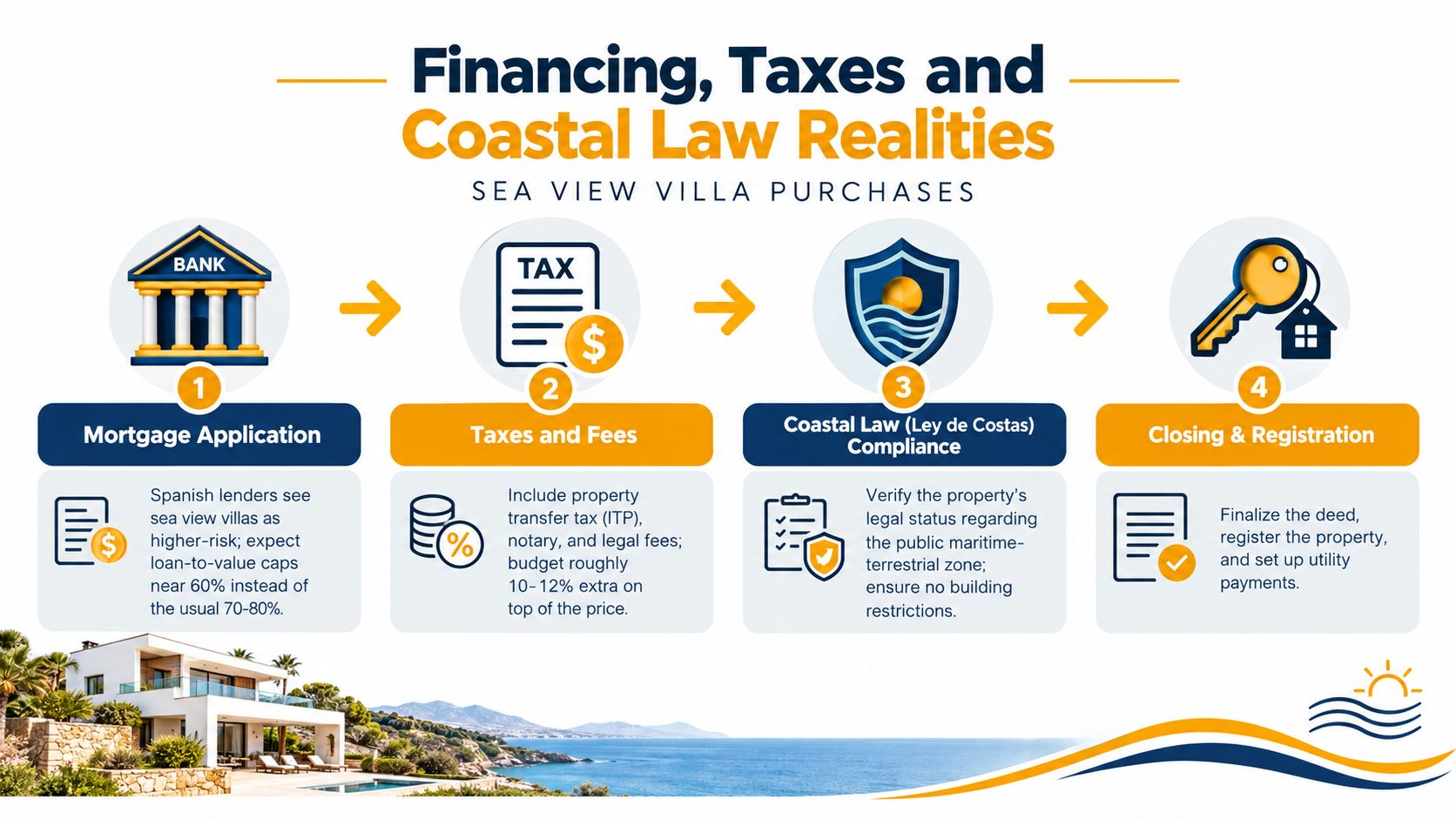
Finance for sea-view property is less forgiving than many foreign buyers expect. The mistake is assuming the bank, the tax bill, and the legal status of the plot will behave like a standard inland purchase.
Benchmark the market before you talk to the bank
Lenders look at collateral quality, resale resilience, and legal complexity. You should do the same. In Alicante province, one August 2026 market benchmark showed €3,116 per m² with municipal values ranging from 0 to 4,605 €/m²; separate analysis for the same period cited an average transaction price of €1,978 per m² for built area and 52,847 transactions across the Costa Blanca report period, according to Indomio's Alicante market data.
That spread matters because a bank won't finance your emotional attachment to one particular terrace. It finances an asset that must be defendable in the local market.
Taxes and price benchmarks
Buyers also need a realistic sense of the local baseline before agreeing that a “sea view premium” is justified. Tinsa-based reporting for Q1 2026 put Alicante province's average housing price at €1,877 per m², up 18.3% year on year, while Benidorm reached €2,786 per m² after a 20.5% annual rise.
For tax and purchase-cost planning, work qualitatively rather than casually. Besides the purchase price, non-resident buyers should account for transfer or VAT treatment, notary, registry, legal fees, and stamp-duty exposure depending on the purchase structure and region. Don't reserve a villa until your lawyer has mapped the full cost stack.
Coastal law changes what you can do after completion
The practical legal question isn't whether the current owner enjoys the sea view. It's whether you can legally maintain, alter, or extend the property you're buying.
Older coastal villas often include terraces, enclosures, pool alterations, or external structures that owners treated as harmless improvements. On a regulated coastal plot, those assumptions can become expensive. Buyers should have a lawyer verify planning status, title detail, and any coastal-law exposure before reservation money changes hands.
A simple order of operations
- Value the villa against local market evidence
- Check whether the view tier justifies the asking price
- Have a lawyer review title, planning, and coastal constraints
- Only then discuss finance and reservation timing
That order prevents most avoidable mistakes.
Matching Buyers to the Right Sea View Villa
“Sea view” is where plenty of buyers lose discipline. It sounds precise. On these coasts, it isn't. A front-line villa, a hillside villa, and a view-corridor property can all be sold under the same label, even though they behave very differently on price, upkeep, legal exposure, and resale.
Buy by ownership pattern first. Buy by view tier second.
Lifestyle buyers and full-time movers
Full-time movers usually do best in hillside positions above established towns such as Altea, Moraira, Jávea, and Cumbre del Sol. You get a wider outlook, better privacy, and a house that often works through all seasons rather than only in peak summer. That matters more than the romance of being as close to the water as possible.
Front-line only makes sense for this group if they actively want the compromises that come with it. More exposure to wind and salt, less privacy, and tighter limits on what you may be able to change later are ownership realities, not minor details.
Holiday buyers and rental-minded owners
Holiday buyers often overpay for prestige northern stock when their real brief points elsewhere. If the priority is short stays, direct access, and strong guest appeal, front-line villas in selected parts of the Costa Cálida and southern Costa Blanca can fit better.
Just be honest about the trade-off. Front-line property usually gives a stronger arrival experience than a simple ownership experience. If you want low fuss, buy a different tier.
Buyer Profile | Recommended Tier | Preferred Region | Main Trade-Off |
|---|---|---|---|
Full-time lifestyle mover | Hillside | Altea, Moraira, Jávea, Cumbre del Sol | Pays a premium for outlook and privacy |
Holiday-use buyer | Front-line | Costa Cálida, southern Costa Blanca | More exposure, more maintenance sensitivity |
Capital-preservation buyer | View-corridor or established hillside stock | Mature urbanisations across Costa Blanca | Less dramatic view, steadier entry price |
Weekend buyer wanting low fuss | Hillside | Managed hillside communities | Community structure may reduce privacy |
Space-seeking international buyer | Hillside or front-line value stock | Murcia coast | Less prestige, but often more house |
Capital-preservation buyers and cautious second-home owners
Capital-preservation buyers should focus on view-corridor villas and established hillside stock in proven urbanisations. These homes rarely win on drama, but they often avoid the markup attached to heavily marketed panoramic listings. They also tend to bring a broader resale audience, which matters far more than brochure language.
Cautious second-home buyers should stay practical. Prioritise manageable plots, organised maintenance, and a sea view that adds value without putting the whole building envelope in constant contact with the harshest coastal conditions.
Buy the view tier that matches how you will own the property. That is what protects both lifestyle and resale.
Good advisory work starts before viewings are booked. The job is to cut the shortlist by tier, spot properties where the asking price outruns the actual quality of the view, and remove villas with weak legal or planning positions before travel time gets wasted.
If you're searching for sea view villas for sale on the Costa Blanca or Costa Cálida, AP Properties Spain helps buyers narrow the field by area, view tier, and legal practicality before time gets wasted on the wrong stock. You can explore their current approach and property selection at AP Properties Spain if you want a more curated route from shortlist to completion.
Share