






Luxury Property for Sale on Costa Blanca Guide 2026
You're probably doing what most international buyers do at the start. You've opened half a dozen tabs, saved a few sea-view villas, compared a penthouse with a finca, and then realised the listing price is only one part of the decision. The bigger question is whether the home fits the life you want on the coast, and whether the numbers still make sense when you look beyond the photos.
That matters even more around La Romana, Alicante, Costa Blanca, Spain, where buyers often balance two goals at once. One is lifestyle: sunshine, privacy, golf, beach access, a slower rhythm, space for family and guests. The other is discipline: buying well, avoiding legal surprises, and choosing a location that will still feel right in five or ten years.
A good luxury purchase sits in the overlap. It should feel enjoyable to own and sensible to hold.
Introduction to Buying Luxury on Costa Blanca and Costa Cálida
A typical search starts with a broad phrase like luxury property for sale, but the coastline quickly teaches you that not all “luxury” is the same. A frontline penthouse near a marina, a hillside villa with open sea views, and a restored finca inland can all sit in the same price conversation while offering completely different daily lives.
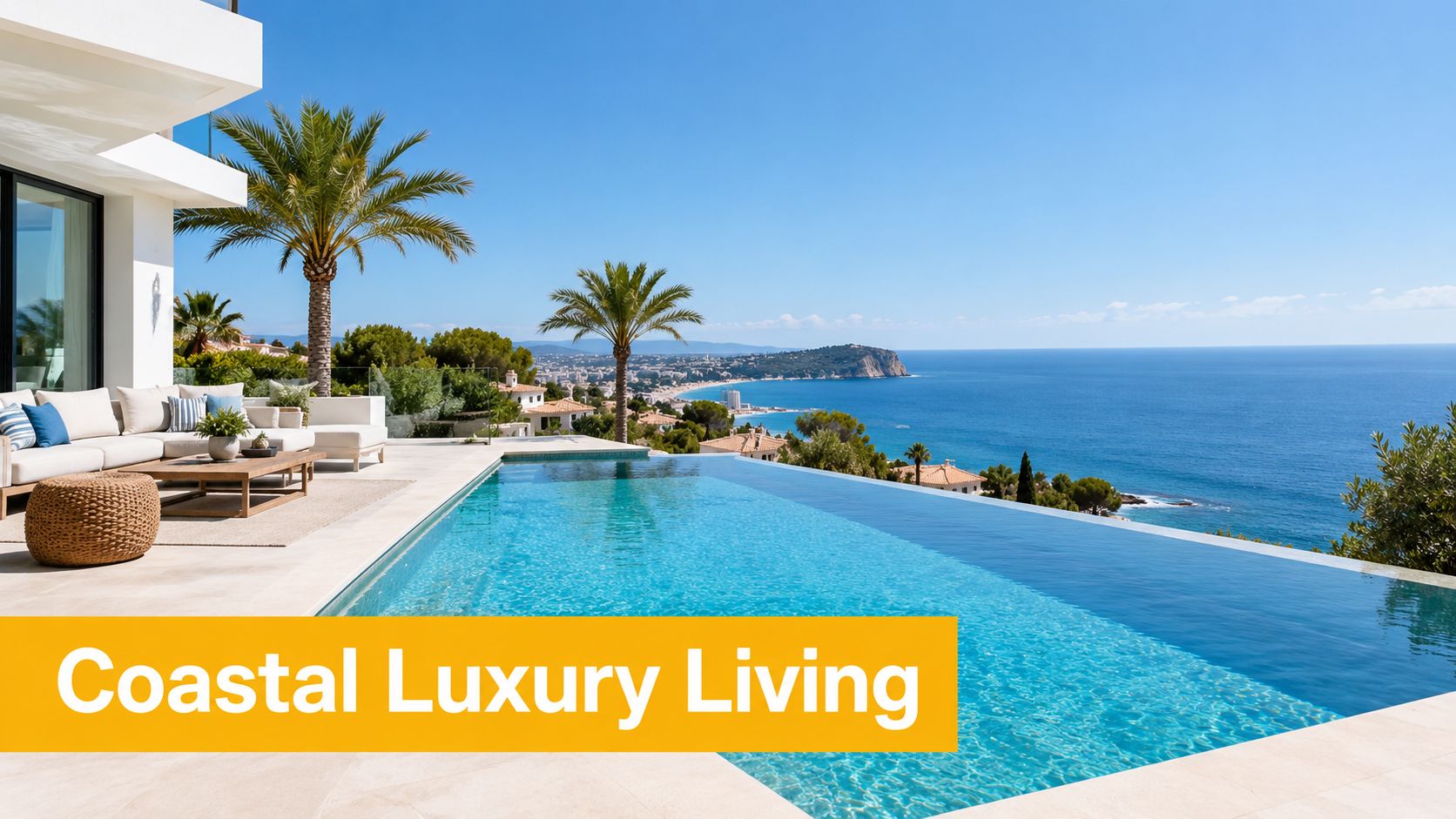
What buyers usually discover first
Many people arrive on Costa Blanca expecting one single market. In practice, they find a chain of micro-markets. Northern coastal towns can feel polished, scenic and tightly held. Central and southern stretches often offer a different balance of access, services, and value. Costa Cálida adds another layer, with its own pace and property mix.
That's why buyers who begin with “I want a modern villa” often end up refining the brief into something more useful:
- Daily living needs: year-round restaurants, healthcare, schools, airport access
- Property style: contemporary villa, penthouse, bungalow, townhouse, finca or plot
- Ownership plan: holiday use, permanent move, rental use, or a long-hold investment
- Work required: move-in ready, light updating, or full turn-key renovation
Practical rule: Start with the life you want to live, then choose the property. Buyers who do it the other way round often overpay for features they won't use.
Why this segment behaves differently
At the top end, buyers aren't only paying for square metres. They're paying for orientation, privacy, finish quality, outdoor living, a protected view, walkability, and how difficult that combination is to find again. Two homes with similar interiors can trade very differently if one has a wide terrace facing the sea and the other looks into neighbouring roofs.
The luxury end of the Spanish market has also expanded sharply. A market report cited by Infinitum states that demand for luxury homes in Spain rose 97% between 2019 and April 2024, while supply of homes priced above €800,000 increased by more than 150% over the same period. The same report identifies Alicante as one of Spain's core luxury hubs, with 18.9% of luxury stock and an average asking price of about €1.6 million in this segment, which gives important context for Costa Blanca buyers looking at premium coastal areas (Infinitum's summary of the 2024 luxury housing market report).
For a buyer in La Romana or elsewhere in Alicante province, that means choice has improved, but so has competition for the right home.
Understanding the Luxury Market Dynamics Today
Luxury markets rarely move in a straight line. They move in pockets. That's the first idea to keep in mind when you're reviewing any luxury property for sale on this coast.

Why international demand matters so much
In the broader Spanish ultra-luxury segment, foreign buyers accounted for 60% of demand, with annual foreign-buyer transactions estimated at about 130,000 in 2025, and luxury prices having risen 30% over five years according to a 2026 report summary. The same dataset reported more than 43,707 homes and apartments priced above €1 million in Spain, with over 80% concentrated in just six provinces, including Alicante.
That concentration changes how you should read listings. In ordinary markets, a provincial average can tell you quite a lot. In luxury markets, it often tells you very little about the exact home you're considering.
Think of Alicante province like a map of small harbours, not one open beach. Money doesn't spread evenly across the coastline. Buyers cluster in specific areas, and prices respond where premium stock is limited.
Provincial averages versus prime pockets
Alicante province posted 44.65% of all home purchases by foreign buyers in Q1 2026, described by the source as a national record, with an average home price of €2,214/m², up 1.5% quarter-on-quarter (Directimo Costa Blanca market report, September 2026). In Q2 2026, foreign demand in Alicante province accounted for 46.43% of purchases, while the average price reached €2,267/m².
Those are useful signals. They tell you international demand is still a major support for pricing. They don't tell you what happens in a sea-view enclave where few owners sell.
A provincial average is like the temperature for the whole region. It helps you decide what coat to bring. It doesn't tell you whether the exact terrace you want sits in sun or shade.
How micro-locations reprice faster
In the northern Costa Blanca luxury corridor, foreign buyers represented 84% of transactions in Altea, Calpe, Moraira and Benissa. The same report notes prices above €3,500/m² in several locations, reaching €6,458/m² in Calpe's most exclusive areas. It also states that Dénia and Jávea rose close to 29% to an average €3,388/m²(Idealista's review of international buyer demand in the Valencia region's prime coastal areas).
This is why one villa can feel “expensive” compared with the province and still be correctly priced for its niche. If the home has open views, a strong address, modern specifications, and very little direct competition, buyers compare it with a tiny local universe, not the whole map of Alicante.
A practical reading of the market looks like this:
- Use averages as background: They help frame broad market conditions.
- Study the micro-location: Sea view, walking distance, road access, and privacy often matter more than municipal boundaries.
- Check true comparables: A renovated villa with a clean layout and strong outdoor living isn't comparable to an older home needing structural or planning review.
- Expect scarcity premiums: In prime streets or hillside zones, replacement options can be limited.
Key Coastal Locations and What Each Offers
The easiest mistake is choosing a town because it sounds familiar. The better approach is to match your lifestyle to the shape of each coastal cluster.
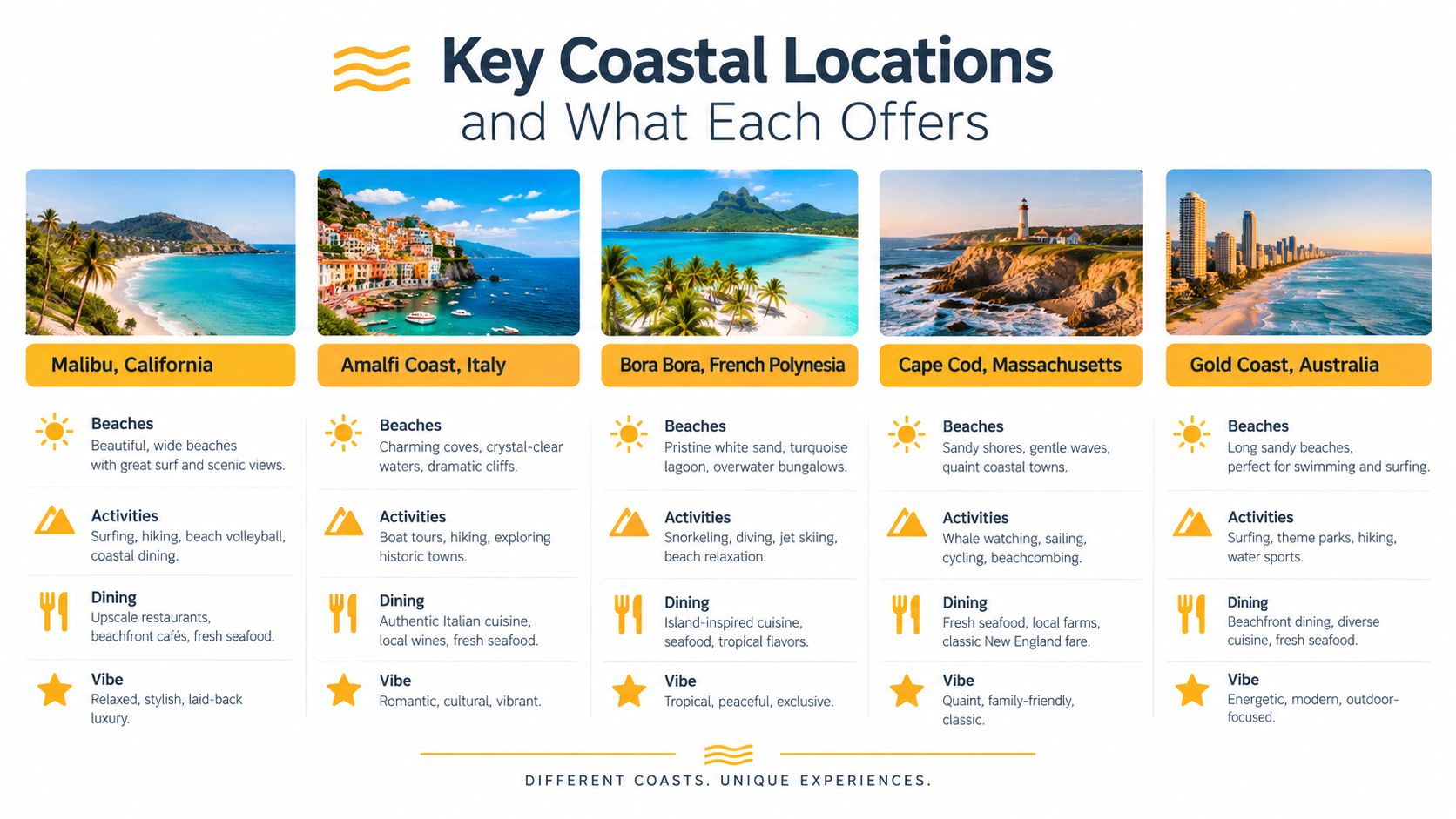
Northern Costa Blanca
Dénia, Jávea, Moraira, Altea, Calpe and Benissa attract buyers who care about scenery, marinas, established villa zones and distinctive coastal character. You'll see more hillside homes, more strong sea-view positions, and more variation between one street and the next.
These areas often suit buyers who want one or more of the following:
- A polished coastal routine: marina lunches, beaches, old town charm, and a sociable international scene
- A statement home: architect-designed villas, panoramic plots, and larger terraces
- A hold-worthy location: places where limited prime stock can support long-term appeal
The trade-off is simple. Prime northern pockets can be less forgiving on budget, especially when views, privacy and modern finish come together in one property.
Central and southern Costa Blanca
Alicante city, Guardamar, Torrevieja, Orihuela Costa and surrounding areas serve a broader mix of buyers. Some want lock-up-and-leave apartments near the sea. Others want modern villas in established residential zones with golf, road access and easier everyday logistics.
La Romana sits differently within that picture. It appeals to buyers who like inland space and authenticity while still wanting access to the coast, airport routes and the wider Alicante market. For some, that balance is more liveable than a frontline address. You may give up immediate marina access, but gain plot size, privacy and a calmer year-round rhythm.
Alicante's long-running international appeal is well documented. One report cited 45.67% of transactions in the province being made by foreigners, while another stated 43.29% for 2025, confirming that foreign-buyer concentration has remained unusually high over time (Diario de Alicante's reporting on sustained foreign demand in Alicante province).
Costa Cálida
Costa Cálida often enters the search later, after buyers realise they want more breathing room or a different price-to-lifestyle equation. It can suit purchasers who prioritise newer developments, golf-oriented living, marinas, or a slightly quieter profile than some better-known Costa Blanca hotspots.
It's not a “lesser” choice. It's a different one. Some buyers feel at home there immediately because the daily pattern fits them better.
Buy the place where your ordinary Tuesday works well. Holiday energy is nice. Daily livability is what decides whether you still love the home after the first season.
Coastal Location Comparison for Luxury Buyers
Location Cluster | Lifestyle Profile | Typical Luxury Stock | Price Signal |
|---|---|---|---|
Northern Costa Blanca | Scenic, established, marina-led, design-conscious | Sea-view villas, hillside homes, penthouses, select fincas | Prime micro-locations can sit well above provincial averages |
Alicante and central Costa Blanca | Urban-coastal mix, practical access, year-round services | Penthouses, modern apartments, villas near city or coast | Broader price spread, driven by exact neighbourhood and finish |
Southern Costa Blanca | Golf, beach urbanisations, lock-up-and-leave convenience | New-build villas, apartments, townhouses, resort-style homes | Value depends heavily on walkability, amenities and rental appeal |
Inland Alicante including La Romana | Space, privacy, local character, slower pace | Fincas, country villas, plots, renovated traditional homes | Often judged more by plot quality and specification than by sea premium |
Costa Cálida | Relaxed coastal living, marinas, golf and newer schemes | Contemporary villas, apartments, penthouses | Buyers often compare lifestyle value against stronger-name coastal rivals |
If you're comparing several areas, don't ask “Which town is best?” Ask “Which location best fits how I'll use the home?”
How the Buying Process Works Step by Step
Spanish buying becomes much easier when you stop seeing it as one big legal event and start seeing it as a relay race. One person passes the baton to the next. You, the agent, the lawyer, the bank if needed, the seller, the notary, and the registry each have a job.
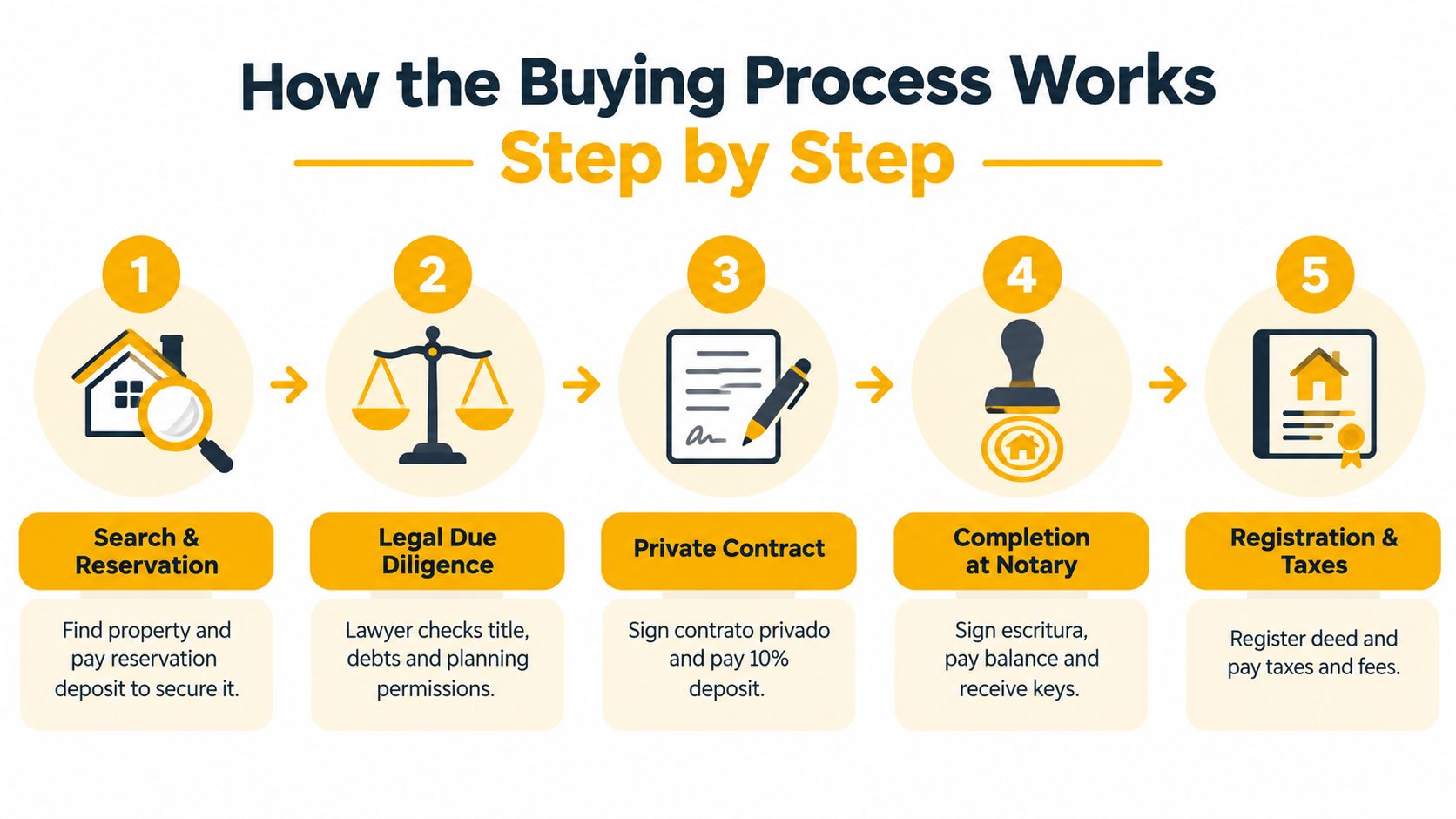
Step one to step three
- Search and reservation
You shortlist homes, view them, compare location quality and check whether the asking price reflects condition and setting. Once you choose a property, the seller may accept a reservation agreement and a reservation deposit to take it off the market.
This stage feels emotional because you've found the house you want. It still needs discipline. Reservation is not the same as full legal comfort.
- Legal due diligence
Your lawyer checks title, ownership, charges, debts linked to the property, planning status, and whether what exists on the ground matches what should legally exist. For luxury homes, this step matters even more because extras such as pools, guest annexes, terraces, or boundary changes can create hidden issues if they were altered incorrectly.
- Private contract
Once checks are satisfactory, buyer and seller usually sign a private purchase contract. This document sets out the agreed terms, price, completion timing, and what's included in the sale. For many resale transactions, this is the stage where a larger deposit is paid.
Step four and step five
- Completion at the notary
Completion happens when the public deed is signed before the notary. The balance is paid, ownership is formalised, and keys are handed over. If you can't attend in person, many international buyers arrange a power of attorney so their lawyer can act for them.
- Registration and post-completion
After signing, the deed is registered and taxes are paid. Utilities, community administration, insurance and practical ownership matters also need to be put into your name.
Keep your paperwork organised from day one. Passport copies, proof of funds, NIE, bank details, and signed documents move the process along far more smoothly when they're ready early.
Where buyers often get confused
The most common confusion isn't legal language. It's timing.
- Resale homes: usually move according to seller readiness, legal checks, and how fast both parties can document everything.
- New-build homes: often involve developer paperwork, stage payments, licences, and a different completion rhythm.
- Remote purchases: can be efficient, but only if the legal and practical coordination is solid.
An NIE is typically needed for buying in Spain, and many non-resident buyers also set up a Spanish bank account because it simplifies payments and ongoing property costs. Power of attorney can be useful if you want your lawyer to handle formalities while you're abroad.
What matters most is understanding dependency. You can't sensibly rush to completion before legal review is clear. The sequence exists for a reason.
Legal Taxes Financing and Your Due Diligence Checklist
A beautiful home can still be a poor purchase if you budget only for the listing price. The cost picture includes taxes, fees, financing decisions, compliance checks and the practical cost of owning the property once the keys are in your hand.
Start with the tax treatment
For non-resident buyers in Spain, the tax treatment depends on whether the home is resale or new-build. Resale homes are generally subject to ITP, while new-build homes are subject to 10% VAT plus AJD, and the combined acquisition tax burden is commonly estimated at 8% to 13% of the purchase price depending on region (overview of Spanish property tax for non-residents).
That's why two properties with the same asking price can land very differently in your final budget. A buyer comparing a finished resale villa with a new-build home should never assume the same acquisition cost structure.
What financing changes
Financing affects more than affordability. It affects speed, document preparation, and negotiation style. A cash buyer may have more flexibility on timing. A financed buyer needs lender coordination and should understand early what the bank requires.
Currency planning matters too if your funds are held outside the eurozone. Exchange movement can alter the practical cost of the purchase, especially on larger luxury transactions. Many buyers treat that as an afterthought. It shouldn't be.
Your due diligence checklist
Use a checklist that looks beyond the brochure.
- Title and ownership: Confirm who owns the property and whether all sellers have authority to sell.
- Charges and debts: Verify whether mortgages, embargoes, or unpaid obligations are attached to the property.
- Planning and building status: Check licences, declared built area, extensions, pool legality, terraces and any guest accommodation.
- Community rules and fees: For apartments, penthouses and some gated communities, understand what you can and can't do.
- Included items: Clarify furniture, appliances, lighting, outdoor kitchen equipment, and storage areas.
- Running costs: Review local taxes, maintenance, garden and pool care, community costs and insurance.
- Rental intentions: If you hope to let the property, check whether the location and property type suit that use and whether any local rules affect it.
A luxury home should pass two tests before you commit. You should want to live with it, and your lawyer should be comfortable signing off on it.
Looking at total value, not just purchase price
Many smart buyers gain an advantage. They stop asking “What does it cost?” and start asking “What will it cost to own properly, improve sensibly, and exit well if my plans change?”
A home that looks cheaper at first glance may need more correction work, more compliance review, or more layout improvement than expected. Another may look expensive but already include the privacy, orientation, finish level and legal clarity that save you time and stress later.
Working With a Boutique Agent and Creating Turn Key Value
Luxury buying on the Spanish coast rewards local judgement. Not sales talk. Judgement. The useful adviser is the one who can tell you that two villas with similar photos are not equal because one has the better approach road, quieter plot, stronger orientation, and a more resilient location for future resale.
What boutique guidance changes
A boutique agent typically works more like a matchmaker than a catalogue. Instead of sending every available luxury property for sale, they narrow the field around how you'll live.
That can mean:
- Area filtering: separating homes that look coastal on a map from homes that deliver the lifestyle you want
- Shortlist discipline: ruling out compromised properties before you spend time travelling to view them
- Negotiation context: identifying where asking prices reflect scarcity and where they reflect optimism
- Coordination support: keeping lawyer, seller, developer, architect or builder aligned
One factual example in this market is AP Properties Spain, a boutique consultancy based in La Romana and active across Costa Blanca, Costa Cálida, Costa de Almeria and Costa del Sol. Its stated role includes area guidance, curated listings, legal coordination, negotiation support, and renovation management for buyers looking at new-build and resale homes.
When renovation creates better value
Not every strong luxury purchase is turnkey on day one. Sometimes the better decision is an older villa in the right micro-location that needs design work. If the structure, plot, orientation and address are right, renovation can bring out value the listing price doesn't yet show.
A few common scenarios:
- Choose new-build when you want efficiency, contemporary layouts, and minimal early maintenance.
- Choose resale when the location is excellent and the home already works well with only light changes.
- Choose renovate-to-spec when the property has a hard-to-replace position but needs a better internal flow, updated finishes, or improved outdoor living.
Remote buyers need an extra layer of caution here. Turn-key sounds simple, but project quality depends on drawings, specification control, site supervision, and realistic budgeting. Trusted architects and builders matter because they convert ideas into measurable outcomes such as better layout, stronger materials, and a finish level that fits the area.
The listing price tells you what the seller wants today. A proper renovation plan tells you what the property could become tomorrow.
For many buyers, that's where the smartest decisions happen. Not at the first click, but in the gap between a decent house and the right house.
Your Next Steps to Securing the Right Luxury Home
Start by tightening your brief. Decide whether your priority is sea view, walkability, privacy, rental flexibility, inland space, or year-round living. Then decide which property type matches that goal best. A villa suits privacy and outdoor living. A penthouse suits lock-up-and-leave ease. A finca suits land and character. A plot suits buyers who want full control and have patience.
Next, build your buying budget properly. Include acquisition taxes, legal fees, financing costs if relevant, and any renovation or furnishing work you'll need before the home feels complete.
Then prepare your paperwork early. If you'll need an NIE, Spanish bank account, power of attorney, or mortgage coordination, getting those pieces in place early reduces friction later.
Finally, view with a filter, not with excitement alone. Ask whether the home fits your ordinary life, not only your holiday mood. The right luxury purchase on Costa Blanca or Costa Cálida should give you both pleasure and clarity. When those two line up, decisions become much easier.
If you're exploring luxury property for sale around La Romana, Costa Blanca or Costa Cálida, AP Properties Spain can help with area guidance, curated viewings, legal coordination, and renovation planning for both new-build and resale homes. Their multilingual team works with international buyers who want a lifestyle-focused purchase without losing sight of the practical details. To learn more, visit AP Properties Spain.
Share