





Houses for Sale Spain with Land Your Costa Blanca Guide
You're probably doing what many overseas buyers do at the start. You open a portal, type in houses for sale in Spain with land, fall in love with white walls, almond trees and mountain views, and assume the rest is just paperwork.
It rarely works like that.
A house with land in Spain is never just a house. You're also buying access, boundaries, planning status, utility reality and sometimes a long local history that doesn't fully match the listing photos. That's especially true inland, around La Romana, Alicante and the wider Costa Blanca interior, where value and privacy can be excellent, but where the right questions matter more than polished marketing.
Introduction to Finding Your House With Land in Spain
A couple from northern Europe recently described their ideal move in simple terms. They wanted quiet, room for dogs, a few olive trees, and enough distance from neighbours to hear birds in the morning. They didn't want a huge estate. They wanted a manageable country home where weekends felt slower.
That dream fits many buyers who start searching for houses for sale in Spain with land around inland Alicante. Places near La Romana attract people who want a more authentic village setting, more space around the home, and a price structure that often feels more approachable than the busiest coastal strips.
What buyers often miss first
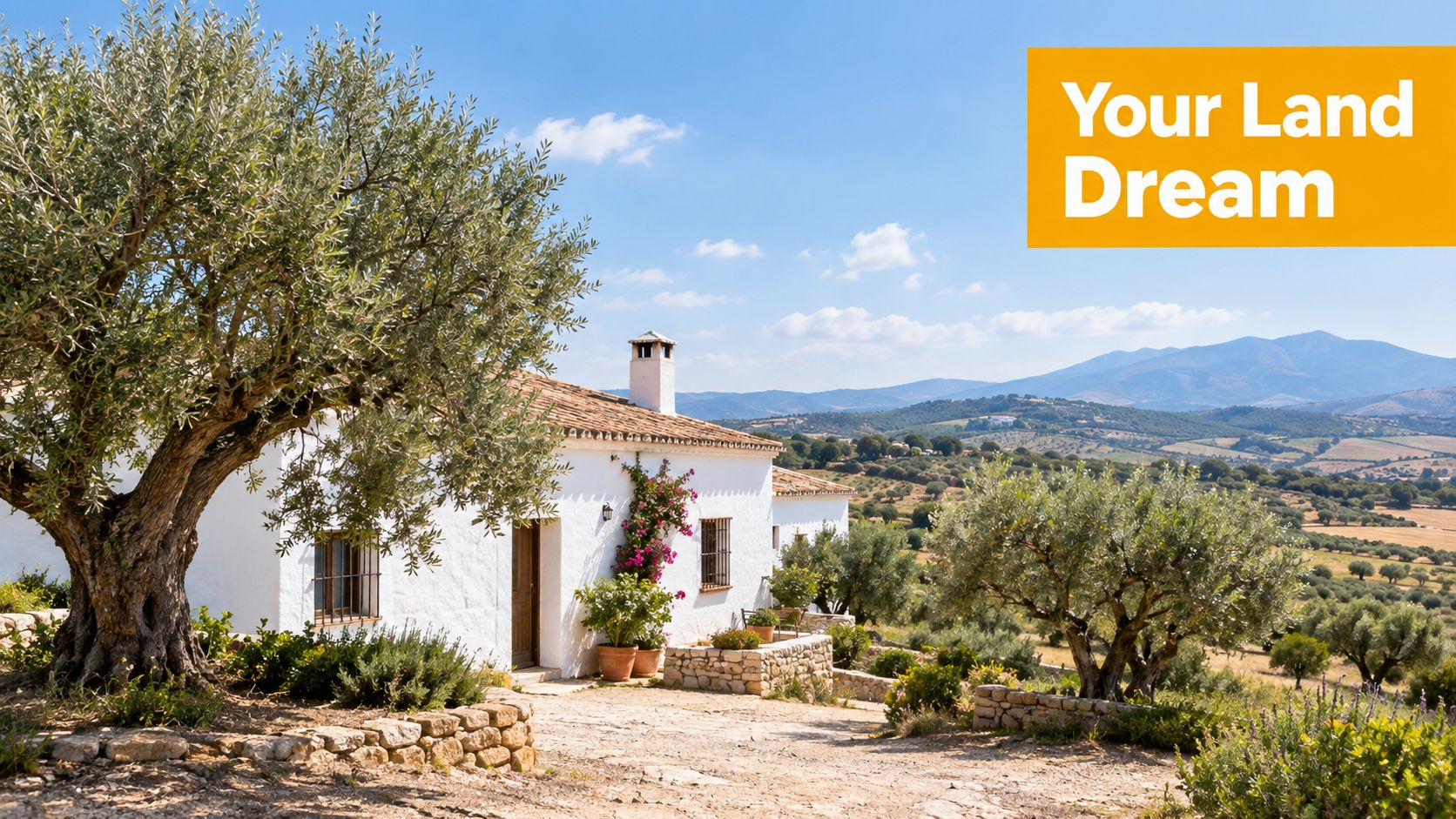
The surprise usually comes after the first shortlist. Two properties may both say “house with land”, yet they can offer very different legal and practical outcomes. One may suit full-time living with straightforward services. Another may look charming, but limit extension works, have awkward access, or sit on land where expectations and legal reality don't match.
A rural home in Spain is partly a property purchase and partly a rights-checking exercise.
Spain's official statistics also show that land and housing are monitored as connected but distinct parts of the market. The National Statistics Institute tracks land prices, real estate transactions, housing stock and registry data through separate operations, which tells you something important. Land is not treated as a minor detail in the Spanish market. It is a category that needs its own attention. In the rural segment, transaction activity has remained active too. INE-based reporting notes 15,108 rural property purchases in May 2026, a 1.2% year-on-year increase, marking three consecutive months of growth, while platform data cited in the same source points to average rural-home landholdings of 7.29 hectares in that broader market context (INE historical operations listing).
The three buyer intents that matter most
Before you compare listings, it helps to decide what “land” means to you.
- Lifestyle space: You want privacy, views, a garden, maybe a pool, and room to enjoy the countryside.
- Micro-farm use: You want productive land for olives, fruit trees, horses, hobby agriculture or recreational rural use.
- Future development optionality: You want land that may allow more building, restructuring or long-term upside, subject to planning.
Those are three different buyer intents. They need three different checks.
Understanding Fincas Country Houses and Land Types in Spain
Buyers often focus on labels. They ask whether they should look for a finca, a casa de campo, a cortijo, or a villa with land. The label helps a little, but not nearly as much as people think.
The more useful question is this. What land classification sits underneath the house?
Property names people use
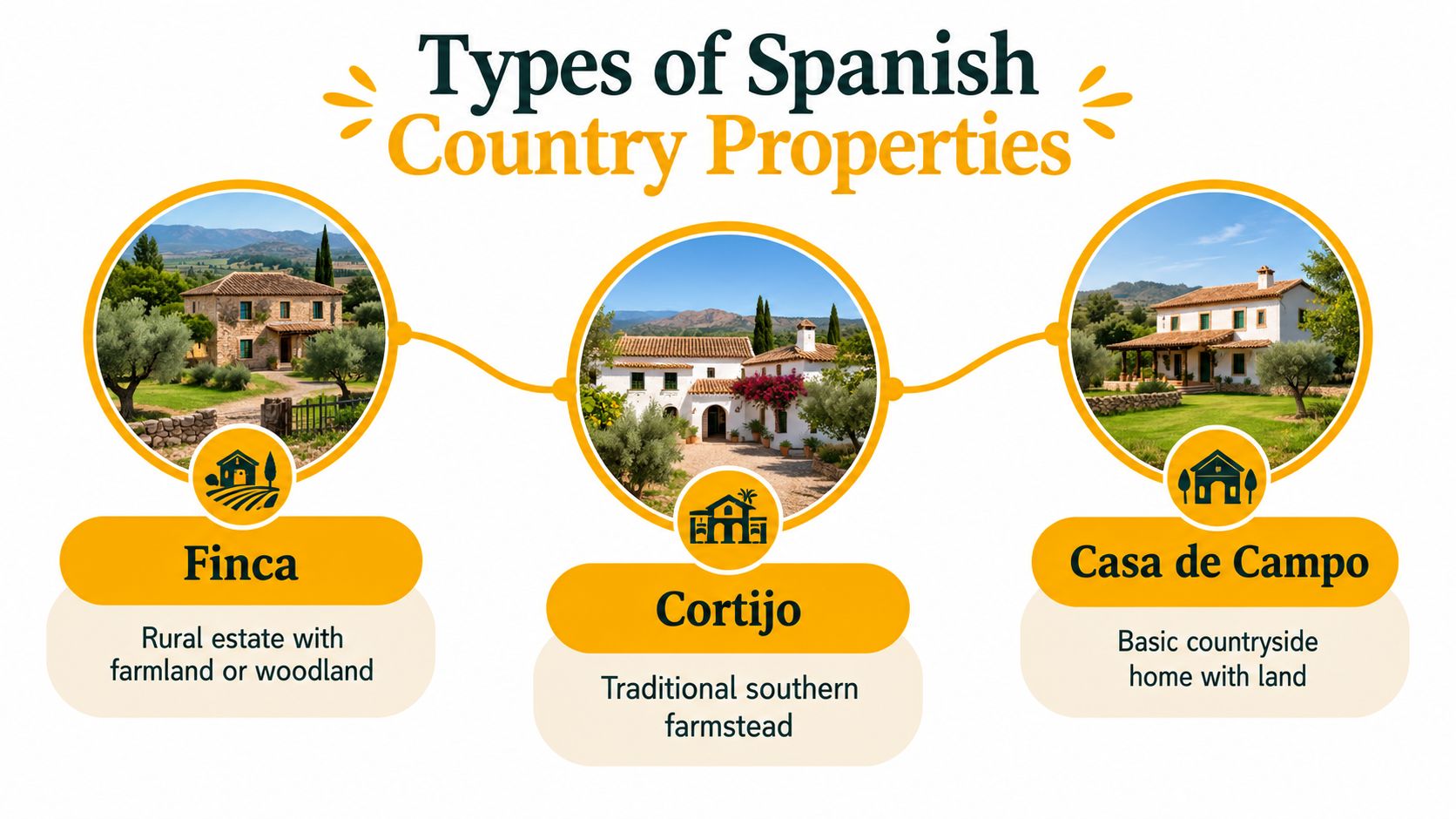
In everyday conversation, these terms usually mean the following:
- Finca: A rural property, often with land used for agriculture, recreation or open space around the home.
- Casa de campo: A country house. This is a broad, practical description rather than a precise legal category.
- Cortijo: More common in southern Spain as a traditional farmstead style. Buyers still see the term used loosely in marketing.
- Villa on rustic land: A more modern detached home that may still stand on non-urban land.
The trap is assuming the style word tells you what you can do with the plot. It doesn't.
Think of land as different containers
The simplest analogy is to treat land like three containers. From the outside, they may all hold a house. Inside, each container has a different rulebook.
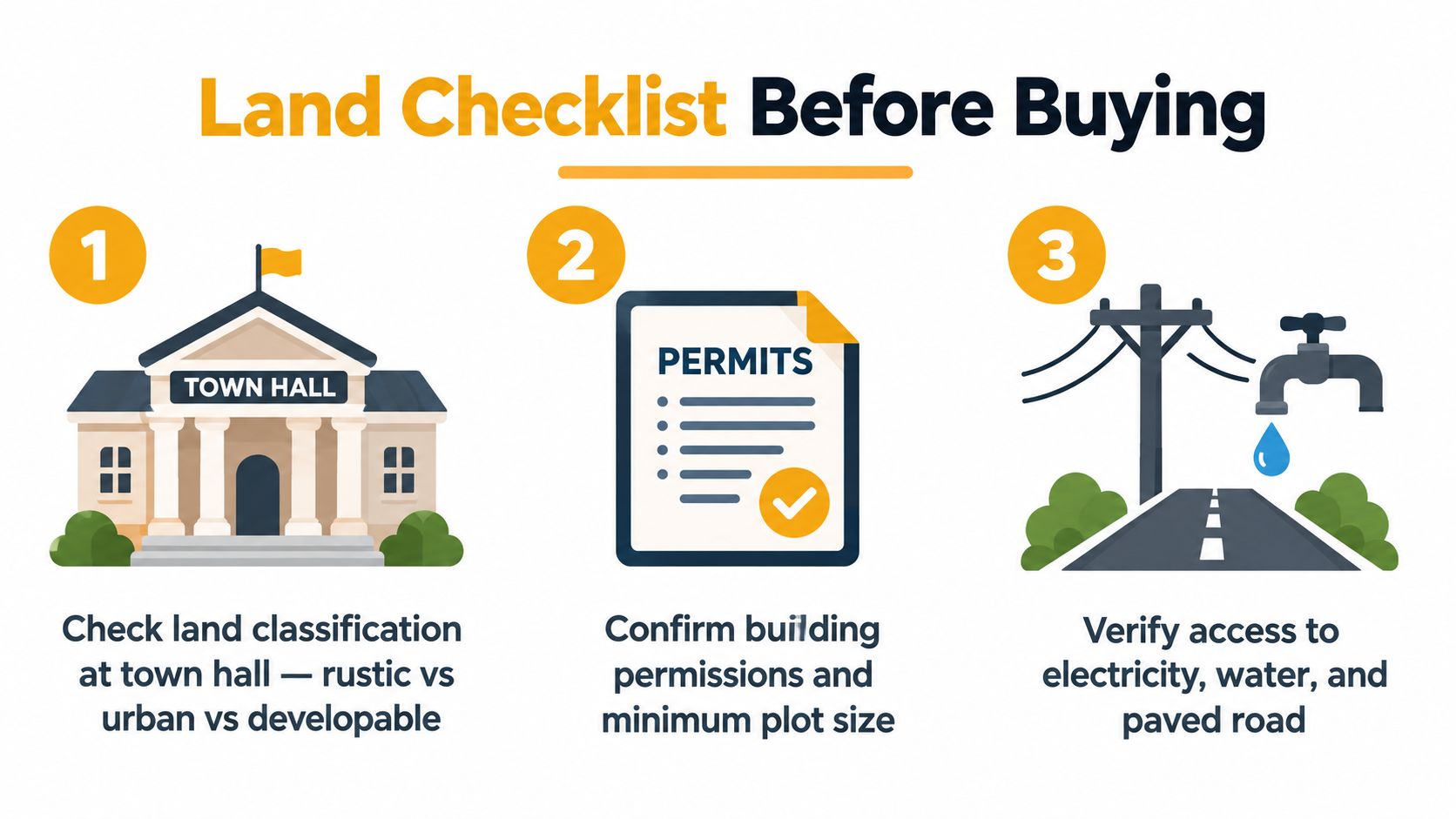
- Suelo rústico is rural land. It usually comes with tighter limits around building, enlarging, changing use or adding new structures.
- Suelo urbano is urban land. This is generally the category with clearer residential servicing and more standard planning expectations.
- Suelo urbanizable is developable land. That doesn't mean “build anything now”. It means the planning path depends on how the municipality has organised future development.
Practical rule: Buy for the use you can confirm today, not the use you hope might be possible later.
This distinction matters because consumer content often treats “land” as one product, when it isn't. A rural property on rustic land may suit peaceful living or hobby agriculture perfectly, yet be unsuitable for the kind of extension or redevelopment a buyer had in mind. That gap is one reason practical guidance matters more than lifestyle photography.
Match the land to the buyer intent
The three buyer intents usually line up like this:
Buyer intent | Most important question |
|---|---|
Lifestyle space | Can I live comfortably here with the access and services I need? |
Micro-farm use | Does the land and local reality support the activity I want? |
Future development optionality | What does the planning classification actually allow in writing? |
The broader rural-land market also appears to be shaped by more than just luxury second-home demand. The 2025 Cocampo report supported by MAPA, as summarised by Red PAC, points to growing participation by families and small investors, with interest extending to micro-farms and recreational rural properties (Cocampo 2025 report summary). That's why it helps to be very clear about your own motive before viewing anything.
Where to Search for Houses With Land Around La Romana and Costa Blanca
When buyers say they want Costa Blanca, they often mean very different things. Some mean sea views and walking distance to restaurants. Others mean a proper detached house, a broad plot, mountain backdrops and a local Spanish village feel.
If you want land, inland search areas usually deserve more attention than the headline coastal towns.
La Romana and the inland valley feel
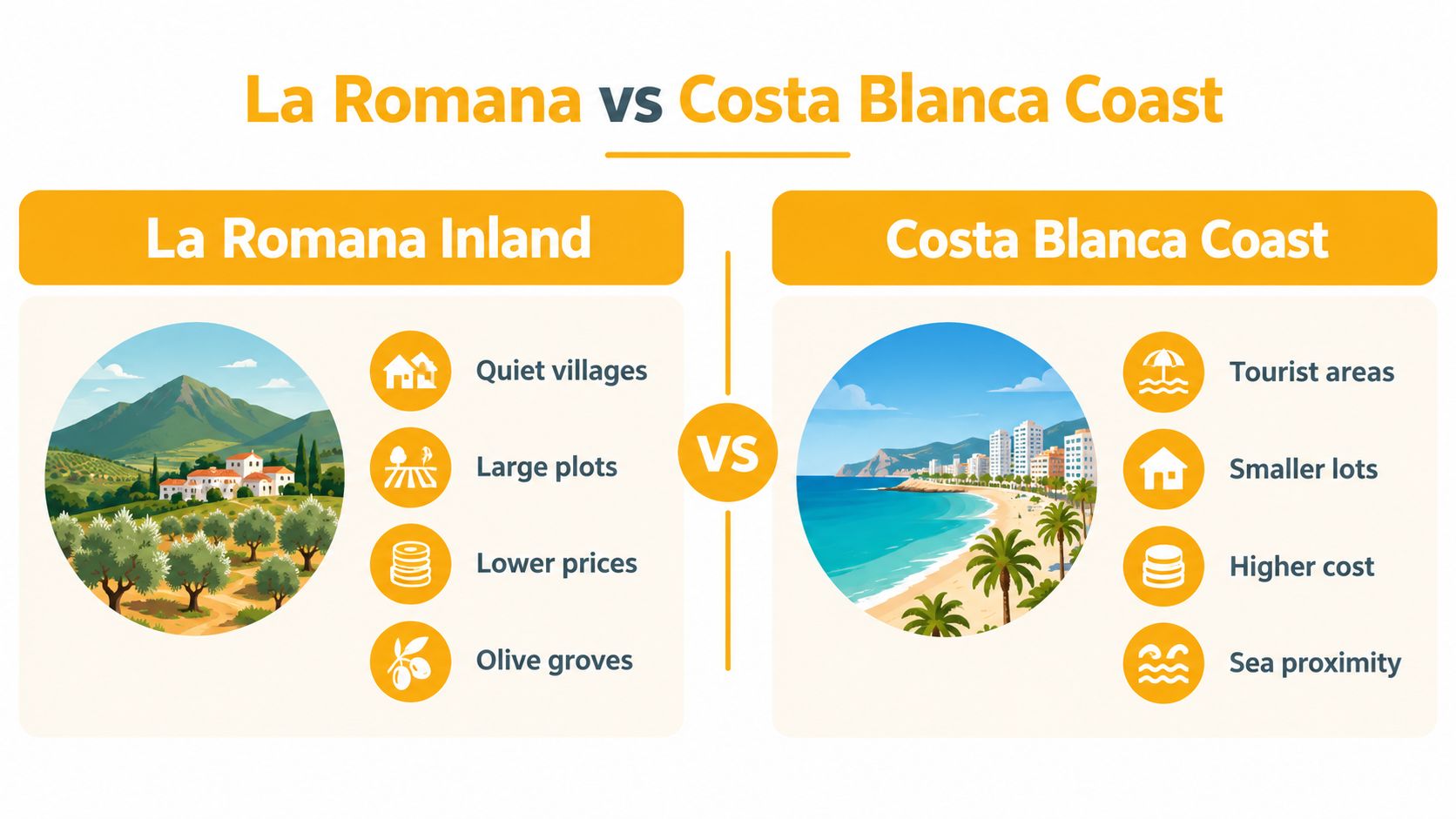
Around La Romana, buyers often find what the coast can't easily give them. More breathing room. Bigger plots. Vineyard and almond scenery. A steadier village rhythm. Homes here tend to suit buyers who care more about privacy, storage, outdoor living and countryside calm than being a few minutes from the beach.
Nearby inland areas such as Pinoso, Novelda and parts of the Vinalopó valley can appeal for similar reasons, although each micro-area has its own character. Some are more agricultural. Some feel more established with expatriate interest. Some are better for buyers who want a year-round local town nearby.
Coast versus inland in practical terms
The coast and the interior don't serve the same buyer.
- Choose inland if you want plot size, quiet surroundings, detached living and a more rural setting.
- Choose coastal zones if you need fast beach access, denser services and a more tourism-oriented environment.
- Stay flexible if you want a compromise. Some buyers accept a slightly shorter plot list to remain within easier reach of Alicante city or the airport.
Alicante province remains a very active market. Data cited for Q1 2026 shows 12,614 residential sales in the province, and it was described as the third-strongest province in Spain for sales volume during that period (Costa Blanca market report). That activity helps explain why buyers often need to narrow their map early rather than browsing the whole province at once.
Use the coast as a benchmark, not always the target
Coastal pricing can also help buyers frame inland value. In Alicante province, asking prices were reported at €2,802 per square metre in August 2026, with Playas at €3,767 per square metre and Zona Norte at €1,449 per square metre(Alicante market pricing on Indomio). Those figures don't price country houses directly, but they do show how quickly location shifts affect budget expectations.
When comparing areas, ask agents practical questions instead of broad ones:
- Access question: Is the final approach road fully comfortable in a normal car?
- Service question: Is the property suited to year-round use or mainly holiday use?
- Neighbourhood question: Are nearby homes occupied full-time, seasonally, or only occasionally?
- Land question: Is the land mostly ornamental, agricultural, sloped, fenced, or hard to maintain?
One grounded option for inland buyers is AP Properties Spain, which works across Costa Blanca and can help filter for fincas, plots and resale homes in areas around the Alicante interior rather than only high-traffic coastal stock.
Land Classification Planning Rules Utilities and Access Explained
A beautiful plot can still be the wrong purchase if the planning rules don't match your plans. Buyers get disappointed here more than anywhere else because they assume common sense will apply. In Spain, written planning status matters more than what seems reasonable on the ground.
What planning status really controls
Planning classification decides far more than whether a house exists. It can affect whether you can extend it, rebuild part of it, add structures, regularise older works, or use the land in the way you intended.
For rustic land purchases in Spain, legal and technical review needs to confirm the planning classification in writing from the town hall, because rights depend on whether the plot is suelo rústico, urbano or urbanizable. The same due diligence guidance also stresses that rural purchases often require reconciling multiple layers of information because records may disagree on size, form, access or built elements (Spain due diligence guidance from DLA Piper Realworld).
If the town hall position isn't confirmed in writing, treat every verbal assurance as provisional.
Common examples that confuse buyers
A few examples make this easier:
- Lifestyle buyer: You see a country house and want to enlarge the kitchen and add a guest suite. The key question isn't whether there's room on the land. It's whether the planning status allows that work.
- Micro-farm buyer: You want olives, chickens and storage for tools. The questions shift toward land use, water, access and whether any outbuildings are recognised.
- Optionality buyer: You hope the land could support another dwelling one day. That's the kind of assumption that must never be made from a listing description.
Utilities and access are part of the purchase
Rural buyers also need to think like operators, not just owners. In practice, comfort depends on ordinary things.
- Water: Is it mains water, deposit supply, irrigation access, or another arrangement?
- Electricity: Is it connected in a standard way and adequate for the home's actual use?
- Drainage: Is there sewer connection or septic?
- Internet: Can you work remotely without patchy service becoming a daily frustration?
- Road access: Is the road practical year-round, and is the right of way clear?
These aren't glamorous questions, but they shape daily life more than the view does after the first month.
Red flags in listings
Watch for wording that sounds attractive but vague.
Listing phrase | What to ask next |
|---|---|
“House with plenty of land” | What is the land classification and current permitted use? |
“Potential to extend” | Based on what written planning position? |
“Private access” | Is that legal access, registered access, or just current use? |
“Ideal for horses or farming” | Is that a practical opinion or a confirmed legal and technical fit? |
Due Diligence Title Checks and Legal Verification Before You Buy
The safest country purchase is usually the one that feels a little slower at the start. Rural property rewards patience. If a buyer rushes because the house is charming, the land often becomes where problems hide.
The key is to verify the property through four separate layers, then compare them.
The four-layer check
For rustic land purchases, professionals commonly reconcile at least these four records:
- Title deed
- Land Registry
- Cadastre
- Physical boundary on the ground
These layers often disagree. The deed may describe one area. The registry may show another. The Cadastre may draw a different shape. The fence may follow an older local understanding that doesn't match any document.
A fence tells you where people have been behaving as if the boundary sits. It does not always tell you what you are legally buying.
Start with the cheapest verification
One sensible first step is cadastral verification. In Spain, the Cadastre is an administrative register under the Ministry of Finance covering rural, urban and special-category properties. For rustic properties, the cadastral registration fee is EUR 3.20 per rural property, while urban or special properties are EUR 6.20 (Spanish Cadastre law text). That low cost makes it a practical early check, but it's only one piece of the full picture.
A working due diligence sequence
A careful buyer usually moves in this order:
- Lawyer first: Ask an independent lawyer to obtain and compare the legal records before any irreversible commitment.
- Survey or technical review next: If the plot, outbuildings or boundaries look complex, bring in a surveyor or architect early.
- Town hall confirmation: Get written confirmation on planning classification and relevant permissions.
- Site reality check: Walk the boundaries, access route and built elements with documents in hand.
- Habitability and use review: Confirm the home's practical legal status for occupation, utilities and intended use.
Not every purchase needs the same depth of technical work, but rural houses with land almost always need more than a standard apartment check.
Documents worth requesting
Ask for documents that answer specific risks, not just a pile of paperwork.
- Registry extract: To confirm ownership and registered charges.
- Cadastral information: To compare physical and tax description.
- Planning certificate or written municipal response: To clarify classification and buildability.
- Evidence for built elements: Especially if there are extensions, garages, pools, guest areas or storage buildings.
- Access information: If the road or entrance crosses neighbouring land.
If any major structure seems to exist only in real life, but not clearly on paper, pause and investigate. A pool, guest annexe or terrace may look minor to a seller. For a buyer, it can affect finance, insurance and resale.
Costs Taxes Fees and Financing Your House With Land Purchase
The listed price is only the beginning. For overseas buyers, the most common budget mistake isn't choosing the wrong house. It's underestimating the cash needed to complete comfortably.
That matters even more for homes with land, because lenders and valuers can take a more cautious view where rustic elements complicate the file.
The upfront money picture
Buying property in Spain usually means planning for more than the agreed price. A practical rule for many buyers is to expect around 10% for taxes plus several fixed fees, while non-resident financing commonly sits around 60% to 70% of the purchase price rather than the higher amount some buyers expect at home (cost guide for buying in Spain).
Here's a simple planning table for the Alicante area.
Cost Component | Typical Range or Note |
|---|---|
Purchase taxes | Often around 10% |
Fixed transaction fees | Additional fixed fees apply beyond tax |
Non-resident mortgage funding | Commonly around 60% to 70% of purchase price |
Buyer cash requirement | Usually substantially higher than the deposit alone |
Why foreign buyer affordability matters
Foreign demand isn't marginal in Spain. Reporting on the 2025 market states that foreign buyers reached almost 97,300 transactions, representing about 13.8% of all home sales, and Alicante had the highest foreign share among provinces at roughly 43% in 2025 (foreign buyer activity in Spain). That's one reason many international buyers focus on Alicante and Murcia first.
The same reporting also highlights a useful financing reality. Nearly 70% of non-resident mortgage applications are for properties under €200,000, while only 2.7% target homes above €500,000. In plain terms, many non-resident buyers remain highly price-sensitive even in a busy market.
What that means for houses with land
Country houses can stretch budgets in less obvious ways:
- Valuation caution: A lender may be more conservative if the property includes rustic land issues, non-standard buildings or unclear legalisation history.
- Insurance questions: Insurers may want clarity on use, access and construction details.
- Renovation cash: If the house needs updating, buyers often need separate funds because mortgage coverage may not solve everything.
- Running costs: Large plots usually mean more maintenance, even if the purchase price felt attractive.
Budget for the property you can complete, insure and maintain. Don't budget only for the property you'd like to win.
Renovation Permitted Uses and Working With Local Professionals
Once the purchase is clean, the next question is usually what you can change. The three buyer intents return in a practical way.
A lifestyle buyer may want a better kitchen, terraces and a pool area. A micro-farm buyer may care more about irrigation, fencing, storage and shade. An optionality buyer may be thinking about future restructuring. The legal answer depends less on taste and more on the land status and the existing paper trail.
Renovation usually works best when it is modest and documented
On urban land, renovation paths are often more familiar to international buyers. On rustic land, works may still be possible, but the scope can be narrower and the need for technical guidance becomes more important. The most common mistake is assuming that because a structure already exists, any improvement or enlargement will be treated as routine.
If a house has older additions, don't start by asking a builder what can be done. Start by asking a lawyer and architect what is recognised and what route applies.
The right local team saves more than money
A solid team usually includes:
- An independent lawyer for title, planning and contract protection
- An architect or technical professional for buildability, drawings and legalisation questions
- A surveyor when boundaries are sensitive
- A reliable builder once the permitted scope is clear
Buyers moving from abroad often need that team coordinated in English and in a way that fits remote decision-making. That matters in inland Alicante, where the difference between a lovely country house and a difficult one often sits in documents that need local interpretation.
A good purchase in this segment feels calm by the time you complete. You know what the land is for, what the house can become, and which works are realistic without guesswork.
If you're searching for a country home around La Romana or elsewhere on the Costa Blanca, AP Properties Spain helps international buyers narrow the right areas, assess houses with land, and coordinate the local professionals needed for a careful purchase. If you want guidance that connects location, land status, financing and renovation reality, it's a practical place to start your search.
Share