






What Is Due Diligence Period in Real Estate: Spain
The due diligence period in a Spanish property purchase typically lasts 2–4 weeks after the reservation, giving your lawyer time to verify title, debts, and planning compliance before you sign the binding arras contract. Broader conveyancing commonly takes 6–12 weeks, with completion often scheduled 60–90 days after signing. (F&L Jordan)
You may be looking at a villa near La Romana, an apartment on the Costa Blanca, or a finca inland from Alicante. The viewing went well, the seller wants a quick answer, and an agent is asking you to reserve the property before another buyer appears. That pressure is understandable, but it's also where international buyers make their most expensive mistake: treating the reservation, legal investigation, and binding purchase contract as if they were the same step.
They aren't. The reservation takes the property off the market. Due diligence tests whether it's legally safe to buy. The contrato de arras creates a much stronger financial commitment. If you sign in the wrong order, a deposit that felt temporary can become difficult to recover.
Understanding the Due Diligence Window
A Spanish due diligence period is the protective investigation between reserving a property and committing to the binding purchase contract. During this window, your independent lawyer examines the property's legal, financial, planning, and documentary position. The aim isn't to confirm that the house looks attractive. It's to establish that the seller can transfer what you think you're buying, without hidden charges or unresolved legal problems.
For most standard purchases, the working window is around 2–4 weeks. The lawyer checks the Land Registry, debts, planning compliance, and supporting documents before you become fully committed.
That distinction matters in La Romana and across the Costa Blanca. A property may have been advertised for years as a “legal villa”, yet contain an extension that doesn't match the registered or cadastral information. A rural home may look complete while lacking the planning status needed for its intended use. An apartment may appear straightforward while carrying community arrears or restrictions that affect renovation or letting.
What the lawyer is trying to establish
Your lawyer should answer four practical questions:
- Who owns the property? The seller must have authority to sell, and the registered ownership must correspond with the person or entity signing.
- What burdens follow the property? Mortgages, embargoes, liens, unpaid community charges, tax debts, and utility arrears need to be identified and resolved.
- Does the physical building match the paperwork? Registry records, Catastro information, licences, plans, and the actual construction should tell the same story.
- Can you use the property as intended? Planning restrictions, occupancy documents, and local regulations may affect habitation, alterations, rentals, or resale.
The Spanish Government's guidance on buying property in Spain highlights ownership, charges, and planning-law proceedings as important pre-completion risks. Your lawyer shouldn't treat due diligence as a formality. It's the stage where you decide whether the property deserves your money.
Practical rule: Never let the seller's deadline replace your lawyer's verification deadline.
A clean result doesn't mean the property has no maintenance issues. It means the legal and documentary position is understood, the risks are priced or corrected, and your contract reflects what the investigation discovered. If the documents don't align, slow down. A longer review is cheaper than inheriting someone else's problem.
The Spanish Property Transaction Timeline
The Spanish sequence is easier to manage once you separate the four stages. Buyers usually get into trouble because they hear “deposit” and assume every payment has the same legal effect.
Reservation
The reservation agreement is normally the first commitment. You pay an agreed amount so the seller removes the property from the market while the parties prepare the next stage. The document should state who holds the money, when it can be returned, the deadline for legal checks, and what happens if the lawyer finds a material problem.
The reservation period is commonly around 2–4 weeks, which gives the buyer's lawyer time to carry out the core investigation while the seller keeps the property off the market. (Waypointsur conveyancing guidance)
Due diligence
This is the investigation itself, not merely a waiting period. Your lawyer obtains and reviews the Nota Simple, checks debts and charges, compares registry and cadastral information, contacts the relevant municipality where necessary, and requests supporting certificates. For an uncomplicated property, the work may fit the reservation window. A rural, older, or irregular property may need more time.
Some Spanish conveyancing guidance describes due diligence as taking 1–5 weeks, depending on complexity and municipal response speed. (Waypointsur conveyancing guidance)
Contrato de arras
The arras contract is the private purchase agreement that normally follows satisfactory legal checks. It sets the price, identifies the property, records the completion deadline, and establishes the consequences if either party fails to proceed. Market practice commonly places completion 30–60 days after arras, while mortgage-funded purchases are also often structured around 30–90 days. (Costa Luz Lawyers)
This is the point at which your exposure changes sharply. Don't sign arras because the reservation period is ending. Sign when your lawyer has either confirmed the property is acceptable or documented the specific risks and negotiated protection for them.
Notary completion
Completion takes place when the parties sign the public deed before a Spanish notary and the balance is paid. Broader conveyancing commonly runs 6–12 weeks from start to finish, and completion is often set 60–90 days after signing, depending on the transaction and financing. (F&L Jordan)
The notary is not a substitute for your own due diligence. The notary formalises the transaction. Your lawyer must protect your decision before you reach that desk.
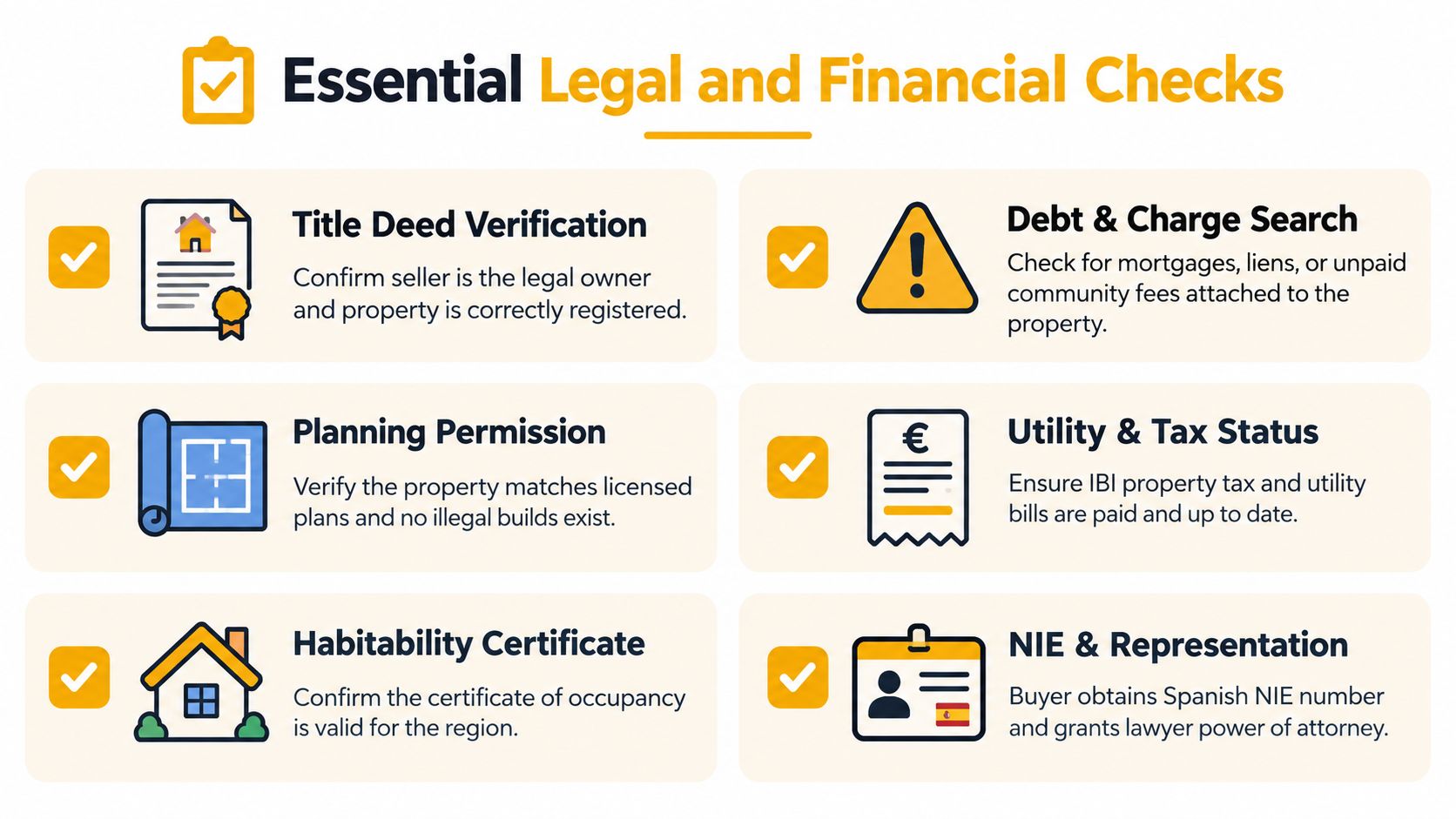
Essential Legal and Financial Checks
A viewing tells you whether you like the property. It doesn't tell you whether the property can be transferred cleanly. The legal investigation should be documentary first, then technical and municipal where the property requires it.
Start with the Nota Simple
The Nota Simple from the Land Registry identifies the registered owner and shows mortgages, embargoes, liens, easements, and other charges recorded against the property. Your lawyer should obtain an updated extract rather than relying on a copy supplied casually by the seller or agent.
The name on the Nota Simple must match the seller's identity or corporate authority. The description should also correspond with the property you're purchasing, including the relevant dwelling, plot, storage areas, garages, and other registered elements.
Cross-match the records
The most valuable check is not reading one document in isolation. It's comparing:
- Land Registry data: Ownership, registered description, charges, and legal burdens.
- Catastro data: Cadastral reference, mapped boundaries, surface information, and tax identification.
- Physical property: The walls, terraces, extensions, pools, outbuildings, boundaries, and access you inspected.
- Municipal records: Planning permissions, licences, infringement proceedings, and occupancy documentation.
A mismatch doesn't automatically make a purchase impossible. It does mean you need an explanation, supporting evidence, and a contract strategy. A terrace shown in the marketing photographs but absent from the legal records should never be treated as an incidental detail.
Check debts and ongoing obligations
Your lawyer should request evidence concerning community fees, IBI, taxes, and utilities. Community debt can affect the buyer because the community may have rights connected to the property. Unpaid IBI or utility balances also need to be identified and allocated clearly before completion.
For a flat or townhouse, ask for the community debt certificate, current community charges, pending extraordinary works, and relevant rules. These documents can reveal obligations that don't appear during a viewing.

Factor in financing
Non-resident buyers commonly face mortgage limits of 60–70% loan-to-value, and Spanish mortgage transparency rules require loan documentation to be delivered at least 10 days in advance. (Wise guide to conveyancing in Spain)
That financing milestone must fit the contract timetable. Don't assume a bank's initial indication is the same as a formal approval. Your lawyer and mortgage adviser should coordinate the valuation, offer, documentation, and completion date so you're not pushed into signing while a key condition remains unresolved.
The principle is simple: every promise about the property must become a document, a certificate, a contract clause, or a condition of completion. Verbal reassurance is not a legal remedy.
Navigating Complex and Rural Properties
A modern apartment with a clear registry description is not the same legal project as an older finca near La Romana. The common mistake is applying a standard fast-track timetable to a property whose history requires municipal and technical investigation.
Rural and older homes can contain extensions, pools, terraces, garages, agricultural buildings, or converted spaces that developed over time. The building may be physically sound but legally incomplete. The cadastral record may not match the Land Registry. The seller may have lived there for years without resolving planning questions that become your problem after purchase.
The extra checks that matter
For a complex property, ask your lawyer and technical professional to consider:
- Catastro mismatches: Compare mapped boundaries, surface areas, and registered structures with the physical property.
- Planning infringements: Establish whether the Town Hall has opened proceedings or recorded an unresolved violation.
- First-occupation status: Confirm that the property has the required documentation for occupation in its municipality and region.
- AFO status: Where applicable, verify whether the property has recognised asimilado a fuera de ordenación status and understand its consequences.
- ITE or IEE reports: Older buildings may require building inspection documentation covering condition and safety.
- IBI and community records: Confirm tax status and obtain certificates for any community obligations.
- Updated Nota Simple: Use current registry information, especially where ownership, inheritance, or alterations may have changed.
Spain-specific legal guidance identifies these issues as particularly relevant to older, rural, and legally complex properties. (Diez Bespoke guidance on legal due diligence in Spain)
Why speed can destroy value
Municipal responses don't always arrive on the timetable preferred by a seller. A lawyer may need to request planning information, while an architect or surveyor compares the built property with approved plans and local records. If the property is rural, the plot and permitted use may matter as much as the house.
The safest due diligence period isn't always the shortest one. It's the period long enough to answer the questions that affect ownership, use, financing, and resale.
If the seller insists on signing arras before the municipality or technical consultant has answered material questions, negotiate a specific condition instead of accepting a vague promise. The clause should identify the issue, the evidence required, the deadline, and the buyer's right to recover the reservation or exit if the condition fails.
A longer investigation can preserve value. It may uncover a problem that allows you to renegotiate, require the seller to regularise the property, or walk away before you acquire an asset with restricted use. For a rural Costa Blanca purchase, patience is not indecision. It's risk control.
Contract Clauses and Financial Exposure
The reservation agreement and the contrato de arras serve different purposes. Treating them as interchangeable is dangerous, particularly when the reservation money has already been paid and the seller presents a prepared arras contract.
A typical Spanish reservation deposit is often described as €3,000–€6,000. It's usually refundable if due diligence reveals a legal problem that makes the purchase unsafe, and it's normally credited towards the purchase price if you proceed.
That protection depends on the wording. The agreement should say that the reservation is conditional on satisfactory legal, planning, documentary, and, where relevant, technical due diligence. It should also state how the refund is triggered and how quickly the money must be returned.
Reservation versus arras
Feature | Reservation Agreement | Contrato de Arras |
|---|---|---|
Main purpose | Temporarily removes the property from the market while checks are completed | Records the private purchase commitment before notary completion |
Typical exposure | Usually limited if the agreement includes a clear due diligence refund clause | Substantially higher because withdrawal can trigger contractual consequences |
Timing | Commonly used before the core legal investigation is complete | Normally signed after the buyer's lawyer has reviewed the property |
Buyer protection | Must expressly cover title, debts, planning, documentation, and financing where relevant | Must define conditions, completion date, default consequences, and remedies |
Deposit treatment | May be returned if a material legal defect makes purchase unsafe | Usually forms part of the purchase price, subject to the contract terms |
Recommended action | Reserve only with written due diligence and refund conditions | Sign only after legal clearance or carefully negotiated conditions |
Arras contracts often use penitential terms, under which the consequences of withdrawal are defined in the agreement. If the buyer fails to proceed without a contractual basis, the deposit may be lost. If the seller fails to proceed, the buyer's remedies can be different. Your lawyer must explain the exact clause you're signing, not just call it “standard”.
Clauses worth insisting on
- Due diligence condition: The purchase remains conditional on satisfactory legal and planning review.
- Defect definition: The contract identifies what counts as a material issue, rather than leaving the phrase open to argument.
- Document deadline: The seller must provide missing certificates and records by a clear date.
- Refund mechanism: The agreement explains who returns the money, when, and under what evidence.
- Financing protection: If finance is essential, the contract reflects the relevant approval or valuation risk.
- Completion flexibility: The timetable allows outstanding municipal or lender documentation to arrive.
Never sign a reservation document that says the money is non-refundable “in all circumstances” if your lawyer hasn't yet checked the property. Never sign arras because the estate agent says the clause is routine. Standard wording protects the party that drafted it. Your lawyer protects you by changing it where the risk demands it.
Securing Your Investment with Expert Guidance
The answer to what is due diligence period in real estate is not a number of days. In Spain, it's the controlled gap between interest and legal exposure. You reserve the property, investigate the records, resolve or price the risks, and only then decide whether the arras contract reflects a safe purchase.
Use a written transaction calendar. Mark the reservation deadline, the date by which the Nota Simple and debt certificates must be reviewed, the municipal and technical enquiries still outstanding, the financing milestones, and the proposed arras and completion dates. Give every open issue an owner. Your lawyer handles legal verification, your architect or surveyor handles technical matters, and your mortgage adviser handles lending requirements.
A buyer's final decision test
Before signing arras, you should be able to answer yes to these questions:
- Ownership: Does the seller own the property being offered?
- Charges: Are mortgages, embargoes, liens, community debts, taxes, and utilities identified and allocated?
- Consistency: Do the Land Registry, Catastro, municipal records, and physical property correspond?
- Use: Can you legally occupy, renovate, rent, or use the property as intended?
- Contract: Does the agreement protect you if an unresolved material defect appears?
- Finance: Are your funding conditions and deadlines realistic?
AP Properties Spain can coordinate the buying process for international clients, including local area guidance, negotiations, legal coordination, and completion support. Its service may be useful alongside an independent Spanish property lawyer, particularly when a buyer needs help organising documents and understanding the practical sequence across the Costa Blanca and Costa Cálida.
The right purchase isn't the one that reaches the notary fastest. It's the one that reaches the notary with the ownership, planning position, debts, documents, and contract protections properly understood. If a seller won't allow reasonable time for that work, treat the pressure as information.
If you're considering a property in La Romana, Alicante, or elsewhere on the Costa Blanca and want the buying process organised around proper legal checks, speak with AP Properties Spain. The team can help you assess the property, coordinate the relevant professionals, and move towards completion with a clear understanding of your contractual and documentary risks. Visit AP Properties Spain to start the conversation.
Share