





How to Buy Land in Spain: A Practical Guide
Most advice on how to buy land in Spain starts with finding a plot, agreeing a price and signing a deposit contract. That sequence is backwards. On the Costa Blanca, the decisive question isn't whether you can legally own the land. It's whether the land can support the home you want, under the planning rules that apply to that exact plot.
Foreign buyers can generally purchase land in Spain, but a valid purchase doesn't guarantee a building permit. Coastal plots, protected areas and rural parcels can carry restrictions that make a luxury villa impossible, regardless of the quality of the views or the seller's promises. Buildability, rather than ownership, is often the real legal bottleneck.
The safest approach is simple. Treat the plot as a planning project before treating it as a property purchase. Verify its classification, boundaries, title, taxes, access, services and development parameters before paying a deposit. This is especially important around La Romana, Alicante and the wider Costa Blanca, where a rural-looking parcel may have very different rights from an urban plot a short distance away.
The Reality of Land Ownership and Buildability
Buying land isn't necessarily easier than buying a house. In some respects, it's more dangerous because a completed home gives you a visible structure to inspect, while a plot's value depends on permissions that may not be obvious from the land itself.
A seller may describe a parcel as “buildable”, “urban” or suitable for a villa. Those descriptions have no value unless the relevant town hall confirms the planning position. The local urban classification controls whether construction is permitted, what type of dwelling may be built, the permitted footprint, building height, setbacks, access requirements and the availability of infrastructure.
Practical rule: Never confuse a purchase opportunity with a construction opportunity.
This distinction matters across the Costa Blanca. A plot near the coast may be affected by coastal protection rules, environmental designations or specific municipal planning restrictions. A parcel in a protected zone may be perfectly capable of changing ownership while remaining unavailable for residential development. Buying it successfully doesn't change that planning reality.
Ask the town hall before you commit
Your lawyer or planning professional should obtain written confirmation from the municipal planning department, not rely on an estate listing or an informal telephone conversation. Ask for the plot's current urban classification and the planning parameters that apply to it.
The written review should address:
- Permitted use: Confirm that residential use is allowed, rather than agricultural, conservation or another restricted use.
- Development capacity: Establish the permitted building area, footprint, height and required setbacks.
- Access: Check whether the plot has legally recognised access from a public road.
- Services: Verify how water, electricity, sewage and telecommunications can be connected.
- Restrictions: Identify protected-land rules, easements, road reservations and other limitations.
- Planning status: Confirm whether the municipality requires further urbanisation or infrastructure works before a licence can be issued.
A plot can look ideal for a villa, pool and guest accommodation yet fail one of these tests. The planning file, not the view, determines the result.
Buildability must match your intended use
Don't ask only whether “a house” can be built. Ask whether the rules support the specific project you want. A primary residence, holiday home, swimming pool, detached garage, retaining walls and rental configuration may each trigger different technical or planning requirements.
For an international buyer, local advice is where it earns its fee. Before signing, prepare a short project brief with the approximate house size, number of bedrooms, pool, parking, terraces and intended use. Give that brief to the architect or planning consultant so they can test the plot against your actual objectives.
Verifying Boundaries and Legal Title
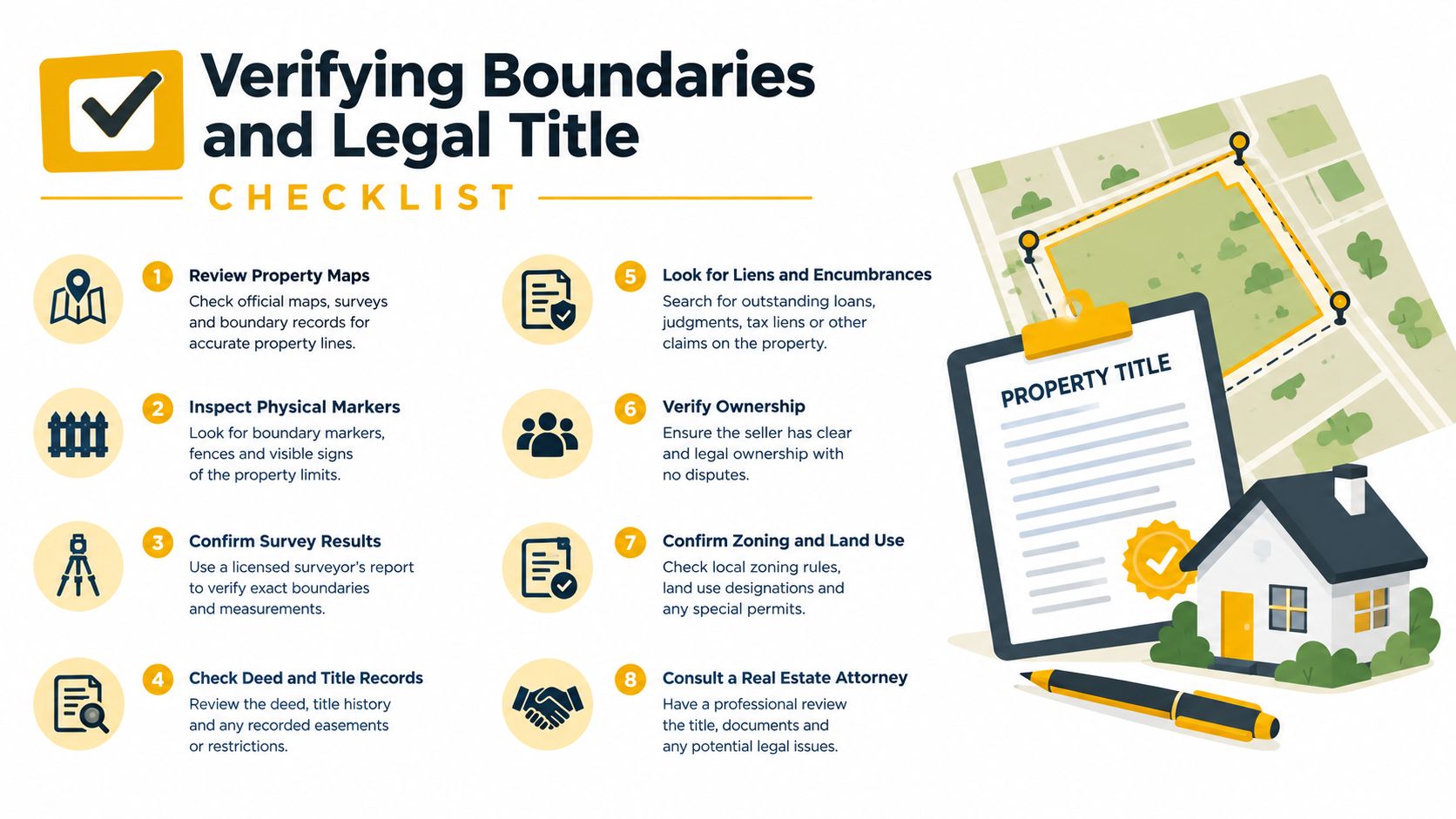
Before any deposit changes hands, compare the physical plot with Spain's two principal property records. The Cadastrerecords the parcel's physical and fiscal information, while the Registro de la Propiedad records legal ownership and registered rights. They can differ, so reviewing only one is poor protection.
Start with the registered title
Request a current nota simple and have an independent Spanish property lawyer review it. The document should identify the registered owner, describe the property and disclose registered charges or rights affecting it.
Check the following against the seller's documents:
- Registered owner: The name on the title must match the person or company selling the land.
- Surface area: Compare the registered area with the cadastral area and the seller's description.
- Boundaries: Check adjoining plots, roads, paths and natural features.
- Liens and mortgages: Establish whether charges must be cancelled before completion.
- Easements: Look for rights of way, water rights, utility corridors and access obligations.
- Litigation annotations: Identify any recorded disputes, embargoes or pending claims.
- Ownership shares: Confirm that every required owner will sign the transaction.
- Cadastral reference: Ensure the reference number relates to the exact parcel being sold.
The Cadastre and Land Registry cross-check should happen before you sign the escritura pública. It's not an administrative formality. It's how you establish that the land you visited is the legal property you're buying.
Match the documents to the ground
Maps can reveal discrepancies that paperwork alone won't explain. Walk the boundaries with the cadastral plan, compare fences and walls with the mapped lines, and identify any apparent occupation by neighbours. If the parcel is large, irregular or rural, commission a topographical survey from a qualified professional.
A survey can expose encroachments, access problems, boundary shifts and differences between the advertised area and the legally recorded area. It can also help the architect assess levels, retaining requirements and the practical position of a future building.
The seller's boundary fence is evidence of occupation, not proof of legal ownership.
Don't accept a promise that a discrepancy will be corrected after completion. If the area, access or title needs clarification, make the purchase contract conditional on resolving it. A private contract should identify the land precisely, include the cadastral reference, and state what happens if the title or planning review fails.
Navigating Urban Versus Rustic Land Classifications
Spanish land classification determines whether you can build, what you can build and which approvals you'll need. The labels matter, but the municipality's detailed planning rules matter more. Two plots that appear similar from the road can have entirely different development potential.
Urban land, or suelo urbano, generally sits within an established settlement and may have a clearer route towards residential development. That doesn't mean every urban plot is immediately ready for construction. It may still need confirmation of frontage, access, utilities, building alignment, development intensity and any outstanding urbanisation obligations.
Rustic land, known as suelo rústico or suelo no urbanizable, is governed by restrictive national and regional rules. Protected rural land cannot be built on. Where construction is permitted, it may depend on agricultural use, visual or environmental controls or a minimum plot size such as 10,000 m², as explained in guidance on Spanish rural land and building restrictions.
Feature | Urban Land (Suelo Urbano) | Rustic Land (Suelo Rústico) |
|---|---|---|
Typical setting | Established urban area or settlement | Countryside, agricultural area or protected landscape |
Residential construction | May be possible if municipal parameters are satisfied | Restricted, conditional or prohibited |
Minimum plot | Determined by local planning rules | May include requirements such as 10,000 m² |
Utilities | Often closer, but connection must be verified | May be distant, unavailable or costly to connect |
Planning risk | Focuses on permitted design and infrastructure compliance | Focuses on protection, use, minimum area and exceptional permissions |
Best buyer approach | Obtain a written planning certificate before signing | Treat buildability as unproven until the town hall confirms it |
Don't let “rustic” become a lifestyle sales pitch
Rustic land can be attractive because it offers space, privacy and open views. Those qualities don't create residential rights. Rural parcels may also contain existing buildings, agricultural installations or pools that were built without the permissions required for lawful residential use.
Ask the town hall to confirm the classification in writing and whether the intended dwelling is permitted. If there's an existing construction, verify its planning and registry status separately. A building shown on a cadastral map isn't automatically a legal home.
La Romana requires a project-led review
For buyers looking around La Romana and inland Alicante, the plot should be assessed against the future building rather than bought as a blank canvas. Topography, road access, water supply, electricity, drainage and protected-land rules can influence the design and budget from the outset.
If a seller says permission “should be fine”, pause the transaction. A suitable plot has a documented planning route. An attractive plot with an undocumented route is speculation.
Budgeting for Taxes and Closing Costs
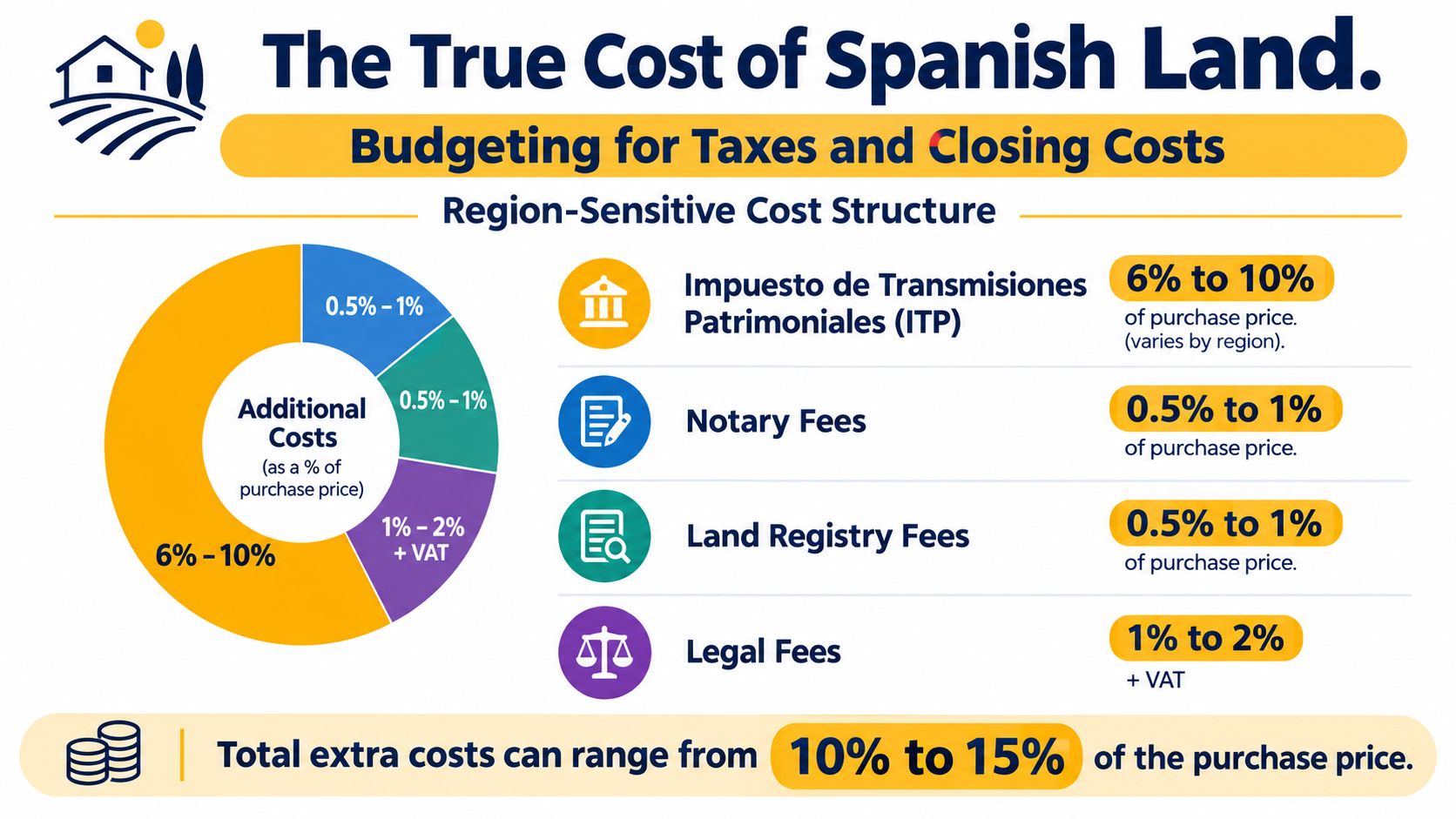
The advertised land price is only one part of the acquisition budget. Spanish transactions combine regional taxes with notary, Land Registry and professional costs, so your lawyer should prepare a written completion estimate before you commit.
For development land and other taxable transfers, VAT can apply at 21%. Rural or non-developable land is generally exempt from VAT and instead subject to transfer tax, which usually ranges from 6% to 11%, depending on the autonomous community. Confirm the treatment for the exact seller, land classification and transaction structure rather than assuming that every plot follows the same rule. The Spanish land registration process and tax sequence provides useful context for how these obligations fit together.
Build a complete cost stack
The main hard costs are transfer tax, VAT or AJD where applicable, notary fees and Land Registry fees. Buyer-side closing costs commonly land around 10% to 14% of the purchase price, depending on the region, property type and financing arrangements, according to this guide to taxes for foreign buyers.
Published buyer guidance places notary fees around 0.2% to 0.5% and Land Registry fees around 0.1% to 0.25% of the purchase price, before VAT, copies and additional deed work. The final invoice may also include legal review, power of attorney, bank charges, translation, surveying and planning reports.
Budgeting rule: Keep the tax estimate separate from the construction budget. Buying the land doesn't fund the surveys, design, licence, connections or build.
Confirm the taxable base
Regional tax calculations may use the administration's valuation rather than only the agreed sale price. A government guide to buying property in Spain notes that taxes are charged on the council's valuation, which buyers can check using the cadastral reference number.
Ask your lawyer to confirm:
- Which tax applies to the transaction.
- The taxable base used by the regional authority.
- Whether VAT or transfer tax is payable.
- Whether AJD applies.
- When payment must be made.
- Which costs are included in the completion statement.
Currency exchange deserves attention too. Arrange the funds early, use a clear audit trail and avoid transferring money based solely on an email instruction. Your lawyer should confirm bank details through a trusted channel before any payment.
Executing the Legal and Administrative Steps
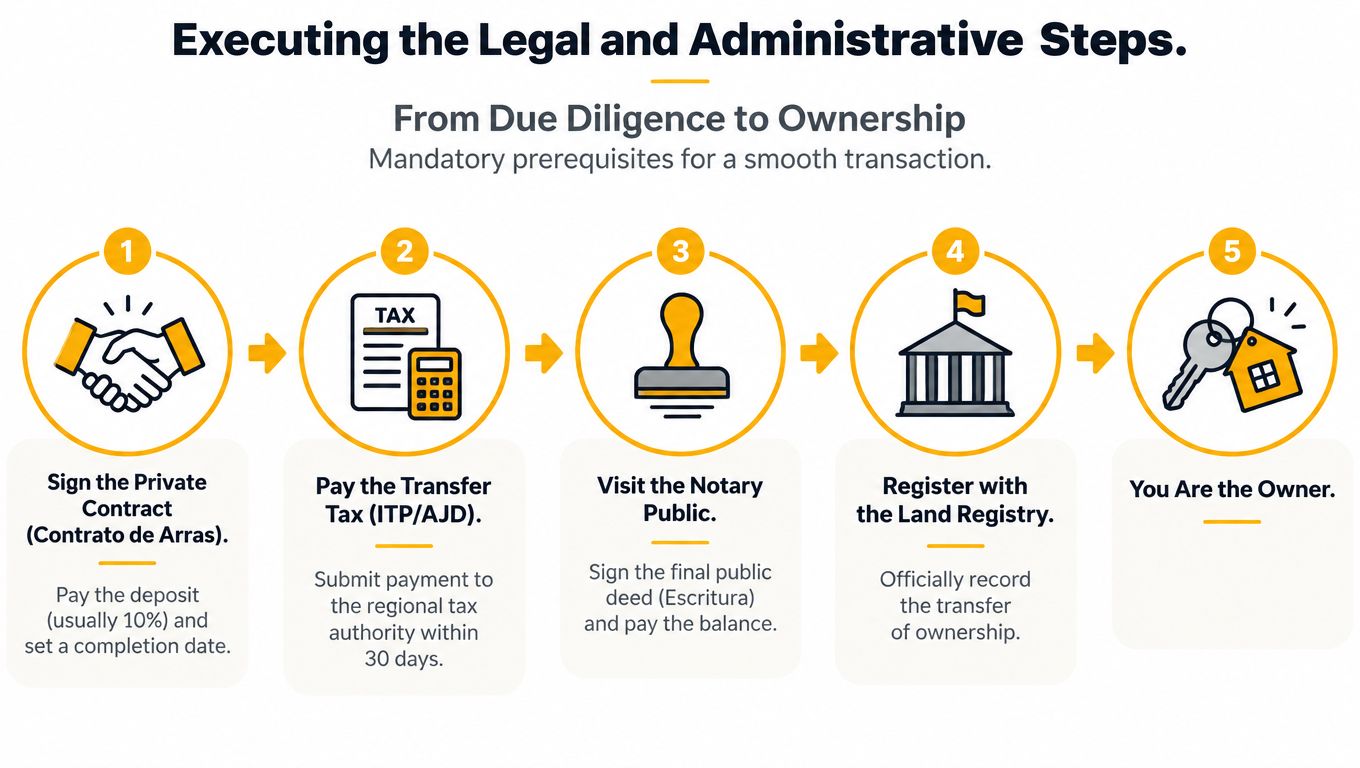
The Spanish purchase process follows a recognised legal sequence, but the order still matters. Obtain your identification, complete due diligence, agree the contract, sign before a notary, pay the applicable taxes and register the title.
Secure the NIE and payment arrangements
Foreign buyers generally need a NIE, the Número de Identidad de Extranjero. It's used for the purchase, tax payments, Land Registry registration and Spanish banking, and the notary won't authorise the escritura without an NIE for every adult appearing on the title. NIE and bank-account guidance for property buyers explains why this should be handled early.
A Spanish bank account is commonly needed in practice for the purchase price, taxes, notary fees, utilities and other ongoing payments. Guidance on the practical steps for foreign buyers also highlights the importance of having an acceptable payment instrument or proof of funds available at completion.
Follow the legal sequence
- Due diligence first: Your lawyer confirms title, planning, boundaries, access, taxes and contractual conditions.
- Private contract: If the checks are satisfactory, the parties sign a private contract, often called contrato de arras, with the deposit and completion terms.
- Public deed: The buyer and seller execute the escritura pública before a Spanish notary. The notary formalises the transaction, but your lawyer should have protected your interests before signing.
- Tax payment: Pay the relevant tax within the applicable regional deadline and retain the receipt.
- Land Registry: Submit the deed for registration. Registration is typically completed in about three weeks, while operational guidance commonly places filing within 15 to 30 working days after signing
Registration is the final protection against third-party claims in the normal purchase workflow. Don't treat the notary appointment as the end of the matter. Obtain evidence that the deed has been submitted and later confirm that inscription is complete.
Post-Purchase Development and Local Partnerships
Buying the plot is the beginning of the build, not the conclusion of the property search. Before an architect fixes the design, commission a topographical survey and a geotechnical survey. The first maps levels, boundaries and site geometry. The second helps the design team understand ground conditions and foundation requirements.
Those reports can change the house you're able to build economically. Sloping land may require retaining structures. Difficult ground may affect foundations. Limited access can influence excavation, deliveries and crane placement. A good architect needs this information before finalising drawings, not after the budget has been set.
Build the right local team
A successful self-build normally requires coordinated input from:
- A local architect: Develops the project and aligns it with municipal rules.
- A geotechnical and topographical team: Supplies the site information the architect and engineer need.
- A Spanish property lawyer: Protects the purchase and reviews planning and title issues.
- A builder: Prices the approved design and confirms practical site requirements.
- A town-hall contact: Clarifies applications, technical documents and planning conditions.
- A project coordinator: Keeps decisions, approvals, contractors and deadlines aligned.
Choose professionals who work regularly in the municipality where the plot sits. Planning practice is local, and a team familiar with one town may not understand the procedures or interpretations used in another.
AP Properties Spain can help international buyers assess plots, coordinate legal checks and connect the purchase with local architects and builders across the Costa Blanca and Costa Cálida. Its role is most useful when the buyer needs one organised point of contact for property selection, negotiations, planning coordination and later renovation or construction support.
The best land purchase is not the cheapest parcel or the most dramatic view. It's the plot with a verified title, confirmed boundaries, a realistic planning route and a development budget that survives professional scrutiny.
If you're evaluating land around La Romana, Alicante or elsewhere on the Costa Blanca, speak with AP Properties Spain before paying a deposit. The team can help you assess the plot's planning potential, coordinate the right local professionals and guide the transaction through to a secure completion, so visit AP Properties Spain to discuss your requirements.
Share