






Sea View Villa Spain for Sale: A Complete Buyer's Guide
You've found a villa with a terrace facing the Mediterranean, attractive photographs, and an asking price that seems just within reach. Then the practical questions start. Is the sea view legally protected, or could another building block it? Was the pool authorised? Does salt exposure threaten the structure? And is the premium justified, or are you paying for a vague description rather than a durable asset?
Buying a sea view villa in Spain for sale requires more than comparing photographs and square metres. On the Costa Blanca, especially around Alicante and the nearby municipalities, value depends on view quality, topography, planning status, construction, access, taxes, and the depth of international demand. The right purchase can deliver an exceptional home and resilient long-term value. The wrong one can leave an overseas owner with expensive repairs, unclear paperwork, or a view that changes after completion.
The Reality of Buying a Sea View Villa in Spain
The Mediterranean lifestyle is a genuine reason to buy. A well-positioned villa can offer privacy, outdoor living, strong light, and easy access to beaches, restaurants, airports, and local services. But coastal property is also a specialised asset. The same slope that creates a dramatic outlook can complicate drainage, retaining walls, vehicle access, and future construction.
The market rewards specific physical advantages, not merely the phrase “sea view”. A direct, open panorama is different from a partial glimpse between buildings. A south-facing terrace may perform differently from a shaded balcony. A home within walking distance of the water carries different practical value from one that needs a car for every journey. Buyers need to separate lifestyle appeal from measurable property characteristics.
The premium has several components
A sea-view premium may reflect several factors at once:
- Scarcity: Buildable land with an open sightline is limited, particularly in established coastal areas.
- Enjoyment: Buyers pay for terraces, gardens, orientation, privacy, and the daily experience of the view.
- Liquidity: International purchasers often search by coast, view, and proximity to amenities, which can support demand for well-presented homes.
- Risk: Steep plots, exposed façades, ageing installations, and planning restrictions can reduce the value of an apparently impressive property.
The purchase therefore has two sides. You're buying a home you may love, but you're also acquiring land, buildings, permits, tax obligations, and future maintenance responsibilities. Treating only the first side seriously is how buyers overpay.
Practical rule: Never value a sea view from the listing description alone. Inspect it from the principal rooms, terraces, pool area, neighbouring plots, and public viewpoints that reveal possible future obstructions.
A reliable local adviser should help you compare the property with genuinely similar villas, not with the cheapest inland listing or the most expensive frontline example. Independent legal review and technical inspection should happen before you commit to an irreversible purchase. On the Costa Blanca, local knowledge matters because two homes in nearby postcodes can have very different planning histories, access arrangements, slopes, and exposure to coastal weather.
Understanding the Coastal Market and Value Premiums
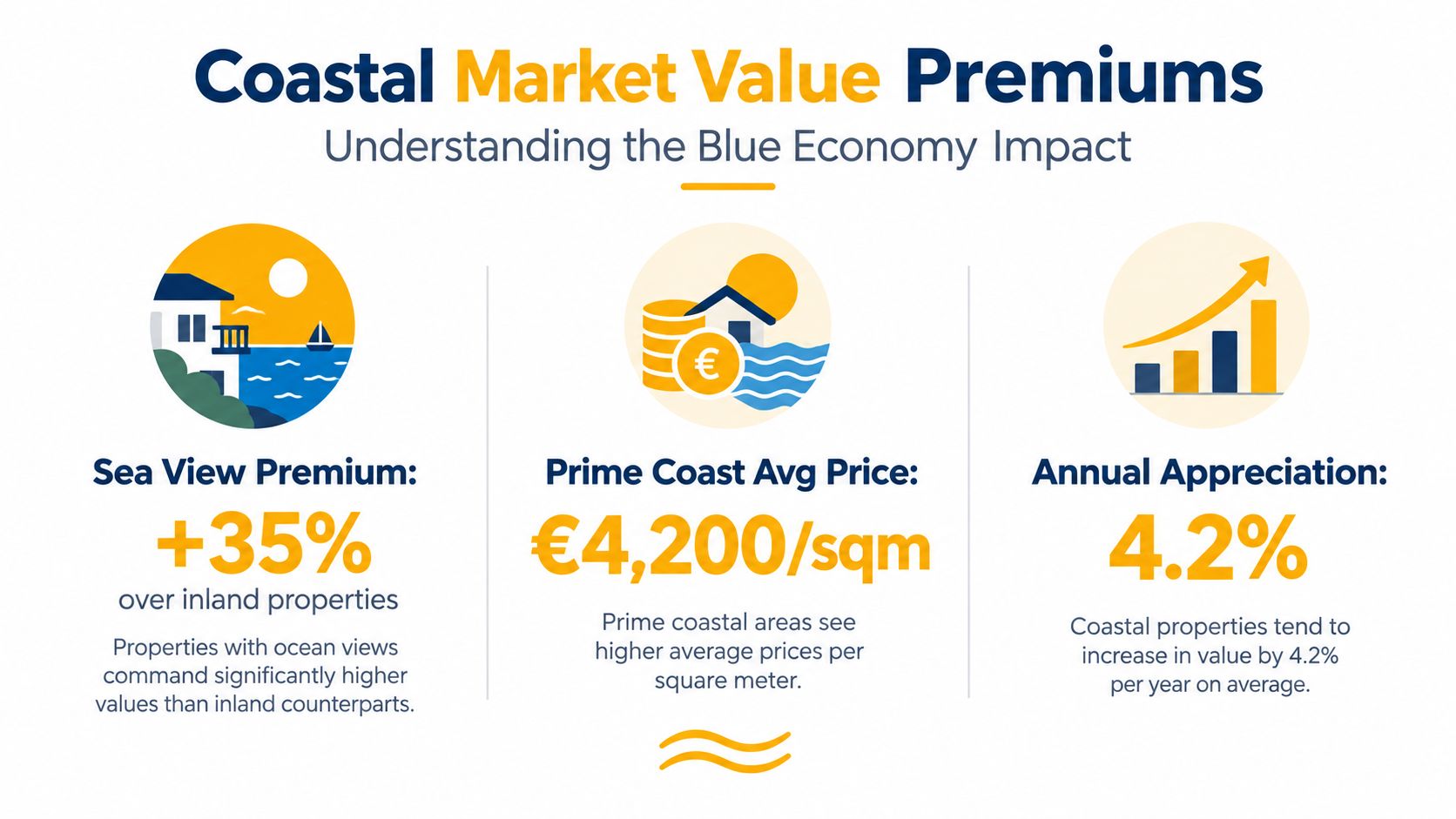
Spain's coastal market is supported by unusually strong international participation. In 2025, foreign buyers paid an average of €2,479 per square metre, compared with €1,839 per square metre for domestic buyers, a gap of nearly 35%, according to the reported comparison of foreign and domestic housing prices. The same source records a national average of €2,487 per square metre in the second quarter of 2026, the highest on record and 9.2% above the same quarter a year earlier.
That national picture matters, but it shouldn't be applied mechanically to every villa. Coastal demand is concentrated in locations with climate, tourism, transport, established services, and limited supply. In the premium segment, non-resident foreigners were already paying €3,063 per square metre in the second half of 2024, compared with €1,713 per square metre for nationals, showing that international demand has supported the upper end for some time. Those figures are useful context, not an automatic valuation formula.
Why Alicante deserves close attention
Alicante is one of Spain's most internationally supported housing markets. Foreign purchasers accounted for 43.29% of all home transactions in Alicante in full-year 2025, while Spain recorded about 97,300 foreign-buyer purchases, representing 13.8% of all home sales.
The provincial averages also show upward pressure. In the third quarter of 2026, Costa Blanca houses averaged €2,707.49 per square metre, up 7% year on year, while apartments averaged €2,843.56 per square metre, up 7.44%. A prime villa with an open view, quality construction, and scarce surrounding inventory can sit above these averages. A dated villa with a compromised view shouldn't be priced as though it has all those advantages.
Location premiums can be substantial. Properties within 300 metres of the coast are reported at approximately 15% to 30% above the local average, while sea views are described as adding 20% to 40% to villa pricing in relevant Costa Blanca comparisons, according to the coastal housing analysis covering beachside and view premiums. Regional villa ranges in that dataset include approximately €280,000 to €500,000 in Torrevieja, €300,000 to €600,000 in Orihuela Costa, and €450,000 to €1,200,000 in Jávea and Dénia.
How to test an asking price
Use the premium as a question, not as permission to accept the seller's price. Check whether the property has:
- A direct or merely partial view.
- A protected sightline or developable land in front.
- Walkable access to the coast and services.
- A modern specification or deferred maintenance.
- Legal documentation matching the built reality.
Top-end dispersion is particularly wide. Direct waterfront homes in Marbella reach up to €62,000 per square metre, while reported upper limits are around €46,000 per square metre in Mallorca and €28,000 per square metre in Ibiza, according to the comparison of Spain's exclusive waterfront addresses. These are not Costa Blanca benchmarks, but they illustrate why waterfront quality and locality must be analysed separately from a generic coastal average.
Essential Due Diligence for Coastal Properties
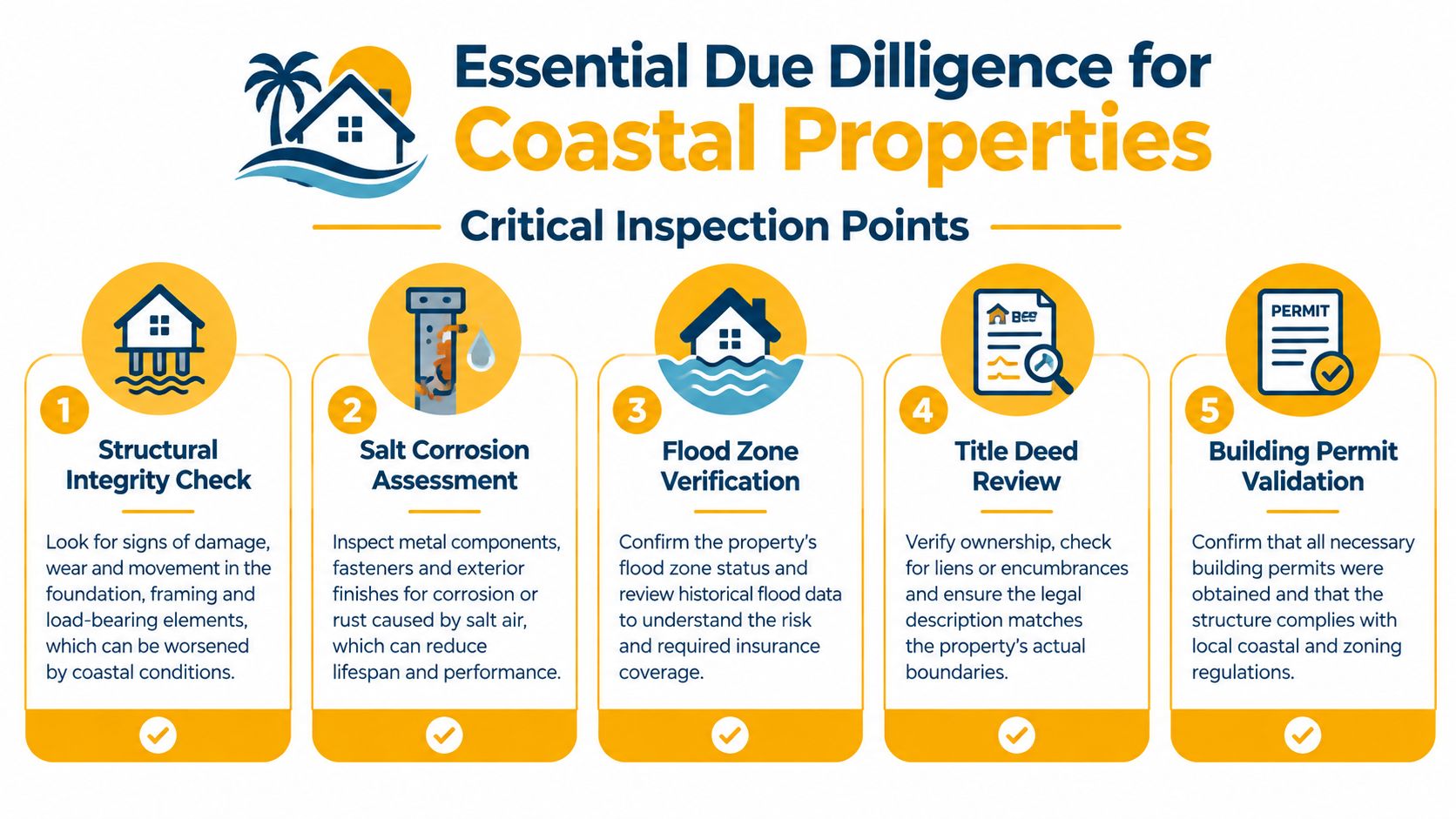
A coastal villa needs a more focused inspection than a standard inland home. Salt, humidity, wind, drainage, slopes, and exposure can affect the building envelope and external installations even when interiors look immaculate. Arrange an independent technical survey, and give the surveyor the property's location and renovation history before the visit.
Start with the land and the view
First, establish what the view actually depends on. Ask the lawyer to review planning information for neighbouring plots and identify whether the foreground is protected, already developed, or potentially buildable. Check the cadastral plan, title deed, planning classification, access rights, and any boundary discrepancies.
A beautiful outlook doesn't create a right to prevent every future development. The buyer needs evidence about the land in front, the height and position of nearby buildings, and any applicable coastal or municipal restrictions.
Inspect the structure and exterior
The survey should examine retaining walls, foundations where accessible, terraces, balconies, roof membranes, drainage channels, façades, window frames, and cracks. On sloping plots, water management deserves particular attention. Look for staining, damp odours, efflorescence, displaced paving, blocked drains, and signs that rainwater reaches the building rather than being directed away from it.
Salt exposure can accelerate corrosion in metal railings, fixings, air-conditioning components, shutters, pool equipment, and electrical installations. Stainless or treated materials still need inspection. A newly painted façade may conceal deterioration, so ask for maintenance records and examine less visible elevations.
Match every feature to its paperwork
Planning compliance is as important as physical condition. Confirm that extensions, enclosed terraces, garages, guest accommodation, pergolas, and pools appear in the relevant documentation. A property can be attractive and usable while still carrying unresolved planning issues.
Use this working checklist:
- Title deed and cadastral record: Confirm ownership, boundaries, built areas, and registered features.
- Urban planning status: Establish whether the plot is legal, developable, protected, or subject to limitations.
- Building permits: Verify licences for construction, extensions, structural changes, and pool installation.
- Completion and occupancy documents: Check that the property can be occupied and that supplied certificates correspond to the actual building.
- Utilities and access: Confirm legal connections, road access, easements, community obligations, and outstanding charges.
Inspection principle: A survey identifies physical risk, while a lawyer establishes legal risk. You need both opinions before treating the asking price as realistic.
Navigating Spain's Key Coastal Regions
Choosing between coastal areas is less about finding a universally superior destination and more about matching the property to how you'll use it. Costa Blanca offers broad international demand, varied municipalities, established services, and a wide selection from apartments to detached villas. Alicante's foreign-buyer concentration makes competition intense in sought-after locations, so buyers should compare view quality, access, and legal condition rather than assuming every coastal listing has equal strength.
For a buyer based in or near La Romana, the Costa Blanca also offers a practical contrast between inland living and coastal ownership. La Romana provides a different setting and property profile from the shoreline. A buyer can compare a genuine sea-view villa with an inland home that offers more land, privacy, or renovation potential, rather than paying a coastal premium by default.
Costa Blanca
The northern coast, including Jávea, Dénia, Calpe, and Altea, tends to attract buyers seeking established villa areas, dramatic scenery, and higher-end stock. The southern coast, including Guardamar, Torrevieja, and Orihuela Costa, offers different urban patterns, beach access, and a wide international community. Airport access, schools, healthcare, golf, marinas, and year-round services vary by municipality, so assess the actual neighbourhood rather than relying on the regional label.
Costa Cálida
Costa Cálida can suit buyers who want a more relaxed coastal environment and a different balance between beach access, resorts, and residential areas. Murcia recorded 21.42% foreign involvement in home transactions, according to the provincial comparison of foreign purchases. That indicates meaningful international participation, although individual micro-markets can still offer a different negotiation environment from the most searched Costa Blanca locations.
Costa del Sol and the wider comparison
Costa del Sol has a strong luxury identity and international visibility, but it isn't the focus for a buyer specifically targeting Alicante, La Romana, Costa Blanca, or Costa Cálida. Málaga recorded 32.80% foreign involvement in transactions in the same provincial comparison, but that figure should not be used to assume identical pricing or competition on the Costa Blanca.
A useful comparison looks at everyday logistics:
Buyer priority | Costa Blanca | Costa Cálida |
|---|---|---|
Villa variety | Broad, from established resale homes to new builds | Strong resort and detached-home options |
International demand | Particularly concentrated in Alicante | Significant, with more varied local conditions |
Lifestyle | Diverse municipalities, beaches, services, and inland connections | Relaxed coastal living with resort-oriented areas |
Main caution | Competition and inconsistent legal or construction quality | Micro-market liquidity and distance from preferred services |
The best region is the one where the view, access, construction quality, ownership costs, and intended use align.
Legal and Financial Considerations for Buyers
Budgeting begins with the purchase price, but it doesn't end there. International buyers should appoint an independent Spanish property lawyer, obtain a NIE number, arrange a practical payment route, and understand which documents must be ready before signing a reservation or private purchase contract. A Spanish bank account can simplify utility payments, taxes, insurance, and ongoing property management, although buyers should take regulated financial advice about their own circumstances.
Purchase tax in the Valencian Community
For resale homes in the Valencian Community, the general transfer tax is 9% from 1 June 2026, rising to 11% when the transferred property value exceeds €1,000,000. This applies directly to villa purchases in Alicante and nearby municipalities, including buyers assessing properties around La Romana and the wider Costa Blanca.
The tax base and transaction structure require professional confirmation. Don't calculate your full cash requirement from the listing price alone. Your lawyer should explain transfer tax, notary and registration costs, legal fees, technical reports, mortgage-related expenses if applicable, and any renovation or compliance work identified during due diligence.
Annual ownership obligations
Annual costs depend on the property, municipality, cadastral value, services, insurance, utilities, maintenance, pool and garden care, and community arrangements. Alicante city approved an urban-property IBI rate of 0.61291% for 2026, down from the previously applied 1.20% urban rate, with the annual charge estimated from cadastral value rather than market price, according to the report on Alicante's 2026 IBI rate. A villa outside Alicante city may follow different municipal arrangements, so request the latest receipt for the specific property.
Non-resident owners generally spend fewer than 183 days per year in Spain and must consider IRNR obligations, annual local IBI, and possible Modelo 210 filings even when the villa isn't rented, as explained in the guidance for non-resident property owners in Spain.
Protect the family's position
Inheritance and succession planning shouldn't be left until after completion. Ask a qualified adviser how Spanish and home-country rules interact, whether a will is appropriate, and how ownership should be structured. The answer depends on nationality, residence, family circumstances, financing, and the intended use of the property.
Budgeting rule: Before making an offer, prepare a written schedule covering acquisition costs, annual taxes, insurance, maintenance, management, utilities, and likely capital works. A villa's true cost is the cost of keeping it compliant, secure, and usable.
Why Local Expertise Matters in Property Purchases
A remote buyer can find listings online, book viewings, and make an offer without understanding the local context. That approach works poorly when the property's value depends on a protected panorama, a difficult plot, an old renovation, or a municipal document that doesn't match the building.
Local expertise has practical value at several points. An experienced adviser can identify whether a villa is fairly positioned against comparable stock, notice inconsistencies between the photographs and the physical property, and explain how roads, services, slopes, and neighbouring development affect daily use. They can also help distinguish a genuinely private location from one that becomes noisy or congested during the holiday season.

Advocacy is different from opening doors
A selling agent represents the seller's marketing process. A buyer needs someone to test the claims behind the listing, organise independent checks, and keep decisions moving across several professionals. That may include the lawyer, surveyor, architect, bank, notary, translator, insurance adviser, and contractors.
For international buyers, coordination is often as important as property selection. Documents need translation and review, deadlines need monitoring, and unanswered questions need written responses. If a villa requires modernisation, a local consultancy may also coordinate architects and builders, helping the buyer assess whether the proposed works are technically and financially realistic before completion.
AP Properties Spain operates as a boutique consultancy across the Costa Blanca and Costa Cálida, handling property search, area guidance, negotiations, legal coordination, completion support, and renovation coordination through architects and builders. It can be considered alongside an independent lawyer and surveyor when a buyer wants one local point of contact for a sea-view purchase.
What strong support looks like
Look for a clear explanation of who represents whom, which professionals are independent, how documents are shared, and what happens if an inspection reveals a problem. Ask for comparable reasoning, not just enthusiasm. The adviser should be comfortable recommending that you walk away when the view, paperwork, construction, or price doesn't justify the risk.
The fee is easier to evaluate when the service has a defined scope. A useful local partner protects time, reduces language friction, exposes hidden issues earlier, and helps you negotiate from evidence rather than emotion.
Your Path to a Successful Coastal Purchase
A successful sea-view purchase combines market evidence, physical inspection, legal verification, regional fit, and realistic ownership budgeting. Compare the view and micro-location, test every premium, confirm the property's planning status, and calculate the obligations that continue after completion. Passion can identify the right home, but prudence protects the investment.
Start by defining your essentials, then obtain independent legal and technical advice before committing funds. For a personalised search and practical guidance across the Costa Blanca and Costa Cálida, contact AP Properties Spain to discuss suitable sea-view villas, resale opportunities, new-build options, and renovation requirements. Their local team can help you assess the property beyond the photographs and coordinate the next steps towards a secure purchase.
Share