






Spain Property Market: 2026 Trends and Insights
Spain's housing market has entered 2026 with 12.9% year-on-year price growth, while resale homes are rising faster than new-build properties. The latest official Housing Price Index data shows resale prices increased 13.5% in Q1 2026, compared with 9.1% for new-builds. That difference tells international buyers more than the headline figure. The pressure sits in desirable existing homes, where supply is limited, replacement properties are expensive and well-located stock attracts immediate competition.
This isn't a uniform national boom. It's a segmented market shaped by planning delays, scarce coastal land, international demand and the quality of individual properties. For buyers focused on La Romana, Alicante, Costa Blanca or Costa Cálida, the right question isn't just whether Spain is expensive. It's whether a particular home has lasting demand, defensible location and realistic resale value.
The Current State of the Spain Property Market
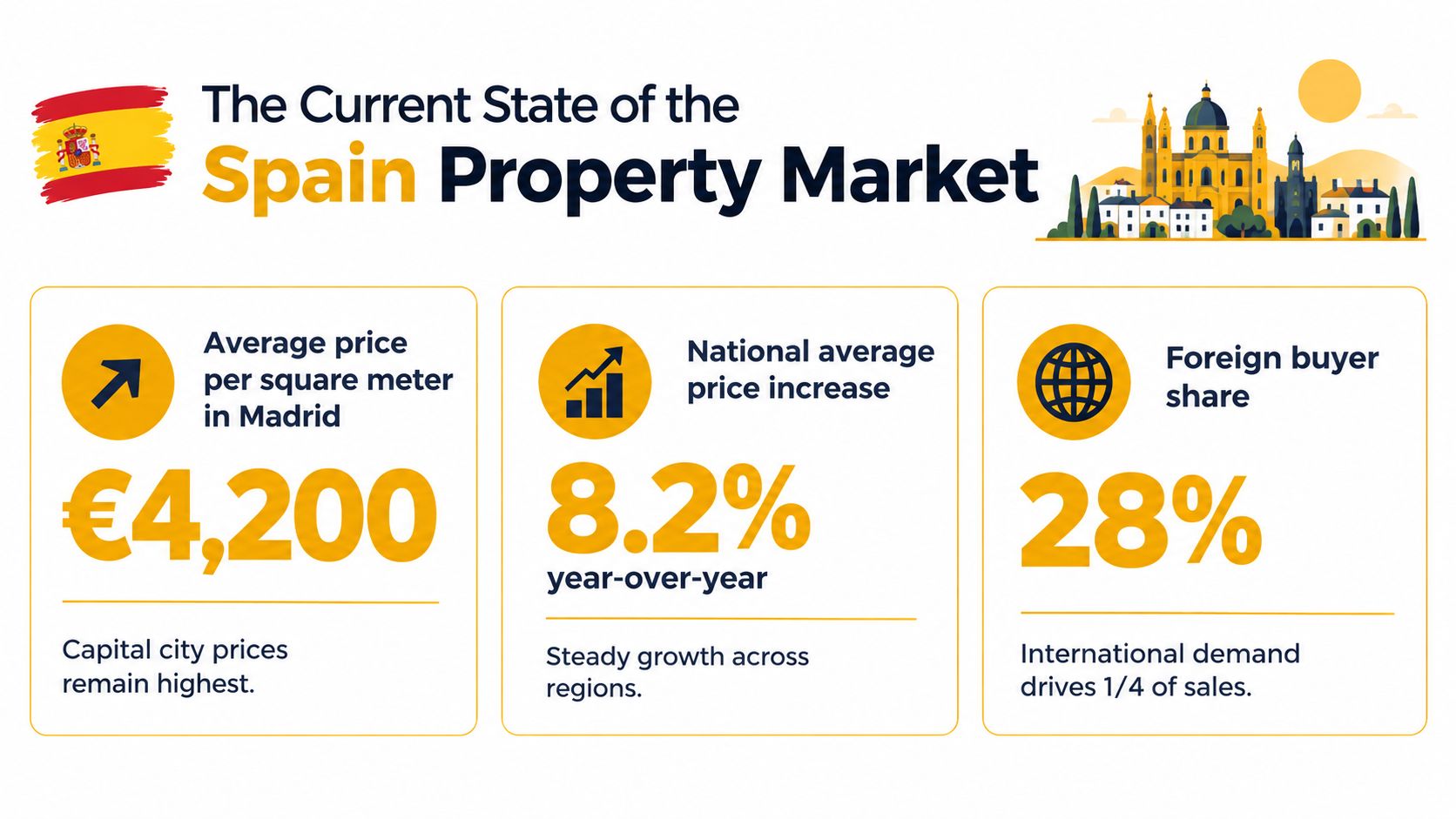
Spain's national Housing Price Index rose 12.9% year on year in Q1 2026, and prices increased 3.5% quarter on quarter, according to Spain's official Q1 2026 housing statistics. The headline matters, but the split beneath it matters more for buyers. New-build prices rose 9.1%, while resale prices climbed 13.5%. That gap reflects a restricted development pipeline and intense competition for established homes in proven locations.
The previous year also delivered strong growth. The official series recorded annual increases of 12.8% in Q3 2025 and 12.9% in Q4 2025, with quarterly growth of 2.9% and 1.8% respectively, as reported in Spain's Q3 2025 Housing Price Index. The figures confirm broad momentum, yet they do not remove the need for local analysis. A coastal villa, a dated apartment in a walkable town and a new development outside an established centre face different supply and resale conditions.
What the transaction figures mean for buyers
Sales activity gives this price growth practical context. Spain recorded 642,000 home sale transactions in 2024, an increase of 10.0% from the previous year and the third-highest result in the historical series, according to CaixaBank Research's analysis of Spain's property market. This level of liquidity means buyers are competing in an active market, not merely reacting to ambitious asking prices.
Official property-transfer figures also showed further growth in 2025, with both total transfers and home sales rising from the previous year. For an international buyer, that activity reduces the chance of securing a desirable property through a slow, exploratory process. A well-priced villa or apartment can attract several serious buyers before a second viewing.
Set your financing limit before travelling. Appoint an independent Spanish lawyer, verify planning and title documents early, and base the offer on comparable local sales rather than the online asking price. Sellers have little reason to discount just because an overseas buyer is unfamiliar with Spanish procedures.
Practical rule: Treat a correctly priced coastal property as time-sensitive, but never let speed replace due diligence.
Preparation protects your negotiating position. Obtain a mortgage indication, identify defects that justify renegotiation and decide which legal conditions must appear in the offer. In a tight coastal micro-market, the prepared buyer moves quickly while still protecting the purchase.
Understanding the Supply Shortage and Price Pressures
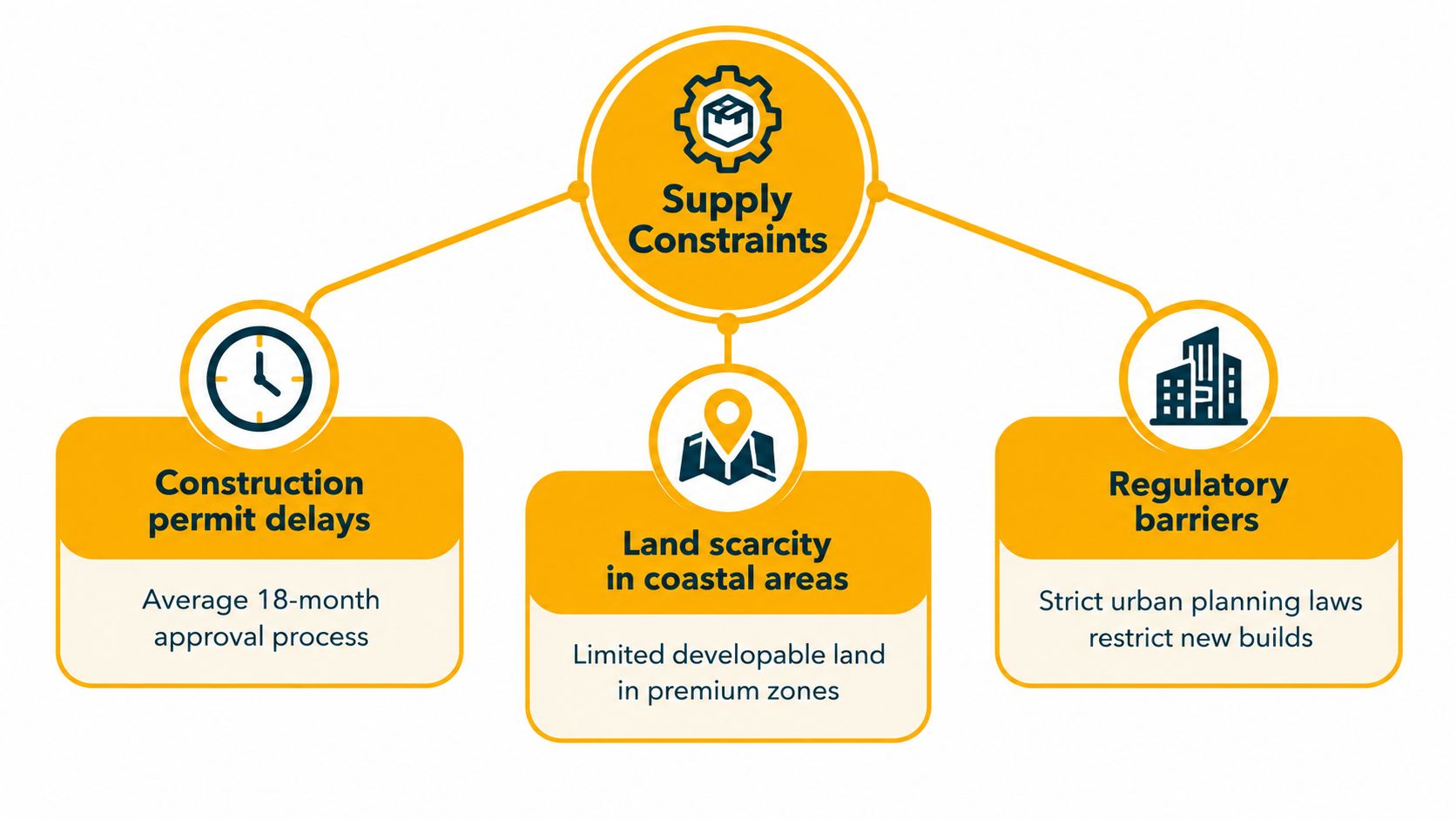
Spain's housing market is being constrained by a limited flow of new homes, with only 136,000 unsubsidised new-build permits and 23,200 social-housing permits in 2025, according to CaixaBank Research's analysis of the shortage of new homes. National price growth therefore hides the more important issue: too few properties are being delivered in the coastal locations where households, retirees and international buyers want to live.
Land, infrastructure and planning capacity are difficult to expand in established coastal markets. That keeps demand concentrated around a narrow supply pipeline and gives well-located existing homes a different pricing dynamic from new developments.
Why resale homes are repricing faster
Because resale stock is repricing faster, buyers need different underwriting assumptions for existing homes than for new developments. A completed property in an established area can be occupied, rented or renovated without waiting for construction. New developments may provide efficient systems and modern layouts, yet delivery still depends on land assembly, licences, construction schedules and the developer's financial strength.
The Q1 2026 official data confirms this separation between the two segments. Resale prices rose faster than new-build prices, showing that competition is strongest for homes available now rather than for an unlimited future pipeline. In a land-constrained coastal market, a renovated villa with practical access to services may be harder to replace than a standard new apartment.
Apply four tests before making an offer:
- Assume tighter entry yields: Do not pay a premium for an established coastal location on the basis of an optimistic future rent.
- Expect competition for usable stock: Sound title, attractive orientation, quality renovation and sensible access can matter more than striking photography.
- Separate construction risk from location risk: A new-build may appear inexpensive until delays, specification changes or infrastructure issues alter the timetable.
- Value replacement difficulty: A property that cannot easily be replicated because of planning or land constraints may protect value better than a larger home in an oversupplied area.
The shortage creates uneven pricing power. A poorly presented house can remain available, while a turnkey home in the right micro-market can draw competing offers. Inspect the local supply rather than relying on the national trend. Establish how many comparable homes are available and legally ready to transact, then assess whether a similar property could realistically be built nearby.
The strongest coastal property is rarely the one with the most dramatic brochure. It is the one buyers will struggle to replace.
Regional Breakdown of Prime Coastal Markets
Costa Blanca, Costa Cálida and Costa de Almería attract overlapping international audiences, but their buying conditions differ materially. Each coastline combines a different level of established demand, property stock, access, lifestyle appeal and resale depth. Choose the region after defining the intended use. Otherwise, you may pay for a location or amenity that does not support your actual priorities.
Region | Market Character | Ideal Buyer Profile |
|---|---|---|
Costa Blanca | The broadest international market of the three, with established coastal communities and a wide mix of villas, apartments, townhouses and fincas. Foreign buyers account for more than 80% of sales in some Alicante municipalities, while the market runs from well-serviced resort towns such as Jávea and Dénia to quieter inland locations around Alicante province. | Buyers seeking a Mediterranean base with strong international recognition, lifestyle flexibility and a wide resale audience. It suits luxury purchasers and clients who want choice across several price points and property formats. |
Costa Cálida | A varied market combining established coastal resorts, golf-oriented communities, quieter inland settings and access to Murcia's wider regional economy. Trading is generally less intense than in the most heavily sought-after coastal micro-markets. | Buyers who want space, outdoor living and a practical second-home or relocation base without limiting themselves to the busiest premium zones. |
Costa de Almería | A more individualistic coastline with unspoilt countryside, traditional towns and pockets of modern development. Market depth and resale appeal can change sharply from one community to the next, so location selection matters more than the regional label. | Buyers who value privacy, distinctive surroundings and a less standardised coastal experience, and who accept a more selective, location-led purchase. |
Costa Blanca
Costa Blanca is the most versatile choice for many international clients because it supports several purchase motives at once. Buyers can target a sea-view apartment, family villa, renovation project, inland finca or modern townhouse within a recognisable international property market.
That breadth makes careful local analysis more important, not less. Dénia, Jávea, Calpe, Alicante, Guardamar, Torrevieja and Orihuela Costa differ in infrastructure, seasonality, community composition and resale appeal. Assess daily life before investment potential. A property suited to permanent relocation may be a poor seasonal rental, while a holiday-focused apartment may offer limited comfort for year-round living.
For Costa Blanca, identify the buyer pool before choosing the property. A home near established services, international schools, transport links and year-round amenities has a wider practical audience than a similar property dependent on summer trade. Treat the municipality as a starting point, then assess the exact neighbourhood, street and building.
Costa Cálida and Costa de Almería
Costa Cálida suits clients who want a relaxed base with a workable balance between coastal living and inland access. The right purchase is not automatically the cheapest available property. Prioritise clear ownership, durable construction, usable outdoor space and a location that remains attractive outside the holiday season.
Costa de Almería requires even more precision. Its appeal is strongest for buyers seeking a particular setting or atmosphere rather than a broadly interchangeable resort product. That can produce a rewarding purchase, but resale depends heavily on exact positioning, local services and the future buyer pool. Confirm access, amenities and transaction liquidity before committing.
Choose the coastline for your future routine, not for the name on the property portal.
The Impact of International Buyers on Local Pricing
Foreign demand is not merely an added layer of activity in Alicante. In several municipalities, it has become the dominant pricing influence. Recent data show that foreigners account for more than 80% of home sales in eight Alicante municipalities, with San Miguel de Salinas above 90%, according to reported analysis of foreign purchases in Alicante.
The same data shows a substantial difference in purchasing power. Foreign buyers paid an average of €224,192, compared with €143,296 for Spanish buyers, a gap of 56.4%. Foreign buyers also represented 15.98% of all Spanish home purchases in Q2 2026, the highest recorded share to that point.
A segmented market, not a single demand story
These figures don't mean every foreign buyer is purchasing luxury property, nor do they prove that international demand alone sets every local price. They do show that prime coastal municipalities increasingly operate as segmented markets, where buyers with different currencies, incomes, tax positions and lifestyle priorities compete for the same limited stock.
That creates two very different realities.
For sellers, international demand can support a stronger valuation when a home offers features that travel well across markets. A turnkey villa, private outdoor space, attractive views, practical airport access and high-quality renovation can appeal to buyers from several countries. Presentation, documentation and professional photography matter because the audience is often remote and highly selective.
For local upgraders, the same dynamic creates pressure. A household moving within the region may compete with a buyer who views the property as a lifestyle purchase, currency hedge or retirement base. The result is not just higher demand. It's a difference in the price each buyer can tolerate.
How international buyers should respond
International purchasers shouldn't assume that being a cash buyer automatically creates advantage. In a sought-after municipality, a seller may prefer certainty, but they may also have several interested parties. Your edge comes from reducing execution risk, not from making an aggressive offer without evidence.
Use local comparables, inspect the title and confirm planning status before treating a property as a bargain. If the seller's valuation depends on international demand, test whether the property would still appeal to a future buyer outside the same nationality group.
Buyer discipline: Pay for location and durable quality, not for a seller's assumption that every foreign purchaser will pay more.
The best international acquisition is one that works on several levels. It should suit your lifestyle, remain understandable to a future purchaser and avoid dependence on a single seasonal audience.
Navigating Financing and Transaction Costs
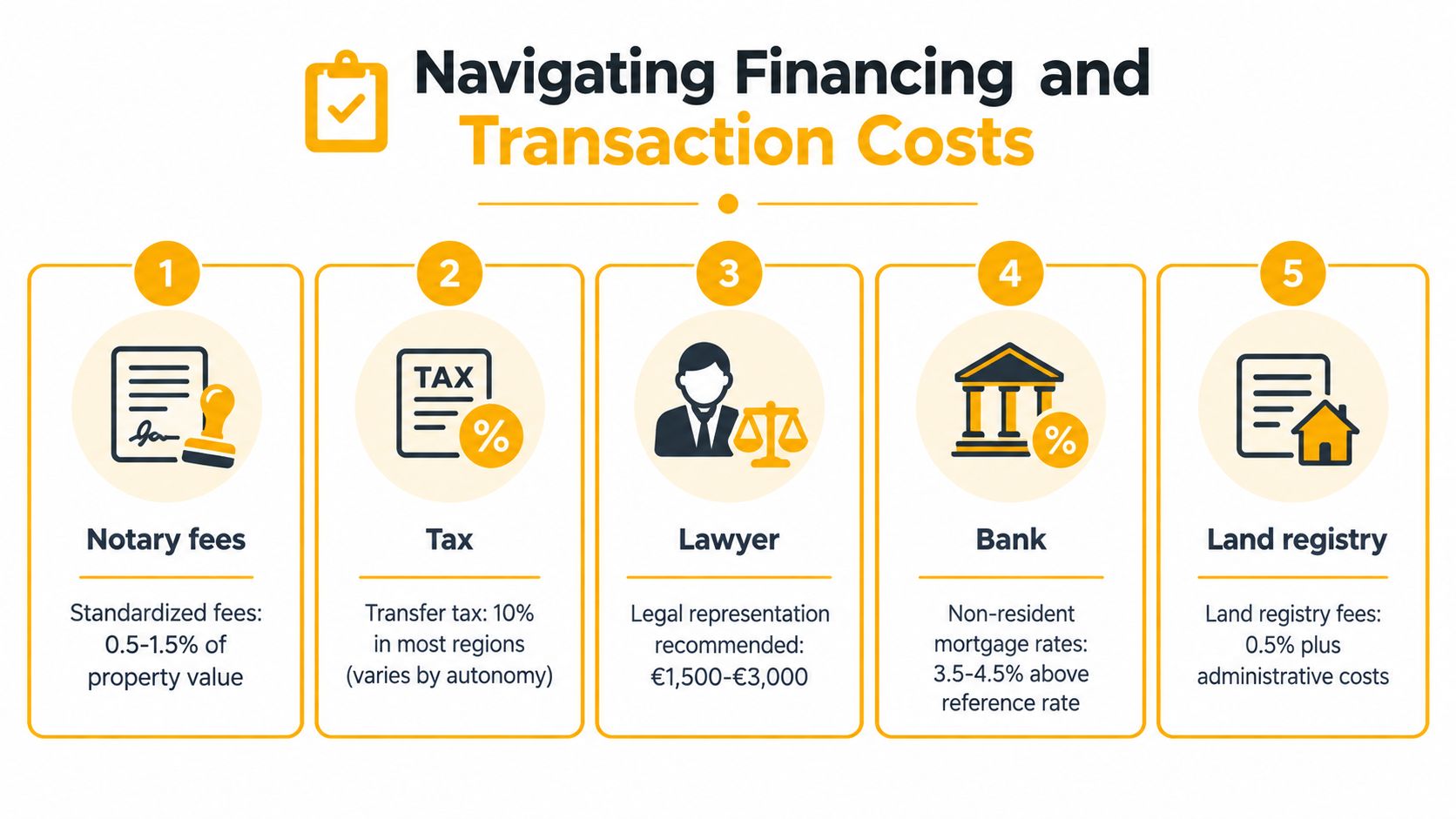
A Spanish purchase budget has two separate parts: the amount needed to acquire the property and the cash required to complete the transaction safely. Non-resident buyers often underestimate the second figure because they focus on the mortgage approval rather than the full funding structure.
Spanish banks generally lend non-residents 60% to 70% of the property value, while residents may reach up to 80%, according to guidance on mortgages for non-residents in Spain. A non-resident should therefore expect to provide at least 30% to 40% in cash before transaction costs. The bank's valuation, income evidence, existing liabilities and residency status can all affect the final offer.
Build the purchase budget correctly
Start with the property price, then add taxes, professional fees, financing expenses and any immediate works. Don't use the maximum bank approval as your target budget. A prudent buyer keeps room for valuation differences, renovation decisions and the cost of bringing the home into comfortable use.
For resale property in the Valencian Community, including Alicante, the buyer generally pays the regional transfer tax. New-build homes are generally subject to 10% VAT plus stamp duty, known as AJD.
The distinction affects more than the headline price. A new-build may offer lower immediate maintenance and better energy performance, but the tax structure must be included before comparing it with a resale home. A resale property may offer a stronger location or established garden, yet require a realistic renovation allowance.
Don't overlook recurring ownership costs
Alicante's annual urban IBI property tax is reported at 0.62% of cadastral value, not market value. A home with a cadastral value of €100,000 would therefore owe about €620 per year, based on Alicante property tax guidance for foreign buyers.
That calculation is useful because international buyers often assume the market value determines the bill. It doesn't. Ask for the latest IBI receipt, confirm the cadastral value and check whether any outstanding local charges exist before signing.
Use a Spanish lawyer who represents you rather than the seller or developer. The lawyer should verify ownership, charges, planning status, licences, community obligations and the contract terms. A mortgage broker can compare lending options, but the buyer still needs independent legal advice.
Strategic Investment Opportunities and Forecasts
The most resilient opportunity in the current Spain property market isn't an abstract national bet. It's a well-located home with limited competition from replacement stock, a broad future buyer pool and a condition standard that doesn't require immediate uncertainty.
That usually points towards turnkey coastal properties, not automatically the largest or newest homes. A renovated villa near established services, a well-positioned sea-view residence or a practical apartment in a year-round community can retain relevance because future buyers value the same fundamentals: access, comfort, legal clarity, outdoor living and low execution risk.

Where unequal pricing power matters
Land-constrained locations deserve attention because buyers can't assume that a similar replacement property will appear quickly. Planning bottlenecks and limited new supply support homes that combine an attractive setting with practical specifications. This doesn't justify paying any price. It does justify analysing scarcity as part of the valuation.
The strongest candidates typically have:
- A clear use case: The property works as a home, second residence or professionally managed rental, rather than depending on one narrow scenario.
- A durable location: Shops, healthcare, transport, schools, beaches or established community services remain accessible in ordinary daily life.
- A manageable condition: Renovation is either completed properly or priced transparently, with licences and documentation available.
- A wide resale audience: The home appeals to more than one nationality, age group or investment strategy.
- A defensible physical profile: Orientation, privacy, views, plot usability and construction quality are difficult for nearby competitors to replicate.
Forecasting the next national price movement is less useful than testing downside resilience. If growth slows, a scarce and usable property should still have a reason to attract buyers. An inconvenient home with inflated specifications may not.
For an international investor, the right strategy is selective acquisition. Don't chase momentum in an unfamiliar municipality. Compare several local transactions, stress-test financing and decide whether the home remains attractive without assuming further rapid appreciation.
Securing Expert Guidance for a Confident Purchase
A Spanish purchase involves several parties. The estate agent, lawyer, mortgage provider, surveyor, notary, bank and renovation team each manage different risks. Assign one adviser to coordinate the process, or minor delays can become costly problems.
Choose local guidance that starts with your objectives, not a catalogue of listings. State whether you are relocating, buying a second home, seeking rental income, planning works or preparing for resale. Your adviser should then explain which municipalities and property types fit that purpose, and which do not.
What effective representation should include
Ask for practical, documented support:
- Area guidance: Which communities suit your routine, access needs and budget, and what local evidence supports that recommendation?
- Curated matching: How many properties were rejected before the shortlist, and why?
- Negotiation support: What do condition, paperwork and comparable local sales justify for the offer?
- Legal coordination: Who is the independent bilingual lawyer, and what remains outside the adviser's responsibility?
- Completion management: Who tracks contracts, banking, utilities, registration and handover, with what written updates?
- Renovation coordination: If works are required, which architects and builders can assess scope, permissions and costs?
In inland Alicante and across the Costa Blanca, similar photographs can conceal major differences in planning, access, construction and resale prospects. Require written answers, document access and a record of every purchase condition before transferring funds.
The adviser should not replace independent legal or financial professionals. Their role is to involve those specialists at the right stage and identify unresolved issues before commitment.
AP Properties Spain provides property selection, negotiation, legal coordination and completion support across the Costa Blanca and Costa Cálida. International buyers assessing La Romana, Alicante or nearby coastal regions can visit AP Properties Spain to discuss their requirements and next steps.
Share