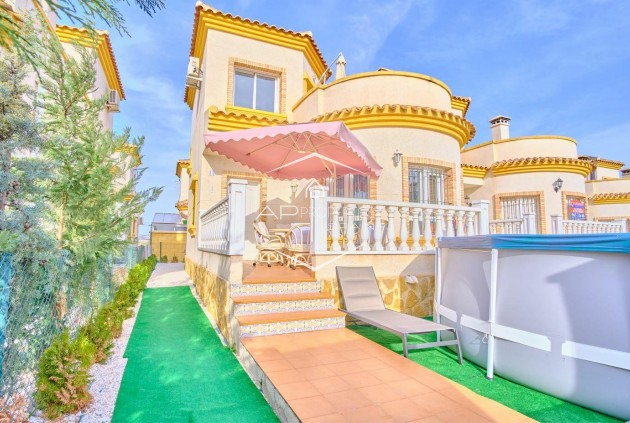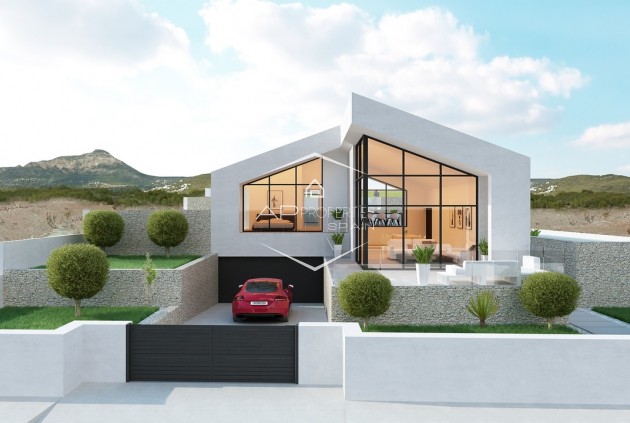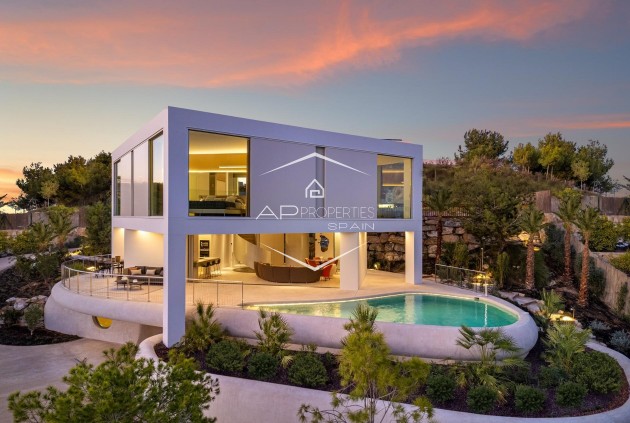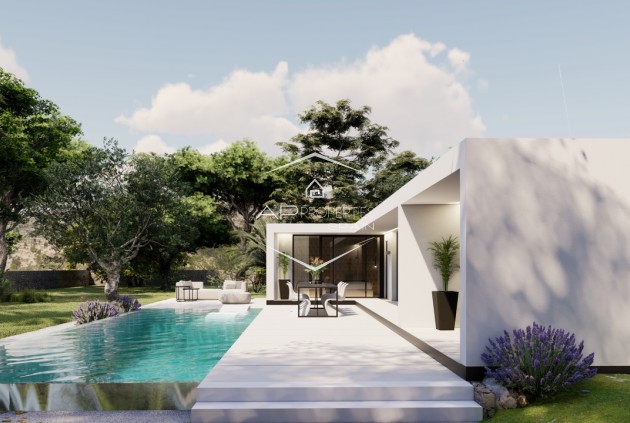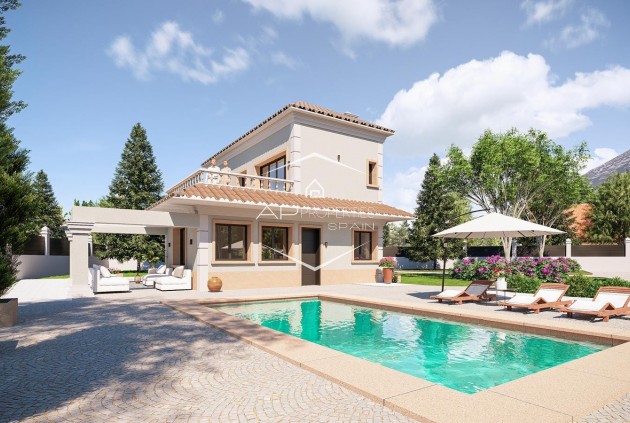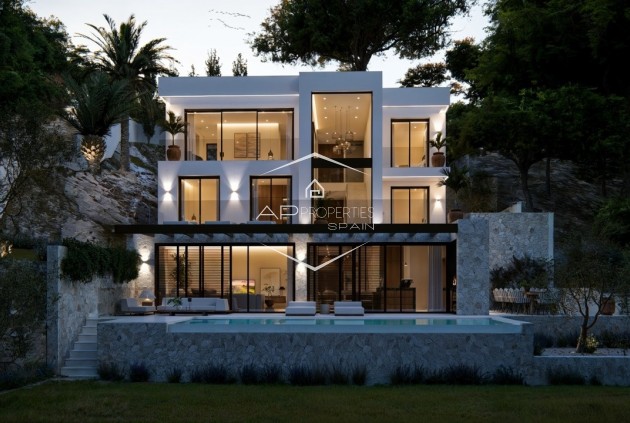






Villas for Sale Alicante: A Buyer's Guide to Costa Blanca
The Alicante villa market is no longer a cheap coastal bargain. In Q1 2026, non-Spanish buyers accounted for 44.65% of all home sales in Alicante province, while the average home price reached €2,214 per square metre. Your real outcome now depends on micro-location, energy performance, and choosing correctly between resale and new build.
You may be searching from a desk in London, Brussels, Amsterdam, or Berlin, comparing sea views, pool sizes, and “renovation opportunities” across portals. Then you arrive in Alicante and discover that two villas with similar bedrooms can have completely different values because one has legal extensions, a better orientation, lower running costs, and a walkable location, while the other has attractive photographs but unresolved paperwork.
This guide is a practical buying playbook for villas for sale in Alicante, focused on the Costa Blanca and the wider Alicante countryside, including the area around La Romana. It covers international demand, neighbourhood selection, resale and new-build choices, taxes, energy certificates, investment considerations, and the transaction process.
Why Alicante Villas Are on International Buyers' Radar
At Alicante Airport, an international buyer quickly sees how broad the market has become. The arrivals hall brings together people relocating with families, owners returning for a second home, and investors flying in to inspect detached villas. The demand isn't coming from one country or one type of buyer.
In the first quarter of 2026, foreign purchasers represented 44.65% of home sales in Alicante province, the highest provincial share recorded nationally in that period. British buyers led the foreign segment at 12%, followed by Belgians at 10% and Dutch buyers at 8%, according to recent Alicante prime-property market coverage.
That mix changes how buyers should behave. You're not negotiating only against a local family comparing nearby listings. You're competing with purchasers who may value privacy, outdoor space, winter sun, international schools, airport access, or the ability to use a villa as a future permanent residence. A well-presented home with a pool, usable terraces, and clear documentation appeals to several nationalities at once.
What Alicante still offers
Alicante continues to offer a strong lifestyle proposition. The Costa Blanca combines beaches, mountain scenery, established communities, healthcare, education, and access to Alicante-Elche Airport. Northern European buyers often choose between coastal locations such as Jávea, Moraira, Benissa Costa, Altea, and Calpe, while others prefer inland towns where plots are larger and traditional homes can offer more privacy.
The province also has a substantial existing housing base. Foreigners own 301,937 homes in Alicante province, equal to 22.6% of all residential properties, while Alicante city itself contains 188,842 residential properties, the largest residential stock in the province, as reported by Información.
What Alicante no longer reliably offers is the effortless bargain. Buyers who arrive without a defined brief often spend too long comparing superficial features and lose the best homes in their preferred area. The practical response is simple: decide which locations fit your daily life, understand the documentation you need, and treat running costs as part of the purchase rather than an afterthought.
Practical rule: A villa's postcode is only the starting point. Orientation, access, legal status, energy performance, and year-round usability decide whether the property is genuinely good value.
The right buying process begins before the viewing trip. Establish your priorities, shortlist by micro-location, compare new build with resale, and arrange independent legal and technical checks before committing a meaningful deposit.
The Alicante Villa Market in Numbers
Alicante's market is active, but province-wide averages can mislead villa buyers. The average sale price across the province was €176,283 in 2024, while the province recorded 56,296 home sales, an annual increase of 6%, according to Spanish Property Insight's market report. Those figures describe a deep residential market, not the price of a sea-view villa in a tightly held coastal enclave.
The longer trajectory is also important. One market review places the provincial average at approximately €1,030 per square metre in 2013 and about €1,890 per square metre in Q1 2026. The average had previously peaked near €1,780 per square metre in 2007, meaning the earlier pre-crisis level was exceeded for the first time, as outlined in this Costa Blanca price analysis.
Why headline averages aren't enough
Alicante city reached an all-time high of €2,435 per square metre in June 2025, up 16.4% year on year, while Playa de San Juan-El Cabo reached €3,424 per square metre, according to Idealista's Alicante price review. A detached villa in the city, a modern home near the coast, and a traditional finca near La Romana shouldn't be valued from the same benchmark.
Resale stock remains central to the market. Alicante closed 2025 with 53,385 home sales, including 43,525 resale transactions and 9,860 new-build sales, according to International Investment. Buyers should therefore expect to encounter considerably more existing homes than new developments, especially when searching for detached properties with established gardens and mature surroundings.
Micro-location | Price €/m² for villas | Entry-level three-bed villa | Trophy segment |
|---|---|---|---|
Alicante province overall | €2,214 average home price in Q1 2026 | Varies by municipality and condition | Varies by views, plot and legal status |
Alicante city | €2,435 in June 2025 | Varies by neighbourhood | Playa de San Juan-El Cabo reached €3,424 per m² |
Coastal villa markets | Must be assessed by submarket | Depends on plot, condition and orientation | Premium values require property-specific valuation |
Alicante countryside | No verified villa average available | Depends on town, land classification and renovation | Privacy and land size can outweigh coastal proximity |
The numbers support a clear conclusion. Alicante is liquid and internationally exposed, but buyers must compare like with like. A provincial average won't tell you whether a villa in Jávea, Altea, Calpe, or the inland countryside is fairly priced.
Best Costa Blanca Neighbourhoods for Villa Buyers
The best area depends on how you intend to live. A family seeking year-round convenience needs a different location from an owner wanting maximum privacy, and a rental-led buyer needs a different property from someone planning to retire permanently.
North Costa Blanca choices
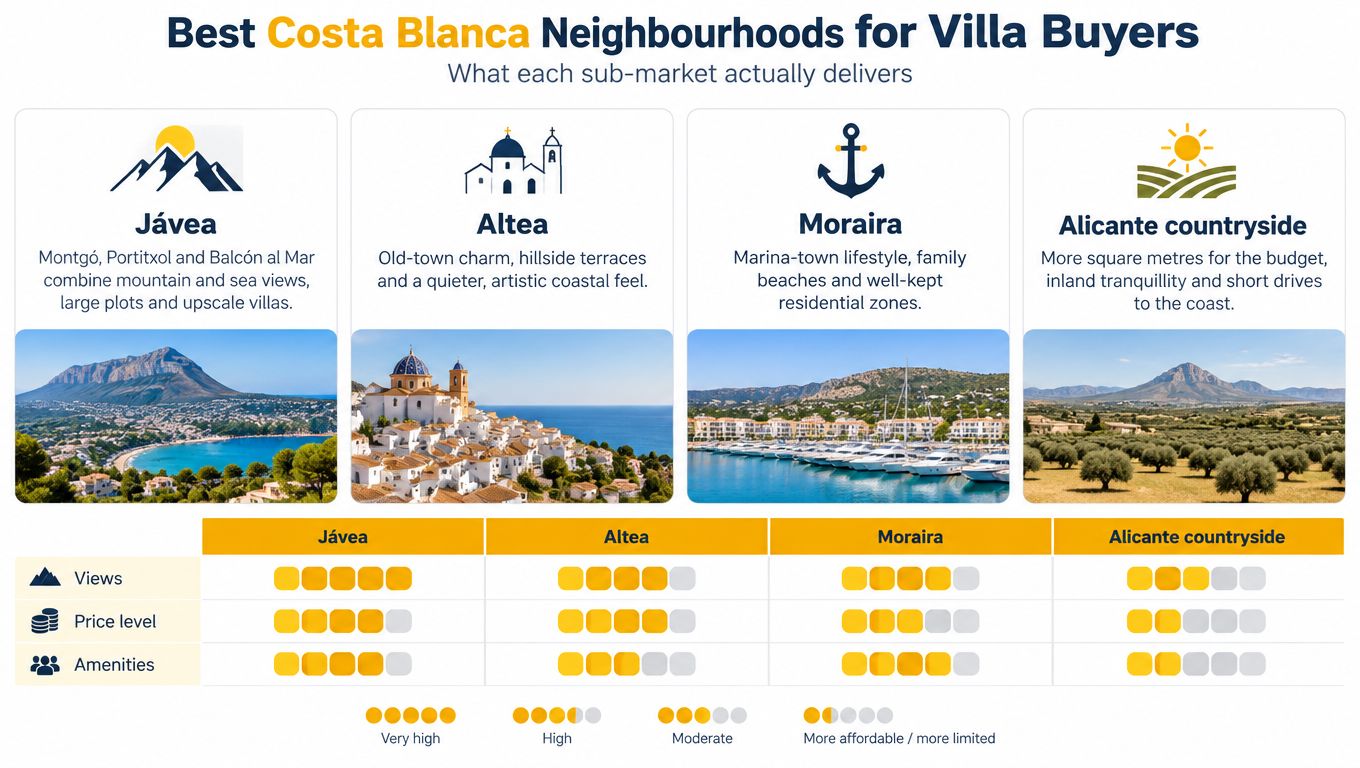
Jávea remains one of the most versatile villa markets. Montgó offers a distinctive outlook and a protected feel, while Portitxol and Balcón al Mar appeal to buyers prioritising sea views and privacy. Check driving times carefully. A villa can look close to the coast on a map yet feel inconvenient for daily shopping, school runs, or winter occupation.
Moraira and Benissa Costa suit buyers who value an established maritime lifestyle and limited supply. Frontline plots are finite, and planning constraints matter. In these locations, a smaller but well-positioned villa with good access and clear title can be a safer purchase than a larger home reached by difficult roads.
Altea and Altea Hills offer high views, hillside architecture, and a more distinctly Spanish atmosphere than some resort-focused areas. Buyers should inspect retaining walls, access gradients, drainage, and the condition of terraces. Hillside homes can be exceptional, but their maintenance profile is different from a flat coastal plot.
Calpe is practical for families who want beaches, amenities, and the Peñón de Ifach as a backdrop. It has a more active holiday-town character, which can help owners seeking convenience and rental appeal. The trade-off is that privacy and quietness vary sharply from one urbanisation to the next.
Inland value and southern access
The inland segment, including Orba, Alcalalí, and La Vall de Laguar, attracts buyers looking for traditional fincas, larger plots, and a quieter setting. These properties reward careful inspection. Roofs, water systems, access roads, land classification, extensions, and renovation permissions can matter more than the listing photographs.
Around Ciudad Quesada and the southern Costa Blanca, buyers can find a broader range of accessible detached homes and established services. Don't assume a lower entry price automatically means better value. Test the area at the time of year you expect to use the property, and assess sun exposure, traffic, walkability, and the distance to everyday amenities.
The strongest location is the one that still works when you're not on holiday.
Create a shortlist based on daily routine first, then views and finishes. A west-facing villa with a dramatic outlook may be less comfortable than a well-oriented home with a usable terrace, efficient cooling, and straightforward access.
New-Build Versus Resale and Turn-Key Options
There are three sensible product choices in Alicante. You can buy a brand-new villa, purchase a resale home that's ready to occupy, or buy a structurally sound property that needs renovation. The correct answer depends on your tolerance for delay, construction risk, and decision-making.
A new build is the cleanest option for buyers who want contemporary layouts, current energy standards, and a predictable specification. You may have less room to negotiate, and you must examine the developer's documentation, construction quality, licences, guarantees, completion terms, and the precise contents of the specification.
A turn-key resale offers something a brochure can't provide: evidence of how the home performs. You can inspect the garden, pool, air-conditioning, storage, neighbourhood, access, and surrounding properties. Mature landscaping and an established community can also be more valuable than a brand-new finish.
Renovation can work well in inland areas and older coastal plots, but only when the buyer has a realistic scope and an experienced technical team. A cheap villa with illegal extensions, poor access, or unresolved planning matters isn't a renovation opportunity. It's a legal and financial problem.
Factor | New build | Resale turn-key | Resale renovation |
|---|---|---|---|
Condition | New specification, subject to inspection | Existing systems can be tested | Requires technical survey and works plan |
Energy performance | Often designed around current standards | Must verify certificate and actual systems | Can improve, but upgrade scope must be priced |
Completion timing | Depends on construction and licences | Usually clearer once due diligence is complete | Depends on purchase and renovation programme |
Negotiation | Often limited around a fixed specification | Depends on seller motivation and condition | Stronger only when defects are documented |
Best suited to | Buyers wanting predictable modern living | Buyers wanting immediate use | Buyers seeking control and value creation |
Match the property to your profile
Choose new build if energy efficiency, warranties, and a modern layout matter more than mature surroundings. Choose turn-key resale if you want to move quickly into an established neighbourhood. Choose renovation only if you can tolerate decisions, inspections, contractor coordination, and a longer path to the finished home.
Don't chase the lowest listing price. Compare the complete purchase, including legal checks, taxes, technical work, improvements, and the cost of leaving the property unused while works are completed.
Legal Steps Taxes and Energy Certificates for Buyers
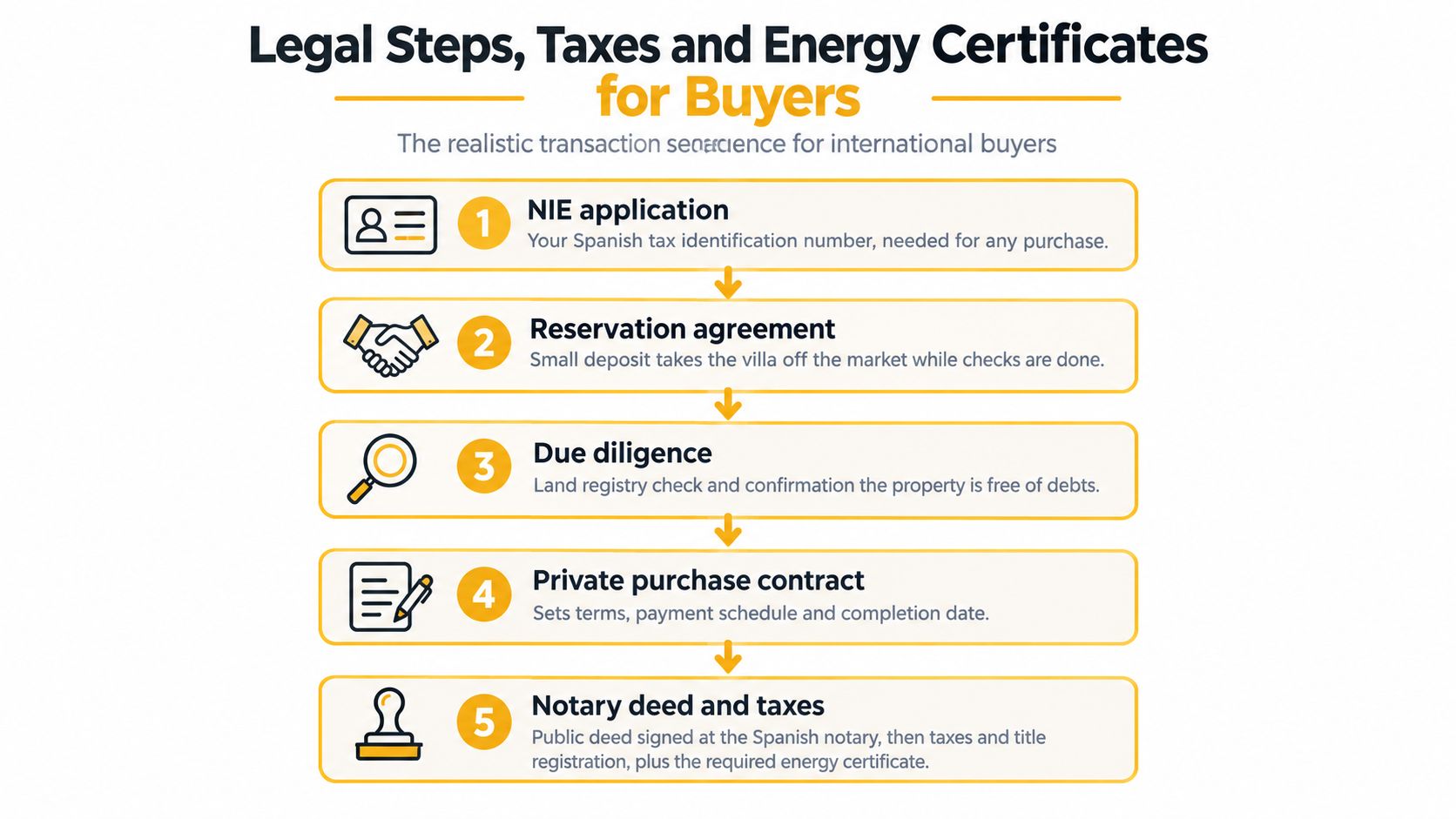
International buyers should treat the transaction as a sequence, not a handshake followed by a trip to the notary. The first practical step is the NIE, the Spanish tax identification number required for the purchase process. After that, a reservation agreement may take the villa off the market while the legal checks begin.
The due diligence should confirm ownership, land-registry details, debts, planning status, licences, and the relationship between the registered property and the building that exists on the ground. Older villas deserve particular attention because enclosed terraces, extra rooms, pools, garages, and outbuildings may not all be recorded correctly.
The purchase sequence
- Obtain the NIE. Arrange the identification number early rather than waiting until a preferred property appears.
- Sign a reservation agreement. The document should identify the property, the deposit terms, the deadline for checks, and what happens if a material legal issue is found.
- Complete due diligence. Review the land registry, debts, planning records, licences, and technical condition with the appropriate professionals.
- Sign the private purchase contract. This should set out the price, payment schedule, completion date, included items, and remedies if either party fails to complete.
- Complete before the notary. The public deed is signed, taxes are handled, and the title is registered in the buyer's name.
Taxes and energy compliance
New-build residential property is generally subject to 10% VAT, while resale homes are subject to ITP instead of VAT. The annual IBI is charged using cadastral value, and municipal rates in Alicante province fall within the national band of 0.4% to 1.1%, so obtain the exact local figure for the property before calculating ownership costs.
An energy certificate is mandatory when selling or renting, remains valid for 10 years, and non-compliance can trigger fines of up to €6,000, as explained by Tinsa's Alicante energy-certificate guidance. The assessment considers the building envelope, ventilation, orientation, solar protection, and heating, cooling, and hot-water systems.
A villa with large façades and extensive glazing needs more than a paper certificate. Ask how the home handles summer heat, what equipment consumes the most energy, and whether insulation, shading, or climate-control improvements should be completed before occupation.
Investment Potential and Running Costs That Matter
Alicante villas can serve as homes, second residences, or rental assets, but investment performance is decided locally. A sea-view property near services may attract a different tenant profile from an inland finca, while a secluded home can appeal strongly to holidaymakers but be less convenient for long-term occupation.
Don't underwrite a purchase using gross rent alone. Confirm whether the intended rental use is permitted, examine local rules, account for management and maintenance, and test demand for the exact location rather than the province. A villa that looks attractive in a spreadsheet can perform poorly if guests need a car for every basic errand or if the pool and garden require constant attention.
The costs owners feel after completion
The annual cost structure usually includes IBI, insurance, utilities, pool and garden care, repairs, and, where applicable, community charges. The amount varies sharply by plot size, equipment, urbanisation, pool type, landscaping, and whether the home is occupied throughout the year.
Cost item | Typical annual range in euros | Notes |
|---|---|---|
IBI | Varies by cadastral value and municipality | Confirm the current bill with the seller or town hall |
Community charges | Varies by urbanisation | Check budgets, reserve funds, and planned works |
Pool and garden | Varies by size and service level | Detached homes usually require regular specialist care |
Energy and utilities | Varies by occupancy and efficiency | Inspect HVAC, insulation, shading, and solar protection |
Repairs and insurance | Varies by age and construction | Older villas need a larger maintenance allowance |
The verified market data shows why valuation must be submarket-specific. Alicante recorded 56,296 property sales in 2024, and foreign buyers represented 43.29% of purchases in one land-registry review, as reported by Spanish Property Insight's South Costa Blanca analysis. That depth of demand can support well-located, well-documented homes, but it doesn't rescue a villa with excessive running costs or weak access.
Investment discipline: Calculate the net result after ownership, maintenance, management, taxes, and empty periods. A lower purchase price isn't automatically a higher return.
Energy performance deserves a place in the investment calculation. The province's average efficiency is reported around label E, so a villa with improved insulation, shading, efficient climate control, and a strong certificate can stand apart when buyers compare total ownership costs.
How AP Properties Spain Supports the End-to-End Process
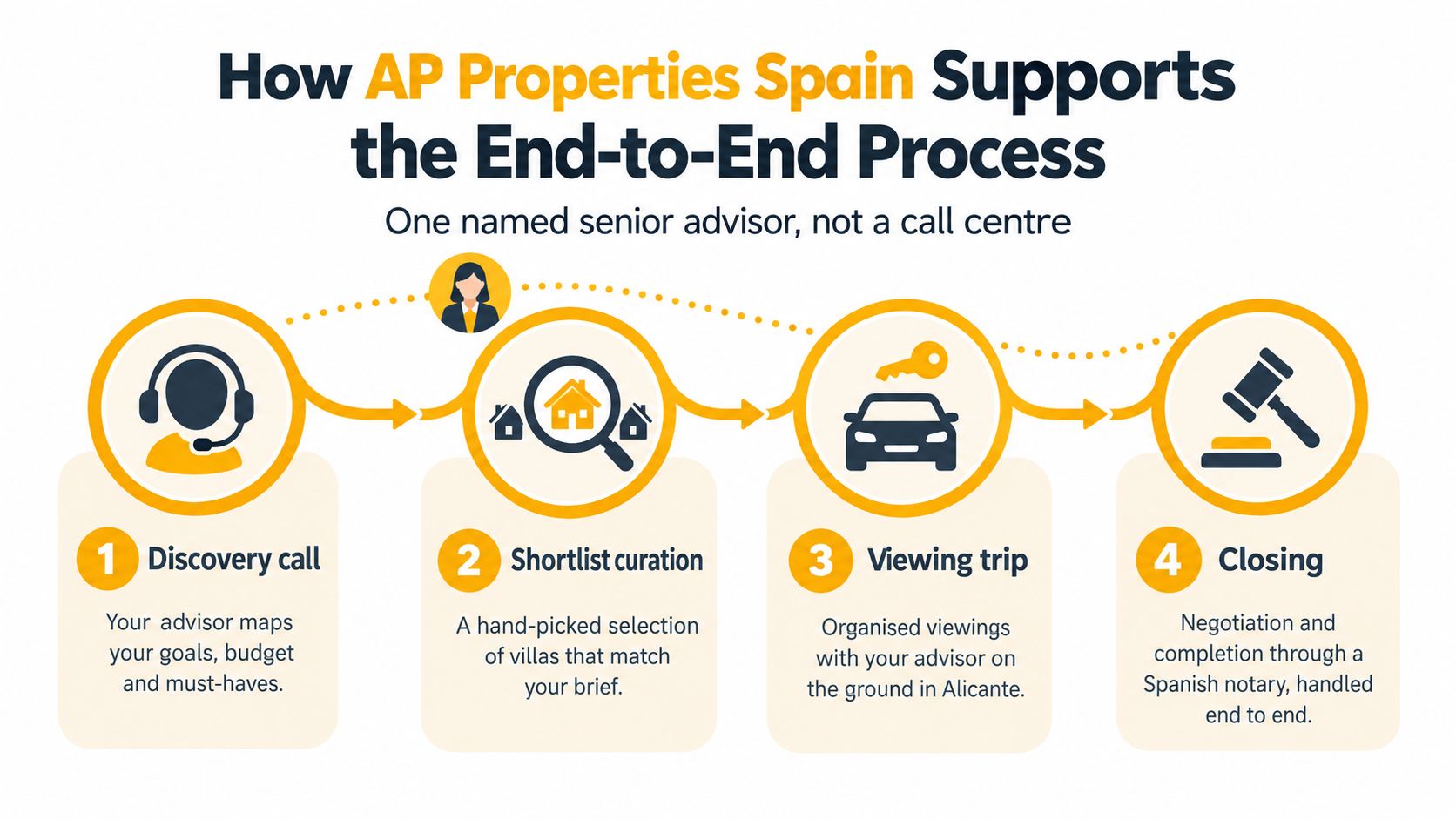
A boutique consultancy should add judgement, not just forward listing links. The useful service is a named adviser who learns how you plan to use the property, rejects unsuitable options, organises a focused viewing trip, and keeps the legal, technical, and commercial steps aligned.
The process works best in four stages:
- Discovery call. Establish budget, intended use, preferred setting, airport access, privacy requirements, and tolerance for renovation.
- Shortlist curation. Compare properties by micro-location, legal position, condition, orientation, energy performance, and likely ownership burden.
- Viewing trip. Inspect the homes in a logical order and visit the surrounding streets, access roads, amenities, and coastline rather than judging the villa in isolation.
- Closing coordination. Manage negotiation and communication with the seller while the buyer's independent legal and tax professionals complete their work through the Spanish notary.
AP Properties Spain operates as a luxury boutique consultancy for Costa Blanca and Costa Cálida buyers, covering new-build and resale homes, villas, fincas, plots, and related property types. Its buyer support includes area guidance, negotiations, legal coordination, completion support, and introductions for renovation or post-completion services.
What the adviser should verify
A serious adviser helps you ask difficult questions before you become emotionally attached to a villa:
- Title and planning: Does the registered property match the physical building and plot?
- Energy and systems: What does the certificate say, and what will cooling, heating, and hot water cost to operate?
- Access and services: Are roads, water, electricity, drainage, and internet suitable for the intended use?
- Resale logic: Who is the next buyer likely to be, and what features will matter in that submarket?
- Completion readiness: Are the documents, contracts, tax details, and notary timetable organised?
The adviser doesn't replace your lawyer, surveyor, architect, or tax professional. The value lies in coordinating the process, filtering choices, and helping you avoid spending time on properties that fail basic suitability or due diligence.
Smarter Decisions Before You Buy a Villa in Alicante
The “cheap coastal market” assumption is now dangerous. Alicante city reached €2,435 per square metre in June 2025, and Playa de San Juan-El Cabo reached €3,424 per square metre, while foreign participation remains structurally high across the province. The question isn't whether Alicante is cheap. The question is whether a particular villa justifies its price through location, condition, legal clarity, energy performance, and usability.
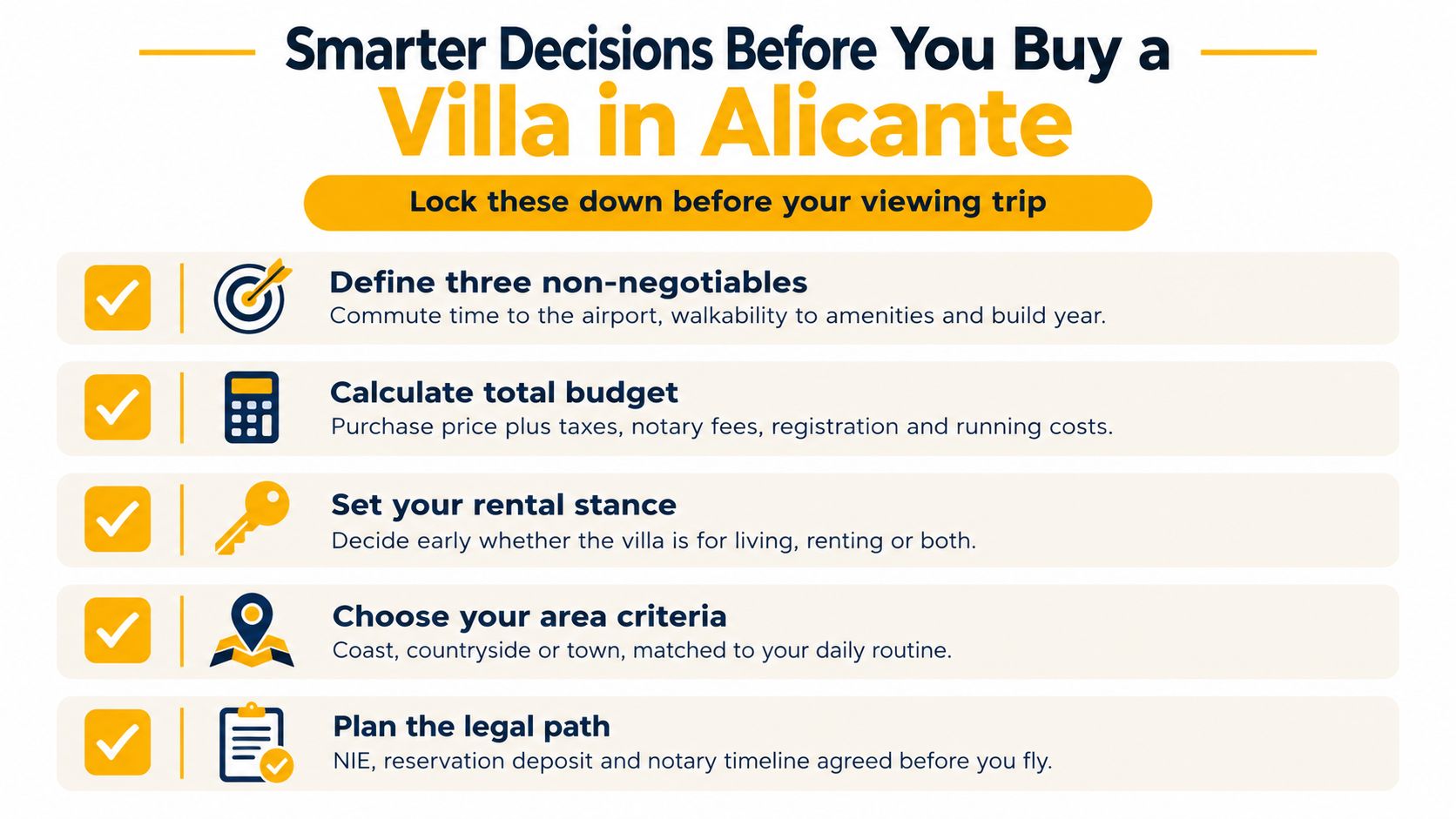
Lock down three priorities before you book flights:
- Airport access: Decide how long you're prepared to drive for regular arrivals, family visits, and urgent travel.
- Walkability: Identify whether you need shops, cafés, schools, healthcare, or the beach within practical reach.
- Build year and condition: Choose whether you want a modern construction, an established resale, or a renovation project.
Then calculate the full ownership budget. Include the purchase tax, notary and registration costs, legal advice, insurance, IBI, community charges where relevant, utilities, pool and garden maintenance, and likely repairs. For a detached villa, the land and outdoor systems can create meaningful costs even when the interior looks finished.
Decide what you're actually buying
A permanent home should prioritise winter comfort, services, storage, energy performance, and year-round access. A second home may justify a more secluded location, while a rental property needs proven demand, legal permission, durable finishes, and efficient management.
Arrange an independent technical survey even for a new villa. Inspect structure, boundaries, moisture, retaining walls, pools, drainage, roof details, installations, and the paperwork supporting extensions or alterations. Don't accept “everyone builds this way” as a substitute for documentation.
Your next step should be specific. Stop browsing undifferentiated portal results, write down your budget and three essential criteria, and arrange a discovery call with an adviser who can turn them into a location-led shortlist.
AP Properties Spain can help you compare villas for sale in Alicante by lifestyle, legal readiness, running costs, and resale logic, not just photographs and asking price. Visit AP Properties Spain to begin a focused conversation about your preferred Costa Blanca location and the right route to completion.
Share