






Property Lawyer Spain: A Guide for Buyers in 2026
You've found a villa in La Romana, the seller has accepted your offer, and the agent is encouraging you to sign a reservation document before another buyer appears. The property looks right, the negotiation feels finished, and transferring a deposit seems like the natural next step.
That's precisely when independent legal advice matters most. A Spanish purchase involves the Land Registry, planning records, tax authorities, the notary, banks, community obligations and, in many cases, documents issued in another country. A property lawyer in Spain doesn't just check a contract. They identify which missing document could prevent completion, restrict future use or create a costly problem when you eventually sell.
Why You Need a Property Lawyer in Spain
A buyer from the UK, the Netherlands or Germany may expect the conveyancing process to resemble the one at home. In Spain, the transaction is organised differently. The estate agent may coordinate the commercial side, the seller may have a lawyer, and the notary will oversee the public deed, but none of those professionals is automatically your personal legal representative.
The risk becomes more serious in Mediterranean markets, where international purchasers form a substantial part of demand. The Spanish Notarial Council recorded 71,155 purchases of unrestricted housing by foreign buyers in the first half of 2025, an annual increase of 2%, and foreign buyers represented 19.3% of unrestricted-home sales involving individuals during that period. The same source recorded a significant price difference between non-resident foreigners, foreign residents and Spanish nationals, with non-resident foreigners paying an average of €3,126 per square metre, compared with €1,912 for foreign residents and €1,809 for Spanish nationals. These figures make independent verification particularly important for overseas buyers purchasing higher-value second homes. The Spanish Notarial Council's foreign-buyer figures provide useful context.

The document that looks harmless
A reservation agreement can appear to be a simple promise to hold the property. In practice, it may contain a deadline, a forfeiture clause, conditions about mortgage approval, wording about the property's legal description or terms that determine whether your deposit is refundable.
A buyer who signs first and investigates later has already lost negotiating power. The better order is straightforward:
- Choose independent Spanish counsel.
- Collect and examine the property documents.
- Sign only when the legal and commercial risks are understood.
- Transfer funds through an agreed and documented process.
For a resale home, the lawyer should compare the title, cadastral information and the physical property. For a new build, the review must also address the developer, planning permission, specifications, completion documents and protection for advance payments. A plot, finca, villa with a pool or property with extensions each creates a different risk profile.
Why coastal properties need local knowledge
The foreign-buyer market isn't evenly distributed across Spain. The Association of Property Registrars recorded foreign buyers as responsible for 14.1% of Spanish home purchases in the first quarter of 2025, while the largest national groups included British, German, Dutch, Moroccan, French, Romanian and Italian purchasers. The data also shows that buyers came from several wider regions, including the European Union, the rest of Europe, Africa, Asia and South America. The Registrars' first-quarter 2025 report illustrates why Spanish conveyancing frequently involves translated powers of attorney, source-of-funds evidence, tax-residency questions and cross-border family documentation.
A local lawyer should know which municipality holds the relevant planning records, how to obtain community certificates and which documents a bank or notary is likely to require. That knowledge doesn't replace formal legal work, but it prevents avoidable delays and exposes problems before your deposit is at risk.
Practical rule: If you haven't received independent legal advice, you're not ready to sign or send a deposit, even if the property appears perfect.
Understanding the Notario vs Abogado Roles
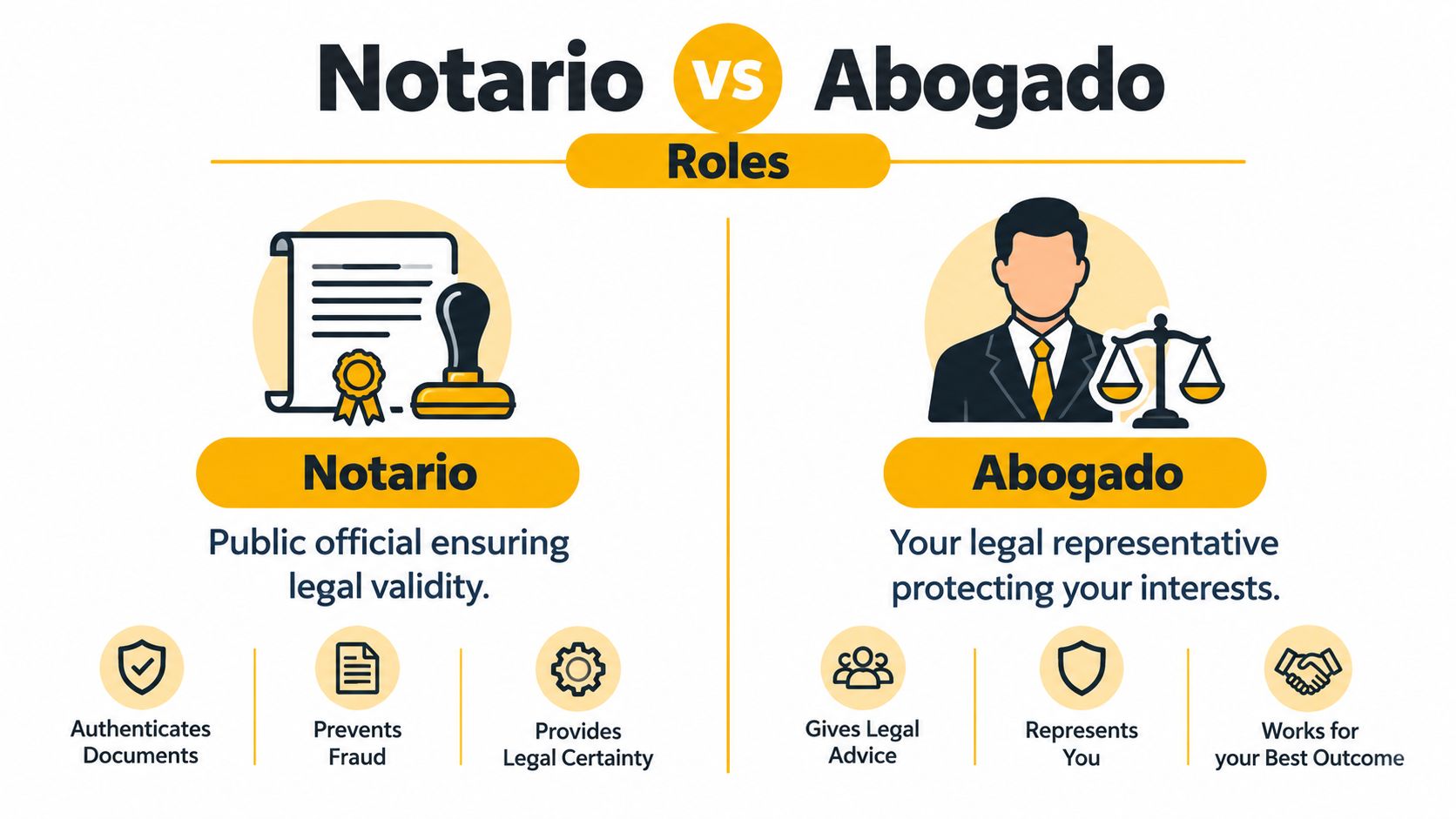
The Notario and the Abogado serve different functions. Confusing them is one of the most persistent misunderstandings among international buyers.
A Notario is a public official who authenticates documents and oversees the formal validity of the transaction. At completion, the notary checks identities, capacity, the deed and certain legal and administrative information. The public deed of sale is signed before the notary, which is the normal completion mechanism in Spain.
The Notario is neutral. They don't negotiate the price for you, investigate every practical risk in the property or advise you whether an illegal extension makes the purchase commercially sensible. They also don't act as your exclusive representative against the seller.
Your private Abogado, by contrast, is instructed by you. Their role is to investigate the property, review the contract, explain the consequences of signing and raise objections when the documents or proposed terms don't protect your position. A useful comparison is this: the notary is the impartial referee who ensures the formal transaction can take place, while your lawyer is the adviser in your corner before and during the match.
What the notary does
At the completion appointment, the notary's work is vital. They formalise the public deed and ensure the required legal formalities are observed. Their involvement gives the transaction its public character and makes the deed suitable for subsequent registration.
That doesn't mean the notary has conducted the full buyer-side investigation. A notarial signature isn't a substitute for checking whether a pool, terrace, extension or outbuilding corresponds with the planning and registry records. It also doesn't mean the purchase contract was drafted to give you the best remedy if the seller fails to complete.
The official administration describes the sequence clearly. After the sale deed and any mortgage deed are signed and the relevant taxes are paid, the transaction must be entered in the Land Registry. The deed is essential for registration and for the protection associated with registration, but the appointment itself isn't the final administrative step. Spain's official guidance on notaries and property registration confirms this distinction.
What your abogado should do
Your lawyer should act before you become contractually committed. Their work may include:
- Reviewing the reservation or private contract: Identifying deposit terms, deadlines, default provisions and conditions.
- Checking ownership and charges: Confirming that the seller owns the property and identifying mortgages, attachments, easements or other registered rights.
- Investigating planning status: Comparing what exists on the land with licences, declarations and municipal records.
- Coordinating documents: Organising NIE applications, powers of attorney, sworn translations and identification evidence.
- Managing completion: Confirming that taxes, deed signing and registration are dealt with in the correct order.
The two professionals complement each other. Replacing a lawyer with a notary is like asking an impartial auditor to negotiate your contract. The auditor may confirm that the document meets formal requirements, but they aren't engaged to decide whether the deal is wise for you.
Essential Legal Checks for International Buyers
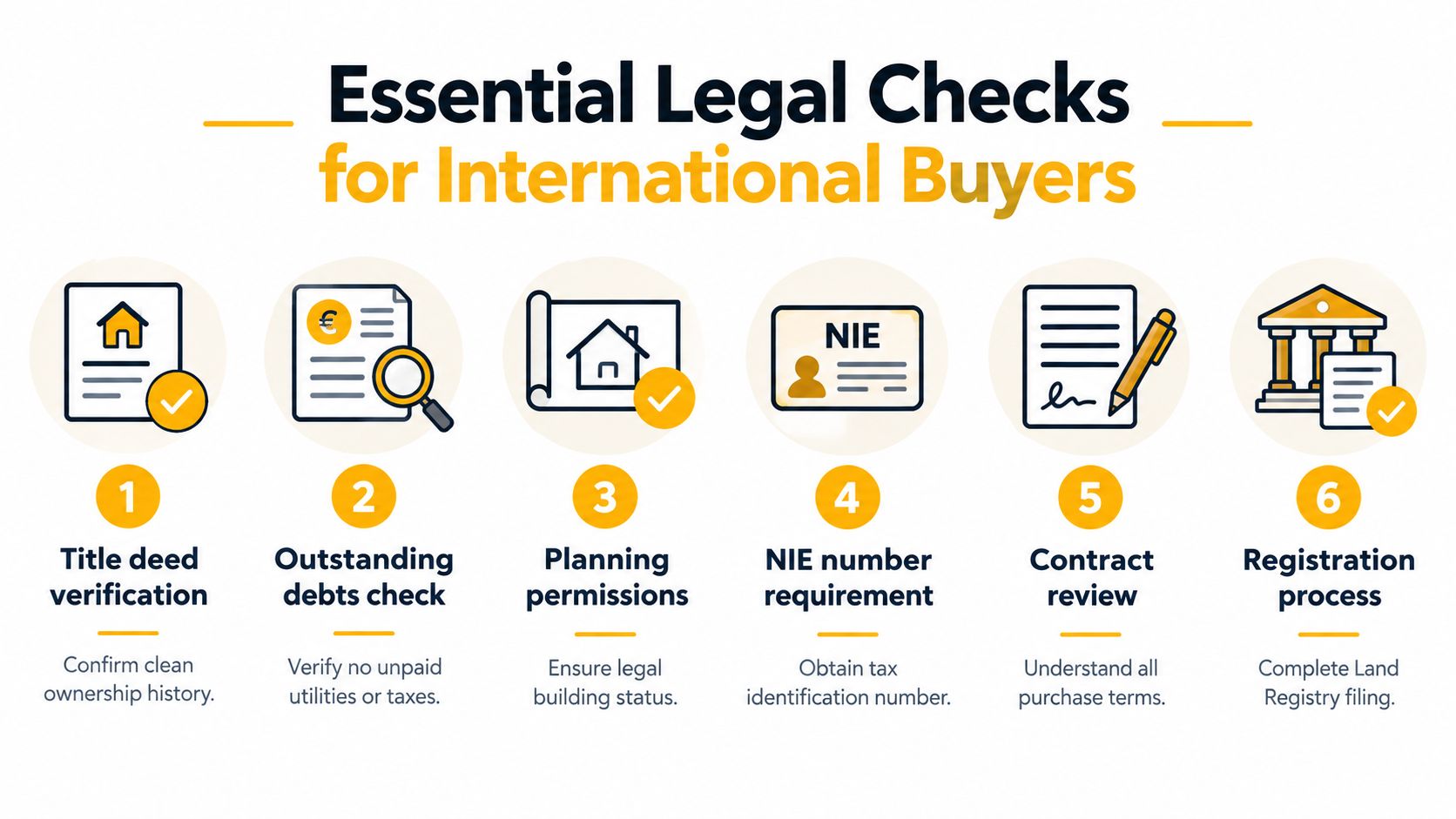
A useful due diligence process is document-led. Your lawyer should be able to tell you what has been requested, what has been received, what remains outstanding and what consequence follows if a document doesn't match the property.
Start with the Land Registry
The first check is official registry information from the Land Registry responsible for the property. It should confirm the registered owner, description and charges, including mortgages, attachments and other rights. Don't rely on a document supplied by an agent without confirming its origin and date.
For a property in La Romana, the official Registrars' service allows ownership and encumbrance information to be requested in English. Its listed price for an ordinary information extract is €9.02 plus 21% VAT per individual property, which makes an early title check a modest expense compared with the risk of acquiring registered liabilities. The official Registrars' buying-a-house service explains how this information can be requested.
Compare the records with the building
The registered description shouldn't be viewed in isolation. Your lawyer should compare it with the cadastral record, the purchase deed, planning documents and the physical property.
Many apparently simple coastal purchases become more complicated. A villa may have a pool, enclosed terrace, garage, guest accommodation or extension that isn't reflected consistently across the records. The issue may be capable of correction, but that requires knowing what happened, whether the work had permission and whether the municipality accepts the current status.
For a rural or semi-rural property, check more than the house:
- Boundaries and surface area: Confirm that the land description is consistent.
- Access: Establish whether access is legally recorded, not merely used in practice.
- Water: Verify the source and legal basis for any well or other supply.
- Planning classification: Identify whether the land is urban, developable, rustic or subject to special restrictions.
- Outbuildings: Check garages, storage rooms, agricultural buildings and guest accommodation separately.
Review debts and community obligations
A lawyer should request evidence concerning property tax, utilities and, where relevant, community fees. An apartment or townhouse may have pending assessments for roofs, lifts, façades, pools or other shared works. Meeting minutes can reveal disputes or planned expenditure that won't appear in the sales brochure.
The contract should also state how known debts and charges will be cleared before or at completion. “The seller will sort it out later” isn't a suitable completion plan.
Confirm planning and use
Planning legality affects more than the seller's ability to complete. It can influence mortgage approval, insurance, future renovations, resale and the use you intend to make of the property.
A lawyer should establish whether the property has the relevant occupation or first-use documentation, whether extensions are authorised and whether any rental activity requires a licence or registration. If the property is near protected land, flood-prone areas or the coast, additional restrictions may apply. The correct checks depend on the municipality and the property itself.
Get your identity and authority documents ready
International buyers often lose time because they begin the legal review before preparing their own documents. Obtain the NIE, verify passports and tax-residency information, and arrange any power of attorney early if you'll complete from abroad.
Where a company is buying, the lawyer should identify the beneficial owners and confirm corporate authority. Foreign civil-status documents may need apostille or other legalisation and sworn translation before a notary, bank or registry can accept them.
Navigating Taxes and Registration Requirements
Tax depends on the property's classification, the transaction structure and the autonomous community where the property is located. A buyer in La Romana needs advice based on Valencian Community rules, not a generic Spain-wide estimate.
For a new dwelling, Spain's official guidance states that VAT generally applies at 10% for ordinary dwellings and 4% for officially protected or publicly promoted housing. Other property types can attract VAT at 21%. Resale purchases fall within the regional Transfer Tax and Stamp Duty framework, whose rates are administered by the autonomous community. Official guidance on Spanish property taxes sets out the distinction.
The legal sequence matters:
- The deed is prepared and signed before the notary.
- The applicable tax filings are made and paid.
- Evidence of payment is submitted for registration.
- The Land Registry entry is checked after filing.
The buyer's nationality and residence status can affect the practical administration of the purchase. A non-resident may need additional bank checks, source-of-funds documents and tax coordination. A British, Swiss, American or other non-EU buyer may also need carefully prepared legalised documents, while an EU buyer may have a different documentation route. These distinctions should be identified at the beginning, not at the notary appointment.
The notary may submit the deed electronically to the Land Registry and assist with tax or cadastral processing. Your lawyer should still verify the outcome. Signing the deed, paying tax and obtaining the completed registry entry are related stages, but they aren't the same event. Spain's official completion guidance confirms that registration requires evidence that the relevant taxes have been paid.
Spain's foreign-buyer demand makes this coordination routine rather than unusual. The Registrars recorded approximately 93,000 foreign purchases in 2024, representing 14.6% of residential acquisitions nationally. Foreign buyers accounted for 28.9% of purchases in the Valencian Community, 23.6% in the Region of Murcia and 43.8% in Alicante province. The 2024 Registrars' annual statistics show why local counsel must be comfortable with cross-border completion.
Estimating Costs and Typical Fee Structures
Legal fees are only one part of the acquisition budget. A clear engagement letter should separate professional fees, taxes, regulated charges, translations, powers of attorney, technical reports and any work that falls outside ordinary conveyancing.
A fixed fee can work well for a straightforward resale when the scope is clearly defined. It gives you predictability, but it may exclude planning advice, litigation, company structuring or complex rural investigations. Hourly billing can be more suitable when the matter is uncertain, although you should request an estimate, reporting intervals and approval requirements before additional work begins.
Cost Category | Estimated Range / Notes |
|---|---|
Property lawyer | Obtain a written quote defining title checks, planning review, contract work, completion and registration support. |
Notary | Regulated charge that varies with the deed, price and complexity. Request a transaction-specific estimate. |
Land Registry | Regulated registration charge, separate from legal fees. |
Transfer Tax or Stamp Duty | Depends on the resale transaction, property classification and Valencian Community rules. |
VAT on a new dwelling | Official guidance states 10% for ordinary dwellings and 4% for officially protected or publicly promoted housing. |
VAT on other property types | Some property types may attract 21% VAT, so classification must be checked. |
Registry information | An ordinary extract is listed at €9.02 plus 21% VAT per individual property by the Registrars' service. |
Translation and legalisation | Cost depends on the document, language, issuing country and whether sworn translation or apostille is required. |
Technical or planning review | May be separate where the property has extensions, rural land, pools or unresolved discrepancies. |
What a transparent quote includes
Ask whether the fee covers the first registry search, contract review, communication with the seller's side, checks with the town hall, tax coordination, notary attendance, power of attorney arrangements and post-completion registration.
A very low quote may cover only a narrow contract review. That can be appropriate if you're an experienced buyer with a clean, fully documented property, but it isn't equivalent to full conveyancing. The practical comparison is scope against risk, not price alone.
Ask for exclusions in writing. A quote that says “legal services included” without describing the work leaves too much room for disagreement.
You should also ask when payment is due and whether tax, notary and registry funds are held separately from professional fees. Keep a written record of every transfer and request confirmation when each administrative stage is completed.
How to Verify Credentials and Choose Your Lawyer
A lawyer may speak your language and know Alicante well, yet still be the wrong choice if their loyalty is unclear. Your lawyer should act only for you, independently of the seller, developer, estate agent and bank. That independence matters because the Notario confirms and formalises the transaction, while your Abogado investigates risks and advises whether you should proceed.
Before sending documents or money, ask each candidate:
- Are you registered with the relevant Spanish Bar Association? Request registration details and confirm that the lawyer is authorised to practise.
- Do you act exclusively for me in this purchase? Ask about any relationship with the estate agent, seller, developer or lender.
- What does your written fee include? Separate ordinary conveyancing from planning, tax, dispute or remedial work.
- Who will handle the matter day to day? Get a named contact and a clear method for urgent communication.
- Have you handled properties in La Romana or the relevant Alicante municipality? Local experience can help with town hall records, planning history and rural-property issues.
- How will you report problems? The explanation should cover the consequence, available remedy and decision required from you.
- Can you attend completion or arrange suitable representation? Establish this before signing a power of attorney.
- Which documents do you need from me now? The request should show that the firm has a workable process for overseas buyers.
A useful first meeting ends with a document list and timetable. For a coastal purchase, ask who will obtain and review the nota simple and title deed, cadastral information, planning records, licences for extensions or pools, community-fee status, local tax position and any restrictions affecting the land. The lawyer should identify which document comes from the seller, registry, town hall or community administrator, and explain what happens if the records conflict.
A strong adviser distinguishes a missing document from a serious defect. If discrepancies are dismissed, signing is rushed or the written scope is refused, pause and obtain another opinion.
AP Properties Spain coordinates property-purchase support for international clients, including introductions to independent bilingual Spanish lawyers, document collection, contracts, permits, licences and notary documentation. For a La Romana, Costa Blanca or Costa Cálida purchase, ask the team to connect you with an appropriate independent property lawyer before signing or transferring funds.
Share