






Overseas Property Spain: The 2026 Buyer Guide
In 2025, foreign purchasers were responsible for 43.29% of residential acquisitions in Alicante, compared with 13.82% across Spain. That gap changes how you should approach overseas property in Spain. You aren't entering a uniform national market. You're buying into a highly international, locally regulated environment where the municipality, property type, intended use and exit audience matter more than a glossy lifestyle brochure. (Spanish Registrars)
For buyers focused on La Romana, Alicante and the wider Costa Blanca, the sensible strategy is simple: choose the micro-market first, verify the legal use second, and only then negotiate the property. A sea view can be compelling, but it won't correct an inconsistent title, an unusable rental plan or a renovation that municipal planning won't recognise.
Foreign Demand Patterns in Eastern Spain
Foreign buyers accounted for 13.82% of Spanish home purchases in 2025, approximately 97,500 transactions, compared with about 93,000 in 2024. Their national share was below the 14.98% recorded in 2023, yet national averages hide the concentration across eastern and southeastern Spain. Foreign purchasers represented 27.65% of purchases in the Valencian Community, 21.42% in the Region of Murcia, and 43.29% in Alicante province. (Spanish Registrars)
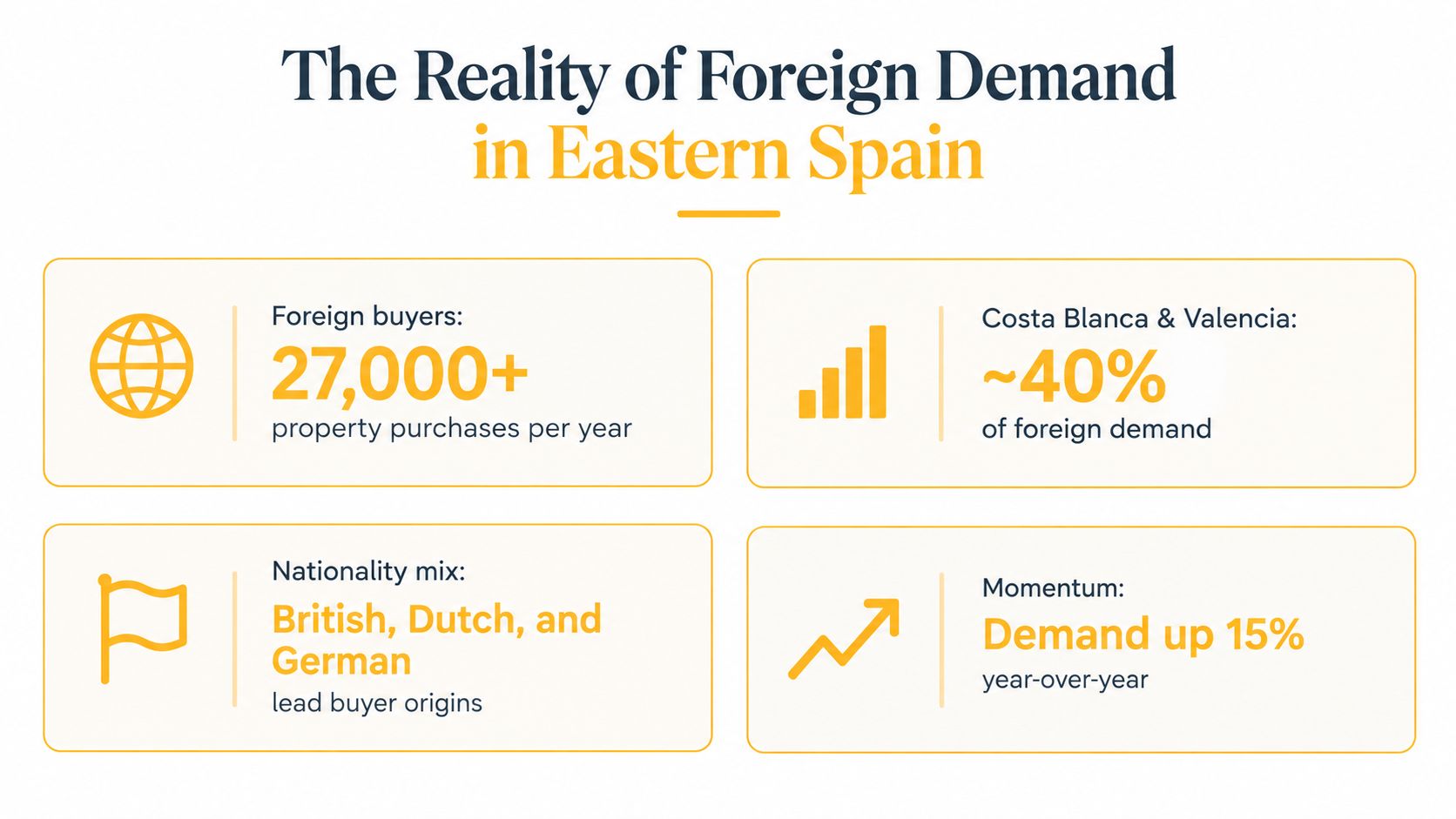
Alicante is therefore a highly international market, not a marginal second-home niche. Almost one in every two residential purchases involved a foreign buyer. Among foreign purchases, British buyers represented 7.97%, followed by Germans at 6.52%, Dutch buyers at 6.31%, Moroccans at 5.74%, Romanians at 5.24%, French buyers at 5.11%, and Italians at 5.05%. These buyer groups create demand, but they do not make every property easy to resell. (Spanish Registrars)
Why concentration matters
International demand gathers where coastal amenities, transport links, established services and resale liquidity meet. The Valencian Community and Andalusia together accounted for approximately 65% of Spain's non-resident foreign transactions in 2023. In that year, non-resident foreign purchasers represented roughly 20% to 25% of residential transactions in the Valencian Community. (Bank of Spain presentation)
That concentration brings competition as well as opportunity. Before purchasing, identify the property's likely exit audience. A home may suit British retirees, a Dutch family seeking seasonal use, a Spanish household requiring year-round occupation, or an investor seeking lawful rental income. Each audience values different access, services, property layouts and documentation.
Practical rule: Treat international demand as a market condition, not a guarantee of resale.
Population movement strengthens the case for examining year-round demand. During the first quarter of 2025, the Valencian Community recorded population growth of 0.50%, while the Region of Murcia grew by 0.26%. Tourism influences these markets, but relocation, employment, family movement and permanent settlement influence housing decisions too. (Spanish Registrars' first-quarter statistics)
For an overseas buyer, the recommendation is clear. Use local transaction expertise, multilingual communication and independent legal coordination from the beginning. A national guide can explain the broad process. Only local due diligence can establish whether a La Romana property has appropriate planning status, reliable access, documented services and a credible resale audience.
Navigating the Costa Blanca and Costa Cálida Micro-Markets
Alicante, Murcia, Almería and the Costa del Sol are separate markets, not interchangeable coastal destinations. Buyer profiles, construction standards, transport links, services and international competition vary sharply. Even within the Costa Blanca, an inland villa in La Romana has a different risk and resale profile from an apartment in Torrevieja, a townhouse in Orihuela Costa or a new residence near Alicante city.
Compare the location with the intended use
La Romana suits buyers seeking space, privacy and a rural setting in Alicante province. It can work for permanent relocation, a private retreat or a renovation project, provided the buyer verifies legal access, utilities, building records and the journey to everyday services. A coastal apartment may attract more seasonal demand and allow easier lock-up-and-leave ownership. Community fees, building rules and restrictions on letting can still change the financial result.
The Costa Cálida has a distinct buyer mix and property supply. Murcia recorded foreign participation of 21.42% of purchases in 2025, below Alicante's level but still indicating substantial international demand. The Region of Murcia also recorded population growth of 0.26% in the first quarter of 2025, supporting interest from local households as well as overseas owners. As noted earlier, the available regional statistics support examining permanent demand alongside tourism.
Choose the market against the intended use:
- Permanent relocation: Check year-round access to healthcare, shops, schools and professional services.
- Seasonal ownership: Confirm that the home remains secure, manageable and affordable while you are abroad.
- Long-term letting: Test its appeal to local tenants rather than relying only on holiday demand.
- Holiday letting: Confirm that the use is permitted and that any licence or registration can be verified.
- Resale: Identify the likely next buyer and the competing properties they will compare.
The municipality is the investment unit
National averages are too broad for a serious acquisition. Compare the exact municipality and property type. Review whether the home is new-build or resale, urban or rural, detached or within a community, close to services or dependent on a car, and suited to year-round occupation or seasonal use.
The Costa de Almería and Costa del Sol can attract strong international interest, but individual properties still carry different liquidity risks. A high-value villa aimed at a narrow luxury audience has a different exit profile from a well-connected apartment with broad practical appeal. A cheaper inland property may provide more space while requiring substantial work before it meets the expectations of international buyers.
Your objective determines the right location. Do not ask which coast is “best”. Ask which municipality supports your intended use, budget, management capacity and eventual exit.
For a La Romana purchase, complete a property-level review before becoming emotionally attached. Confirm roads, water, electricity, internet, planning records and nearby services. Then compare the property with realistic alternatives across inland Alicante. A rural villa should be judged against similar homes, not against a coastal holiday apartment with a different buyer base and operating model.
Legal Prerequisites and Tax Structures for International Buyers
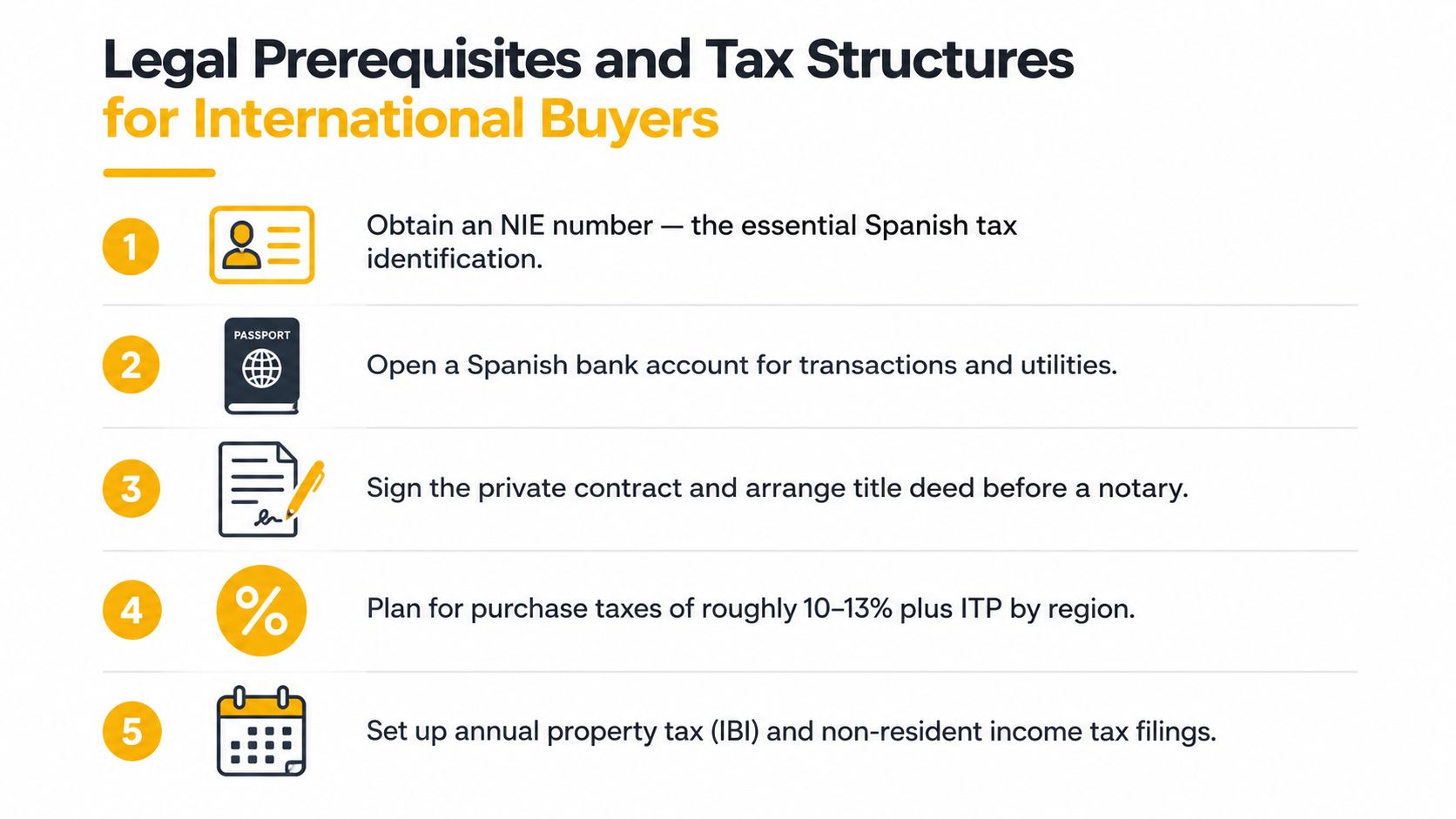
Cross-border purchases become expensive when the buyer treats administration as a final formality. The correct order is to identify the buyer, prepare the banking route, obtain independent legal advice, verify the property and calculate taxes before funds are committed.
Start with identification and banking
A foreign buyer generally needs a Foreigner Identification Number, or NIE, for fiscal transactions such as buying property and opening a Spanish bank account. Non-residents can apply through a Spanish embassy or consulate or appoint a representative in Spain. The NIE identifies you for administrative and tax purposes, but it doesn't grant residency. (UK government guidance on buying property in Spain)
Obtain it early. Your lawyer or representative can help coordinate the application, while the bank will usually need identity, tax-residence and source-of-funds documentation. Prepare those documents before signing a reservation agreement. Delays at this stage can affect finance, contracts, utilities and completion.
Separate new-build and resale taxation
For a newly built dwelling, VAT is normally charged at 10% of the purchase price. Officially protected housing or housing under a public-promotion scheme may qualify for a 4% rate. The buyer normally pays VAT to the vendor, who accounts for it to the tax authorities. Confirm the property's classification before using the lower rate in any budget. (Spanish government property tax guidance)
Resale purchases follow a different regional tax structure, so don't apply a new-build calculation to an existing home. Your independent Spanish lawyer should produce a transaction-specific completion estimate covering the purchase tax, notary, registration, legal work, finance and any technical reports.
A solid purchase file should include:
- Identity documents: Passport, NIE application or certificate, tax-residence details and powers of attorney where required.
- Funds evidence: Bank statements and documents explaining the lawful origin of the money.
- Title evidence: Land Registry information, cadastral details, deeds and information about charges.
- Planning evidence: Licences, declarations, occupation or habitability documentation and records of alterations.
- Contract review: Reservation terms, deposit conditions, completion deadlines and remedies if either party defaults.
The notary is essential, but the notary is neutral. The notary doesn't replace a buyer's lawyer, negotiate commercial terms or investigate every practical risk. Have your own legal adviser review the file before you sign or transfer a deposit.
The New Compliance Landscape for Holiday Rentals
Holiday-rental income does not automatically come with a coastal property. Spain's national short-term-rental framework requires homes advertised through online platforms to display a registration number. Authorities can revoke that number when legal requirements are unmet or outstanding deficiencies remain.
By July 2025, authorities had reported more than 215,000 short- and seasonal-rental applications, including 169,908 tourist-rental applications, or 78.87% of the total. The volume confirms a major compliance shift, not a licence for every property on a portal. A buyer needs property-level verification before treating projected rental income as reliable. (Spanish government rental-registration update)
Verify the complete permission chain
A listing stating “tourist rental permitted” is not evidence of a transferable right. Before signing, instruct your independent lawyer to verify:
- Regional authorisation: Does the property satisfy the Valencian or Murcian rules for the proposed activity?
- Municipal planning: Does planning permission allow tourist accommodation at this address?
- Community rules: Has the owners' association adopted restrictions on short-term letting?
- Registration status: Is the registration active, correctly linked to the property and usable after completion?
- Physical compliance: Does the dwelling meet applicable safety, equipment and occupancy standards?
- Transferability: Does the permission survive the sale, or must the buyer submit a new application?
A licence, registration number and community approval are separate requirements. Your sale contract should state who bears the risk if the intended rental use cannot be confirmed before completion. Do not release a deposit against verbal assurances or an expired registration.
Compare three operating scenarios
Model the purchase against three uses, rather than relying on one optimistic holiday-let forecast:
Intended use | Main question | Principal risk |
|---|---|---|
Licensed holiday rental | Are every approval and operating condition current? | Licence loss, restrictions and management complexity |
Medium-term rental | Is there demand from workers, relocators or seasonal residents? | Vacancy between occupancies and tenant management |
Personal use or long-term rental | Does the property remain viable without tourist income? | Lower flexibility or slower income growth |
Alicante has 35,716 tourist dwellings, placing it among Spain's provinces with the highest totals. The figure confirms an established holiday-rental market, not approval for a particular address. Check Valencian licensing, registration, planning and community-property requirements before including rental income in your financing or return calculations. (National Statistics Institute tourist-dwelling data)
Recommendation: If the purchase only works with holiday lets, do not proceed until qualified advisers document the permitted use in writing. If the property also works as a medium-term, long-term or personal-use asset, the investment has a more defensible risk profile.
The Value of a Boutique Consultancy in Cross-Border Transactions
A property portal can show you listings. It can't take responsibility for whether a rural extension is recorded, whether the community has approved tourist letting, whether the seller's documents align or whether the renovation brief is realistic. Those tasks require people who understand the municipality and coordinate the specialists around the purchase.
Foreign non-residents owned about 11% of Alicante's housing stock, compared with roughly 2% nationally, according to the Bank of Spain. That ownership pattern explains why multilingual guidance and transaction coordination aren't decorative extras in Alicante. They're part of the market's operating structure. (Bank of Spain analysis of foreign ownership)

What meaningful support looks like
A boutique consultancy should add value before and after the viewing:
- Area selection: Compare La Romana with coastal and inland alternatives according to your intended use, services and resale audience.
- Shortlisting: Reject unsuitable properties early, including homes with unclear documentation or unrealistic rental assumptions.
- Negotiation: Use the legal and technical findings to set terms, conditions and deadlines.
- Coordination: Keep the buyer's lawyer, notary, bank, surveyor, architect and seller aligned.
- Communication: Explain Spanish documents and decisions in a language you understand, without pretending that translation replaces legal advice.
- Aftercare: Coordinate architects and builders when the property needs refurbishment, energy improvements or a turn-key finish.
AP Properties Spain is one example of this model. The Costa Blanca and Costa Cálida consultancy works with international buyers on property selection, administrative coordination, negotiations, completion and renovation arrangements through architects and builders. The right adviser shouldn't pressure you to buy. They should make it easier to identify when a property isn't worth buying.
Executing a Secure and Transparent Property Acquisition
A secure purchase is built around evidence. Before you send money, your lawyer should match the Land Registry, cadastral information, deed, planning records and physical property. Any mismatch might be explainable, but you need the explanation documented before signing.
The checks that protect the purchase
Start with ownership and charges. Confirm that the seller owns the property and that mortgages, liens, embargoes, easements and other burdens are identified and resolved. Obtain confirmation of property-tax and community-fee status, including any pending extraordinary assessments.
Then examine lawful use. For a rural home near La Romana, review land classification, building permissions, pools, outbuildings, water rights, boundaries and legal access. For a coastal or community property, check planning status, occupation documentation, community rules, energy information and any rental restrictions. Don't treat a beautiful renovation as proof that the work was authorised.
The contract should reflect the findings. It should specify the property accurately, state what is included, define the completion timetable and protect your deposit if a critical legal or planning issue emerges. Your lawyer should review the reservation contract before you sign it, not afterwards.
The safest sequence is lawyer first, documents second, money third.
Alicante's substantial tourist-dwelling stock makes rental due diligence particularly important, but the same principle applies to every intended use. If you want a private retreat, confirm access and maintenance. If you want a relocation home, test year-round services. If you want an investment, model lawful alternatives instead of assuming holiday income.
Ownership also continues after completion. Arrange insurance, utilities, tax filings, property maintenance and local oversight before you leave Spain. Keep invoices and official records, particularly for improvements, because they can matter when you sell or transfer the property.
Overseas property in Spain can deliver a strong lifestyle decision and a defensible long-term asset, but only when the purchase survives legal, operational and resale scrutiny. If you want a locally grounded assessment of homes across La Romana, Alicante, Costa Blanca or Costa Cálida, speak with AP Properties Spain about your intended use, documentation requirements and renovation plans. Their team can help coordinate the search, negotiations and completion process before you commit funds.
Share