






Nie Nummer Spain
Applying for a Spanish NIE through a consulate takes roughly two weeks and costs approximately €9.84, but you must submit the correct forms and clear proof of an economic interest in Spain. The number is essential for a property purchase, yet it isn't a residence permit and it doesn't authorise you to live in Spain.
You may be looking at a villa near La Romana, comparing resale homes around Alicante, or preparing to sign a reservation agreement on the Costa Blanca. Then someone asks for your NIE, and the purchase suddenly feels less like a viewing and more like an administrative project. That reaction is understandable. The process is manageable, but small errors involving jurisdiction, forms, payment or supporting evidence can disrupt a carefully planned transaction.
For buyers, the important distinction is simple: the NIE is an identification number, not immigration status. The Spanish Ministry of the Interior describes it as a permanent, personal, unique and sequential identifier for foreign nationals who interact with Spain for economic, professional, social or other reasons. It must appear on documents issued or processed for you, including paperwork connected with property, banking and tax matters. You can review the official Spanish Ministry of the Interior NIE guidance before starting.
Why Your NIE Number Is Essential for Buying Property
A buyer can spend a morning viewing properties in Alicante, agree on a home in La Romana by the afternoon, and still be unable to complete the administrative side of the purchase without an NIE. The issue usually appears when the lawyer, notary, bank or tax professional needs to identify the foreign buyer on formal documents. The property may be perfect, the funds may be available, and the seller may be ready, but the file remains incomplete.
The Número de Identidad de Extranjero, or NIE, solves that identification requirement. It's assigned to foreign nationals who have a legitimate economic, professional or social connection with Spain. A property purchase is one recognised reason, alongside banking transactions, tax declarations, inheritances and company formation. The number remains associated with you, rather than with one specific property or one temporary visit.
Practical rule: Treat the NIE as a transaction prerequisite, not as paperwork to handle after every commercial decision has been made.
The number's role extends beyond the purchase contract. Spanish authorities require it on relevant documents processed for the foreign national, so it can become part of the wider administrative trail around ownership, taxes, banking and other property-related obligations. That's why an estate agent, solicitor or gestor may ask for it early, even when the buyer hasn't yet chosen a final property.
It isn't a residence permit
A frequent misunderstanding is to assume that receiving an NIE grants the right to stay in Spain. It doesn't. The NIE identifies you for Spanish administrative, legal and financial purposes, but it doesn't prove residence and it isn't a residence permit.
This distinction matters for international buyers considering a holiday home on the Costa Blanca. You may obtain an NIE because you're buying property while remaining resident in another country. If you later intend to live in Spain under a separate immigration route, that status must be assessed independently.
The practical lesson is to make the NIE one of the first administrative actions after your purchase purpose becomes genuine. Don't wait until the signing date is close. At the same time, applying without a credible reason creates its own risk, because the authority needs to understand why you require the number.
Choosing the Right Application Route for Your Situation
There are three practical routes for obtaining an NIE. You can apply through the Spanish consulate responsible for your country of residence, apply personally in Spain through an Immigration Office or police station handling the procedure, or use a legally authorised representative in Spain. The best choice depends on where you live, how soon you need the number, whether you're already travelling, and how much control you want over the appointment.
Applying through a Spanish consulate
A consulate is often the cleanest option for a buyer who lives abroad and wants the NIE before travelling to Alicante. You deal with the Spanish mission responsible for your place of residence, rather than choosing any consulate that happens to be convenient. Consular rules can differ in appointment availability, payment methods, evidence requirements and collection arrangements.
The principal advantage is planning. You can begin the administrative process before a viewing trip or purchase visit. The disadvantage is that the consulate may have limited appointments, and physical attendance may still be required. Spanish consular guidance states that the applicant or an authorised representative must appear physically, so you shouldn't assume that a fully remote application by email is available.
Applying in Spain
Applying in Spain can suit a buyer who's already in the country and has a clear property-related reason. The application is made personally through the relevant Immigration Office or police station. This route gives you direct control over the documents and the explanation you provide, but it requires you to identify the correct office and follow its appointment system.
It's also a poor choice if your purchase timetable depends on receiving the number during a very short visit. Local capacity, appointment access and document corrections can make the timing uncertain. Contact the receiving office before committing travel plans.
Using a representative
A duly accredited representative in Spain can submit the application on your behalf, provided the authorisation and supporting documents meet the receiving office's requirements. This can be useful when you're abroad, can't attend the relevant appointment, or want a Spanish professional to manage the filing.
The trade-off is reduced personal control and the need to check exactly what authority has been granted. A representative can't repair an unexplained purpose or inconsistent passport details. They can only submit a file that is properly prepared.
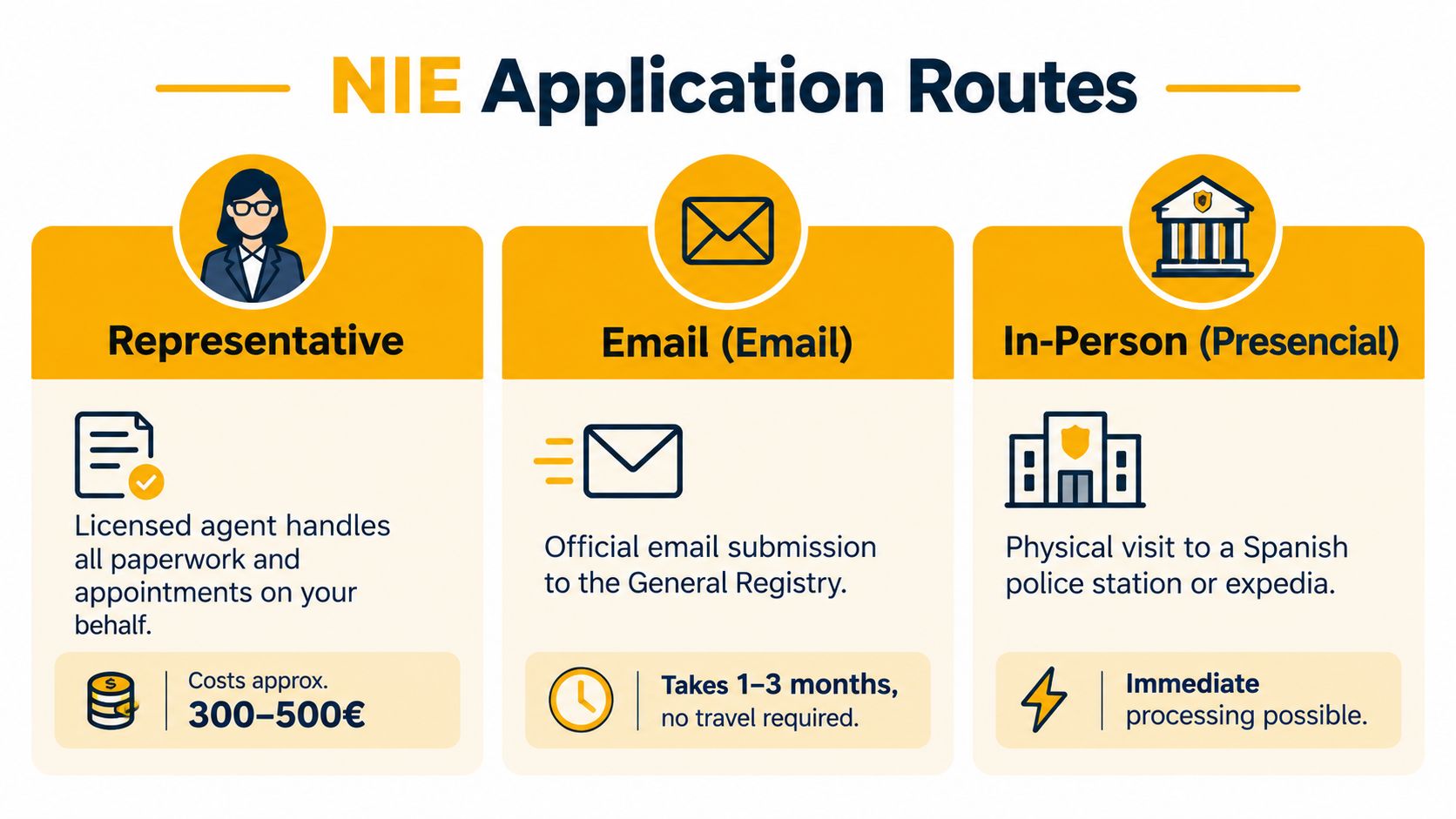
Use this decision test:
- Before travelling from abroad: Check the consulate serving your residence and prepare for its physical-attendance rules.
- Already in Spain: Confirm which local office handles NIE applications and whether an appointment is required.
- Unable to attend personally: Ask a legally authorised representative to confirm the required authorisation format before filing.
Preparing Your Documentation and Required Forms
A successful application is built around consistency. Your name, passport number, nationality and other personal details should match across the passport, Form EX-15, Form 790 code 012 and any authorisation documents. Spanish offices can correct genuine administrative issues, but a mismatched identity record creates an avoidable reason to pause or reject the file.
Start with the reason for the application
The NIE application requires a legitimate economic, professional or social reason. For a buyer, state the property purpose clearly. A vague sentence such as “I need an NIE for Spain” is weaker than a direct explanation that you require the number for a planned property purchase in Alicante, the Costa Blanca or another defined Spanish location.
Evidence should support that explanation. Depending on the stage of your transaction, this may include property-related correspondence, a reservation or purchase document, or written confirmation from a professional involved in the transaction. Don't submit evidence that refers to a different name, property or transaction without explaining the connection.
Complete Form EX-15 carefully
Form EX-15 is the main NIE application form. Complete and sign it with the same personal details shown in your valid passport. The reason for requesting the number should be explicit rather than implied.
Before printing or submitting the form, check:
- Your full name matches the passport character for character.
- The passport number and nationality are correct.
- The stated Spanish address or contact details are accurate where requested.
- The purpose refers to a genuine economic reason.
- The signature is present and consistent with the receiving office's requirements.
Don't leave the application until the appointment morning. A completed form gives you time to compare every field with the passport and supporting evidence.
Complete Form 790 code 012
Form 790, code 012, is used for the administrative fee connected with issuing the NIE. It isn't a property-purchase tax and it isn't calculated as a percentage of the property price. Complete the form using the same identity details and retain the payment receipt.
Bring the original valid passport and a copy of the complete passport or the pages requested by the relevant office. The Ministry of the Interior identifies the original passport or equivalent valid identity document, together with a copy, as standard documentation. Consular or local instructions may set out additional copying requirements, so check them directly before attending.
Before submission: Put the passport, EX-15, Form 790 code 012 receipt, proof of purpose and representative authorisation, if applicable, into one organised file.
A representative should also verify whether the authorisation must be notarised, legalised, translated or presented in another format. Those requirements can depend on the receiving office and the applicant's circumstances. Never assume that a document accepted by one consulate will automatically be accepted by another.
Understanding Fees, Payments, and Processing Times
The fee and timing are both manageable when you treat them as local administrative variables rather than universal Spanish rules. Official consular pages publish different equivalent charges. One consular instruction lists €9.84 for a first issuance, while another publishes €9.54, so check the current instruction for your consulate or Spanish police office before generating or paying Form 790 code 012. The official Spanish consular information for NIE applications illustrates why a single assumed fee can be unreliable.
The charge is a separate administrative fee for issuing the identification number. It isn't a transfer tax, a notary fee, a solicitor's fee or a percentage of the property price. Confusing these costs can lead buyers to budget incorrectly or pay the wrong amount.
Payment depends on the receiving office
The consulate or police office may specify its own accepted payment method. Some instructions may require payment connected with Form 790 code 012, while a consular post may direct applicants to pay by card at the appointment. Check the current local instructions rather than relying on an online guide written for another country.
Keep the receipt with the rest of the application. If a representative submits the file, send a clear copy and confirm whether the office requires the original.
Build time into the purchase timetable
The most useful published processing benchmark for consular issuance is approximately two weeks, although the Spanish Consulate General in London warns that force-majeure or administrative circumstances can extend that period. You can read the Manchester consular NIE guidance for the physical-attendance and application details relevant to consular processing.
For a property purchase, build a minimum two-week administrative buffer before signing or completing, while allowing extra time for appointment scarcity, corrections, public holidays, postal delivery or local office capacity. Don't schedule a critical signing on the assumption that the number will arrive on an exact day.
Avoiding Common Mistakes During the Application Process
Most delays don't come from a complicated legal question. They come from a file that doesn't tell one consistent story. The passport identifies one version of the applicant, the EX-15 contains another spelling, the proof of purpose refers to a different transaction, and the appointment belongs to the wrong jurisdiction.
The failure points that matter most
- Unclear purpose: Explain the economic reason directly and attach evidence that supports it. A property purchase should look like a real transaction, not a general wish to own a home in Spain.
- Inconsistent identity details: Compare every form with the passport, including accents, middle names, passport numbers and nationality.
- Wrong consular jurisdiction: Apply through the Spanish consulate responsible for your country of residence. Convenience alone isn't a valid basis for selecting another post.
- Missing payment evidence: Complete Form 790 code 012 as directed and retain the receipt in the application file.
- Assumed remote submission: Confirm whether the applicant or representative must attend physically. Don't treat an email exchange as proof that the filing can be completed remotely.
- Confusing the NIE with residence status: Receiving the number doesn't grant residence or replace an immigration authorisation.
Use a transaction checklist
A week before the appointment, compare the appointment confirmation with your passport and the consulate or police office's current instructions. Then ask your solicitor, agent or representative to review the purpose evidence, not just the forms.
The most efficient workflow is usually organised around the purchase timetable:
- Confirm the property-related reason.
- Identify the correct route and jurisdiction.
- Check the local appointment and payment rules.
- Prepare EX-15, Form 790 code 012, passport copies and supporting evidence.
- Verify names and numbers across every document.
- Keep a buffer before any binding signing or completion date.
This approach works better than submitting quickly with an incomplete file. Speed only helps when the receiving office can accept the application at the first appointment.
Next Steps After Receiving Your NIE Number
Receiving the NIE doesn't finish the property process. It removes one important identification barrier, but you still need coordinated legal, banking, tax and completion work. Give the solicitor, bank and other authorised professionals a clear copy, and store the original approval document securely with your property records.
The NIE is permanent and personal, but that doesn't mean every related document is permanent. Keep the supporting paperwork, payment receipt, application copy and proof of purpose because they may help explain the origin of the number during later administrative or legal work.
Don't apply blindly too early
Applying early is usually sensible when you have a genuine and documentable purchase intention. It isn't always sensible to apply before you know why you need the number. An application without clear economic evidence can create more friction than waiting until the transaction has produced a suitable supporting document.
The right moment is generally after your purchase purpose is credible and before the property timetable becomes urgent. For a buyer considering La Romana, Alicante or another Costa Blanca location, that often means coordinating the application with the solicitor or property professional who can confirm what evidence the receiving office is likely to accept.
Once issued, the NIE can support banking, tax and contractual procedures, but it doesn't replace a residence permit if you intend to live in Spain under a separate immigration route.
AP Properties Spain helps international buyers coordinate property searches and the practical administration surrounding purchases on the Costa Blanca and Costa Cálida, including guidance on the NIE paperwork and connections with legal professionals. Visit AP Properties Spain to discuss your intended purchase, location and administrative timetable before you commit to a signing date.
Share