






Cost of Living Spain
Spain's average household spending reached €35,101 in 2025, up 3.1% year on year, while housing-related costs rose 5.8%, faster than any other expenditure group. That national benchmark is useful, but it understates the true cost of owning a large Mediterranean home, especially on the coast.
You may be comparing a sea-view villa near Alicante with a quieter townhouse inland, checking rental listings before committing, or trying to work out whether a second home will remain affordable once the novelty wears off. In reality, “the cost of living in Spain” is not one figure. It changes sharply with location, property size, occupancy, transport needs and access to services.
A buyer in La Romana, Alicante, can have a very different monthly budget from someone renting in Alicante city, living beside the beach in Orihuela Costa, or maintaining a villa near the coast for seasonal use. The right approach is to build your budget around the home and lifestyle you will choose, not around a national average designed to describe millions of households.
Two Buyers, Two Very Different Spains
One buyer arrives with a coastal wish list: a sea view, outdoor terraces, a swimming pool, air-conditioning and easy access to the airport, beaches and international services. Another is considering a townhouse in the Valencian Community, perhaps in La Romana or another inland municipality, where the property offers more space and quieter surroundings but may require a car for everyday errands.
Both ask the same question: what does it really cost to live in Spain? They won't receive the same answer.
The coastal buyer's purchase price is only the beginning. A detached property brings electricity demand, pool equipment, garden irrigation, insurance, maintenance and possibly community or private service charges. A second home also needs attention while empty. Gardening, pool care, security checks and pre-arrival cooling can turn an apparently inexpensive property into a meaningful annual commitment.
The inland buyer may benefit from lower rent or a lower purchase price, but the saving can shift into transport. A daily journey to Alicante, a private healthcare appointment on the coast or repeated airport transfers all cost time and money. Lower housing costs don't automatically mean lower living costs.
Match the budget to the lifestyle
Use these profiles while reading:
- Coastal villa owner: Detached home, regular air-conditioning, pool and garden, with strong demand for coastal services.
- Inland permanent resident: More space and quieter living, but greater dependence on a car or interurban transport.
- City apartment renter: Convenient services and public transport, with higher rent per square metre.
- Seasonal second-home user: Lower day-to-day consumption while absent, but ongoing security, insurance, maintenance and arrival costs.
Practical rule: Compare the full annual operating cost of a property, not just its asking price or monthly mortgage.
Spain remains attractive because buyers can still choose between dense coastal markets, regional cities and inland communities. The mistake is treating those choices as interchangeable. Your budget should reflect how often you'll occupy the property, how much space you need and how far you're prepared to travel for ordinary services.
What Spain's Household Budget Actually Reveals
The latest national benchmark gives international buyers a useful starting point. Spain's National Statistics Institute recorded average household spending of €35,101 in 2025, an annual increase of 3.1%, while average spending reached €14,066 per person. The housing, water, electricity, gas and other fuels category rose 5.8%, the largest increase among expenditure groups. These figures are reported in the INE 2025 Household Budget Survey.
That tells you two things. First, Spanish household spending is broad, covering ordinary consumption rather than the specific costs of an international buyer purchasing a villa. Second, housing-related costs are moving faster than the overall household budget, so an old national average can make future ownership look safer than it is.
Housing takes priority
The earlier household budget structure shows why property costs deserve particular attention. In 2024, housing, water, electricity, gas and other fuels absorbed 32.4% of household spending, while food represented 15.8%, transport 11.4%and restaurants and hotels 9.9%, according to the INE 2024 Household Budget Survey.
Housing is more than rent or a mortgage. For an owner, the category includes energy, water, maintenance, insurance and local services. For a coastal villa, the property's size and equipment can push those recurring costs well beyond what an apartment household experiences.
Food remains a substantial but more flexible category. A household can adjust its grocery habits, cook more often or reduce restaurant spending. It can't easily switch off a pool system, replace inefficient windows overnight or avoid a maintenance contract for a property that sits empty for months.
Transport reveals the importance of location. A city resident may walk to shops and use a local pass. An inland owner may need a vehicle for medical appointments, larger shopping trips, airport journeys and coastal access. The national percentage provides context, but it doesn't tell you whether your own transport budget will be light or unavoidable.
The Valencian benchmark
The Valencian Community recorded average spending per person of €13,704, with an index of 97.4 relative to the Spanish average, in the same INE release. That makes the region a useful reference for Alicante buyers, but it shouldn't be mistaken for a La Romana or Alicante city budget. Regional figures combine different municipalities, housing types and lifestyles.
My recommendation is to use the INE figure as a sanity check, then rebuild your budget around the specific property. Ask how much space you'll heat or cool, whether you'll need a car, how often you'll eat out and whether the home remains occupied year round.
Housing and Rent Where You Actually Want to Live
Housing costs vary enough across the Costa Blanca and nearby inland areas to change the entire affordability calculation. In 2025, rental data placed Alicante province at approximately €12.1 per square metre, with Alicante city around €13.1 per square metre. The Region of Murcia averaged about €9.1 per square metre, while Murcia city reached roughly €9.7 per square metre. These figures are shown in Idealista's 2025 rental report.
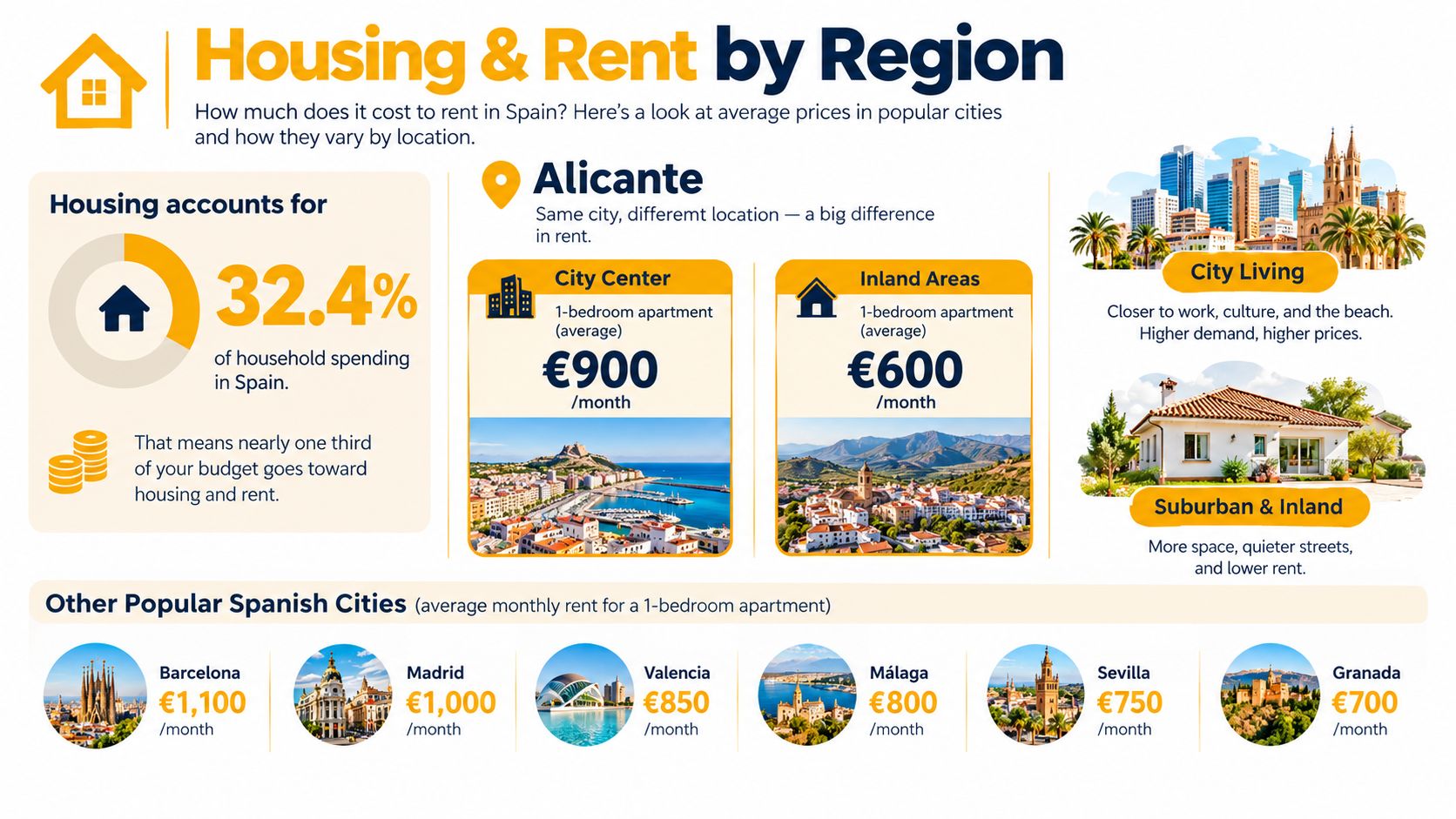
The gap becomes clearer inland. Alcoy was around €8.4 per square metre, compared with approximately €13.9 per square metre in Alicante city, while Alcantarilla was near €8 per square metre, compared with approximately €9.9 per square metre in Murcia city. Those differences matter because rent is often the largest monthly commitment for a tenant, and the purchase market tends to reflect the same location pressures.
What the square-metre gap means
A one-bedroom apartment in central Alicante can cost materially more each month than a comparable home inland. The difference pays for more than a postcode. Coastal and capital markets offer easier access to airports, private healthcare, restaurants, beaches, international schools and established rental demand. Inland towns can offer more floor space and a slower pace, but services may be less concentrated.
Moving inland by a manageable commute can reduce housing pressure, but don't count the saving without pricing the journey. Fuel, vehicle ownership, parking and time can erode part of the difference. A lower rent also may come with fewer furnished options, more seasonal service limitations and less immediate resale or rental liquidity.
Test the municipality, not the region
For every property, compare three alternatives:
- The exact municipality: Check rents and services where you'll live, not only the province-wide average.
- A nearby coastal option: Price the convenience you're giving up or gaining.
- An inland alternative: Include transport, healthcare access and airport journeys in the comparison.
A buyer considering La Romana should compare the complete monthly cost with Alicante, Torrevieja, Guardamar, Orihuela Costa and other relevant Costa Blanca locations. Don't assume the cheapest property produces the cheapest life. The sensible choice depends on whether you value coastal access every day or only occasionally.
Utilities and the Real Cost of Running a Mediterranean Home
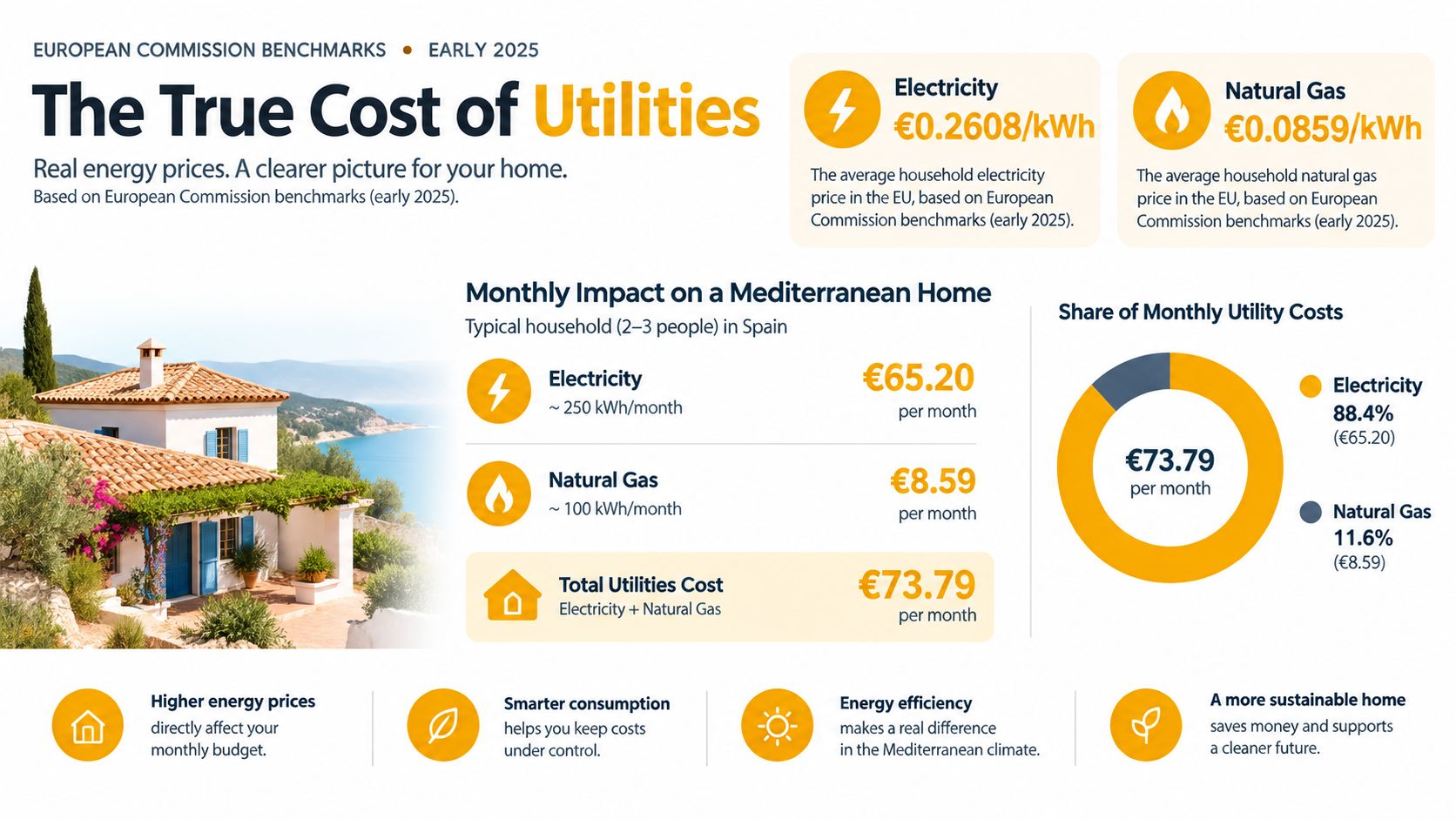
Spanish energy prices can look favourable at first glance. European Commission data places household electricity at approximately €0.2608 per kWh and household gas at about €0.0859 per kWh in the first half of 2025, both below the EU average, as reported in the European Commission energy price data.
The tariff isn't the whole bill. The property determines how much energy you use. An efficient apartment with good insulation is a completely different proposition from an older townhouse or a large villa with several air-conditioning units, a pool pump, exterior lighting and irrigation.
Three property profiles
An energy-efficient new-build apartment usually has a smaller conditioned area, modern systems and fewer external loads. The main variables are cooling, hot water, cooking and appliance use. Efficient heat pumps, external shading and smart controls can help keep consumption predictable.
An older townhouse may have more heat transfer through walls, roofs and windows. It can also rely on less efficient heating and cooling equipment. Before buying, inspect insulation, window quality, air-conditioning age, hot-water production and the electricity contract. A low purchase price can hide a renovation requirement that affects both comfort and running costs.
A large sea-view villa carries the greatest exposure. Air-conditioning may run across several zones, the pool pump operates regularly, irrigation serves the garden and exterior lighting adds a further load. The villa may also need cooling before arrival, remote monitoring while empty and scheduled cleaning or maintenance between visits.
Reduce consumption before you sign
Prioritise improvements that address the property's largest loads:
- Solar photovoltaic panels: Useful where roof orientation and planning conditions support generation.
- Insulation and shading: Reduce heat entering during hot weather and improve winter comfort.
- Efficient heat pumps: Replace outdated systems with equipment that delivers heating and cooling more efficiently.
- Smart controls: Let owners monitor temperatures and switch systems remotely rather than cooling an empty home continuously.
- Pool covers: Limit evaporation and reduce the work required to maintain pool temperature and cleanliness.
Get recent utility bills from the seller and ask which months they cover. A mild spring bill tells you little about a villa's summer profile. Ask for equipment ages, service records and the irrigation schedule as part of the purchase checks.
Spain's social-bonus framework isn't a general discount for international homeowners. For qualifying vulnerable domestic electricity consumers, the applicable discount was 42.5% from 1 July to 31 December 2025, while severely vulnerable consumers received 57.5%, according to the Spanish Official State Gazette rules. Eligibility matters, so buyers shouldn't build an ordinary ownership budget around those reductions.
Everyday Spending from Groceries to the Bus Stop
A normal week in the Costa Blanca interior often starts with a practical choice. Do you shop locally in La Romana, drive to a larger supermarket, or combine errands with a trip towards Alicante or another coastal town? The answer affects fuel, time and convenience more than a national food percentage ever can.
Food represented 15.8% of household spending in the 2024 INE structure. That makes groceries a meaningful recurring cost, but it's also one of the categories where households can adjust most easily. Buying seasonal produce, cooking at home and using local markets can support a lower-cost routine, while frequent restaurant meals and long shopping trips raise the total.

Transport depends on the corridor
In Alicante's metropolitan area, the 2025 listing for an Alicante TAM 30-trip pass was €21.20, with a temporary 50% reduction bringing it to €10.60 through 31 December 2025. The reduced 10-trip Móbilis Multiviaje ticket was €5.25, according to Generalitat Valenciana Alicante transport information.
Those urban figures don't automatically apply in La Romana. Regional interurban routes use separate regulated fares, and the Generalitat Valenciana lists corridors such as Alacant to Villena and Benferri, Orihuela, Guardamar and Alacant in its regional transport regulations.
For an inland household, transport planning should start with the destinations you use:
- Daily services: Shops, school, work and healthcare.
- Coastal access: Beaches, restaurants, hospitals and international amenities.
- Airport journeys: Family visits, business travel and property-related appointments.
- Large purchases: Furniture, appliances and home-improvement materials.
A city apartment can reduce car dependence but usually charges more for location. An inland property may give you more living space, yet each regular journey becomes part of the cost of enjoying it. Price the lifestyle, not only the bus ticket.
Sample Monthly Budgets for Four Realistic Profiles
The following budgets are planning frameworks, not national averages or promises. They deliberately avoid inventing unsupported totals. Use the INE benchmarks, local rent evidence and property-specific bills to fill in your own figures for housing, energy, food, transport, healthcare, insurance and discretionary spending.

Coastal villa owner
This profile suits a buyer near the Costa Blanca who occupies the villa throughout much of the year. Start with the financing or opportunity cost, then add electricity based on actual summer bills, water, pool servicing, gardening, insurance, maintenance and communications. Food and restaurants will resemble your chosen lifestyle, while transport depends on proximity to shops and healthcare.
The critical line isn't the grocery basket. It's the property operation. A villa with several air-conditioning zones, irrigation and exterior areas should be stress-tested against high-use months, equipment replacement and contractor visits.
Inland permanent resident
For a permanent resident in La Romana or a nearby inland town, housing may provide more space for the money. Build the budget around regular transport, vehicle running costs, fuel, insurance, maintenance and journeys to Alicante or other service centres.
Keep separate lines for routine living and irregular travel. A household can feel inexpensive most months, then absorb a large vehicle or home-repair expense. A reserve for these items is more realistic than treating every month as identical.
City apartment renter
A renter in Alicante city pays for location through rent per square metre. In return, daily errands, restaurants, services and public transport may be closer, reducing dependence on a car.
The budget should include rent, utilities, food, transport, healthcare, insurance, communications and a discretionary allowance. Ask whether community charges are included in the rent and verify which utilities remain in the tenant's name. The city profile suits people who value convenience more than maximum floor space.
Seasonal second-home user
This profile is often miscalculated. Owners may think an empty property costs nothing, but insurance, community charges, security, gardening, pool maintenance, utilities, internet and inspections continue between visits. Add pre-arrival cleaning, cooling and repairs caused by humidity or equipment failure.
Use two budgets: unoccupied months and occupied months. The second should include higher electricity, water, food, restaurants, transport and guest-related costs. This structure exposes the actual annual commitment more clearly than dividing a few holiday bills by the number of visits.
The cheapest home to operate is usually the one whose size, systems and location match how you actually live.
Choosing the Right Spain for Your Budget
The useful question isn't “is Spain affordable?” It's which Spain fits my lifestyle and budget?
If you want beaches, airport access and international services on your doorstep, accept that coastal housing and larger homes can carry higher recurring costs. If you prefer La Romana or another inland setting, value the space you gain, but price every regular journey to healthcare, shopping, the airport and the coast. If you're comparing Costa Blanca with Costa Cálida, use the same worksheet for each municipality rather than relying on a regional label.
Before committing, check four things:
- Rent before buying in the same municipality. A short rental period reveals traffic, seasonal noise, service access and real travel times.
- Inspect the property's energy profile. Request bills, identify air-conditioning and heating systems, check insulation and include pool and garden equipment.
- Price transport to essential destinations. Compare a walkable city location with an inland home after adding vehicle and interurban travel costs.
- Separate annual ownership from monthly occupancy. Second homes need security, maintenance, insurance and utilities even when nobody is present.
Don't let a lower purchase price persuade you to overlook operational reality. A smaller efficient apartment may suit a frequent traveller better than a large villa, while a permanent resident may reasonably choose inland space because they use the home every day.
The strongest decision comes from matching property, municipality and routine. Build one annual budget for the home you want, one for a nearby alternative and one for an inland option. Then compare the cost of living Spain offers you in practice, not the version presented by a generic national average.
AP Properties Spain helps international buyers compare Costa Blanca and Costa Cálida locations, coordinate rental or purchase arrangements, and organise practical move-in steps such as utilities and local support. Visit AP Properties Spainto discuss a property search built around your lifestyle, running-cost expectations and preferred municipality.
Share