





Denia Real Estate Market Guide 2026: What Buyers Should Know
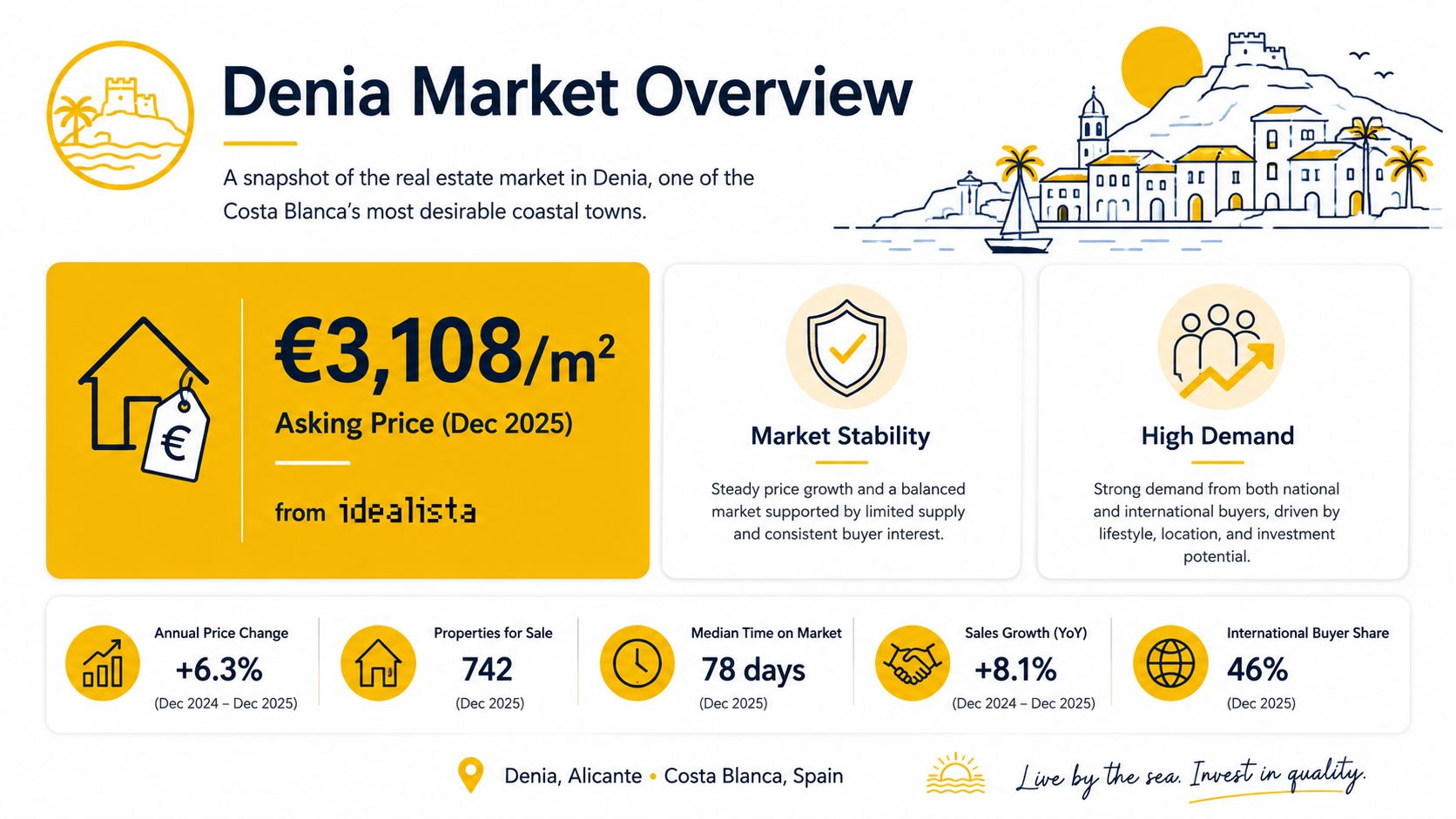
Dénia's current asking-price benchmark is €3,108 per square metre in December 2025. That number matters, but it's still an advertised figure, not the final price you'll end up paying, and the market itself shifts with neighbourhood, property type and the zoning rules attached to the address.
For anyone looking at Dénia real estate, that's the first trap to avoid. Buyers see a single €/m² headline and assume the whole town moves in one line, when in fact the market is split by coastline, urban streets, tourist-use stock and residential enclaves.
Understanding the Denia Market at a Glance
Dénia's asking-price benchmark reached €3,108 per square metre in December 2025. That headline matters, but it only makes sense once you separate asking prices from actual transaction reality and from the rules attached to each address. The idealista historical series for Dénia shows a rise from €2,860/m² in February 2025 to €3,108/m² in December 2025, a gain of €248/m² and roughly 8.7% over ten months, with a 9.3% year-on-year increase in December 2025.
What the headline price does and doesn't mean
That number gives you a current reference point. It does not tell you what a property will ultimately fetch once condition, sea views, parking, outdoor space, building age, and street type are factored in. A beachfront apartment, an inland family home, and a resale villa with weaker energy performance can sit under the same municipality-wide average while behaving very differently in negotiations.
Practical rule: use the citywide asking price as a starting line, not a purchase decision.
Month to month, the market still moved upward at the end of 2025. Prices rose 0.7% in December, after 0.2% in November and no change in October. That points to a market that is still firm, but not wildly swinging. For international buyers, that distinction matters because a steady average can hide sharp differences between streets, building stock, and zoning status.
Why the same average can mislead you
One average asks too much of one number. A renovated apartment near the seafront, a townhouse in the centre, and a larger villa with a dated layout will not trade on the same basis, even inside the same town. The market rewards fit, not just location.
Start with the intended use. Year-round living puts more weight on services, access, and resale liquidity. A second home often shifts the balance toward view, setting, and holiday use. Investment buyers need to test the licensing position, the zoning context, and the likely exit price together. The sharper question is which kind of Dénia property keeps its value when demand changes.
Denia Neighbourhoods and Where They Fit Your Lifestyle
Dénia looks compact on a map, but its micro-markets behave very differently. The urban centre, Les Marines, Les Rotes-Montgó and the port area each attract a different buyer profile, and each one carries a different balance of convenience, seasonality and liquidity. The tourist-home map makes that clear. Les Marines has the largest concentration with 2,574tourist homes, Les Rotes-Montgó follows with 1,432, and the urban centre has 605 registered units, around 40% of them on the seafront municipal tourism-home data.
The main areas and who they suit
Neighbourhood | Character & lifestyle | Typical property types | Best for |
|---|---|---|---|
Urban centre | Walkable, service-led, active year-round | Apartments, town flats, smaller resale homes | Permanent residents, buyers who want daily convenience |
Les Marines | Beach-oriented, highly seasonal, visitor-heavy | Apartments, holiday homes, front-line stock | Short-stay users, investors who understand seasonality |
Les Rotes-Montgó | Natural setting, quieter pace, more private | Villas, larger homes, mixed residential stock | Buyers who value space, views and a calmer setting |
Port area | Local life mixed with visitor traffic | Apartments and central homes | Buyers wanting central access without full tourist saturation |
The urban centre works well if you want cafés, shops and services at your door. It's the part of town where year-round living makes the most sense, but it's also the area where regulation needs close attention, because tourism pressure and residential demand overlap.
Les Marines is the obvious choice for buyers who prioritise beach access. It's also the most visibly tourist-led part of town, which can support holiday appeal but can also mean more competition, more seasonal noise and less neighbourhood stability. Les Rotes-Montgó tends to appeal to buyers who want a slower pace, more privacy and a stronger outdoor feel. The port area sits in between, where local life and visitor movement share the same streets.
A useful rule is to choose the neighbourhood by use first, then by view. Buyers often reverse that order and regret it later.
Buy the area that supports your routine, not the one that photographs best.
New-Build versus Resale Property in Denia
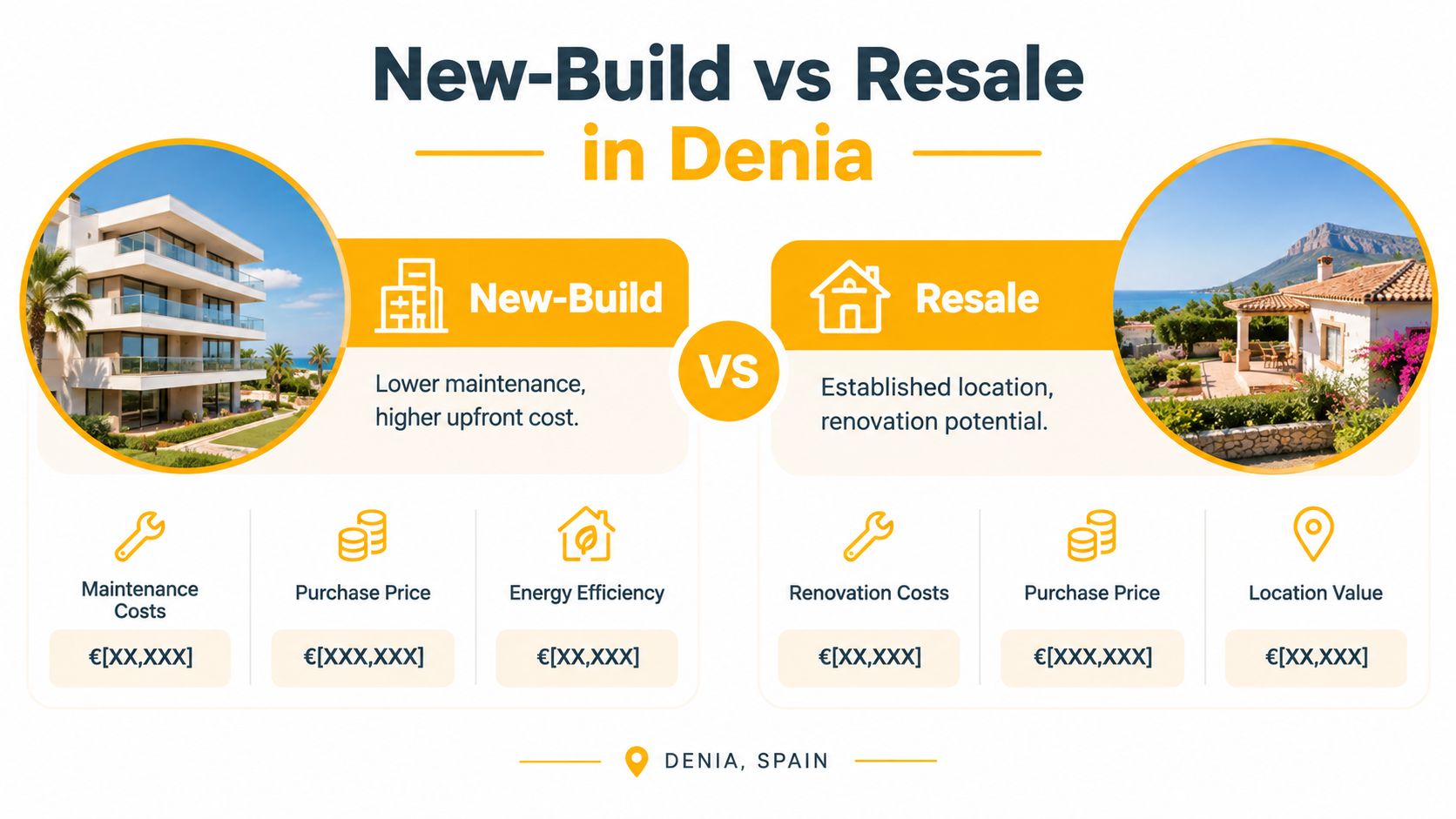
A Dénia buyer usually ends up choosing between two very different propositions. New-build offers modern standards, cleaner documentation and less immediate work. Resale offers location, character and often a better entry price, but it can hide renovation costs that don't show up until after completion.
Construction data helps frame the supply side. Alicante province saw 11,011 homes begin construction in 2025, 31.8% above 2024, with Dénia accounting for 517 starts, and average construction costs rose 6.1% year-on-year construction activity benchmark. That tells you supply is active, but not that finished stock is immediately available.
How the two routes differ in practice
Cost or risk item | New-build | Resale |
|---|---|---|
Upfront condition | Fresh, compliant, lower immediate maintenance | May need upgrades or corrective work |
Purchase friction | Often cleaner handover, but delivery risk exists | Faster occupancy if condition is good |
Budget planning | Higher headline price, fewer surprise repairs | Lower entry price, but renovation can add up |
Suitability | Buyers who want certainty and efficiency | Buyers who want location, character or better value |
The price tag alone doesn't decide the winner. A new-build may make sense if you need move-in readiness, energy efficiency and warranty protection. A resale can be stronger if location matters more than finish and you're prepared to fund works after completion.
The part buyers underestimate
Renovation isn't just cosmetic. Older homes can need energy improvements, plumbing attention, electrical updates or compliance fixes that eat into the discount you thought you were getting. New-build avoids much of that, but delivery timing and specification need closer scrutiny.
For an investor, the right question is not “which is cheaper?”, it's “which route gives me the more reliable total cost over the first few years?” For a homebuyer, the question is simpler, “which one lets me live the way I want without constant compromise?”
The Hidden Regulatory Risk Behind Holiday Rental Income
Holiday rental income looks attractive until the licence question gets in the way. In Dénia, that question has become sharper, not softer, because zoning rules are changing fast and the municipal view on tourist homes is more selective than many overseas buyers realise.
In July 2025, the city extended the suspension of new tourist-housing licences in the urban centre for another year, while Les Marines, Les Rotes and Montgó remained outside the suspension. Local authorities also reported that about 800 tourist homes had been deregistered after failing to correct deficiencies, while another 400 were still under remedial procedures municipal notice on tourist housing licences.

What buyers need to verify before they assume rental income
A property can look rent-ready and still be wrong for short-term letting. The checks that matter are simple to describe and easy to miss:
- Municipal compatibility: confirm the planning zone allows the intended use, because a normal residential purchase does not automatically permit tourist use.
- Regional registration status: make sure any tourist registration is current and valid, not just mentioned in the marketing copy.
- Community rules: some buildings and developments impose their own restrictions, which can override what the municipality allows in practice.
- Outstanding compliance notices: a property with unresolved deficiencies may lose the income story buyers priced in too early.
- Resale impact: a fragile licence profile can reduce buyer interest later, especially if regulation tightens again.
Why the risk profile has changed
The old habit was to judge a property by gross tourist yield. That's too shallow now. A home in the right coastal area may still be attractive, but income depends on the licence surviving the next regulatory round, not just on summer occupancy.
A better comparison is often between a glamorous tourist-led asset and a quieter residential property with stable year-round appeal. The second one may produce less short-term excitement, but it can carry less compliance risk and hold broader appeal when the rental market softens.
A licence history is not the same thing as a licence future.
How International Buyers Handle the Spanish Purchase Process
Buying in Spain is straightforward if the sequence is right, and messy if it is not. In Alicante province, foreign purchasers accounted for 43.29% of recorded home purchases in 2025, the highest provincial share in the national comparison Registradores 2025 figures. Across Spain, foreigners completed about 97,500 residential purchases in 2025.
The first step is the NIE, the foreigner identification number. Without it, everything else becomes harder than it needs to be. A Spanish bank account follows, because deposits, taxes and completion payments are easier to manage through a local account.
Then separate the early paperwork from the binding stage. A reservation agreement usually takes the property off the market while checks are made. A private purchase contract carries more weight and deserves proper legal review. Buyers from abroad often rely on one lawyer to keep the paperwork, timing and payment conditions aligned.
Practical rule: don't confuse a deposit with due diligence.
The notary signing is important, but it is not the first moment to discover a missing document. By then, the deal is already in motion. Ownership, charges, building status, utility set-up and intended use should all be checked before completion.
Tax treatment also changes depending on whether the property is new-build or resale, so closing costs should never be copied from one deal to the next. In practice, that means asking your lawyer or conveyancer to spell out the payment timing clearly, because the legal rhythm in Spain can differ from what buyers expect elsewhere.
A practical option for buyers who want local support is AP Properties Spain. It handles property searches, area guidance and transaction coordination across the Costa Blanca, including Dénia, while keeping the legal and financial steps separate from the viewing process. That helps when you are comparing neighbourhoods, use cases and documentation at the same time.
Making a Smart Purchase Decision in Denia Real Estate
A good Dénia purchase usually passes three tests. First, the neighbourhood fits the way you'll use the property. Second, the tenure choice, new-build or resale, matches your budget, timeline and tolerance for work. Third, the regulatory position is clean enough that your plans won't collapse later.
If the property is for living, favour year-round access, services and liquidity over glamour. If it's for investment, don't price in holiday-rental income until the licensing position is confirmed. If it's for mixed use, make sure the building rules and municipal rules point in the same direction.
The best decisions in Dénia real estate aren't made by chasing the most visible listing. They're made by matching the property to the neighbourhood, the tenure and the use case, then stress-testing the legal status before the offer goes in.
If you're weighing Dénia against nearby Costa Blanca markets, AP Properties Spain can help you compare neighbourhoods, property types and purchase routes with a buyer-first view. Visit AP Properties Spain to start a focused search and get guidance on the kind of property that fits your plans, not just the one that looks strongest in photos.
Share