






Moving to Spain: Your Guide for the Costa Blanca
You've already started making decisions before the boxes are packed. The school run, the temporary rental, the bank appointment, and the first visit to the town hall all sit in the same mental queue, and the common mistake is treating them as separate problems. For moving to Spain, especially to the Costa Blanca or Costa Cálida, the move goes far more smoothly when you work backwards from arrival and build the administration around the life you genuinely plan to live.
If you're aiming for a permanent move, a second home that becomes more than occasional use, or a slower transition into coastal life, the sensible timeline starts well before travel. That matters because Spain's systems do not reward improvisation, and the local reality in places such as Alicante, La Romana, Jávea, Dénia, Calpe, Torrevieja, and Orihuela Costa is shaped by people arriving continuously, not by a seasonal trickle. The move works best when the paperwork, the property search, and the family plan all point in the same direction.
Planning Your Move to Spain
Moving to the Costa Blanca rarely happens in a single burst. A more realistic approach is to think in phases, starting two to three months before travel and keeping the key appointments, translations, and document checks in one place. That's the difference between arriving organised and arriving with a folder full of papers that don't yet match each other.
Build the move around deadlines, not enthusiasm
The people who stay calm during relocation usually treat it like a project with dependencies. Passport validity comes first, then civil-status documents, then accommodation evidence, then local registration, then the banking and healthcare steps that depend on the first layers being correct. If one document is missing or mismatched, the rest of the chain slows down.
Practical rule: make one master file for your move and keep every document in it, digital and paper. A clean file saves more time than any last-minute shortcut.
That file should include the rental deed or property escritura, passport, NIE or residence card where relevant, padrón appointment confirmations, and any translations you've already arranged. The goal isn't to collect paperwork for its own sake. The goal is to make sure every office sees the same names, dates, and address details.
For buyers in La Romana and nearby parts of Alicante, the timeline should also reflect the property process itself. Reservation, due diligence, mortgage steps, and completion all need room to breathe. If you leave residence planning until the week you sign, you're already behind.
A good move has a rhythm. First the legal route, then the address, then the services, then the household.
Securing Your NIE and Residency
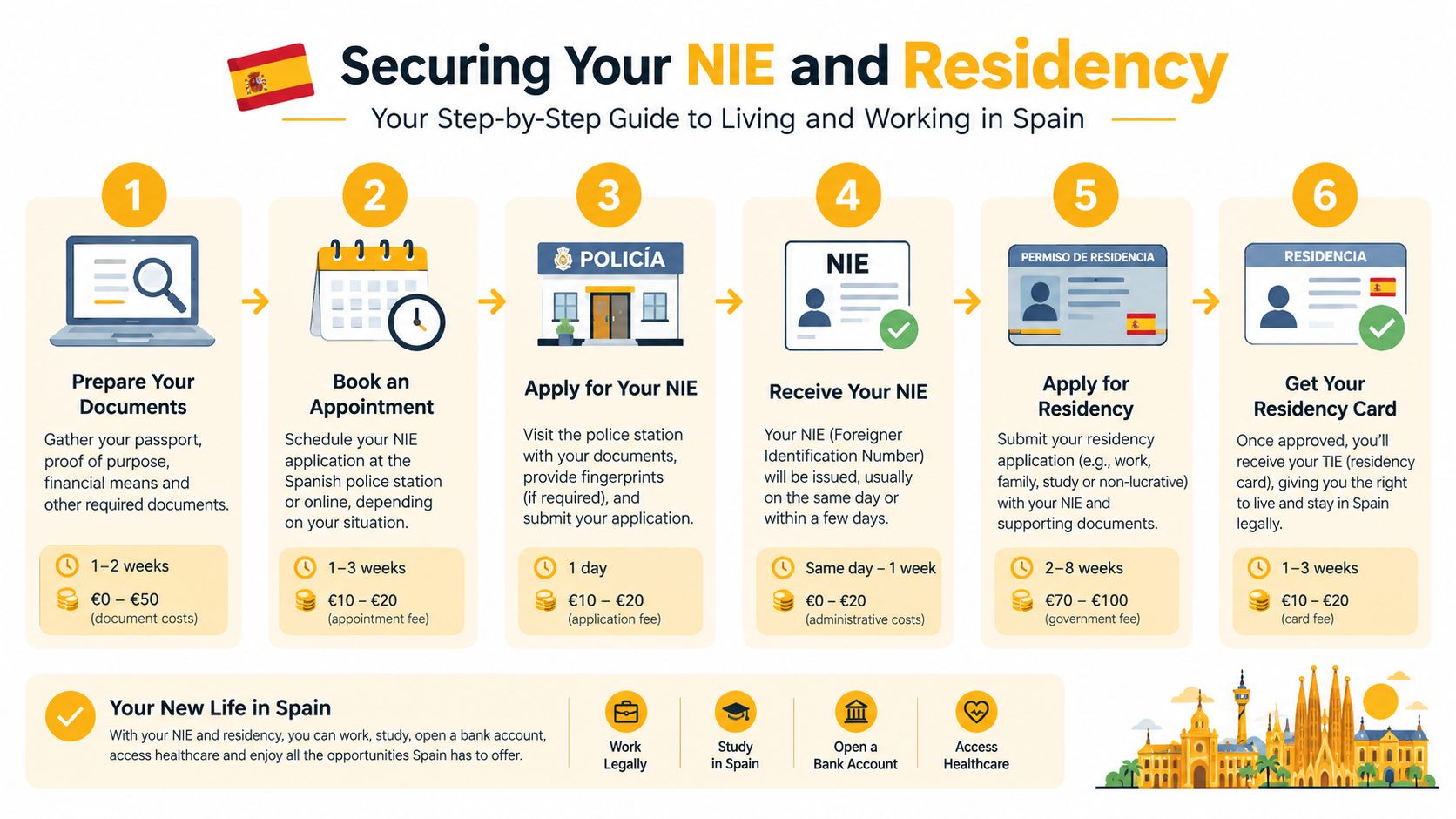
The first thing to get right is the distinction between identity, residence, and local registration. Your NIE is not the same thing as residency, and neither one is the same as the padrón municipal. Mixing them up creates delays, especially when a bank, a notary, or a town hall asks for one document and you arrive with another.
Start with the route that matches your nationality
EU, EEA, and Swiss nationals follow one path. Non-EU nationals follow another. That sounds obvious, but in practice many movers search for generic advice and end up wasting weeks on the wrong checklist. Spain's official guidance says that EU/EEA/Swiss citizens can stay for up to three months with only a valid identity document, while anyone staying longer must meet a residence condition such as working, studying, or having sufficient resources and full health insurance, according to the official residency guidance for EU citizens and others in the country. Spain's official residency guidance
For non-EU movers, the route depends on the basis of stay, and that basis needs to be clear before you settle into a property or sign anything long-term. Buying a home in Alicante does not, by itself, create residence rights. That is a common and costly misunderstanding.
Treat the padrón as a local control point
The padrón matters because it anchors your address in the municipality. Spain's official guidance states that non-EU foreigners without permanent residence must renew their municipal registration every two years, while EU citizens and foreigners with permanent residence generally confirm registration every five years, according to the official address-registration guidance. Spain's address registration guidance
That makes the padrón a recurring compliance task, not a one-off formality. It doesn't grant immigration status, but it often supports other local procedures. Keep your address evidence, passport, NIE or residence card, and appointment confirmations together, and make sure the spelling of your name is identical across every document.
For long-term movers, the practical sequence is simple. Confirm your legal route, secure the residence document, register the address, and then calendar every renewal date before you forget it.
Navigating Healthcare Options
Healthcare is one of the few parts of relocation that people often assume they can sort out later. That works badly in Spain. A smooth arrival on the coast usually means deciding before travel whether you'll rely on the public system through an entitlement route or maintain private coverage from the start.
Use the S1 route only if it applies to you
People moving their habitual residence to Spain who receive healthcare rights from another EU or EEA country, Switzerland, or the United Kingdom can register an S1 form with the Spanish public healthcare system. The Social Security administration also requires a Spanish address and identification such as a passport, NIE, DNI, or TIE, and family members must provide documents proving the relationship. Spanish Social Security S1 registration guidance
That route is specific. It is not a general shortcut for every newcomer, and it only works if your entitlement sits with the issuing country. If you qualify, register it early and keep the paperwork ready for the first appointment or claims process.
For everyone else, private health insurance is the practical bridge during relocation. The important point is continuity. You don't want a gap between arrival, residence processing, and actual access to care, especially if your move involves children, chronic prescriptions, or a timetable tied to property completion.
Keep the health plan aligned with the move date, not the wishful date. A policy that starts after you've already arrived creates unnecessary friction.
This is also where family paperwork matters. If one spouse or dependent is covered differently, the whole household needs a clear record of who is insured where. A doctor's visit should not turn into a document hunt.
Setting Up Finances and Banking
Money management in Spain is easier when you separate three questions. What do you need to open a bank account, what do you need to pay local costs, and what makes you a tax resident. People often blur those together, then wonder why a simple bank visit feels more complicated than expected.
Open the account that matches your paperwork
Banks usually want clear identification, proof of address, and supporting evidence of why you're in Spain. In many cases, the practical sticking point isn't the account itself, it's whether every document is in the same name and whether translations are ready. Once that is sorted, the process becomes much more manageable.
The broader context matters too. Spain's resident population reached 49,128,297 on 1 January 2025, after increasing by 508,602 people, or 1.0%, over the previous year, according to the National Statistics Institute. INE population updateThat scale helps explain why banks, utilities, and other service providers are used to dealing with international clients, but it doesn't remove the need for the right documents.
Separate residency from tax assumptions
A bank account is a practical tool, not a conclusion about where you're tax resident. Physical presence, habitual residence, and tax status are distinct tests, and it's unwise to rely on a hunch. The safer approach is to ask a tax adviser to look at your specific pattern of time in Spain, income sources, and family situation before you make assumptions.
Practical rule: if your income, savings, and day-to-day spending are split between countries, document everything from the start. Clear records prevent avoidable tax and banking confusion later.
Once the account is open, set it up to support the move instead of reacting to each bill separately. That means enough access for rent, utilities, insurance, and property costs, plus a clean record of what came in and what went out during the first months.
Shipping Household Belongings
Shipping the contents of a home into Spain is a logistics decision, not just a transport decision. The right method depends on how much you're moving, how urgently you need it, and how much of your life you're willing to live without for a while. The wrong method is usually the one chosen too late.
Compare speed, volume, and tolerance for delay
Air freight makes sense when you need essential items quickly and the shipment is relatively small. It's faster, easier to track, and better for the things you can't do without in the first weeks. It's also a poor fit for most full households.
Sea freight suits larger moves, furniture, and the parts of a home that can arrive after you do. It's the more realistic choice for a full relocation, especially if you're moving from outside Europe and want to keep the cost and volume under control. The trade-off is time, since your household may not be ready when you are.
A lot of people overpack the first shipment and underpack the essentials. That leads to frustration on arrival. A better method is to separate the move into three groups, keep, store, and send.
Pack by function, not by room
- Immediate-use items: passports, medication, chargers, basic kitchenware, seasonal clothing, and a few tools.
- Decision items: books, décor, spare appliances, and anything you haven't used in a year.
- Arrival essentials: bedding, towels, a kettle, and enough clothing to cover the gap before the rest arrives.
This is also the point where customs paperwork and inventory discipline matter. Use clear descriptions, not vague labels. “Kitchen contents” helps nobody when a shipment needs checking.
If you use a shipping partner, ask how they handle damage claims, storage at destination, and delivery access to the new property. A villa on the Costa Blanca and an apartment in a coastal town don't always need the same delivery setup. The move goes better when the transport company knows exactly what kind of access the property has.
Choosing the Right Location
Moving to Spain is a national decision on paper, but a local decision in practice. Day-to-day life is shaped by the municipality you choose, the services available there, and whether the area works in winter as well as in August. That's especially true along the Costa Blanca and into the Costa Cálida, where two nearby towns can feel completely different.

Look at population growth as a service signal
Alicante was among Spain's fastest-growing provinces in the 2025 Annual Population Census, recording population growth of 2.0% over the reported period. The same official census said that 24.4% of Spain's 9,464,210 residents born abroad had arrived during the previous two years, equivalent to 2,308,073 people, according to INE's census release. INE census update for Alicante and international arrivals
That matters because population growth isn't just a headline. It usually means more pressure on housing, more demand for administrative services, and a broader international mix in daily life. For newcomers, that can be a real advantage if you want communities that already understand multilingual, multicultural routines.
Choose the municipality, not the postcard
The best place for a permanent move isn't always the place that looks nicest in a weekend visit. Some towns suit full-time living because they have year-round services, others work better as second-home bases. Think in terms of transport, schools, healthcare access, and winter habits, not just beaches and restaurants.
For buyers comparing La Romana with coastal options such as Alicante, Guardamar, or Torrevieja, the question is how the area functions when holiday traffic drops. Quiet can be a benefit, but isolation can become a problem if you need frequent appointments or rely on public services.
A location should support your ordinary week, not just your ideal weekend.
If you're still choosing between areas, one useful shortcut is to spend a few days in each place outside peak season. That usually tells you more than a glossy listing ever will. Where do you shop, how long does a simple errand take, and does the area feel like a place you can live in, not just visit?
Finalizing Your Relocation Checklist
By the time the move is close, the goal changes from planning to confirming. You want every important item checked, every document matched, and every appointment either booked or already completed. That's the stage where a calm system beats last-minute energy.
Your final list should cover the legal route, residence papers, address registration, healthcare setup, banking access, shipping status, and property timeline. Keep one version of the list on paper and one on your phone so you can check things in the moment.
A sensible last-pass review looks like this:
- Legal status: the route you're using matches your nationality and reason for staying.
- Address evidence: your current accommodation details are ready for the padrón and related forms.
- Healthcare: you've confirmed whether the S1 applies or private cover needs to bridge the move.
- Banking: you have the identification and address documents the bank is likely to request.
- Household logistics: shipping, storage, and arrival essentials are separated cleanly.
- Local fit: your chosen town works for normal life, not just for holidays.
The strongest relocation plans are the ones that assume bureaucracy will take time and then leave enough room for it. That isn't pessimism, it's good project design. Once those basics are in place, the move stops feeling like a scramble and starts feeling like a transition.
If you want support choosing the right area, reviewing property options, and aligning a purchase with the realities of relocation on the Costa Blanca or Costa Cálida, visit AP Properties Spain. They work with international buyers on local area guidance, property search, and the practical steps around Spanish procedures that often sit alongside a move.
Share