





Retiring to Spain: A Practical Guide for 2026
You can spend a year reading glossy guides about retiring to Spain and still miss the part that matters most. The move is not one decision. It is a chain of decisions, and the early ones shape everything that follows, especially if you are looking at the Costa Blanca and trying to work out whether the life you want is practical. If you are mid-50s now, comparing Spain with staying put, you are not really deciding on a holiday. You are deciding whether the next twenty-plus years will be simpler, healthier, and more manageable, or just warmer.
What Retiring to Spain Really Looks Like in 2026
A couple in their mid-50s often starts with the same thought. They want better weather, a slower pace, and a home where they can still manage daily life when they're older. That's sensible, but it's also where the first mistake creeps in, because retiring to Spain should be planned as a long logistics exercise, not a lifestyle leap.
Spain's Ministry of Health reported life expectancy at birth of 83.8 years in 2024, placing the country third among EU member states, and residents aged 65 could expect to live an additional 21.7 years on average. Men were at 19.7 years and women at 23.5 years, which tells you exactly why this move needs to be treated as a multi-decade plan, not a short post-work escape. Spain's 2024 national health overview
The first year is mostly admin, not sunsets
The first twelve months on the ground are rarely about settling into a perfect routine. They're about residence paperwork, tax positioning, healthcare registration, account opening, and learning which offices want original documents and which ones won't accept a photocopy even if it looks immaculate. That's why people who think in “move first, sort later” terms usually end up paying for it twice.
Practical rule: if a decision changes your residency route, it also changes your tax exposure and healthcare options. Treat those as one file, not three separate errands.
For retirees on the Costa Blanca, especially around Alicante and inland villages like La Romana, the key question is whether the place works when mobility changes, appointments stack up, and you need reliable transport more than a nice view. That's where the brochure version of Spain falls apart. The practical version is more useful, because it forces you to think about access, not fantasy.
Choosing the Right Residency Route
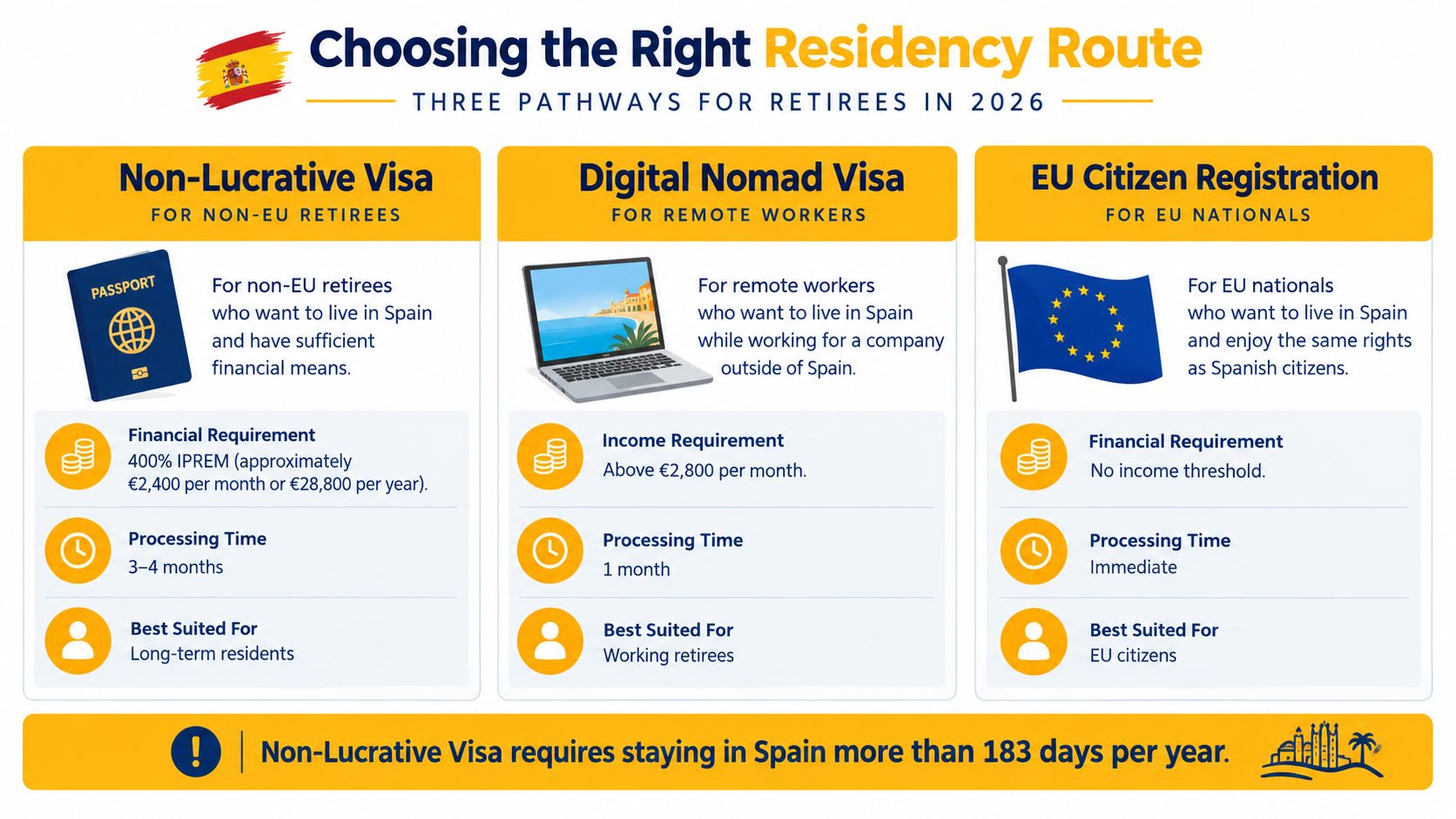
If you get this part wrong, the rest becomes harder than it needs to be. The route you choose decides what documents you need, how your health cover works, and whether you'll later regret a shortcut that seemed harmless at the time.
The non-lucrative residence authorisation is the main route for non-EU retirees who want to live in Spain without working. Spain's Ministry of Inclusion requires financial means equal to 400% of IPREM monthly for the principal applicant plus 100% of IPREM monthly for each dependent, alongside public or private health insurance with a Spanish-authorised insurer. The paperwork matters more than people expect, especially the passport validity, criminal-record certificate, insurance wording, medical documentation where required, and the legalization or apostille plus sworn translation that often slows everything down. Official non-lucrative residence guidance
The EU route is different. EU citizens can qualify for permanent residence after living legally and continuously in Spain for more than five years, and some workers reaching retirement age have an accelerated route if they've worked in Spain for at least the final 12 months and lived there continuously for more than three years. That's useful if you're already inside the EU system, because it changes how urgently you need to think about the non-lucrative route. Permanent residence guidance for EU citizens
For pensioners entitled to healthcare in an EU or EEA country, Switzerland, or the United Kingdom, the S1 route is the cleanest public-healthcare path. Spain's Social Security guidance says you need the completed S1, proof of identity, and a Spanish address, and registration can give access for an initial period of up to two years, with renewal possible if eligibility stays unchanged. That's a very different process from hoping a property purchase will provide care, because it won't.
Don't buy insurance that looks private on paper but doesn't behave like proper Spanish coverage. That mistake causes delays, rejections, and last-minute panic at the consulate.
Tax Residence, Pensions and the 183-Day Rule
This is the part many retirees underestimate, and it's the part that tends to bite later. You can arrive in Spain thinking you've just changed address, then discover you've also changed tax residence because your time in the country crossed a line you didn't monitor closely enough.
Spain's tax authority treats sporadic absences as potentially counting toward the 183-day test unless you prove tax residence in another country. In practical terms, spending most of the year at a Costa Blanca home can make you Spanish tax resident even if your foreign pension keeps arriving as usual. That's why I tell clients to count days from the start, not after the first Spanish tax notice lands. Spanish tax residence guidance
The order that saves people trouble
Start with a day-count calendar. Keep travel evidence. Then map where your pension, investment income, and any rental income sit for tax purposes. Only after that should you move income streams, because once the money starts landing in Spain, you're no longer planning in the abstract.
A holiday home doesn't prove non-residence if you're living there most of the year. A foreign pension doesn't keep you outside Spanish tax just because it's paid from elsewhere. The mistake is treating income and presence as separate issues when the tax authority won't.
Practical rule: before you become settled, ask a qualified tax adviser to review treaty residence, pension treatment, and the country where each income stream is likely to be taxed.
The other trap is assuming your old life stays neatly outside Spain. It rarely does. If you keep a property, a pension, and bank accounts in another country, that whole picture needs to be documented properly before you make Spain your main home.
Healthcare Beyond the Brochure
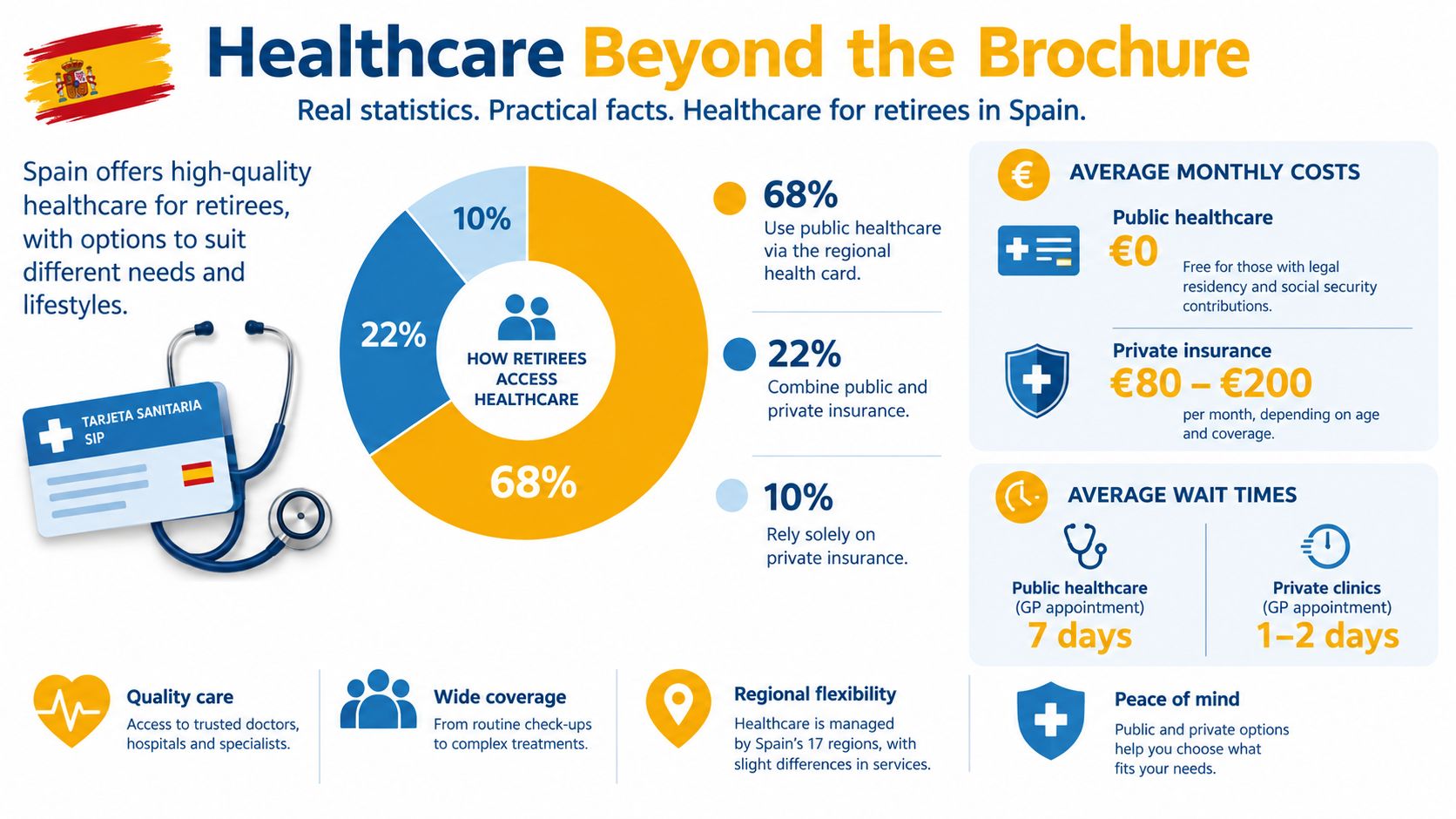
People talk about Spanish healthcare as if the choice is public or private, full stop. That's too simple. The key questions are who covers you, what isn't covered, and what happens when you need repeat prescriptions, dental work, or specialist care that sits outside the neat brochure version of retirement.
Spain's 2025 Living Conditions Survey found that 8.4% of households considered healthcare expenses a heavy burden, up from 7.0% in 2022. Dental costs were a heavy burden for 18.7%, up from 17.0% in 2022, and lower-income households were more exposed. That's the part people ignore when they're comparing policy premiums, because the policy price isn't the same as the care price. INE Living Conditions Survey 2025
What coverage actually means
If you're eligible for public healthcare through Spain's system, the relevant process runs through the entitlement document and the regional health card. If you're an EU, EEA, Swiss, or UK pensioner using the S1, you register in Spain and then access the system through the regional route. That's different from assuming a private policy replaces public registration, because it doesn't. For a retiree in Alicante, that distinction matters the moment an appointment, referral, or prescription is involved.
Couples also need to think separately. Coverage doesn't magically move as a household unit just because you live together. Each person's entitlement, insurance, and paperwork need to stand on their own, especially if one partner has pre-existing conditions. Many off-the-shelf policies look fine until the exclusions start doing the work.
The right healthcare plan isn't the cheapest premium. It's the one that still works when the problem is repeat care, not one-off treatment.
Where on the Coast to Actually Settle
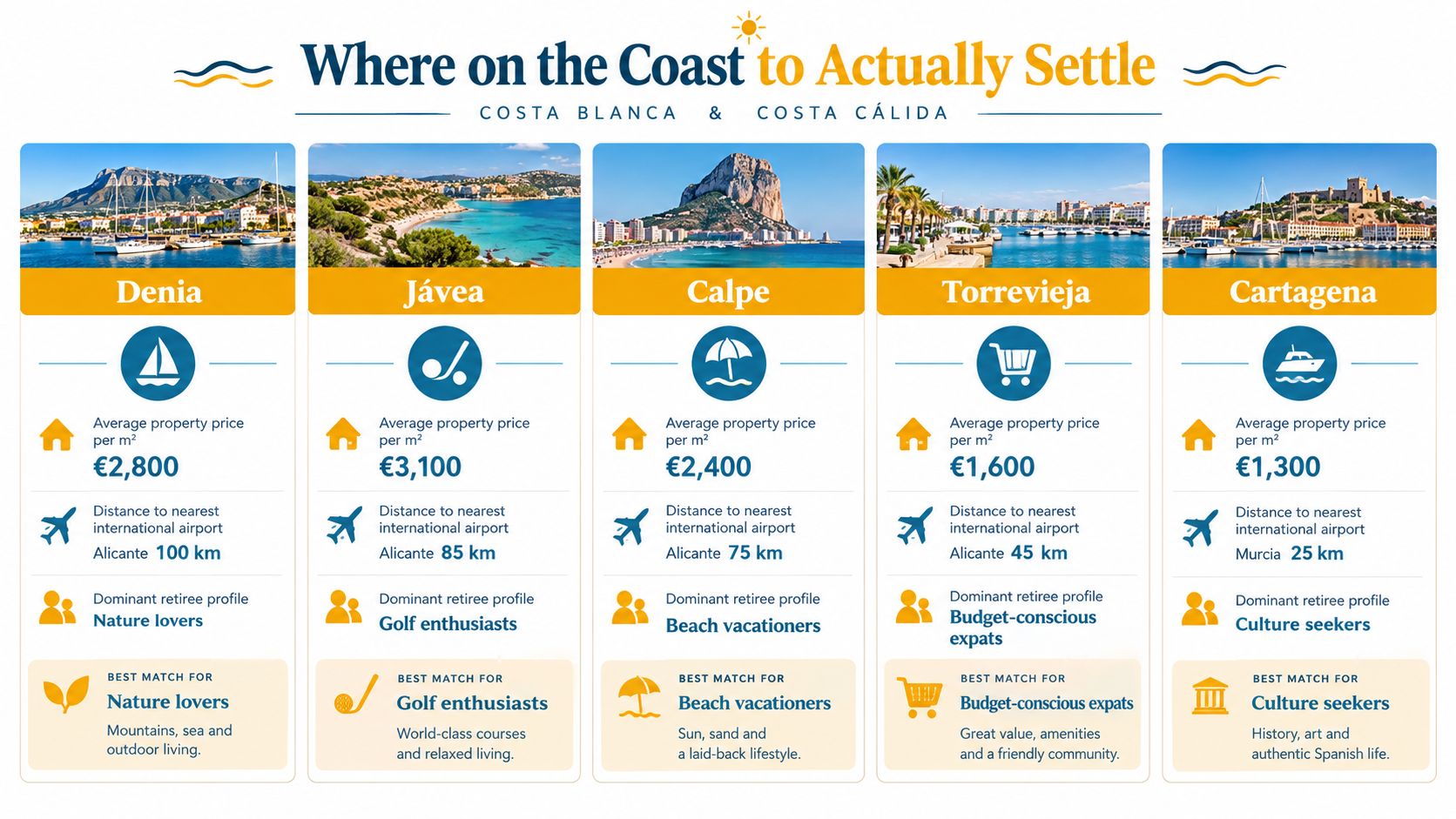
The Costa Blanca is not one place, and pretending it is leads to bad decisions. A retiree who wants scenery and quieter surroundings will have a very different day-to-day life from someone who wants airport access, a stronger expat network, and more year-round services. Costa Cálida adds another layer, especially if you're comparing inland villages with coastal developments.
Northern Costa Blanca, think Dénia, Jávea, and Calpe, tends to suit buyers who prioritise scenery, coastline, and a slightly more settled feel. Central Costa Blanca, including Alicante, La Romana, and surrounding villages, is the practical middle ground. You get a better balance of healthcare access, airport proximity, and price without drifting into the most crowded expat zones.
Southern Costa Blanca, including Guardamar, Torrevieja, and Orihuela Costa, is where higher expat density often meets more budget-conscious buying. That can be useful if you want familiarity and services around you. It can also be less appealing if you want a quieter retirement and don't want every errand to feel like you're living inside an English-speaking enclave.
The trade-offs that actually matter
Costa Cálida works differently again. Inland Mar Menor villages can appeal to buyers who want calmer surroundings and lower-density living, while coastal developments suit people who want more immediate access to the water and seasonal activity. Neither option is automatically better. The right one depends on whether your retirement model is car-light, service-heavy, or built around regular social contact.
Alicante and La Romana make sense for a specific retiree profile, the one that values central access without paying a premium for constant seafront living. That's not a sales pitch, it's a practical read on the map. If mobility, medical access, and staying connected to the airport matter more than beachfront status, central Costa Blanca usually deserves serious attention.
Property Costs Beyond the Purchase Price
A cheap purchase price can hide an expensive life. That's the point many buyers miss, especially when they compare homes only by asking price and sea view. The true affordability test is what the property costs to own once you've lived in it for years, not months.
Spain's 2025 Household Budget Survey recorded average annual expenditure of €23,024 for one-person households headed by someone aged 65 or over, while housing, water, electricity, gas and other fuels rose 5.8% in the same period. Those figures don't describe your exact budget, but they do show why ownership costs and utilities have to be modelled alongside your pension income, not after the purchase is signed. INE Household Budget Survey 2025
Typical Annual Ownership Costs for a Costa Blanca Retirement Home | Apartment in established town | Detached villa with pool |
|---|---|---|
IBI local property tax | Varies by municipality | Varies by municipality |
Community fees | Lower if shared areas are modest | Often higher, especially with more services |
Utilities | Moderate, depending on use | Usually higher because of space and pool demand |
Home insurance | Basic cover for structure and contents | Broader cover often needed |
Maintenance reserve | Smaller, but still needed | Larger, especially for roof, pool, and climate wear |
Security and lock-up costs | Sometimes modest | Often more important for detached homes |
Renovation and accessibility reserve | Sensible for upgrades over time | Essential if you expect mobility changes |
What usually surprises people
Air-conditioning replacement, pool maintenance, roof work, and accessibility adaptations don't feel urgent at purchase time. They do feel urgent later. If you buy in an inland village and become more car-dependent than you expected, the “bargain” can turn into a higher retirement cost than a slightly pricier home in a more connected place.
AP Properties Spain is useful as one part of the process, because the firm can help buyers look at homes on the Costa Blanca and Costa Cálida with relocation in mind, not just aesthetics. That matters when you're trying to match property type with long-term use rather than first-week excitement.
A Twelve-Month Pre-Move Checklist
The right sequence saves time, money, and stress. Do the paperwork first, because it's slower than expected. Then look at housing, banking, healthcare registration, and arrival logistics in that order.
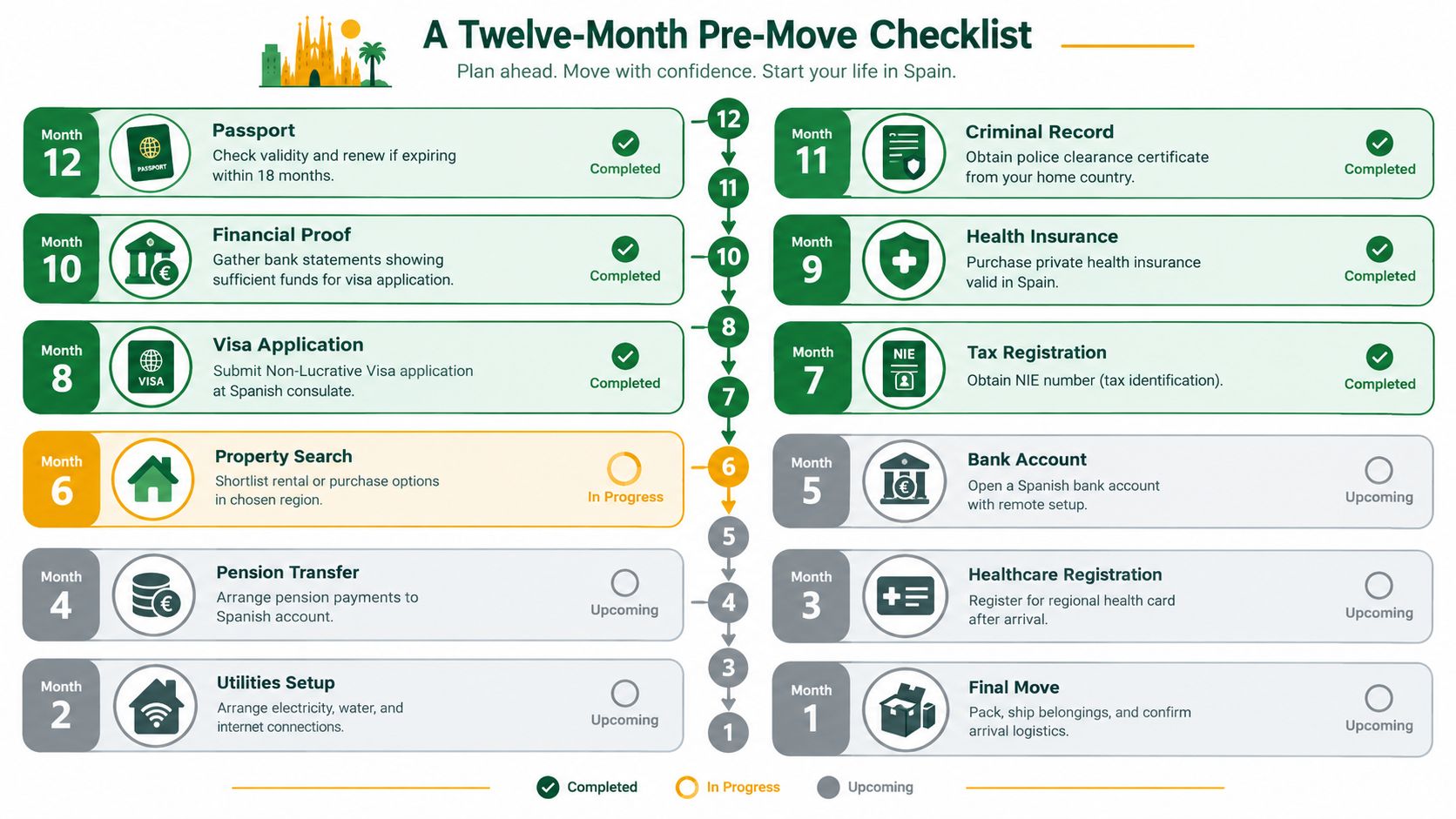
- Month 12, Passport: check validity early and renew if it's getting close to expiry.
- Month 11, Criminal record certificate: get the clearance document from your home country and prepare for apostille or translation if needed.
- Month 10, Financial proof: gather pension letters, bank statements, and anything that clearly shows stable means.
- Month 9, Health insurance: secure a policy that satisfies the route you're using.
- Month 8, Residency application: file the correct application with the right supporting paperwork.
- Month 7, Tax identification: obtain your NIE before you try to force banking or utility steps that depend on it.
- Month 6, Property search: shortlist areas and property types based on access, not sentiment.
- Month 5, Spanish bank account: open it once your documents support the application.
- Month 4, Pension transfer: arrange payment into the right account and keep the paper trail clean.
- Month 3, Healthcare registration: complete the regional process after arrival if your route requires it.
- Month 2, Utilities setup: sort electricity, water, and internet before you assume they'll appear.
- Month 1, Final move: pack, ship, confirm arrival logistics, and keep originals in your hand luggage.
Practical rule: start day-count tracking the moment you arrive. If tax residence is going to matter, it matters from day one, not after you've unpacked the kitchen boxes.
If you want this handled with less trial and error, AP Properties Spain can help with property selection on the Costa Blanca and Costa Cálida while keeping the move aligned with the paperwork that comes after the search.
If you're planning retiring to Spain and you want the property choice, paperwork, and local logistics handled in the right order, visit AP Properties Spain. They work across the Costa Blanca and Costa Cálida, and they can help you focus on homes that fit the way retirees live, not just the way they holiday.
Share