





Buying Property in Alicante: A Complete Step-by-Step Guide
You're probably staring at listings from another country, trying to tell whether a bright sea-view apartment is a smart purchase or just an expensive mistake with good photos. In Alicante, that question matters more than in most Spanish markets, because international demand, coastal price gaps, and tourist-rental rules change the outcome long before you sign anything.
If you're buying property in Alicante, treat it as a local decision, not a provincial one. A home in Jávea behaves differently from a flat in Alicante city, and both are very different from an inland house in La Romana. The right move is to start with the area, then the legal structure, then the tax bill, and only then the deposit.
Why Buying in Alicante Is Different from Anywhere Else in Spain
Alicante behaves unlike any other Spanish province. Foreign demand shapes pricing, the speed of sale, and the level of paperwork risk from the first viewing onward. Spain's official Land Registrars' 2025 data shows that foreign buyers accounted for 43.29% of all residential property purchases in Alicante province, the highest share in the country and almost triple the 13.82% national average. Official Land Registrars' 2025 data
Start with Alicante, not with Spain
Buyers often begin with Spain as a whole and then use one rough average to judge every listing. That approach fails here. Alicante's coastal strip, holiday towns and inland villages serve different buyer profiles, and they differ in price, liquidity and rental rules.
Start with the submarket. A second home, retirement base, rental asset or family relocation each pushes you toward a different part of the province. A buyer comparing Torrevieja, Dénia, Calpe, Orihuela Costa, Guardamar or La Romana is not shopping in one market, even if every option sits in Alicante province.
Practical rule: if a listing looks cheap compared with the province average, ask which submarket it sits in before you ask anything else.
Why international buyers need a different playbook
When nearly half of the buyers are foreign nationals, casual due diligence is a bad idea. Use bilingual coordination, keep the tax position clear, and work with a lawyer who understands the transaction from search to registration. Assume the seller and the agent may want speed for their own reasons.
That is the right process for non-resident buyers. First, understand the market. Then narrow the municipality. Then verify the property. Only after that should you deal with tax, rental use, financing, negotiation, signing and post-completion admin.
The Alicante Market in Numbers for 2026
If you are buying in Alicante, start with the numbers that separate one submarket from another. In June 2025, Alicante province averaged €2,595/m², but the coastal names buyers chase sit well above that line. Jávea reached €3,958/m², Calpe €3,438/m², Altea €3,415/m², Benitachell €3,335/m², Benidorm €3,246/m² and Dénia €3,217/m². Idealista market data
Where the price competition actually sits
That spread is where serious buyers should focus. The provincial average is a benchmark, not a buying target. Once you move into sea-view terraces, walk-to-beach addresses or prime resort locations, you are in a different pricing tier, and the competition is tighter.
Municipality | Average €/m² | Profile |
|---|---|---|
Jávea | €3,958/m² | Premium coastal market with strong international demand |
Calpe | €3,438/m² | Established seaside resort with broad buyer appeal |
Altea | €3,415/m² | Scenic coastal town with luxury and lifestyle demand |
Benitachell | €3,335/m² | High-end residential and sea-view stock |
Benidorm | €3,246/m² | Dense coastal market with strong tourism influence |
Dénia | €3,217/m² | Active coastal town with a mix of lifestyle and second-home demand |
Alicante province average | €2,595/m² | Provincial benchmark, not a target price |
Tourist demand also shapes the case for buying here. Generalitat Valenciana data recorded 79,659 registered tourist homes across the Valencian Community in 2024, and Alicante province held 60.8% of that regional total. The province also contained around two-thirds of the 364,603 tourist places, which explains why coastal towns feel the pressure from short-stay demand. Generalitat Valenciana tourist-home data
That matters because a coastal purchase can only work as an investment if the property can legally do what you expect it to do. Supply is tight too. Available-for-sale stock was down about 6% in 2025 and remained roughly 39% below the 2019 peak, according to the same market report cited above.
The conclusion is straightforward. Compare municipality by municipality, then compare property by property. Buyers who rely on the province average will misread both value and competition.
Choosing the Right Area and Property Type in Alicante
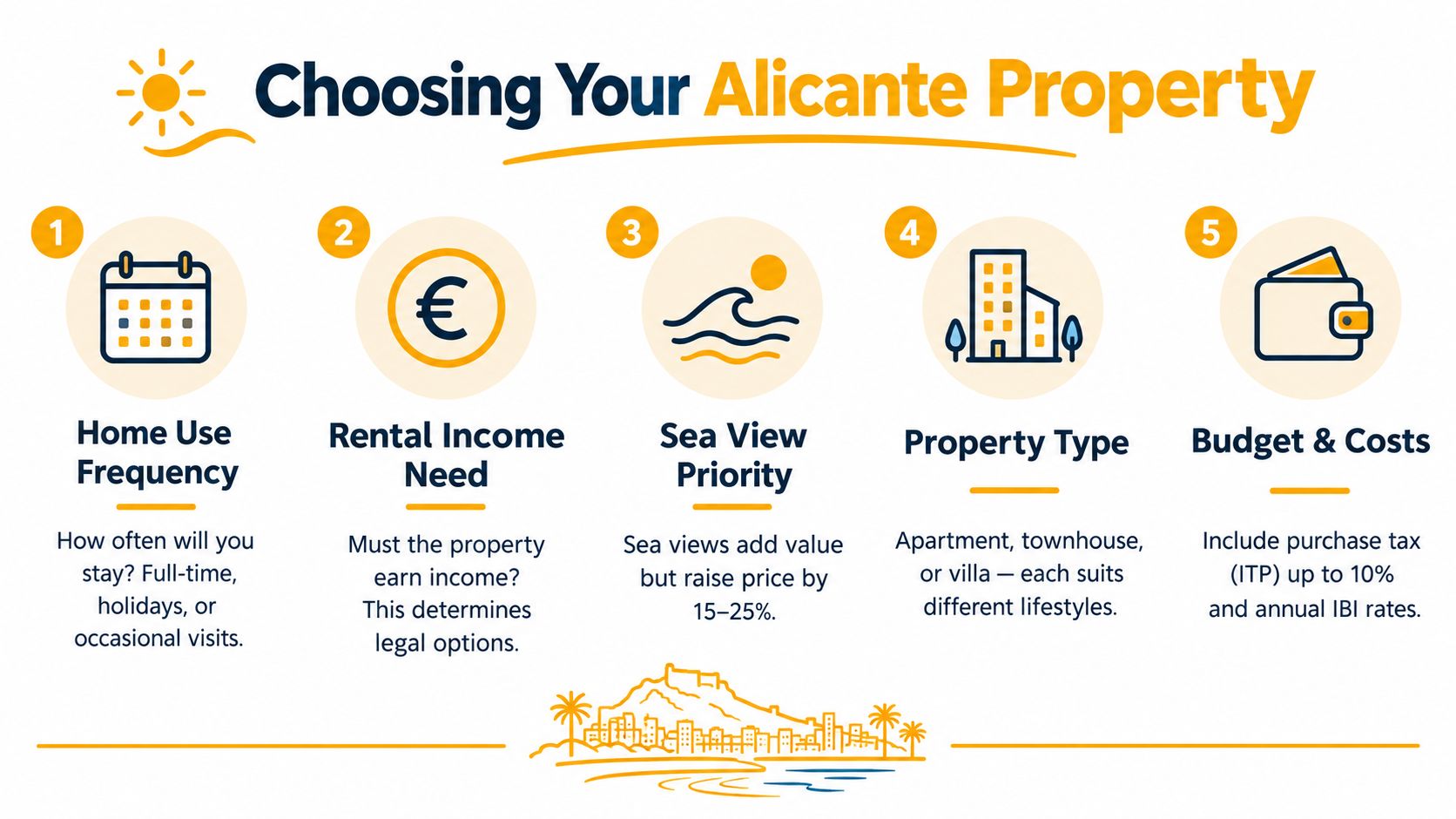
Start with how you will use the home. If you will be there often, school access, healthcare, parking and year-round convenience matter more than a sea view. If you will only come for short stays, focus on lock-up-and-leave ease, maintenance costs and whether the property can work for guests without creating headaches.
Match the area to the way you'll live
A beachfront apartment in Alicante city serves a different buyer from a detached villa in Jávea or a townhouse in La Romana. City buyers usually want services, transport and day-to-day livability. Coastal resort buyers usually care more about the beach, outlook and holiday use. Inland buyers usually get more space and privacy for the money.
Write down three requirements before you start looking. Sea views, a short drive to school, quiet surroundings with room for guests, pick the three that matter most, then shortlist three municipalities, not ten. Ask for comparable homes in each area before you visit. That keeps you from comparing fantasy against reality.
Do not fall for the first property that photographs well. In Alicante, the cheapest mistake is usually the one you make before seeing two better options.
Resale and new-build need different caution
Resale homes and new-build homes carry different risks. With resale, you inherit someone else's paperwork, community history and sometimes hidden maintenance issues. With new-build, you are relying on the developer's delivery schedule, specifications, snagging process and completion paperwork.
The checks change accordingly. Resale needs tighter legal verification, especially around title, debts, planning and community charges. New-build needs contract discipline, stage payments, warranty review and a hard look at finish quality before completion.
Tourist-rental risk needs a separate check in Alicante. In coastal municipalities such as Calpe and Dénia, confirm the tourist-registration position of the specific building before you shortlist it, because the position can vary by property and by community. If short-term rental income matters to your purchase, ask that question before you reserve anything, not after.
One practical rule works well here. Inspect at least two alternatives before you commit. That stops the first home from feeling irreplaceable and gives you a cleaner comparison of light, noise, layout, condition and walkability.
Legal Checks and Taxes Specific to the Valencian Community
A bad Alicante purchase usually starts with speed. The safer order is simple: get your NIE, appoint an independent Spanish lawyer, and check the title before you pay anything serious. The College of Registrars' buying guide says foreign buyers should obtain a Spanish NIE before completing the purchase, and its registry system lets non-residents use a passport or identity card to request a nota simple. Land Registry buying guide
Check the property before you trust the sale
The nota simple is the first filter. It shows who owns the property and gives you a legal description you can compare with the home on offer. Your lawyer should then check the cadastre reference, title match, planning status, habitation position, community charges, utilities, and any registered or municipal debts.
Practical rule: an estate agent's file is not a legal review. It helps you start, but it does not protect you.
Budget the tax side properly from the start. Spain's central administration confirms that ITPAJD and AJD are handled by the autonomous community where the property is located, and the rate depends on the region. In the Valencian Community, the published schedule lists 10% for dwellings, urban plots and commercial premises, 11% above €1 million, and 1.5% on several notarial acts. Valencian tax schedule
Calculate the true all-in purchase cost
The asking price is never the final figure. Add notary fees, registry fees, valuation, legal fees, and mortgage arrangement costs if you are borrowing. If you are transferring funds from abroad, use a specialist FX desk. Retail-bank transfers often look easy and cost more than buyers expect once the exchange rate moves against them.
Use this rule in Alicante: do not reserve a property until you know the full cost of owning it. That means the tax bill, completion costs, and the money needed to keep the purchase safe after signing, not just the deposit.
For larger acquisitions, the broader market matters too. The same national data set shows that 12.22% of foreign-buyer purchases in Spain exceeded €500,000 in 2025, which tells you lawyers, lenders and tax advisers are handling more higher-value cross-border files than before. Official Land Registrars' 2025 data
The clean sequence is the one we use with serious buyers: NIE first, independent lawyer second, registry check third, tax calculation before signing, then contract and deposit only when the legal picture is clear.
The Short-Term Rental Question Most Alicante Guides Skip
A lot of buyers assume that if a coastal home in Alicante has holiday appeal, it can automatically generate tourist-rental income. That assumption is dangerous. Under Valencian Decree-Law 9/2024, tourist-home registrations generally have a five-year validity period, and in June 2025 the Generalitat began removing 7,000 additional tourist homes without cadastral references, 6,343 of them in Alicante province. GVA tourist-home procedures
Ask what survives completion
The key question isn't whether the property once had a tourist registration. It's what exactly transfers to you after completion, and what you'll need to reapply for. A licence-like document is not the same thing as a permanently transferable income stream.
That means your due diligence has to go deeper than a sales brochure or a holiday-rental spreadsheet. You need to know whether the property still meets registration conditions, whether the community of owners allows tourist use, whether the municipality has extra limits, and whether the occupancy and insurance structure fully support short-term letting.
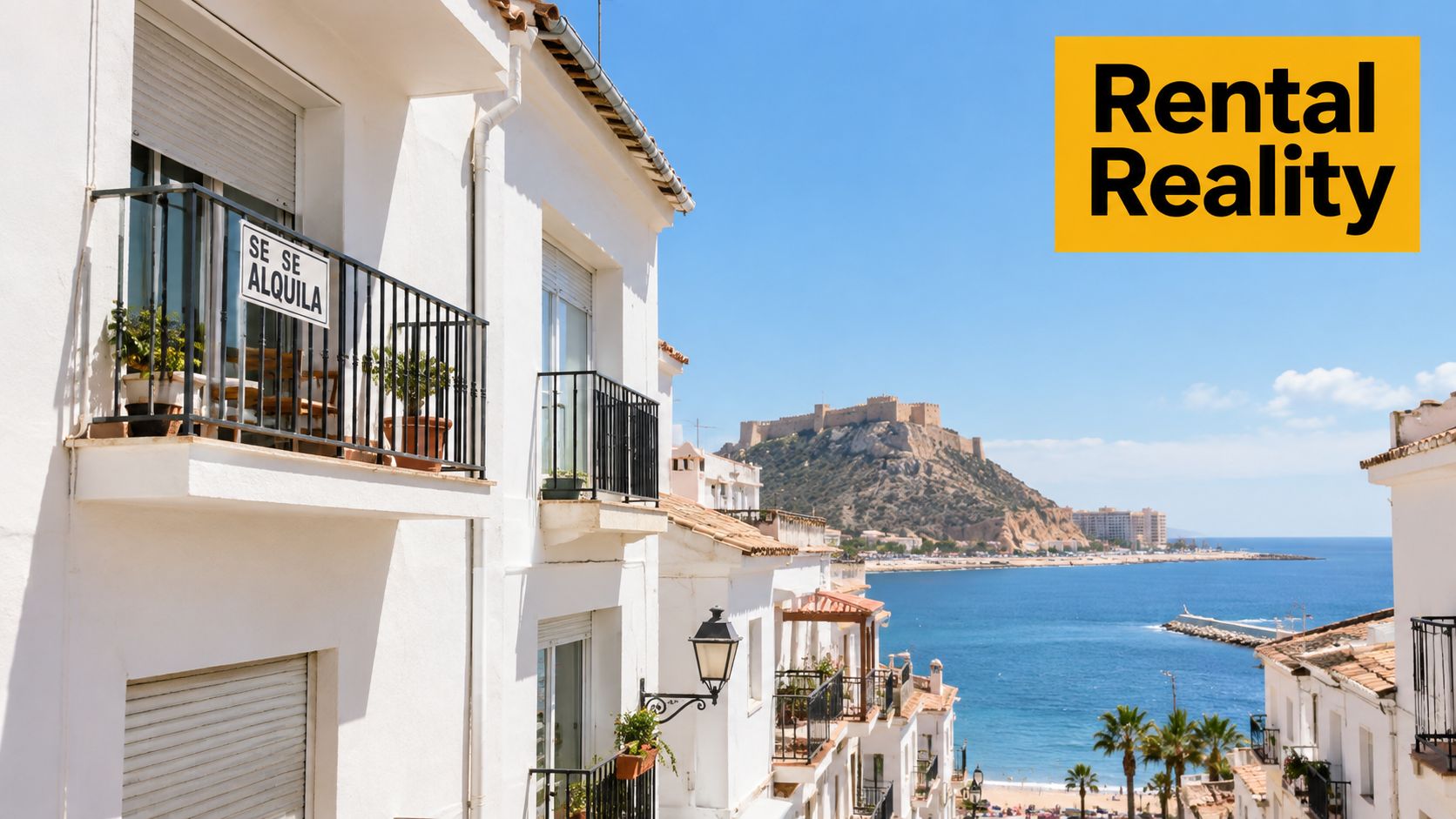
A home can look perfect on paper and still be unusable as a tourist rental once the register, community rules and renewal timetable are checked properly.
Check these points before you price the deal
- Registration status: confirm whether the tourist-home registration is current, expired or conditional.
- Community rules: verify the homeowners' community allows short-term rental use.
- Municipal limits: ask whether the town hall applies local tourism restrictions or caps.
- Insurance coverage: make sure the policy covers the intended rental activity.
- Occupancy rules: check the legal guest and use conditions tied to the property.
If the numbers only work with optimistic rental assumptions, the deal is fragile. A property that looks attractive because of holiday demand can turn into a poor purchase if the legal rental route is blocked, delayed or renewed on a different timetable. Buyers who treat licensing as an afterthought usually find out too late that gross income forecasts were never enough.
Financing, Negotiation, Closing and What Happens After
If you need mortgage finance, speak to a Spanish mortgage broker early, before you get attached to one property. Non-resident income is assessed differently from local income, and lenders are stricter on proof of earnings, deposit size and paperwork. If your income comes from more than one country or currency, expect extra checks and do not assume the first offer is the best one.
Negotiate the contract, not just the asking price
Strong negotiation in Alicante is about more than lowering the price. You should also push on payment timing, responsibility for repairs, snagging retention and what happens if a legal issue appears before completion. The deal that protects you in writing is usually the better deal, even if the headline price is a little higher.
Use the reservation stage to hold the property while your lawyer checks title and paperwork. Then sign the private purchase contract only once due diligence is complete and the deposit terms are safe. On completion day, the deed is signed before the notary, tax is paid, and the title is then registered.
The College of Registrars' buying guide, cited earlier, confirms the NIE-first sequence for international buyers. That is the order I would use on every cross-border purchase in Alicante.
Don't treat the keys as the finish line
After completion, register the escritura at the Land Registry, update the cadastre owner record and set up direct debits for IBI, community fees and rubbish. If the property will be used for tourist letting, notify the town hall where required and make sure the local registration position is still valid. If you will live there, open a Spanish bank account and sort residency paperwork as needed.
Older properties deserve a budget for post-purchase energy work. That is not decoration. It affects comfort and running costs, especially if you will live in the home or manage it from abroad.
A single local coordinator who handles sales, legal, tax, currency and aftercare cuts friction fast. In Alicante, that coordination matters more than polished brochures.
If you want a straight answer on which Alicante areas fit your budget, lifestyle and rental plans, speak with AP Properties Spain. We work with international buyers every week, and we can help you compare areas, check the legal route and keep the purchase process tight from first viewing to completion.
Share