


Plot for Sale Spain: A Buyer's Step-by-Step Guide
You've found it late at night. A hillside Plot for sale in Spain with sea views, pine trees at the edge, and a description that uses words like urban, residential and ready to build. It looks perfect, and it costs less than the finished villas you've been watching for months.
That listing is exactly where most international buyers start, and it's the wrong place. You're not buying a view. You're buying a construction project that starts with municipal paperwork, ground conditions and utility capacity. If you treat it as a romantic property search, you'll pay for the lesson later.
Why Most International Buyers Pick the Wrong Plot First
A buyer I see too often flies in for a long weekend, stands on a sloping plot above the coast, and falls for the light. The agent says it's urban land. The seller wants a reservation quickly because another couple is interested. A deposit changes hands before anyone has asked the town hall a single written question.
Months later the plot appears. The access track isn't a legal public road. The slope needs retaining works the buyer never priced. Part of the land sits under a protected overlay, or the services stop well short of the boundary. The home in the buyer's head doesn't fit the setbacks, height limit and occupancy ratio for that parcel.
None of that means the seller lied in a simple way. Listings describe the dream because listings sell viewings. They rarely describe edificabilidad, infrastructure obligations, pending urbanisation charges or whether a building licence can realistically be issued for the design you want. The advert answers whether you'd like to live there. It doesn't answer whether you can build there.
The Question You Should Ask on Day One
Stop asking whether a plot is pretty, cheap or close to the beach. Ask this instead. Can this specific parcel legally and physically support the home I want, at a total cost I can defend? Every useful check flows from that sentence.
That shift changes your behaviour. You request the cadastral reference before you book a flight. You ask for written planning information before you discuss finishes. You involve an architect while you can still walk away, not after the deposit contract has trapped you into defending a bad decision.
The mindset shift that protects budgets: A plot isn't purchased when you sign at the notary. It's purchased, well or badly, during the verification you do before you reserve it.
Foreign demand makes this discipline harder, not less necessary. Foreign buyers represented 28.3% of registered home purchases in the Comunitat Valenciana and 20.4% in the Región de Murcia in Q1 2025, according to the Registradores Q1 2025 property registry statistics. Those figures cover homes, not plots, so they tell you competition is real. They tell you nothing about whether the land in front of you is buildable.
Don't let a busy market bully you into skipping parcel-level checks. A good plot survives scrutiny. A weak plot needs urgency to sell. If a seller won't tolerate proper due diligence, you have your answer.
The next decision isn't which plot looks best at sunset. It's what the land is in planning law, because that classification controls everything that follows.
Understanding Urban, Rustic, and Buildable Land in Spain
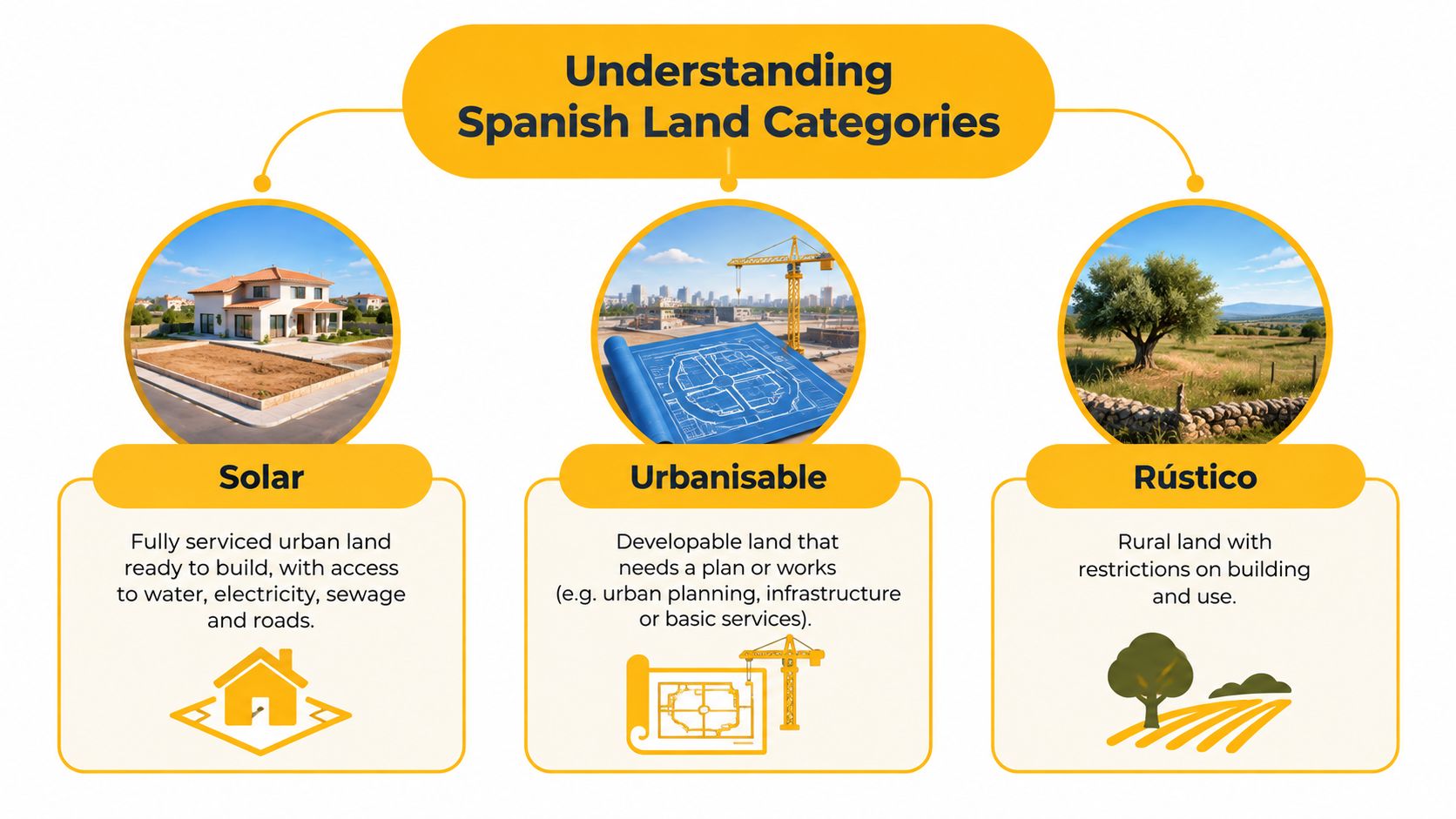
Spanish land labels confuse foreign buyers because the same word gets used loosely in adverts and precisely in planning documents. You need the precise meaning. A solar is the cleanest category, fully urbanised land with road access, street lighting, potable water, sanitation and electricity available at the boundary. It's the closest thing to ready to build, subject still to project approval and a licence.
Urbanisable land is different. It's earmarked for development, but it may still need a detailed development plan, reparcelling, urbanisation works or infrastructure contributions before a building licence can follow. Buyers hear future potential and imagine next spring. In practice you may be buying timing risk and costs you don't control. Don't pay solar money for urbanisable uncertainty.
Rústico land is rural land, and you should assume a normal dwelling isn't permitted unless your lawyer and architect prove a specific lawful route for that parcel. Beautiful countryside and a low price don't change the classification. Neither does a neighbour's house, an old ruin or a seller's assurance that people build there all the time.
The Cadastre Does Not Grant Building Rights
The Cadastre is primarily an administrative and tax inventory, as the official Cadastre statistics and services portal reflects in its role. It helps identify the parcel, its reference, boundaries and recorded area. It doesn't decide what you may legally build. Municipal planning does that through the PGOU or equivalent local plan.
That's why an advert saying urban can still mislead you. The land may sit in an urban area yet lack completed services, legal access or the development status needed for a licence. You need the town hall to confirm classification, permitted use, building coefficient, maximum height, setbacks, occupancy and minimum plot size for that exact parcel.
Alicante's published rules show why plot size alone tells you little. The Alicante municipal planning framework states maximum plot occupation of 50% in the relevant provisions, while maximum buildability varies by grade at 1.16 m²/m² in Grades 1 and 2, 0.72 m²/m² in Grade 3 and 0.56 m²/m² in Grade 4. Those are Alicante parameters, not La Romana parameters. They prove the point. Two plots with identical areas can support very different homes.
Minimum parcel rules bite just as hard at the edge of town. Alicante's published urban planning rules with minimum plot thresholds specify 6,000 m² for Grade 1, 3,000 m² for Grade 2 and 2,000 m² for Grades 3, 4 and 5 for certain non-agricultural permitted uses, plus a separate 20,000 m² minimum in an applicable rural-planning context. Don't import those numbers into another municipality. Do use them as a warning to verify the exact threshold before you assume a rural plot can take a house.
Your working rule is simple. Classification first, location second, design third. If the classification fails, the view is irrelevant.
The Pre-Deposit Due Diligence Checklist That Saves Six-Figure Mistakes
Do this work before a reservation, not after it. Once you've paid money and fallen in love with a design, you'll start negotiating with facts instead of listening to them. A disciplined buyer runs the same sequence every time and makes any deposit conditional on satisfactory legal and planning results.
Start with identity and title. Get the cadastral reference and a descriptive and graphic cadastral certificate, then obtain a nota simple from the Land Registry. Your lawyer checks ownership, charges, easements and whether the seller can sell. Then reconcile the registered area, the cadastral area and the measured area on the ground. Discrepancies aren't paperwork trivia. They affect value, boundaries and sometimes the buildable envelope.
Next comes the document that matters most. Request written planning information, the informe urbanístico or planning certificate, from the town hall. I want it to confirm the applicable municipal plan, land classification, permitted use, edificabilidad, maximum height, setbacks, plot occupancy ratio, minimum plot size, access requirements and infrastructure obligations. If the town hall won't put it in writing, don't fill the gap with optimism.
Your Hand It to the Lawyer Checklist
- Title and charges: Obtain the nota simple, verify the seller, and check mortgages, seizures, easements and rights of way before any binding payment.
- Area reconciliation: Compare Land Registry, Cadastre and a fresh topographical measurement, then investigate any mismatch rather than averaging the numbers away.
- Planning certificate: Confirm classification, permitted use, buildable floor area, height, setbacks, occupancy, minimum plot size and any pending modification affecting the parcel.
- Access and utilities: Get written confirmation of legal road access plus water, sanitation and electricity availability, capacity and connection cost.
- Ground and slope: Commission topographical and geotechnical work early enough for foundations, retaining walls and drainage to enter the budget.
- Debts and charges: Check IBI arrears, urbanisation contributions and municipal penalties that could follow the property or block a clean transfer.
La Romana shows why a current parcel check beats a general label. The La Romana town hall planning approvals and regulations page publishes the municipal General Plan together with planning regulations, zoning documentation and modifications. A plot doesn't become buildable because it's near the village. Its status depends on the relevant classification and any later amendment that applies to that land.
One local example should sharpen your questions. A La Romana planning modification for Ampliación de Cascodescribes a street-alignment system, compact-block typology and global residential use, while explaining that a modification may change a particular parcel's permitted use without changing the zone's overall residential designation. Read that carefully. The neighbourhood can stay residential while your parcel's position changes.
Do not reserve a plot on the strength of a zone label, a cadastral description or a seller's summary. Reserve it, if at all, on a plot-specific planning certificate and an architect's compliance report.
National permit statistics won't rescue a weak parcel either. The Ministry sourced construction series definition defines dwellings under construction from site-management certificates and doesn't necessarily mean physical work started that month. Permit indexes describe markets. They don't give your plot a probability of approval. Your municipality, infrastructure status and project compliance do that.
If the checklist produces a clean, written, plot-specific answer, proceed. If it produces maybes, price them as risk or walk away.
What a Plot Really Costs Beyond the Asking Price
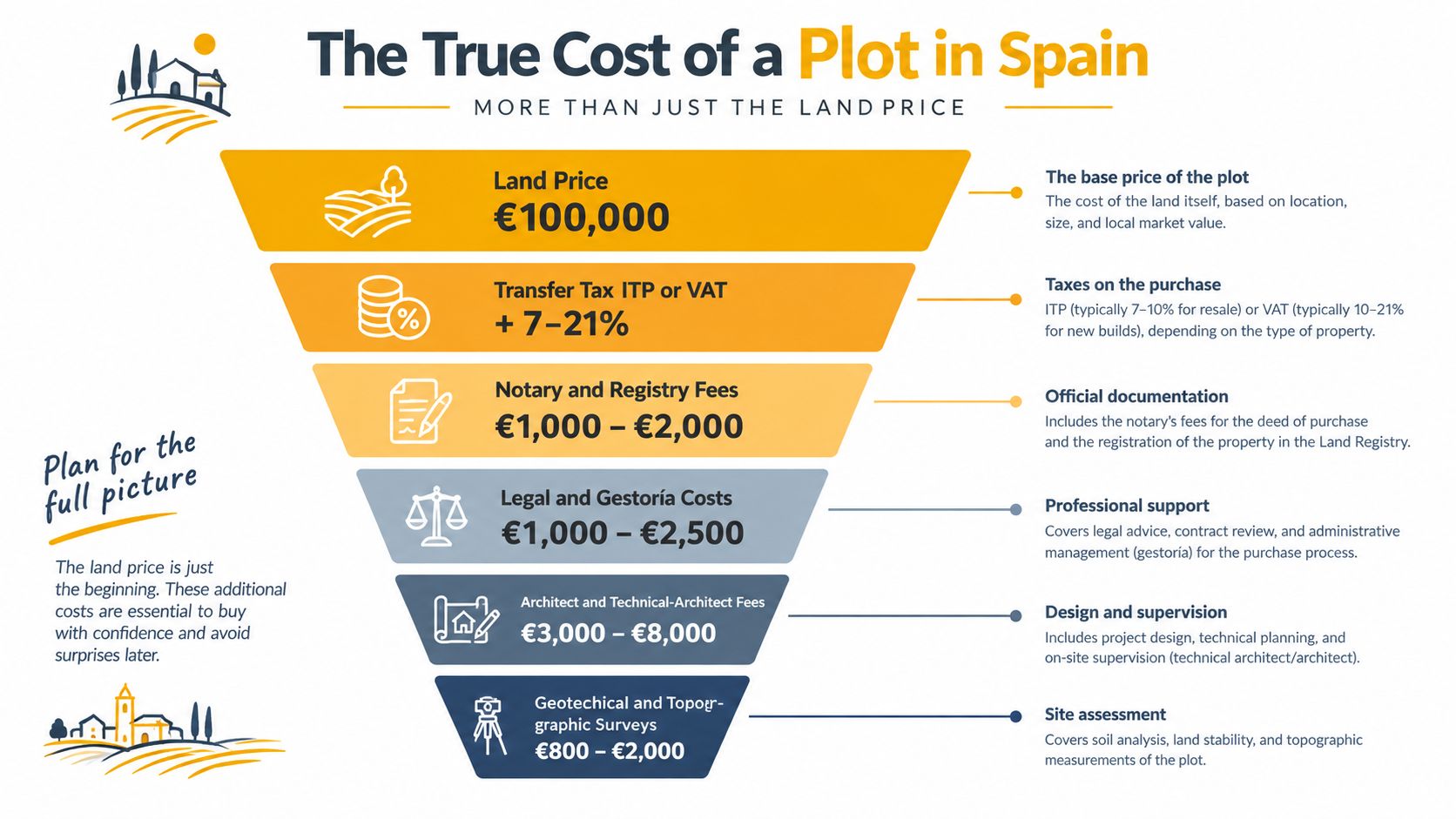
The asking price is the entry fee, not the project cost. Buyers get into trouble because they compare a bare plot with a finished villa and call the difference savings. It isn't savings until you've priced the land, the transaction, the professional team, the licence route, the ground, the connections and the build itself, with contingency for the unknowns you haven't found yet.
Build your model in layers. Start with land price, then transfer tax ITP or VAT depending on the seller and transaction structure, notary and Land Registry fees, independent legal advice and gestoría support. Add the architect and technical architect, topographical and geotechnical surveys, municipal licence taxes including ICIO, utility connections or capacity upgrades, site preparation, retaining structures, drainage, financing costs, VAT on construction where applicable and a contingency line you don't raid for nicer tiles.
Why the Cheaper Plot Often Loses
A low headline price usually has a reason. Slope is the obvious one because it drives excavation, foundations, retaining walls, access for machinery and drainage design. Incomplete infrastructure is quieter but just as expensive. If water, sewerage or electricity capacity isn't available at the boundary, you're buying works, negotiations and delay before the house even starts.
Planning friction costs money too. A parcel that needs a development step, a boundary regularisation or a redesign to satisfy setbacks consumes professional time and extends the period where your capital earns nothing. Delay has a real cost when you're renting elsewhere, financing the project or watching build prices move while you wait for paperwork.
Use national land data only as context. Ministry figures reported by Europa Press on urban land prices at the close of 2025put the average urban-land price at €171 per square metre in Q4 2025, down 2.6% year on year but up 1.9% on the previous quarter, with 8,473 transactions, up 93.4% year on year, and 10.4 million square metres traded. The same report puts land in municipalities above 50,000 inhabitants at €302.50 per square metre. That gap is the lesson. National averages don't price a serviced plot near the coast in Alicante province.
The high-value end of foreign demand also needs honest reading. Registry coverage in the Registradores 2025 foreign buyer release records that 12.22% of foreign home purchases in Spain reached at least €500,000 in 2025. That shows money is moving into finished homes at higher price points. It doesn't prove that buying land and building is cheaper, faster or safer. You still have to make your own numbers work.
Model three cases for every serious candidate. Your low case assumes smooth licensing and no ground surprises, your base case uses written quotations and utility figures, and your high case stresses slope works, connections, professional time and contingency. Commit only if the high case still leaves you comfortable. If the project only works in the low case, it doesn't work.
Compare that high case with a resale or new-build home that you can inspect, licence-check and occupy sooner. Sometimes the finished house is the better risk-adjusted buy. Pride in building your own home shouldn't override arithmetic.
Choosing Between Costa Blanca and Costa Cálida Sub-Regions
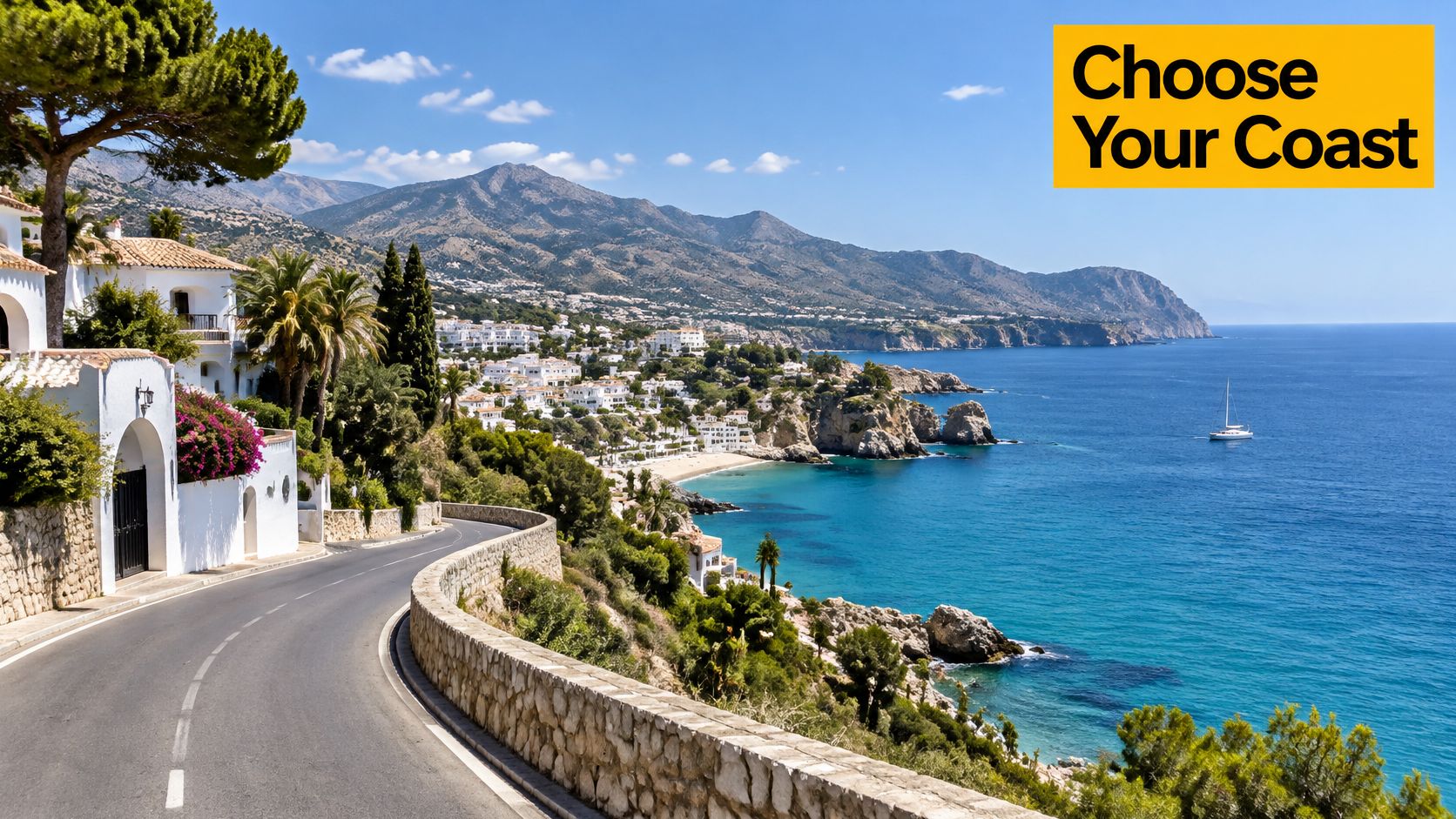
Choose your sub-region by the friction you're willing to manage. Around La Romana and inland Alicante, buyers often get more space and a quieter setting, but they must be especially careful where village-edge, agricultural and residential classifications meet. On the coast, services may be closer, yet coastal, environmental and density controls can narrow what you can build. The right choice depends on your tolerance for complexity, not only on the photograph.
The northern Costa Blanca, including Denia, Jávea, Moraira and Calpe, tends to attract buyers who prioritise views, established villa areas and a more exclusive feel. Terrain can be more demanding, and attractive plots often come with slope, access or protected-view considerations that need early architectural input. If you want a bespoke house and you accept slower, more detailed verification, the north can suit you. If you want the simplest build route, be selective.
Central and southern areas around Alicante city, Guardamar, Torrevieja and Orihuela Costa usually offer a different trade. Infrastructure and services are often more immediately present, the terrain can be easier to read, and there's a broad mix of resale, new-build and plot opportunities. That convenience doesn't remove municipal differences. Two neighbouring towns can apply different parameters, timelines and urbanisation expectations, so your planning certificate still decides.
The Costa Cálida and Mar Menor side appeals to buyers who want value, flatter living and access to Murcia's coast and inland towns. It can be a sensible route for buyers who'd rather spend on the house than on prestige in the address. Apply the same scepticism there. Water proximity, environmental sensitivity and local plan status matter, and a keen price may reflect infrastructure or licensing work still to come.
Supply is significant but finite, and it moves unevenly. The INE regional urban land plot tables record 2,298 urban-land plots in Alicante province in 2023, compared with 2,358 in 2022, and 2,727 in the Region of Murcia in 2023, down from 3,142 in 2022. Those counts don't prove any individual plot is immediately buildable. They show neighbouring markets don't move in lockstep, so a short drive can change choice, competition and negotiating power.
Match the Area to Your Risk Appetite
- Lowest friction: Prioritise a genuine solar in an established residential area with written services, straightforward access and an architect-approved envelope.
- Balanced route: Consider village-edge or inland Alicante locations such as La Romana only after the General Plan classification and any modification are confirmed for the parcel.
- Higher complexity: Treat steep, scenic or partially serviced land as a specialist project, priced for surveys, retaining works, infrastructure and a longer licence path.
Don't pick a sub-region because a portal search looked exciting. Pick the place where the planning culture, terrain and service maturity match the project you can realistically manage from abroad.
Why You Need a Local Team Before You Need a Builder
Assemble your team in the wrong order and you'll pay people to solve problems that should have stopped the purchase. Builders price construction. They don't protect your title, interpret a municipal plan or tell you whether your design fits the plot. You need lawyer and architect first, builder last.
Your independent lawyer should be in place before reservation wording is agreed. That lawyer reviews the nota simple, title, charges, easements, debts and contract conditions, then coordinates the route to the notary. Independence matters. If the same small circle sells you the plot, checks the plot and reassures you about the plot, ask who is being paid to say no.
A gestoría or tax adviser keeps the administrative side clean. They help with NIE, tax filings, ITP or VAT treatment and the practical sequence after signing. Don't treat tax as an afterthought once the deed is signed. The structure of the purchase can affect the bill, and deadlines don't care that you're flying home.
The architect is your highest-value early spend. Before you commit, that architect should test a simple massing study against the town hall parameters, check access and slope, flag likely retaining or foundation issues and produce a feasibility budget. This isn't drawing your dream villa in detail. It's proving whether the parcel can contain a lawful, buildable version of it.
Hiring a builder before an architect has tested the plot is the most expensive shortcut I see. You get a construction price for a house that may not be licensable on that land.
The technical architect, or aparejador, becomes central once the project moves towards execution and site control. The notary formalises the transaction and checks identity and documentation at signing, but the notary doesn't replace your lawyer's buyer-side due diligence. If you're financing, a tasador may be required for valuation, and that valuation won't fix weak planning status either.
Be polite about recommended partners, then verify them yourself. Ask who they act for, how they're paid, whether they've handled plots in that municipality and whether they'll put feasibility concerns in writing. Good professionals welcome hard questions because clear scope protects them too.
A small local team costs money before you own anything. That's the point. You're buying the right to walk away from the wrong plot while walking away is still cheap.
Your First 90 Days After Reading This Guide
Use the next 90 days to replace browsing with evidence. Don't book a viewing trip as your first move. Build a shortlist you can interrogate from home, then travel only for plots that survive the paperwork.
In days 1 to 30, secure your NIE route, open a Spanish bank account and write a one-page brief. State your maximum all-in budget, target areas, minimum house size, single-storey or two-storey preference, pool requirements, access needs and latest acceptable completion window. Shortlist three to five plots and demand the cadastral reference for each. A seller or agent who can't provide it isn't ready for a serious buyer.
In days 31 to 60, your lawyer requests notas simples and checks title while planning certificates and utility confirmations are sought for the strongest candidates. Commission an architect's feasibility study on the best one, not on all five. That study should test the massing, access, slope response and likely cost layers. Kill weak candidates quickly. Keeping a doubtful plot alive because the view is lovely wastes the month.
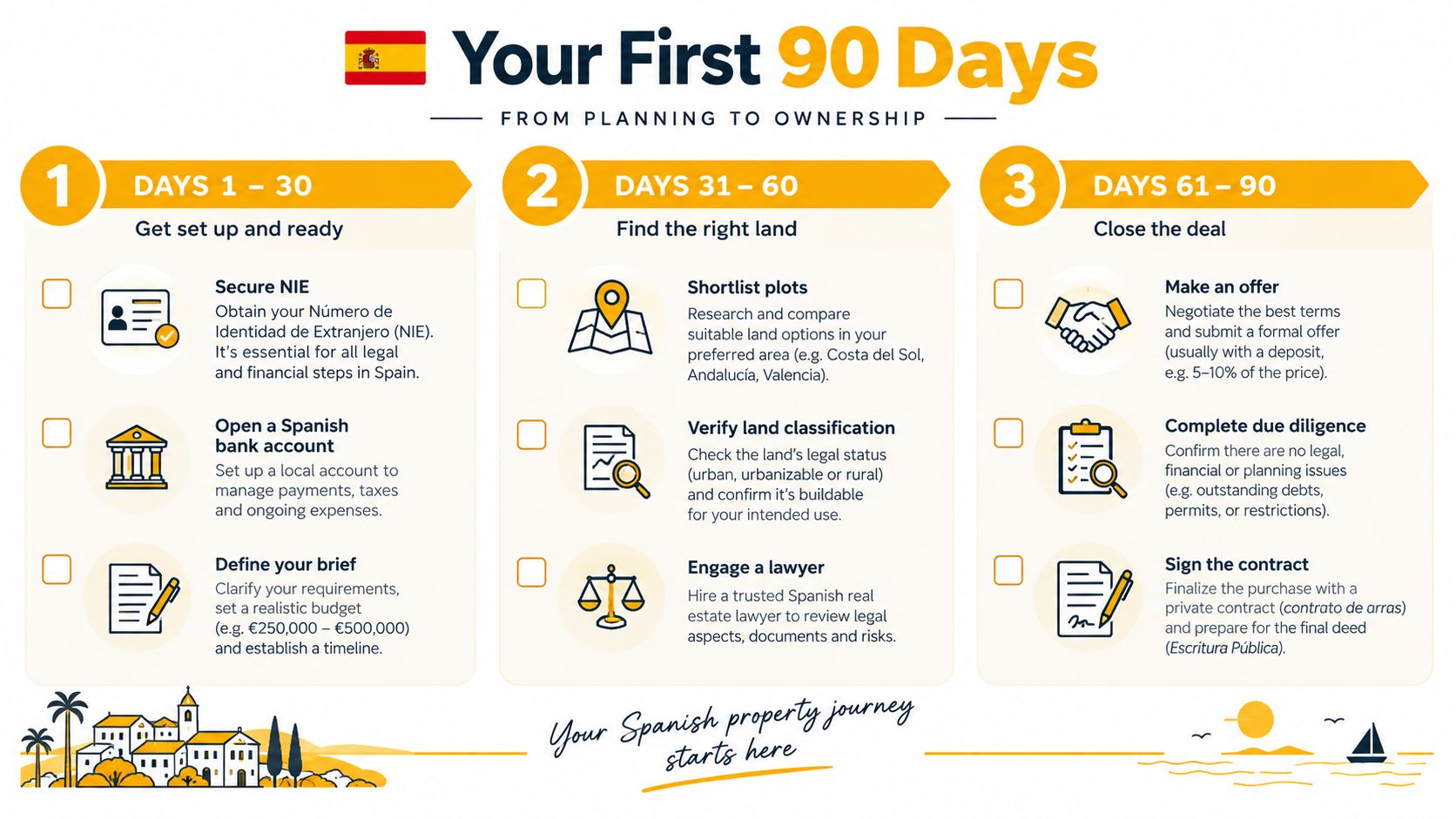
In days 61 to 90, negotiate only around documented facts. If you reserve, make the reservation or contrato de arrasconditional on satisfactory legal, planning, utility and technical due diligence, with clear return mechanics if those checks fail. Prepare the licence pre-file thinking with your architect and line up the notary once your lawyer is satisfied. Don't let a completion date be set before the people protecting you have finished their work.
The Final Test Before You Commit
Ask whether you'd still buy the plot if the sea view disappeared from the brochure. That sounds harsh, but it strips the decision back to access, services, buildable area, ground conditions and total cost. If the answer becomes no, you were buying a photograph. If the answer stays yes, you've probably found a project.
Also give yourself permission not to build. A resale villa or a properly checked new-build home can be the better choice when the plots you like carry slope, infrastructure or planning burdens you don't want to manage. Building is a means to the home you want. It isn't a moral victory over people who buy finished property.
My recommendation is blunt. Talk to a local adviser who understands plots around La Romana, Alicante and the wider Costa Blanca and Costa Cálida before you reserve anything or book a flight around a single listing. Bring cadastral references, not screenshots. Bring your all-in budget, not only the land budget. You'll get a useful answer faster, and you'll avoid spending your first year in Spain undoing your first weekend.
If you're weighing a specific plot for sale in Spain around La Romana, Alicante, the Costa Blanca or the Costa Cálida, get the parcel checked against its municipal planning status, services and realistic build cost before you pay a reservation. Visit AP Properties Spain to discuss your brief, compare suitable plots with finished villas and new-build alternatives, and take the next step with local guidance from first shortlist to notary.
Share


