



Spanish Property Buying Costs: What You Really Pay
There's no single percentage for Spanish property buying costs, because a new-build home in Alicante normally carries 10% IVA plus regional stamp duty, while a resale in the Valencian Community is generally taxed at 10% transfer tax, so a €300,000 resale creates roughly €30,000 in tax before notary, registry and legal fees. If you're sitting at home comparing a villa near La Romana with an apartment on the coast and trying to add a neat 10% to both prices, you're not alone, and that shortcut is exactly where budgets start to wobble.
You've found a home you like. The photos look right, the price fits, and then someone mentions taxes, a notary, a registry and something called AJD, and suddenly the total feels less certain.
Don't worry. The system is logical once you separate it into parts. You'll learn which tax applies to which type of purchase, which fees are regulated, which ones you can influence, and what you'll still pay each year after you collect the keys.
Why Spanish Property Buying Costs Defy a Single Percentage
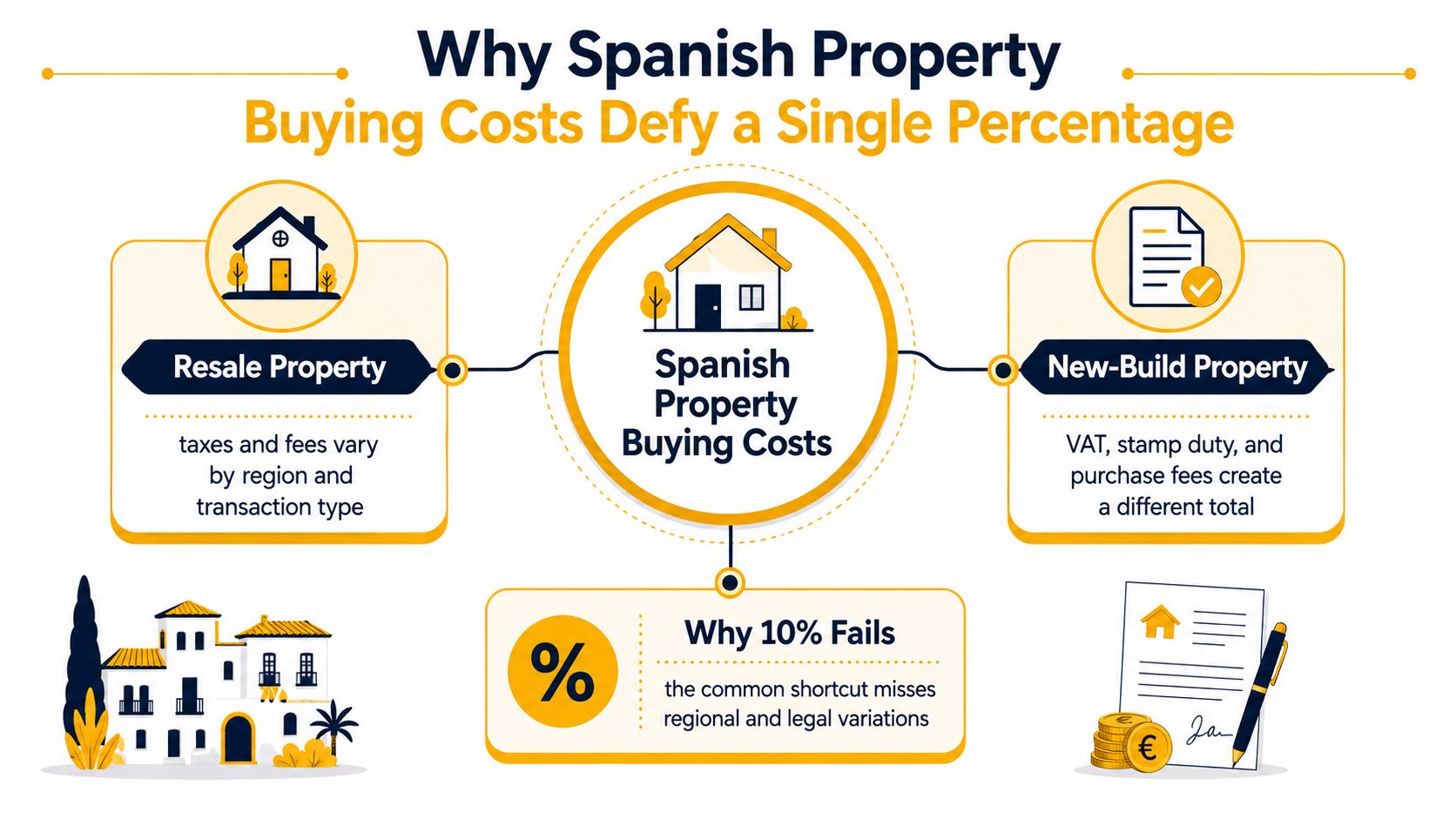
A couple we often meet in spirit, if not in name, arrives with a spreadsheet. They've allowed 10% on top of the price for everything, because that's what a forum post advised. One home on their list is a resale villa inland from Alicante. The other is a new apartment from a developer nearer the coast. Same price, same allowance, and yet the two purchases don't work the same way at all.
That's the first thing to get clear in your mind. Spanish property buying costs follow two different architectures, and mixing them up is the most common source of confusion for first-time international buyers.
Two Purchases, Two Tax Systems
A new home sold by a developer normally carries VAT, called IVA in Spain, plus stamp duty, called AJD. A resale home bought from a private owner generally falls under Property Transfer Tax, known as ITP or TPO, instead. You don't pay both main taxes on the same ordinary purchase, which is why asking whether a home is new or resale is always the starting question.
The second complication is geography. Spain's official administration confirms that ITP and AJD rates differ between autonomous communities and are administered regionally, so a budget built for one region can't be applied to another.
Three Numbers You Need, Not One
Most buyers talk about cost as if it's a single figure. In practice you need three separate numbers, and they answer different questions.
- Total purchase cost: The price plus taxes, notary, registry, legal work and any finance-related expenses.
- Cash needed at completion: What must leave your bank account, which changes if you're using a mortgage and paying a deposit.
- Ongoing ownership cost: What the home costs you each year once you own it, even in months when nobody's there.
A broad allowance can be useful for a first conversation, but it shouldn't be the figure you reserve a property on.
Generic guides often present a broad 10–13% allowance without separating resale from new-build purchases, regional differences, mortgage costs and recurring taxes, as noted in the same official guidance on regional administration. That blending is where surprises come from. Once you split the purchase type, the region and the way you're paying, the numbers become much easier to pin down.
Before you reserve anything, ask three plain questions. Is this a first transfer from a developer or a resale? Which autonomous community sets the tax here? And are you buying with cash or with finance? Those answers shape almost everything that follows.
How Taxes Differ Between New-Build and Resale Purchases
Think of the tax question as a fork in the road. You take one path or the other, and each path has its own main tax, its own extras and its own paperwork.
The New-Build Path
When you buy a newly constructed or substantially rehabilitated home directly from a developer, that's generally a first transfer. The Spanish government's guidance explains that a first transfer is generally subject to IVA at 10% for residential housing, payable by you as buyer to the seller at completion.
Put a real price on it and the idea sticks. On a €400,000 new-build home, that rate normally creates €40,000 in IVAunder the same government guidance. That's before anything else, and it's why the tax line alone can use up a whole generic allowance.
There are exceptions worth knowing about, even if they won't apply to most second-home buyers. The rate is reduced to 4% for certain specially protected or publicly promoted housing, while non-residential real estate generally falls under the 21% standard rate, according to that government guidance. If a property is described to you in unusual terms, ask your lawyer which category it sits in rather than assuming the residential rate.
On top of IVA, a new-build purchase can attract AJD on the public deed. National notarial guidance notes that for a new-build home in Alicante, including La Romana, AJD is set by the autonomous community and can range nationally from 0.5% to 1.5%. Because La Romana sits in the Valencian Community, you should confirm the regional rate at signing rather than lifting a figure from a national guide.
To see why that confirmation matters, consider a worked assumption. On a €500,000 purchase, a 1.4% AJD assumption equals €7,000, but the correct amount depends on whether a reduced regime applies and whether the deed connects to VAT, as the Valencian tax material discussed later in this guide shows. Small percentages still produce large euro amounts at these prices.
The Resale Path
Buy an existing home from its current owner and the picture changes. VAT doesn't apply to the ordinary resale transaction, and you normally pay Transfer Tax (TPO) instead. The charge is calculated on the legally relevant taxable base using the current regional tariff.
That taxable base point catches people out. Don't add a percentage to the advertised price and treat the result as final. Your lawyer should confirm the base that applies to your transaction, because the tax follows the legal figure, not necessarily the number on a listing.
Purchase Type | Main Tax | Typical Rate | Worked Example |
|---|---|---|---|
New build from developer | IVA, plus AJD on the deed | IVA at the residential rate, AJD set regionally | IVA is the larger of the two charges |
Resale from existing owner | Transfer Tax (TPO/ITP) | Set by the autonomous community | No IVA on an ordinary resale |
Protected or publicly promoted housing | IVA at a reduced rate | Lower than the standard residential rate | Eligibility and category must be confirmed |
Practical rule: Ask "new or resale?" before you ask "how much tax?" The first answer decides which tax you're even talking about.
Notary, Land Registry, Legal and Agency Fees Explained
Taxes take the largest slice, but they're not the whole bill. Buyers often underestimate the professional and administrative costs because each one looks modest on its own. Added together, they matter, and they behave very differently from one another.
Costs That Are Regulated
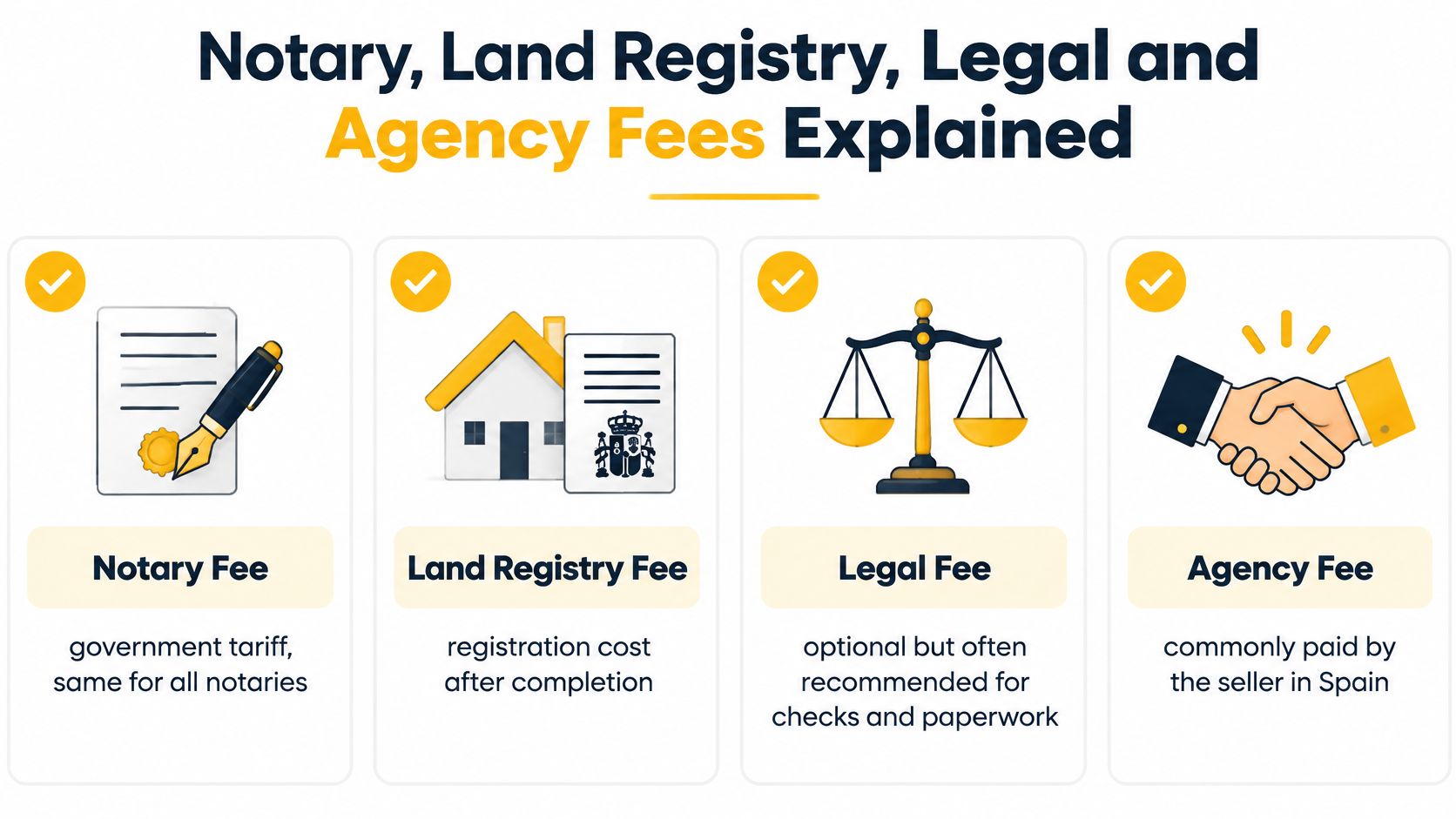
Start with the two fees you can't shop around for. The General Council of Notaries states that notarial fees are established by government tariff and are the same for all notaries, and registration fees are also government-established and uniform for registrars. In plain terms, choosing a different notary doesn't buy you a discount.
The notary's role is formal and impartial. If the parties request it, the notary can handle payment of the transaction taxes and submit the deed electronically to the Land Registry after completion, according to the same notarial guidance. That's a helpful administrative service, but it doesn't remove the underlying tax or the registration charge. The money still has to be paid, whoever presses the buttons.
Who pays what also has a default pattern. In the absence of a different agreement, Spanish rules generally allocate the seller's original public-deed expenses to the seller and the buyer's copies and registration costs to the buyer, subject to regional and contractual qualifications, as that guidance sets out. Because contracts can vary, check your own paperwork rather than relying on the default.
Costs You Can Influence
Legal work sits in a different category. An independent lawyer carries out due diligence on ownership, debts, licences and the contract itself, and that protection is where many international buyers get the most value for money. Legal fees aren't fixed by a government tariff in the way notary fees are, so you can compare quotes, but compare the scope of work as carefully as the price.
- Legal due diligence: Negotiable in price, and worth defining in writing before you commit.
- Valuation: Only relevant where you're using finance, so cash buyers don't carry this line.
- Administrative help: Optional support with filings and payments, separate from the taxes themselves.
- Agency commission: Structured according to the arrangement behind the sale, so ask explicitly who pays it on your transaction.
Ask for a written estimate that separates regulated fees from professional fees. If everything arrives as one lump sum, you can't tell what you're actually paying for.
The useful question isn't how to avoid these costs. It's which ones are fixed by tariff, which ones scale with price, and which ones you can negotiate or choose not to incur at all.
Regional Tax Variations on the Costa Blanca and Costa Cálida
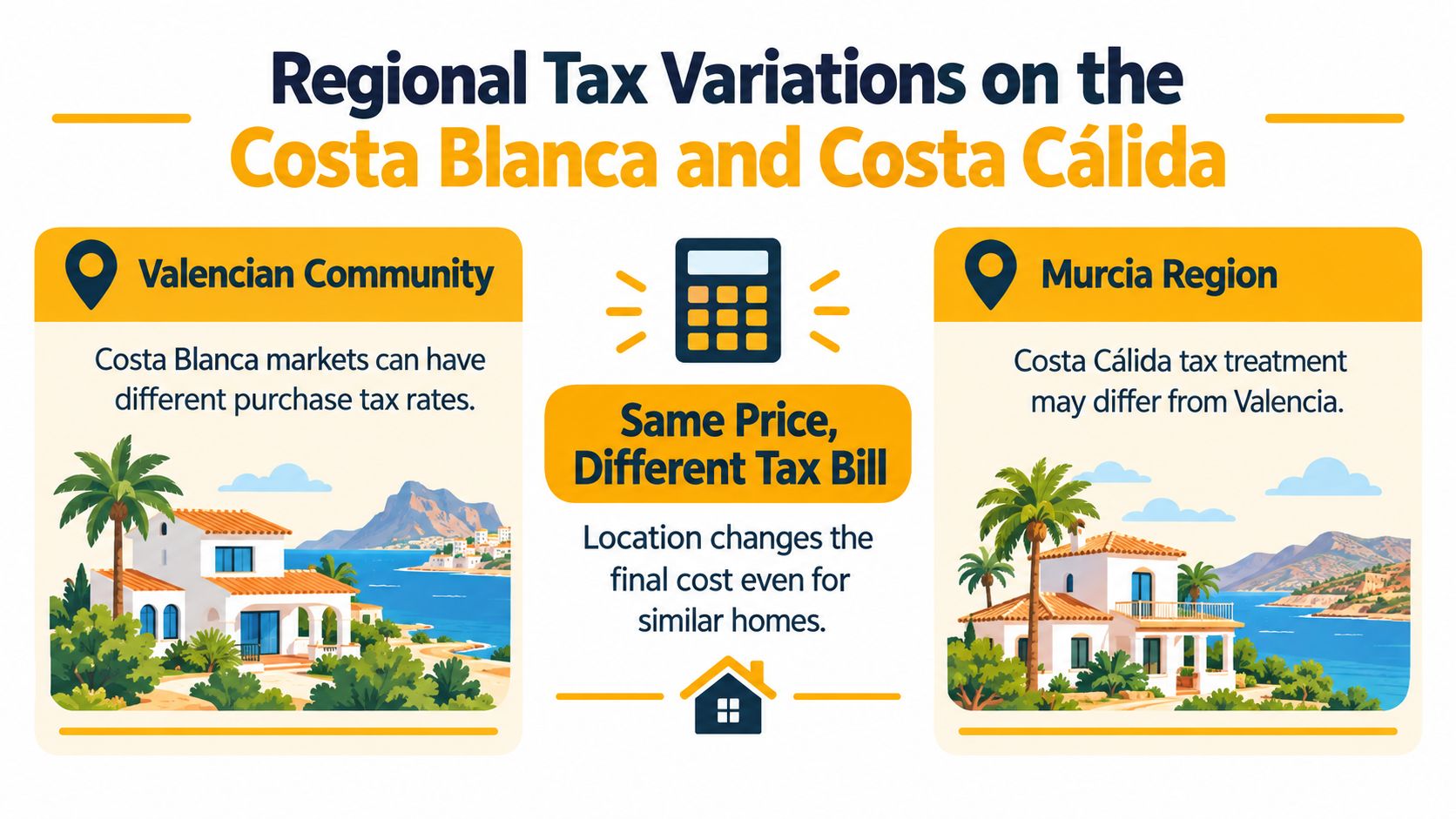
Two homes, same price, different sides of a regional boundary. The tax bills don't match, and a Spain-wide percentage lets you down most visibly.
The Valencian Community and the Costa Blanca
The Valencian Community covers the markets most of our buyers ask about, including Alicante, Jávea, Calpe, Guardamar, Torrevieja and Orihuela Costa, as well as inland La Romana. The Generalitat Valenciana's published tariff lists a 10% ITPAJD rate for residential properties, including garages and annexes transferred together with the home.
That garage detail is worth pausing on. If a parking space or storage room transfers with the home, it can fall inside the same treatment rather than sitting outside your calculation. Always check what's included in the deed.
Reduced rates exist, but they're targeted. The same tariff identifies 6% for a first habitual residence bought by a person under 35 where the value doesn't exceed €180,000, and 3% for qualifying groups including certain disabled buyers, large or single-parent families, victims of gender violence and some protected-housing purchasers, subject to stated conditions and a value ceiling, according to the Generalitat tariff.
The euro difference is striking. A qualifying €180,000 purchase at 6% generates €10,800 in ITP, while a 3% transaction generates €5,400, which are differences of €7,200 and €12,600 respectively compared with a 10% charge, based on the tariff figures. Those gaps show why a buyer-specific calculation matters as much as a property-specific one.
Murcia and the Costa Cálida
Cross into Murcia and the headline changes. The regional tax authority states that the general TPO rate for real estate in Murcia is 8%, with reduced rates available in specified cases. That document is a Valencian ruling that also illustrates how rates hinge on category, identifying 0.1% AJD for first copies of deeds documenting acquisition of a primary residence, 2% where VAT exemption is waived on qualifying transfers, and 1% in other cases under the cited rules.
Timing adds another layer. The current Valencian tariff material reports a general real-estate TPO rate of 9% and a general AJD rate of 1.4% for taxable events from 1 June 2026, as set out in that authority's material. Treat those as dated figures to verify against your completion date, not as permanent fixtures.
Reduced rates are built around habitual residence and eligibility. If you're buying a second home from abroad, don't assume a concession applies to you until someone qualified confirms it in writing.
The lesson is simple. Location isn't just about beaches and driving times. It decides which tariff sheet your purchase is taxed under.
Building a Realistic Purchase Budget with Worked Examples
Let's turn all of this into a method you can use on any listing you're considering. Work through two contrasting purchases and watch how the lines change.

Example One, a Resale Villa in the Valencian Community
Take the resale from the opening. Your main tax line is TPO, calculated on the legally relevant taxable base under the current Valencian tariff. National notarial guidance identifies TPO as a buyer-side charge for an existing home, with VAT and AJD listed among buyer-side taxes for the relevant transaction type.
Below that main line, add the regulated notary and registry charges covered earlier, then your legal fees. If you're paying cash, your list largely stops there. If you're borrowing, add valuation and any mortgage-related expenses, and remember that those lines exist only because finance is involved.
Example Two, a New-Build Apartment in Alicante
Now take a developer sale. Your main line is IVA rather than TPO, and AJD sits beneath it at the regional rate confirmed for your signing date. The developer's contract should reconcile IVA, AJD, guarantees and payment timing before you reserve, so the staged payments and the tax treatment tell the same story.
Payment timing deserves its own moment of attention. New-build purchases often involve payments before completion, so your budget needs a calendar as well as a total. Ask when each amount falls due, not just how much it is.
Your Own Estimate, Step by Step
- Confirm the purchase type: New build from a developer, or resale from an existing owner.
- Confirm the region: Valencian Community, Murcia, or elsewhere, because the tariff follows the property.
- Confirm the taxable base: Use the legally relevant figure your lawyer identifies, not just the advertised price.
- Add the regulated lines: Notary and Land Registry charges at the government tariff.
- Add your choices: Legal work, and finance costs only if you're borrowing.
Your cash requirement is not the same as your total purchase cost. A mortgage adds a deposit on top of taxes and fees, while a cash purchase removes finance charges but never removes conveyancing and registration.
Separate every line into one of four boxes. Percentage-based costs move with the price. Fixed or regulated costs follow a tariff. Negotiable costs depend on who you instruct. Finance-only costs disappear if you're not borrowing. Once a cost sits in the right box, estimating it stops feeling like guesswork.
Ongoing Ownership Costs After You Complete
Completion day gets all the attention, but ownership has a second budget that runs in the background. For international buyers especially, it's the budget most likely to surprise.
The Tax Bill on an Empty Home
Here's the point that catches second-home owners out. A property that earns nothing can still produce a tax obligation. Non-resident owners can owe Spain's non-resident income tax even when the property is not rented, calculated using a deemed income based on the property's cadastral value.
That word, cadastral, refers to the official value recorded for your property for local tax purposes. It's not the price you paid and it's not a market valuation. Because deemed income is built from that figure, your lawyer or tax adviser should identify the cadastral value early so you can estimate the annual charge rather than discover it later.
Alongside it sits IBI, an annual ownership charge connected to the property itself. Between IBI and non-resident tax, an empty holiday home on the Costa Blanca or Costa Cálida still generates paperwork and payment deadlines every year, even in a year when you barely visit.
The Recurring Cost Stack
Model your first five years, not just your first day. A realistic annual list for a second home usually includes several of these lines.
- IBI and non-resident income tax: The two recurring tax obligations to diarise from the start.
- Community fees: Payable where your home sits within a shared development with common areas.
- Insurance and utilities: Ongoing even at low occupancy, because standing arrangements continue.
- Maintenance: Gardens, pools and general upkeep don't pause while you're abroad.
- Legal and accounting support: Filing help that keeps non-resident obligations on track.
The most useful question after "what will it cost to buy?" is "what will it cost to own in a year when it earns nothing?"
Renting the property out changes the picture rather than simplifying it. A rented home introduces additional filing, management and licensing considerations, and potentially regional tourism-law costs. Don't assume holiday letting is permitted for your specific property and area. Verify the local position first, and build any compliance costs into your expectations before you count rental income.
Resident and non-resident owners aren't treated identically, so your personal tax status belongs in the budget conversation from the beginning. A short session with a tax adviser before you buy can save you from structuring five years of ownership around an assumption that doesn't fit you.
How a Local Consultancy Keeps Your Costs Under Control
None of these costs are difficult once they're organised. They become stressful when nobody's coordinating them, and each professional assumes someone else has checked the figures.
That's where we work. AP Properties Spain supports clients throughout the property-buying process and provides a full service at every stage to keep transactions smooth and successful. In practical terms, that means taxes, documents, registry submission and payment timing get reconciled before completion rather than discovered at the notary's table.
We provide the documentation required for presentation before a notary, while our lawyers advise you on the transaction and your best interests. For international buyers, we and our lawyers also help with applications for a NIE identity document, a residence permit and a Spanish bank account, and we offer document translation in your own language so you're never signing something you only half understand.
After a sale, we can follow up on changes to utilities, cadastral ownership, taxes and community information, which connects directly to the ongoing costs covered above. We help buyers compare new-build and resale options across coastal towns including Dénia, Jávea, Calpe, Altea, Benidorm, Alicante, Torrevieja, Orihuela Costa and Guardamar del Segura, and inland locations including Benissa, Alfaz del Pí, Polop, Finestrat, Benijófar, Pilar de la Horadada, Elche, La Romana, Hondón de las Nieves and El Pinos.
Your next step is straightforward. Before you reserve any property, request a written, property-specific cost estimatethat separates the main tax, the regulated fees, your legal costs and any finance lines. If a figure can't be explained in plain language, it isn't ready to be relied on.
If you'd like that property-specific estimate before you reserve, tell us which home you're considering and whether it's a new build or a resale, and we'll walk you through the tax, notary, registry and legal lines in plain English. Visit AP Properties Spain to start the conversation and buy with the full cost picture clear from day one.
Share


