



Alicante Real Estate Market 2026: Prices, Areas and Rules
Foreign buyers accounted for about 35% of Alicante province's home transactions in the four quarters to the second quarter of 2025, compared with 14.4% nationally, according to CaixaBank Research's analysis of foreign demand. That makes the Alicante real estate market more than a local housing story: international demand shapes its activity, while local rules, property condition and physical risk determine whether a specific purchase makes sense.
A busy market and rising prices don't guarantee that a home is fairly valued, legally rentable or safe from flooding. Buyers need to separate provincial averages from local evidence, and advertised rental income from income a property can actually earn under the applicable rules.
Alicante Real Estate Market at a Glance
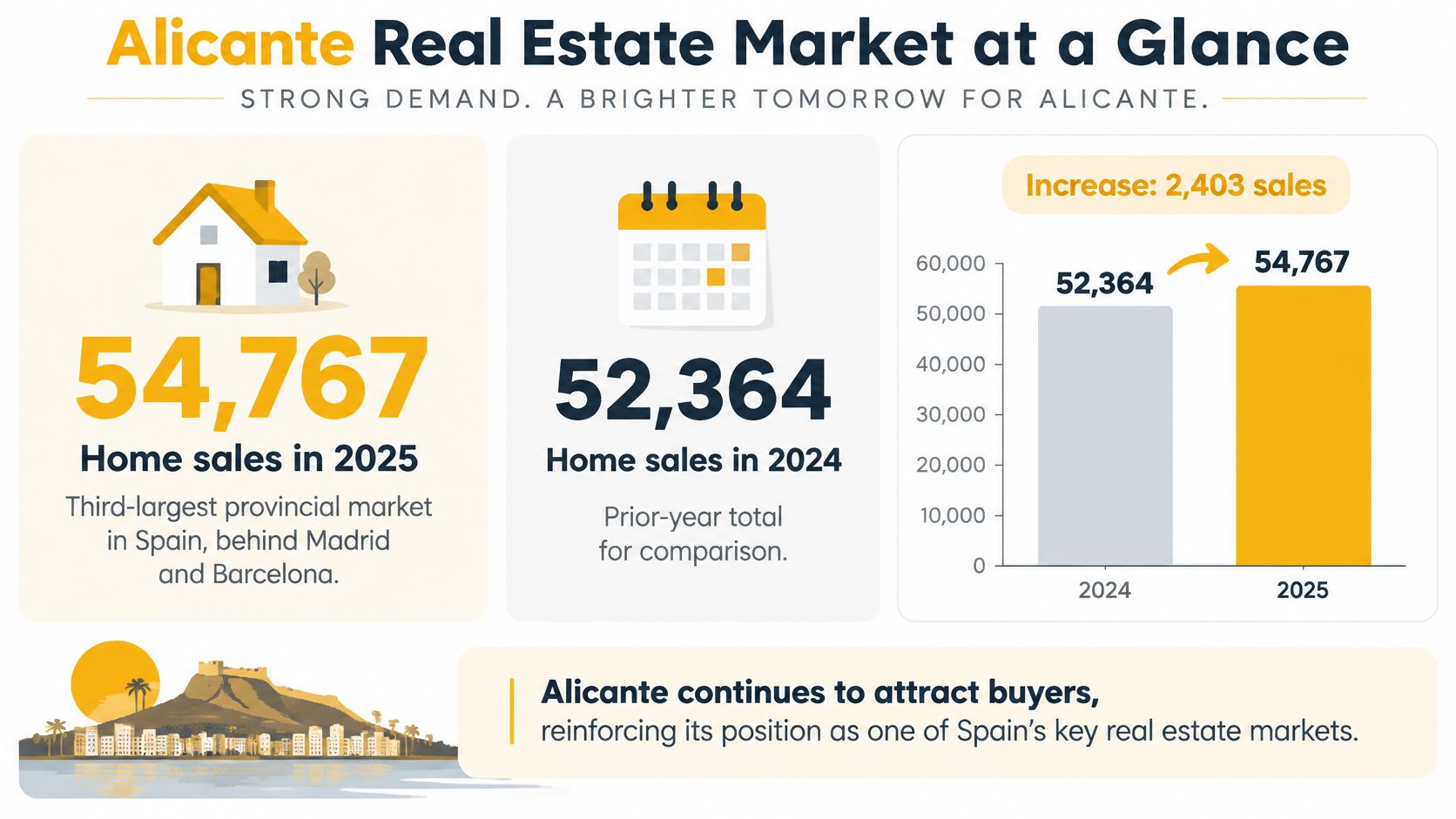
Alicante recorded 54,767 home sales in 2025, making it Spain's third-largest provincial market by transaction volume, behind Madrid and Barcelona. That was up from 52,364 sales in 2024, a year that surpassed the previous modern record and the level recorded during the 2007 property boom, according to reporting based on Spain's National Statistics Institute property-transfer statistics.
The mix matters more to a buyer than the headline total. Second-hand homes accounted for 44,051 transactions in 2025, about 80% of sales. New-build transactions reached 10,716, leaving new supply a small slice of activity and still below the volumes recorded during the 2007 boom.
Read the totals within each source
Published totals are not identical across accounts. Separate 2025 Registrars data reports a lower transaction count than the figure above, along with a per-inhabitant sales rate that ranks among the highest of Spain's provinces. Treat the two series as different measurements of the same market and avoid combining them.
Indicator | Latest figure | Context |
|---|---|---|
Home sales, 2024 | 52,364 | Above the previous modern record and the 2007 boom level |
Home sales, 2025 | 54,767 | Third-largest provincial market in Spain by volume |
Resale transactions, 2025 | 44,051 | About 80% of all home sales |
New-build transactions, 2025 | 10,716 | Below the new-build volumes of the 2007 boom |
Sales per 1,000 inhabitants, 2025 | Among the highest in Spain | Registrars data; total count differs from the INE-based series |
For year-on-year comparisons, use figures from the same source and series rather than selecting the larger total from one account and the smaller from another. The reliable market-level conclusion: transaction activity is high, resale housing dominates, and new-build sales remain below their boom-era volume.
That composition carries a practical consequence. Roughly four of every five purchases involve existing stock, where building age, renovation quality and legal status can vary widely between homes in the same town. New-build buyers face a thinner pipeline, so asking prices in that segment respond more to scarce supply than to any provincial average.
A busy market is evidence of demand. It is not proof that an individual property is fairly priced, correctly documented or cleared for the use a buyer has in mind.
Prices and Price Gaps Across Alicante
Provincial registry data shows Alicante's average residential price rising at a double-digit annual pace in 2025. Treat that average as context for the whole province, and resist reading it as a valuation for a particular home. The 2025 notarial report on foreign-buyer transactions and prices records fewer foreign purchases alongside a higher average price paid, a combination consistent with buyers favouring better-located or higher-specification properties while available stock stays limited.
Take a 90 m² flat and a 110 m² villa at the provincial average and the multiplication produces two tidy figures. Neither describes a real home. The average blends prime coastal sales with inland resales, and sea views, a plot, a pool, condition and building specification can push two homes of identical floor area far apart in price.
Separate the price signal from the property
A coastal new-build with outdoor space can sit well above the provincial average, while a resale flat inland may sit below it. Even within one town, building age, renovation quality, energy performance and access to services produce meaningful differences. A headline average also rises when more transactions involve larger or better-located homes, even if the same type of property has gained less than the headline rate.
Benchmark | What it shows | Source | How to use it |
|---|---|---|---|
Provincial average price | One average across coastal and inland towns | Registrars, 2025 | Context only; every valuation needs same-town comparables |
Provincial price change | Double-digit growth year on year | Registrars, 2025 | Headline growth; split it by asset type |
Share of advertised homes above €1 million | Alicante among six provinces holding 86% | Idealista report index | Confirms a real luxury segment |
Price per m² by municipality | Prime coastal towns run above the provincial average, inland towns typically below | Same-town transaction records | Compare like-for-like homes in the same municipality |
Price per m² for new-build | Can sit well above the provincial average in coastal areas | Same-town new-build and resale comparisons | Weigh the premium against resale in the same town |
Alicante belongs to a group of six Spanish provinces that together contain 86% of advertised homes priced above €1 million, according to Idealista's report index. That confirms a substantial luxury segment alongside mid-market and inland housing. It says nothing about whether a particular premium listing is fairly priced, since an asking price reflects a seller's target rather than a completed sale.
For an offer, compare the same municipality and property type, then account for plot scarcity, energy performance, outdoor space and likely renovation costs. A below-average asking price can still carry costs the €/m² figure never captures, from an unregistered extension to flood exposure on low-lying ground or a community that restricts holiday letting. The provincial figure is context. The same-town evidence is what prices the property.
Coastal Towns and Inland Areas Compared
Alicante province placed 16 of the 84 municipalities in a first-quarter demand-pressure ranking, with Alicante city, Elche, Santa Pola, Dénia, Benidorm, Torrevieja, Calpe, Altea and Jávea among the locations named, according to Idealista's demand ranking.

Demand pressure is a signal, not a price. A high ranking tells you buyers are competing in a town; it says nothing about what a specific property should cost or what rental income it can legally produce. Premium coastal markets such as Altea and Jávea sit at the top of that demand curve, where plot scarcity and sea views carry much of the value.
The resort corridors ask different questions. In Torrevieja, Orihuela Costa and Guardamar del Segura, a purchase needs close scrutiny of rental eligibility, building rules, community costs and flood-zone classification before any projected yield deserves trust.
Inland towns such as La Romana, Hondón de las Nieves, El Pinos, Polop and Elche offer a different search entirely. Entry prices are typically lower and plots larger, but a cheap asking price says nothing about the land underneath it. On an illustrative €400,000 budget, a buyer might weigh a modest coastal apartment against an inland townhouse with a garden. That comparison only holds after checking road access, drainage and plot legality.
Area | Setting | What the budget typically buys | What to check |
|---|---|---|---|
Altea | Premium coastal town | Established homes, often with sea views | Plot size, sea-view premium, age of stock |
Jávea | Premium coastal town | Villas and apartments in a high-demand market | Flood-zone status, access, sea-view premium |
Alicante city | Provincial capital, high demand | City apartments across varied districts | Price by district and building age |
Torrevieja | Resort corridor, high foreign exposure | Apartment stock aimed at second-home buyers | Rental rules and community fees |
Orihuela Costa | Resort corridor | Newer developments near golf and beaches | Urban legality of older developments |
Guardamar del Segura | Coastal mid-market | Mid-range homes near the river mouth | Flood-zone classification near the river and coast |
La Romana | Inland village | Village houses and larger plots | Road access, drainage, plot legality |
Hondón de las Nieves | Inland village | Rural homes and building plots | Plot size, water supply, access roads |
AP Properties Spain covers coastal locations including Dénia, Jávea, Calpe, Altea, Benidorm, Alicante, Torrevieja, Orihuela Costa and Guardamar del Segura, as well as inland areas including Benissa, Alfaz del Pí, Polop, Finestrat, Benijófar, Pilar de la Horadada, Elche, La Romana, Hondón de las Nieves and El Pinos.
The contrast comes down to what each market prices. The coast sells lifestyle and liquidity; inland areas sell space and lower entry costs. Neither setting prices the property itself. The value sits in the condition, legality and physical risk of the individual home, and that work happens after the location decision, not instead of it.
Who Is Buying Alicante Property and Why
Alicante demand has two parts. Local and resident buyers are affected by employment and access to credit; overseas buyers may be weighing lifestyle moves, currency effects, retirement and second-home plans. These groups can look at the same property for different reasons, so a seller or buyer should not treat the province as one uniform audience.
Foreign purchasers bought 30,290 homes in Alicante province in 2024, up 1% on 2023 and 254% since the start of the report's series in 2010, according to a report based on data from the Valencia Notarial Council. The average price paid by foreign buyers was €198,180 that year, 12% higher than in 2023. This is evidence of substantial international demand, but it doesn't mean foreign buyers are all seeking the same areas, budgets or property types.
The nationalities differ in both volume and average spending. Buyers from the Netherlands recorded average prices above €300,000; buyers from the UK, the Netherlands and Belgium were among the leading groups by transaction volume, with Poland close behind. Those distinctions matter when setting a price or preparing a property for sale: the audience a home can realistically attract depends on its location, condition and price point, not merely on the province's international profile.
Demand indicator | Figure | What it suggests |
|---|---|---|
Foreign purchases in Alicante, 2024 | 30,290 homes | International demand is a substantial part of the market |
Change from 2023 | +1% | Foreign transaction volume rose slightly |
Change since the series began in 2010 | +254% | Demand has expanded over the longer series |
Average price paid by foreign buyers, 2024 | €198,180 | A useful benchmark for this buyer group, not a property valuation |
Dutch buyers' average price | Above €300,000 | Buyer budgets differ by nationality |
Leading groups by transaction volume | UK, Netherlands and Belgium; Poland close behind | Marketing needs to match the likely audience |
The same notarial report shows that the average price paid by foreign buyers rose even as the number of foreign purchases fell in 2025. Read together, the figures support a cautious interpretation: transactions can decrease while average spending increases, potentially because the mix of homes sold has changed. They don't prove that like-for-like properties rose by the same amount.
For a cross-border transaction, the practical details are part of the offer: buyers need clear property documents, a realistic payment schedule and support with the steps between agreement and completion. Marketing should reach international buyers where appropriate, but sellers still need evidence for the asking price and buyers still need independent checks before committing.
Which Fits Your Plan
The National Statistics Institute recorded 11,284 dwelling sales in Alicante province in February 2025. Of these, 3,412 were new homes and 7,872 were resales; 6,439 involved free-market housing and 231 involved protected housing, according to the INE's February 2025 transaction tables. The monthly figures show resale leading, but they're a snapshot, not a forecast for a particular home or municipality.
Factor | New-build | Resale |
|---|---|---|
Share of home sales, 2025 | About 20% (10,716 sales) | About 80% (44,051 sales) |
Tax at purchase | VAT and Stamp Duty may apply; confirm rates for the property | Property Transfer Tax (ITP) applies; confirm the rate for the buyer and property |
Price negotiation | Often limited; prices are set by the developer | Usually room to negotiate |
Condition at handover | New, with current specifications; check the contract and warranties | Inspect for defects and likely repairs |
Payment structure | Staged payments during construction may apply; verify safeguards and dates | Payment is generally made at completion |
Main risk | Construction delays and handover defects | Hidden defects and unclear legal status |
Tax needs a property-specific check. The new-build and resale tax treatments differ, but the precise amount depends on the applicable rules and circumstances. Don't budget from a generic rate alone; ask a lawyer or tax adviser to confirm the charges before you sign.
For condition, ask what the inspection has established. A new home may need less immediate work, but review the specifications, handover terms and warranties rather than assuming every feature is included. A resale can offer an established street and a quicker move, but inspect the structure, installations and any alterations, and check that the property's legal description matches what is being sold.
Payment terms also change the risk. A new-build contract may require staged payments before completion, so check milestones, protections and the consequences of delay. With a resale, negotiate the completion timetable and ensure searches and financing are ready before signing a binding commitment.
Verdict: Choose a new-build if you value a new home and can wait for completion after checking the contract. Choose a resale if you want to focus on existing neighbourhoods, inspect the actual property and negotiate around its condition and completion date.
Rental Returns and Tourist-Rental Rules
A gross holiday-rental yield is only useful if the property can legally operate as tourist accommodation. In the Valencian Community, a tourist dwelling must be a complete property, hold a favourable municipal urban-compatibility report and be registered with the regional Tourism Register. The Generalitat publishes regional tourist-dwelling information and records on tourist-use dwellings, so a buyer can check the registration status of a specific address rather than take it on trust.
Eligibility rests on two layers that can move separately: the regional rules in force and the municipality's compatibility decision. Both differ between towns, and both can be revised. Confirm the position for the specific property and municipality before purchase, and ask how the registration is maintained, because an entry depends on the conditions behind it continuing to be met.
That changes the first investment question. Before estimating bookings or income, establish whether the address, building and ownership arrangement can support the intended rental model, and whether that position is likely to hold. An advertised return cannot tell you whether a municipality will issue a favourable report or whether a registration entry is active.

A lower asking price can conceal a compliance problem. Two hypothetical flats make the point: one costs €180,000 with uncertain tourist-use eligibility; the other costs €240,000 with clear, durable compliance. The cheaper purchase is the weaker investment if the rental model behind its advertised yield cannot lawfully operate, because that income was never legally available to the buyer. The comparison shows why compliance risk belongs in the purchase decision, early enough to shape the offer.
Rental approach | What to establish first | Main investment risk |
|---|---|---|
Tourist accommodation | Complete-property status, favourable municipal report and valid Tourism Register entry | The property may not qualify or may lose registration |
Seasonal letting | Contract structure, local restrictions and whether the arrangement falls outside the tourist-dwelling definition | Assuming a label alone determines legal treatment |
Longer-term letting | Lease terms, ownership obligations and tax treatment | Underestimating costs or miscalculating net income |
The licence comes before the spreadsheet. Once legal usability is established, move from gross receipts to net income: allow for community charges, property tax, insurance, management, vacancy and tax on rental income. Non-residents can face different treatment from residents, and the applicable rate and any withholding depend on the owner and the arrangement. Have a tax adviser confirm the figures before you budget a net yield.
Before purchase, verify the community statutes for any restriction on tourist lets, the municipal compatibility position, registration validity, insurance requirements, local restrictions and the tax treatment of the income. A lower-priced flat with uncertain eligibility can carry more investment risk than a costlier property whose intended rental use is clearly supported.
Verify the Property and Agent Before You Offer
A University of Alicante study reported in 2025 found that about 20% of identified urban and rural homes in selected rural districts were in flood-hazard areas, around 1,800 of nearly 9,000 mapped constructions and dwellings. The study combined Cadastre information with PATRICOVA flood-risk mapping and other official spatial data, as described by the University of Alicante. The finding applies to selected rural districts, not every home in Alicante, but it makes parcel-level checks essential.
For a villa, finca or plot, check the flood-zone classification alongside drainage, road access, building legality, retaining walls, basement exposure, insurance availability and planned adaptation works. A lower price may not compensate for restrictions on extensions, expensive drainage work or difficulty obtaining insurance. Inland doesn't automatically mean safer, and distance from the sea alone can't establish a coastal property's exposure.
Put the agent and property through separate checks
Before paying a reservation deposit, verify the property and the person representing the transaction. AP Properties Spain holds the licences and insurance required to register as a licensed real-estate agent in the Comunidad Valenciana. We support both buyers and sellers, including clients handling cross-border paperwork.
A capable agent should be able to explain the registry, tax and notary steps in writing before a deposit is paid. That explanation helps you identify what remains to be verified, but it doesn't replace independent legal advice or a property-specific flood review.
Before you sign: Request the property's registry check and flood-zone classification, then resolve any mismatch or uncertainty before signing a reservation agreement or transferring a deposit.
How to Complete a Purchase as a Foreign Buyer
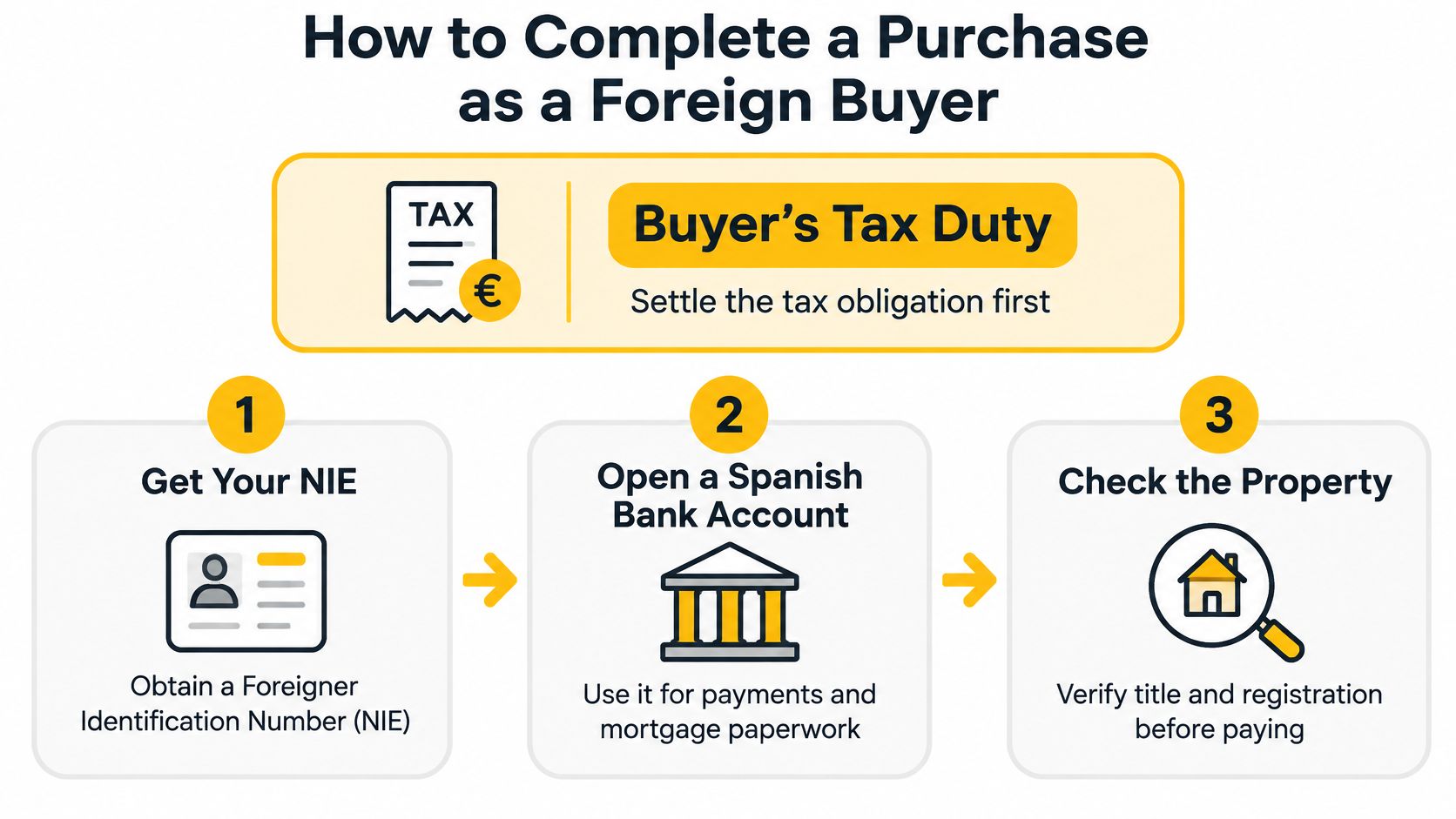
A foreign buyer completes an Alicante purchase by turning three unknowns into paper before money moves: legal identity and tax capacity, verified title, and finance that survives to completion. A low price or advertised yield is usable only after those checks clear, so compliance belongs inside the offer decision rather than after it.
On a resale purchase, the buyer is responsible for declaring and paying the Property Transfer Tax. The Valencian regional government requires the buyer to self-assess and pay through an authorised collaborating financial institution under its prescribed process, as set out in the regional Property Transfer Tax procedure. Treat that as a buyer-side obligation in addition to the agreed price.
Prepare before committing
- Obtain a Foreigner Identification Number (NIE). You need it for formal property and tax steps. Start early, and make sure the identifying details used across your documents match.
- Open a Spanish bank account. A local account can help manage purchase payments and mortgage paperwork. Confirm payment limits, transfer timing and any required authorisations before funds are due.
- Check the registry entry and cadastral record. Confirm the registered owner, property description and recorded charges, then compare those details with the home being offered. Resolve discrepancies before a reservation contract makes them expensive to unwind.
- Confirm financing before signing a reservation or preliminary contract. Non-resident buyers may face lower loan-to-value limits and stricter income checks than residents, so request current lender terms, including arrangement and valuation costs. Set the deposit and completion date only after you understand the finance conditions and the consequences if a mortgage is declined.
- Sign the reservation or preliminary contract only after review. The wording should state the property, price, deposit, conditions and timetable plainly. Have a lawyer review it before funds leave your account.
- Attend the notary to sign the deed. Provide the documents requested for the transaction and check the deed against the agreed terms. Arrange in advance how payment will be made and what must be available on completion day.
- Self-assess and pay the applicable tax. For resale, the buyer completes the regional process and pays through an authorised collaborating financial institution. Confirm the deadline and amount with your lawyer or tax adviser, because late payment is an avoidable compliance problem.
- Register the deed and update ownership details. After completion, register the deed at the Land Registry, then update utilities, cadastral ownership and community information. Keep copies of the completed paperwork so later bills and notices reach the right person.
Budget beyond the agreed purchase price for tax, notary and registry fees, legal advice and mortgage costs. The reliable figure is an itemised budget from your lawyer and lender before signing, since the tax route, professional fees and financing costs depend on the transaction.
AP Properties Spain helps international buyers compare new-build and resale homes across Alicante province, Costa Blanca and Costa Cálida, with support through the buying process and coordination around legal checks and completion. If you are weighing a coastal rental against an inland home, or need to verify a property before making an offer, visit AP Properties Spain to discuss your search and the checks it requires.
Share


