



Spain Real Estate Agency: How to Choose One You Can Trust
House prices in the Region of Murcia rose 15.0% year on year in the third quarter of 2025, the largest increase among Spain's autonomous communities, according to the National Statistics Institute's Housing Price Index. That makes choosing a Spain real estate agency about more than finding attractive listings. You need someone who can explain price evidence, organise the paperwork and distinguish a promising home from an unsuitable purchase.
Before arranging viewings around La Romana, Alicante or elsewhere on the Costa Blanca and Costa Cálida, settle two questions: who will protect your legal interests, and is your intended use permitted? A holiday home for personal use and a property intended for short-term letting need different checks.
What a Spain Real Estate Agency Does for You
A Spain real estate agency finds and shortlists properties, negotiates the price and coordinates the transaction. It doesn't replace your lawyer or the notary, even when it introduces you to both.
International coordination is an established part of the job: foreign buyers represented 13.82% of Spanish home purchases in 2025, with British, German and Dutch buyers accounting for 7.97%, 6.52% and 6.31% of foreign purchases respectively, according to Spain's Association of Property Registrars. Buyers need more than translated listings. They need professionals who understand their separate responsibilities.
- Estate agency. Your commercial coordinator finds suitable homes, arranges access, negotiates and gathers the file. Ask whether it represents the seller, the buyer or both.
- Lawyer, or abogado. Your legal adviser checks ownership, contractual obligations and property-specific risks. Confirm in writing that the lawyer represents your interests, including when introduced by the agency.
- Notary, or notario. This neutral public official authenticates the public deed and checks identity and legality at signing. The notary isn't your personal adviser or a substitute for advance investigation.
- Gestor. This administrative professional can organise applications, filings and registration tasks. Agree the scope, because some work overlaps with services offered by lawyers.
- Bank. The lender assesses your finances and the property if you need a mortgage. Its approval protects its lending position, not every aspect of your purchase.
Who does what in a Spanish property purchase
Role | Main job | When you need it |
|---|---|---|
Estate agency | Finds, shortlists, negotiates and coordinates the file | From first search through completion |
Lawyer (abogado) | Checks title, contract terms and risks, and advises you alone | Before any reservation or contract is signed |
Notary (notario) | Authenticates the public deed (escritura) and checks identity and legality | At the signing of the deed |
Gestor | Handles tax filings, NIE applications and registry steps | NIE assistance before purchase; tax and registration work after signing |
Bank | Assesses and lends the mortgage | Only if you finance the purchase |
In a resale, the seller usually pays the agency. New-build marketing is normally handled by the developer's agents or collaborating agencies, but confirm who pays what in writing before reserving. A friendly introduction doesn't establish representation or disclose a fee.
Boutique Versus Large Firms Side by Side
Choose the working model, not the prestige of the label. The patterns below are useful interview prompts, not guarantees about every boutique or large agency.
Boutique and large agencies compared on the criteria that matter
Criterion | Boutique firm | Large firm |
|---|---|---|
Portfolio size | Smaller, curated listings | Large catalogue across many areas |
Client contact | Usually one senior adviser from viewing to completion | Rotating staff with handoffs between teams |
Off-market access | Often stronger through private client networks | Mostly portal-based listings |
Fee flexibility | Terms sometimes negotiable for high-value deals | Usually standard fee schedules |
Language support | Few languages, often matched to the client base | Broader language teams in larger offices |
Reach | Deep knowledge of a few areas | Wide national and international portal exposure |
Best fit | Bespoke search, premium homes, buyers wanting one contact | Breadth, fast comparison, budget-led searches |
AP Properties Spain was established in September 2021 and operates as a luxury boutique real estate consultancy on the Costa Blanca and Costa Cálida. Our work includes new-build and resale searches, with support throughout the buying process.
Match the service to your search
Say you live abroad, have a firm spending limit and want a sea-view home with particular privacy requirements. A consistent adviser can keep track of the compromises you'll accept, explain why a property was rejected and organise a focused viewing visit.
A buyer who hasn't chosen an area may instead value a broad catalogue. Comparing apartments, townhouses and villas across several locations can help them decide what their budget buys before narrowing the brief.
Neither approach removes the need to test delivery. Ask who answers questions when your main contact is away, who maintains the document file and how unresolved issues are recorded. A named adviser is useful only if the supporting arrangements work.
Test premium-market knowledge
The Spanish Land Registrars' annual report records that 12.22% of foreign-buyer purchases in 2025 were priced above €500,000, compared with 10.76% in 2024. A firm handling premium homes should therefore explain that segment separately rather than relying on broad market enthusiasm.
For a sea-view villa, ask how privacy, road access, legal floor area, orientation and refurbishment quality affect its comparison with alternatives. An expensive kitchen doesn't resolve an awkward plot or undocumented extension.
A smaller catalogue isn't automatically more selective, and a larger catalogue isn't automatically more useful. Ask why each proposed home fits your brief.
Treat the table as a starting filter. Your budget, timeline and need for hands-on attention should determine the shortlist, alongside the firm's ability to produce clear answers and documents.
How Agencies Guide You From Search to Signing
A written brief saves time because it stops unsuitable listings becoming viewing appointments. Our property search supports filters for location, property type, bedrooms, maximum price, sea views, key-ready status and proximity to golf.
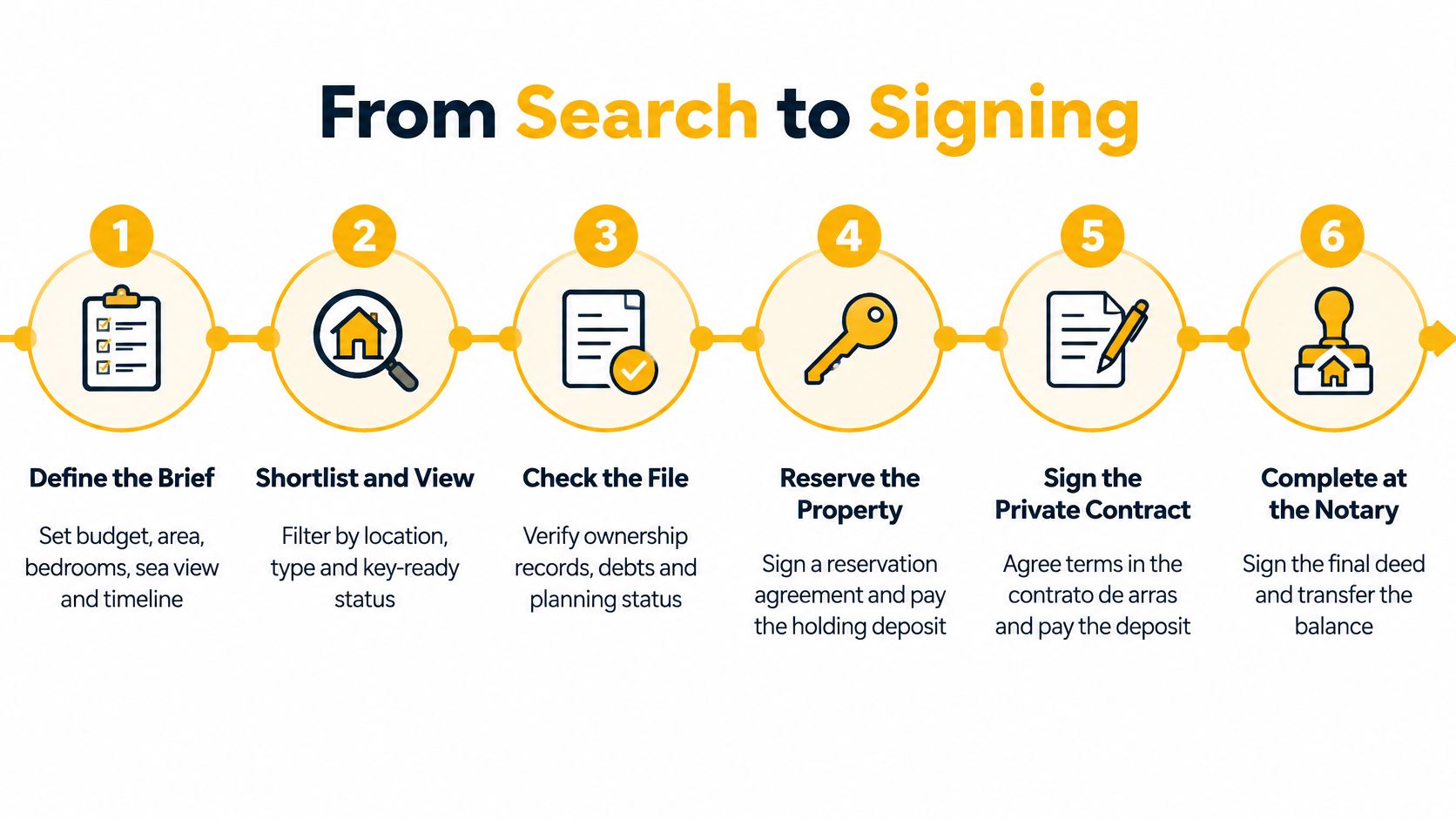
- Define the brief. Set your total spending capacity, preferred areas, bedrooms and moving timeline. The common slip is treating the purchase price as the entire budget or leaving rental intentions unmentioned.
- Shortlist and view. Compare location, property type and readiness for occupation, then inspect access, surroundings and condition. Don't assume attractive photographs establish legal status or freedom from debt.
- Check the file. Your lawyer should review ownership, charges, planning history and the documents below. Viewing first is reasonable, but becoming financially committed before investigating is avoidable.
- Reserve after legal review. Have the lawyer read the reservation agreement and establish where the holding deposit will sit. Don't assume it's refundable unless the written terms provide for that.
- Agree the private contract. Record the price, payment stages, included items, deadlines and any financing or legal conditions. A contract described as a contrato de arras still needs its consequences explained before you sign.
- Complete before the notary. Arrange the deed, payment method and supporting documents for presentation. Our agency provides the documentation required for the notary, while our lawyers advise clients on the transaction and their best interests.
- Finish the administrative work. Arrange registration and update utilities, cadastral ownership and community details. Don't leave these tasks unassigned because you already have the keys.
Read the documents together
No single certificate proves everything. A cadastral record describes the property for administrative and tax purposes, but it doesn't replace the ownership record or establish that every building alteration was authorised.
Due diligence documents and what each one confirms
Document | What it confirms | Who usually supplies it |
|---|---|---|
Nota simple (Land Registry extract) | Registered owner, mortgages and registered charges | Lawyer or agency, on your request |
Cadastral reference certificate | Cadastral plot and built area linked to the tax record | Seller or lawyer |
Community of owners certificate | Fees and debts owed to the community | Seller, through the community administrator |
Energy performance certificate (certificado de eficiencia energetica) | Energy rating of the dwelling | Seller |
Habitability certificate (cedula de habitabilidad) | Habitability compliance where required under the applicable local procedure | Seller or developer |
First occupancy licence (licencia de primera ocupacion) | Authorised first occupation following completion of a new build | Developer |
Request current documents and have discrepancies explained. If the house, registry description and cadastral plan show different areas, your lawyer should establish the reason rather than selecting the largest figure.
Financing and Renovation Support Agencies Coordinate
Identity and banking should start early. You'll need a NIE, the foreigner identification number used in the purchase, and a suitable bank account for the planned payments. A Spanish account is often needed for mortgage arrangements and useful for utilities, but confirm the bank's actual requirements rather than assuming every purchase follows the same route.
We and our lawyers help clients apply for a NIE, residence permit and Spanish bank account. These are separate processes: obtaining a NIE or buying a home doesn't itself grant residence rights.

Mortgage preparation comes before a binding commitment. Non-resident buyers can face tighter lending limits than residents, and banks assess overseas income, existing debts, source of funds and the property valuation. Ask the lender for its current loan-to-value limit and whether it applies to the price, the valuation or the lower of the two.
Prepare payslips or business accounts, tax returns and bank statements in the format the lender requests. An encouraging conversation isn't a final mortgage offer, so your lawyer should address financing risk in the purchase terms.
Timing matters: Don't agree a completion deadline that assumes bank approval, document translation or building permission will be immediate.
Renovation planning should begin before you commit to the scope. Structural alterations may need an architect's project and a building licence; lighter work can follow a different municipal procedure. We provide renovation services through architects and builders specialising in refurbishment who can present a portfolio of projects.
Before authorising work, establish:
- Identity and banking: Passport, NIE and an account suitable for mortgage payments and utilities.
- Language support: A lawyer who works in your language and written translations of key contracts. We offer document translation for foreign clients.
- Legal reference: Keep the original Spanish text alongside translations and have discrepancies resolved before signing.
- Building controls: Confirm the required permission, builder references and insurance.
- Payment milestones: Use a written scope, staged payments tied to completed work and a procedure for approving extras.
Costs and Taxes Beyond the Asking Price
Resale and new-build purchases follow different tax routes. Resales generally attract transfer tax, while a new dwelling normally attracts VAT and stamp duty on the purchase deed.
Spain's official public-administration guidance on property taxes confirms that transfer tax and stamp duty are administered by autonomous communities under Law 22/2009, with rates differing between communities, and that new-dwelling VAT is calculated using the purchase price and the rate in force at completion. For La Romana, use Valencian Community rules, not a generic Spanish tax allowance.
Typical purchase costs for resale and new-build homes
Cost | Resale (existing home) | New build |
|---|---|---|
Transfer tax (ITP) | Charged under current Valencian Community rules; confirm rate, reliefs and taxable base | Generally not charged where VAT applies |
VAT (IVA) | Generally not applicable to an ordinary private resale | Confirm current rate and qualifying conditions |
Stamp duty (AJD) | Purchase generally follows ITP treatment; check any separate deed liability and who pays | Charged on the purchase deed under regional rules |
Notary fees | Scale-based; obtain a transaction-specific estimate | Scale-based; obtain a transaction-specific estimate |
Land Registry fees | Scale-based; request an estimate for registration | Scale-based; request an estimate for registration |
Lawyer fees | Agreed fee, separate from agency commission | Agreed fee, separate from developer costs |
Agency commission | Usually paid by the seller; confirm in writing | Usually included in developer pricing; confirm in writing |
Turn estimates into an available-funds plan
Don't treat notary and registry fees as a fixed percentage of every sale. They are scale-based charges, so a written estimate is more useful than assuming the same share of the price for every property.
Ask your lawyer to confirm the taxable base, any relief you qualify for and the treatment of unusual circumstances. Also separate purchase costs from mortgage costs, because the documents and allocation of charges aren't identical.
Your budget should leave room for practical expenses beyond completion: insurance, utility changes, community charges and any immediate repairs. For a finca near La Romana, inspection and refurbishment allowances deserve particular attention if the property includes older buildings or outbuildings.
Budget habit: Request a written, line-by-line cost estimate before making an offer, then recalculate it whenever the price, financing or property classification changes.
Keep a separate record of when each payment falls due. Having enough money overall won't help if funds aren't accessible when the contract requires them.
Costa Blanca and Costa Cálida Considerations
A national or provincial figure cannot value an individual home. La Romana is an inland Alicante municipality, so a beach-apartment comparison won't explain the value of a finca, its access or its land.
The coastal markets share international demand, but buyers must still apply the correct regional tax rules and municipal checks. Keep the geography precise: Alicante city, Alicante province and the Valencian Community aren't interchangeable areas.

Key checks by coastal area and city market
Area | What to check first |
|---|---|
Valencian Community, including Costa Blanca | Transfer tax rules, municipal planning, community statutes and flood-risk maps |
Region of Murcia, including Costa Cálida | Regional tax rules, coastal planning, flood exposure and new-build delivery status |
Alicante Province | Multilingual legal capacity, rental restrictions and property-specific planning records |
Spain as a whole | National tax and residency framework; use as a benchmark only |
Alicante city asking prices | €2,464 to €3,867 per m² across the cited districts in September 2026, on a citywide average of €2,743 per m², according to Idealista's Alicante price report. Compare like-for-like property type, condition and location |
Two of these checks belong at the very start of your search, before a property has had the chance to win you over. The first is rental legality: if you intend to let the home to tourists, confirm tourist-use permission and the community statutes for that exact address, because the rules differ between the Valencian Community and Murcia and even between neighbouring municipalities. The second is knowing who does what. Treat the agency, the lawyer and the notary as three separate jobs: the agency coordinates the search and the paperwork, the lawyer examines title, planning and your interests for that address, and the notary formalises the signed deed. An agent's enthusiasm cannot certify legality, and a notary does not audit planning on your behalf.
Value the address, not the headline
The citywide average in the Idealista report sits between two very different districts: the endpoints above correspond to Benalúa-La Florida-Babel-San Gabriel and Playa de San Juan-El Cabo, which shows how much the single label “Alicante” can hide. Asking prices work like guide prices at an auction. They show where sellers start, not where deals finish, and they say nothing about an inland finca.
For a La Romana property, compare legal built area, plot characteristics, access, services, condition and documented alterations. For a coastal apartment, add community accounts, approved works, building condition and any coastal restrictions.
Your lawyer should confirm the applicable occupancy documentation and planning position for the exact address. Review official flood-risk maps and coastal boundaries where relevant, rather than judging exposure from how dry or quiet the property looks during a viewing.
Choosing a Trustworthy Agency Before You Sign
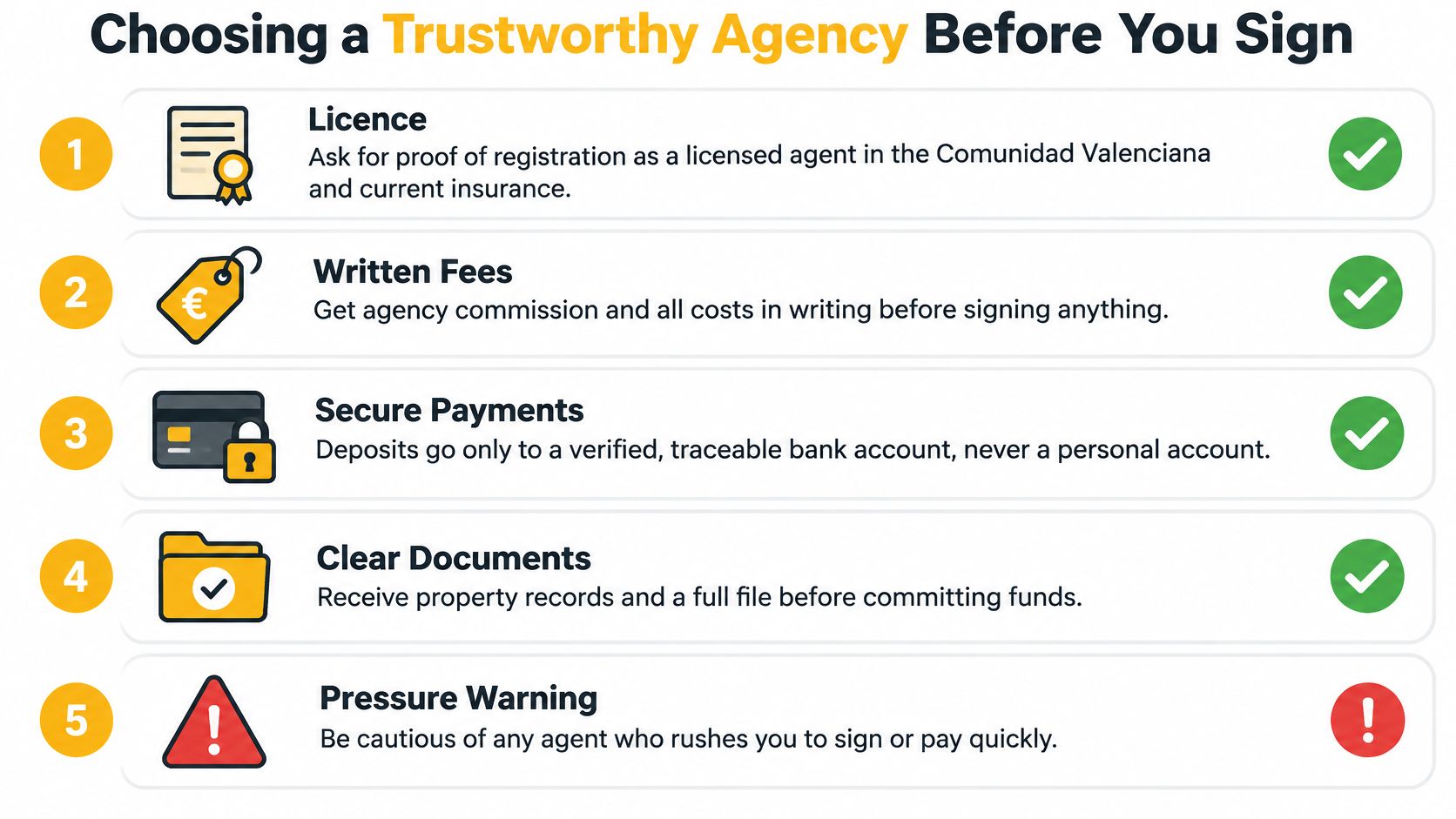
Check registration, insurance and written terms before allowing urgency to influence your decision. We hold the licences and insurance required to register as a licensed real-estate agent in the Comunidad Valenciana.
Red flags and green flags when choosing an agency
Signal | Red flag | Green flag |
|---|---|---|
Licence | Cannot show registration as a licensed agent | Shows registration and insurance details on request |
Fees | Vague commission, verbal terms only | Written fee and commission terms before work starts |
Deposits | Pressure to pay before a lawyer reads the terms | Lawyer-reviewed, documented deposit terms |
Due diligence | Dismisses title or community-debt checks | Provides the nota simple and community certificate |
Language | Key documents only in Spanish, no translation offered | Translates key documents into your language |
Price claims | Price promises without comparable evidence | Explains price using comparable asking and sales data |
Rental income | Promises returns without checking rules | Confirms tourist-use permission and community statutes first |
Look for behaviour that matches the paperwork. A reliable coordinator records unanswered questions, identifies who will resolve them and accepts that a lawyer may advise against proceeding.
Check holiday-let legality before calculating income
Tourist demand doesn't establish permission to let. Spain's Royal Decree 1312/2024 created a single rental-registration system, and a 2025 registry ruling published in the Official State Gazette confirmed that community statutes prohibiting tourist use can prevent allocation of a short-term-rental registration number.
Have your lawyer investigate the intended activity at the property level:
- Municipal compatibility: Does planning permit the proposed tourist use at this address?
- Tourist-use authorisation: What licence, declaration or other regional procedure applies?
- Community restrictions: Do the statutes or relevant resolutions restrict the activity?
- Registration eligibility: Can the property obtain the required registration for the proposed letting?
- Existing permissions: Are they valid, and what happens when ownership changes?
A seller's history of taking bookings isn't enough. The permission may not cover your intended operation, and an existing advertisement doesn't prove compliance.
Say you're comparing a quieter inland villa with a coastal apartment. The better personal retreat may not be the better letting investment, especially if occupancy documentation, planning conditions or community restrictions prevent the proposed use. Model returns only after the legal position is clear, and remember that regulations can change.
Shortlist agencies whose service matches your search, then request written fee terms, a due-diligence plan and a document list. Arrange viewings with those expectations established, and commission legal review before transferring a deposit.
AP Properties Spain supports new-build and resale searches across the Costa Blanca and Costa Cálida, with legal coordination, document translation and renovation support. Visit AP Properties Spain to share your preferred area, overall budget and intended use, then arrange a focused property search with the right checks before you commit.
Share


