



Cadastral Reference Spain: How to Find and Use It
The cadastral reference is a unique 20-character code assigned to each Spanish property, and the IBI property tax receipt is usually the quickest place to find it. However, finding the code doesn't prove that the seller owns the home or that every building on the plot is legally recorded.
That distinction matters when buying in La Romana, Alicante, or elsewhere on the Costa Blanca. A tax bill, a convincing map outline and a matching street address can still leave important questions unanswered. Use the cadastral reference as a checking tool, then test what it identifies against the deed, the Land Registry extract and the property you're buying.
Where the Cadastral Reference Appears on Your Papers
Start with the documents you already have rather than typing the address into a search engine. The IBI receipt, the annual local property tax bill, normally shows the reference in its header. Ask the seller for a legible copy of the whole receipt, not a cropped image containing only the code.
The consolidated Cadastral Real Estate Law establishes the cadastral reference as a unique 20-character alphanumeric identifier linking a property to official cadastral mapping. Its role in property-related economic and tax documentation explains why it appears across paperwork that serves quite different purposes.
Where to find the cadastral reference on existing documents
Document | Where the reference appears | How far to trust it |
|---|---|---|
IBI receipt (recibo del IBI) | Header of the annual property tax bill | High, but check the address matches the house |
Title deed (escritura) | Property description in the notarial deed | High, confirm against the Land Registry |
Nota simple | Land Registry extract, next to the registry data | High for consistency checks |
Electricity supply contract | Supply contract for the property | Medium, may reflect an older address |
Estate agent listing or seller email | Listing file or message | Low, verify before relying on it |
Choose the document for the question
Use the title deed to establish what the notarial document describes. Look in the property description rather than assuming every identifier printed on the deed is cadastral. The Land Registry uses its own identifying details, which aren't interchangeable with the cadastral reference.
The registry extract, commonly called a nota simple, helps you compare the cadastral identifier with the registered property. If the reference is missing from an older document, don't guess it from another number on the page.
An electricity contract can provide a useful starting point, but supply information may retain an older address. Listings and seller emails are less reliable still: a copied code may identify the plot rather than the particular dwelling being offered.
Practical rule: A reference printed on a bill is a lead to verify, not confirmation that the bill describes everything you've been shown.
Check the street, number and municipality against the house itself. For an inland property with an informal house name or unclear postal address, note the access road and location too. If you have the IBI receipt, you already have a code to test; if you don't, use the official search's alternative identifiers.
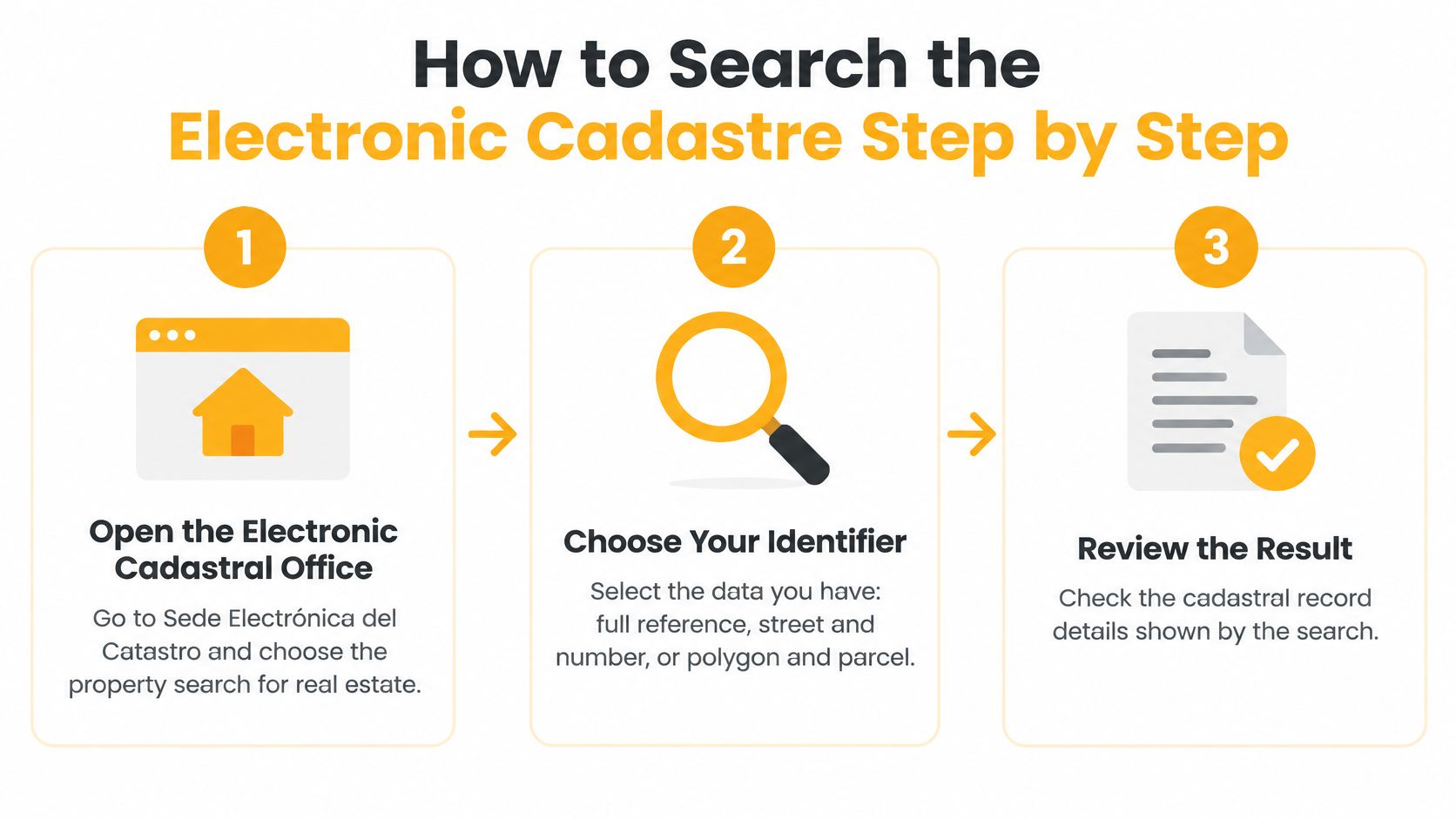
How to Search the Electronic Cadastre Step by Step
Use the official property search rather than relying on a map screenshot forwarded by the seller. An independent lookup lets you confirm which property the identifier returns.
The Electronic Cadastral Office property search accepts the full 20-character reference, an 18-character version without the two control characters, or the first 14 characters identifying the parcel, alongside address, polygon and parcel, geographic coordinates, and Unique Registry Code searches. Those reference formats serve different purposes, so choose deliberately rather than shortening a code at random.
Run the search without losing the correct unit
- Open the Electronic Cadastral Office. Choose the property search. Keep the document containing your identifier beside you so you can compare the entry directly.
- Choose the identifier you have. A complete reference is the most direct starting point; otherwise use the address, rural polygon and parcel, coordinates, or the Land Registry's Unique Registry Code, known as the CRU. Check the municipality carefully, especially where street names repeat.
- Enter the reference in an accepted format. Copy the complete code when it's available, and distinguish letters from similar-looking digits. If part is missing, use an accepted shortened format rather than inventing the missing characters.
- Select the correct property from any returned list. A parcel containing units created through horizontal division can return several associated properties. Match the floor, door and use, rather than selecting the first result.
- Review the description and map together. Check the use, built area, plot area and address against what you've been offered. A plausible street address isn't enough if the map highlights the neighbouring building.
- Save or print the official result. Record the consultation date and retain the identifying details with the map. This gives your adviser a fixed record to review if the cadastral information later changes.
Identifiers accepted by the Electronic Cadastre search
Identifier | What you enter | Best used for |
|---|---|---|
Full cadastral reference | Complete code | Exact property, fastest result |
Reference without control characters | Code excluding the final control characters | When the check characters are missing |
Parcel identifier | Initial parcel-identifying characters | Parcels that hold several units, returns a list |
Street and number | Address | When no reference is available yet |
Polygon and parcel | Polygon and parcel numbers | Rural land |
Geographic coordinates | Latitude and longitude | Plots without a clear street address |
Unique Registry Code | CRU | Matching the Land Registry record |
An address search on a block may require you to distinguish a home from a garage, commercial unit or another flat. On rural land around La Romana, polygon and parcel details or coordinates may be more useful than a postal address.
If a partial reference returns a building, you haven't necessarily identified the home within it. A search result is only as good as the identifier and unit selection used to obtain it.
Matching the Cadastral Record to Your Title Deed
Put the official cadastral result beside the deed and a current registry extract. The Spanish Cadastre's explanation of the cadastral reference describes its function as identifying property unambiguously on cadastral cartography. That function is different from establishing ownership and registered rights, which you check through the Land Registry.
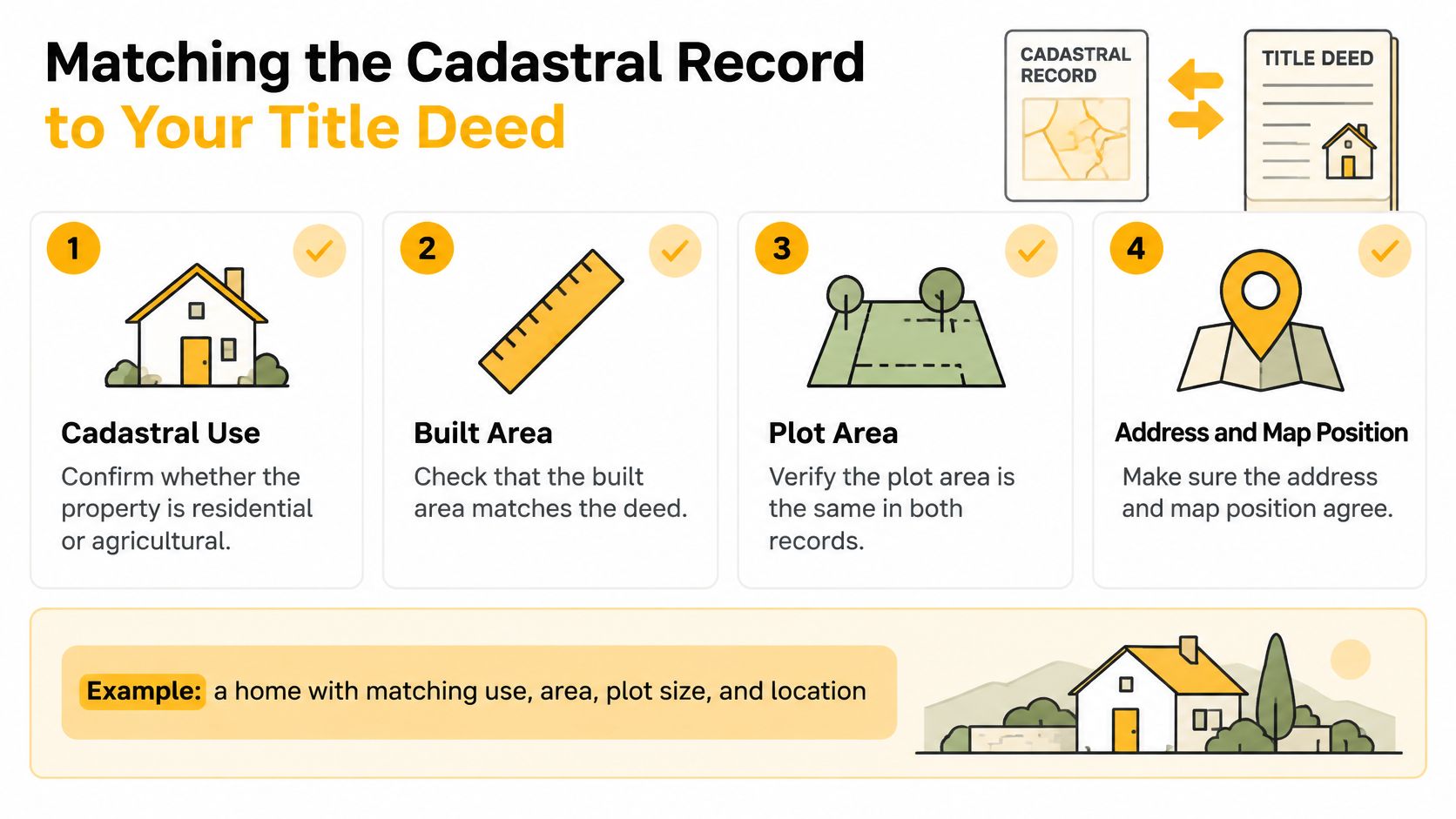
Read the documents as descriptions of the same physical asset, not just as pages containing a matching code. Start with these checks:
- Cadastral use: Compare the recorded use with the deed and the intended purchase. A building described for agricultural purposes shouldn't be treated as a confirmed residential dwelling without further investigation.
- Built area: Compare equivalent measurements. Ask whether the figures include outbuildings, enclosed additions or other spaces before assuming that a difference is an error.
- Plot area: Establish whether each document describes the whole parcel or only the interest being sold. A similar total doesn't resolve an uncertain boundary.
- Address and map position: Confirm that the highlighted parcel contains the property you visited, including the correct access and location.
Investigate the difference, not just the total
For example, suppose a townhouse is described as 120 m² in the deed, but the cadastral built area is lower. That hypothetical mismatch could reflect an extension that wasn't incorporated into the relevant records, or a difference in what each measurement includes. Ask an architect to establish what exists and how it relates to the paperwork before proceeding.
For Costa Blanca purchases, watch for a villa and separate guest house under the same reference, outdated addresses after street renumbering, and extensions absent from the documents. Another trap is comparing a dwelling's unit reference with a building or plot reference and assuming they identify an identical asset.
Stop when you can't establish that the documents and the property on site describe the same thing.
A discrepancy isn't automatically evidence of unlawful work, but an unexplained discrepancy shouldn't become the buyer's problem by default. Keep the dated cadastral result, registry extract and relevant deed pages together so the notary, lawyer or technical adviser can assess the actual conflict.
What the Cadastral Reference Means in Spanish Law
The reference has legal importance in sales, inheritances and mortgages, but that doesn't make it a substitute for title checks. The cadastral reference, known in Spanish as referencia catastral, identifies the asset within the cadastral system; the Land Registry records ownership and registered rights.
Article 38 of the consolidated Cadastral Real Estate Law requires the reference in public instruments, court orders and decisions, administrative files and decisions, documents recording transactions or rights in rem, leases or transfers of use, electricity-supply contracts and technical projects. The requirement connects different documents to an identifiable property, but it doesn't make their contents interchangeable.
Apply the identifier to the transaction
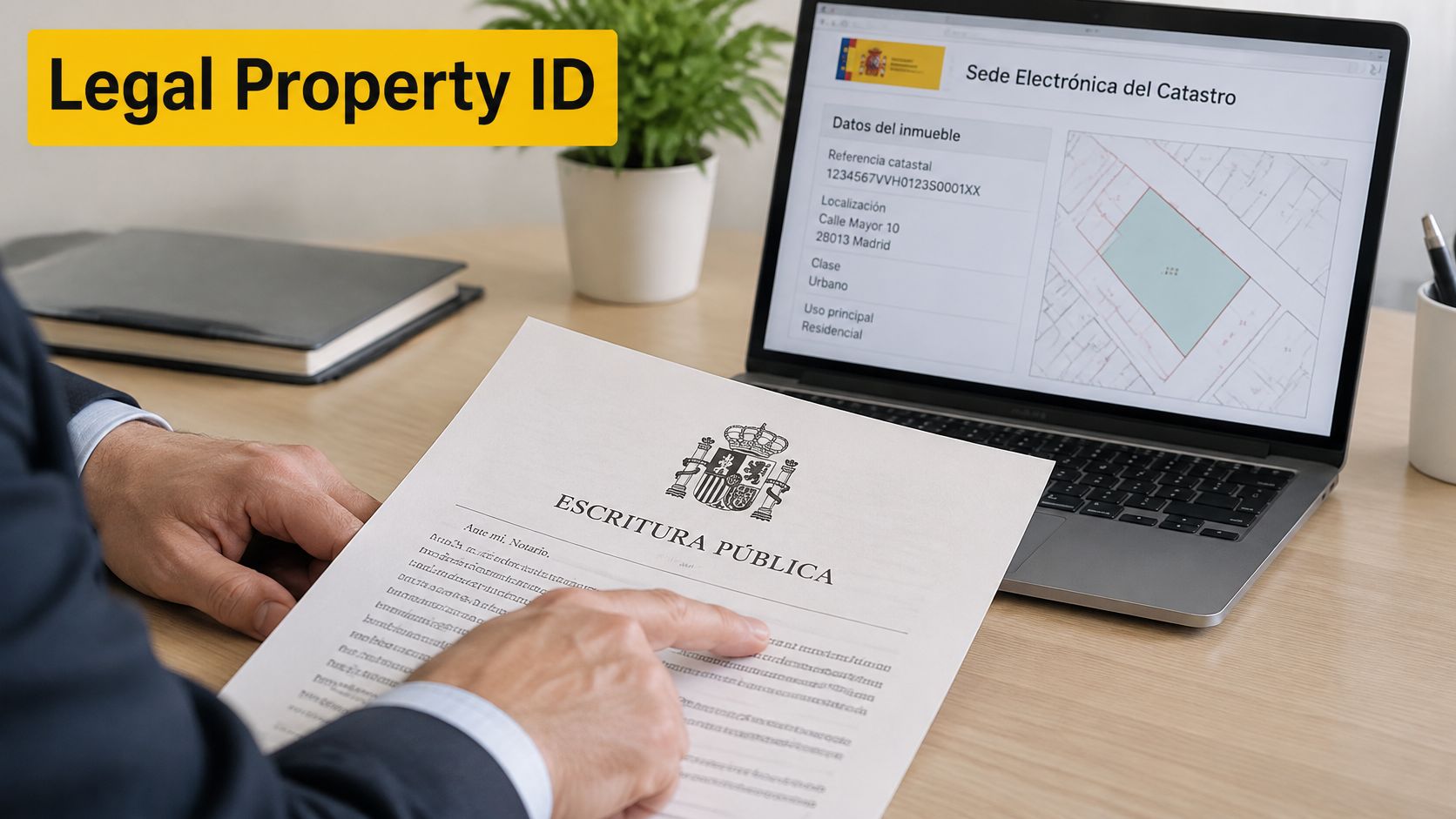
For a sale, check that the reference in the notarial deed identifies the asset the parties intend to transfer. Don't accept a verbal assurance that a neighbouring parcel, separate garage or guest accommodation is included when the documents don't establish that connection.
For an inheritance, heirs need to connect the succession paperwork with the property being inherited. An old family address or familiar house name isn't enough where the estate includes adjoining land or separately identified units.
For a mortgage, the lender needs to connect the proposed security with the correct property. A successful cadastral lookup doesn't remove the need to examine the registered description and any rights or charges affecting the asset.
Keep ownership questions with the Land Registry
Suppose the cadastral address and map match the house, but the registry extract, or nota simple, names someone other than the seller. Don't decide ownership from the tax paperwork. Have the lawyer establish the seller's title and authority to sell, including any necessary inheritance or representation documents.
Before signing: Ask the notary to confirm that the deed uses the correct cadastral reference and that any unresolved discrepancy has been addressed.
A matching reference helps prevent confusion about which property is involved. It doesn't establish planning compliance, remove registered charges or resolve a disputed right of access. Each of those questions needs the appropriate documentation and professional review.
Villas, Plots and Renovated Homes
A cadastral reference is a useful checking tool, but a matching map does not settle whether a villa, plot or renovated home is correctly described. Compare the record with the title deed and the physical property, then ask the appropriate professional to explain any mismatch.
Case | Recommended check | Why it matters |
|---|---|---|
Urban flat in a block | Online search and IBI receipt | A single unit is usually straightforward to identify, but check that the description matches the flat being sold |
Villa with pool or terrace | Current descriptive and graphic certificate | The record may not show every structure or alteration |
Rural plot | Certificate with georeferenced boundary | Coordinates help compare the recorded boundary with the land's occupation |
Subdivision or split plot | Certificate plus surveyor check | Each new unit needs to be identified against its own boundary and reference |
Renovated or extended home | Certificate plus architect review | Works may differ from the cadastral description |
Inherited property | Certificate requested by an authorised party | The requester's authority must be documented |
A screenshot can help locate a property, but it is not enough to resolve a boundary or assess a complex building. For a villa, rural plot, subdivision or renovated home, request a current cadastral descriptive and graphic certificate and have the relevant technical details checked.
A fence, terrace edge or access track may look clear on the ground without matching the cadastral boundary. A pool shown on a map also does not establish the planning status of the associated works.
Obtain a certificate that can be checked
Ask the owner, an authorised representative or a documented agent to obtain the certificate through the Electronic Cadastre. Its graphic boundary and georeferenced vertex coordinates give a technical adviser defined points to compare, rather than an approximate outline.
The Cadastre's georeferenced geometry validation service checks whether submitted geometry agrees with current cadastral mapping. A surface-area difference in registry procedures is assessed case by case; it is not an automatic tolerance. The service's geometry check does not establish whether a building has planning permission or whether existing works can be legalised.
Have the adviser complete the practical comparison:
- Validate the geometry: Check whether the certificate's coordinates agree with the mapping in force on the verification date.
- Overlay the evidence: Compare the boundary with the survey, planning documents and visible occupation, including pools, terraces and outbuildings.
- Assign each open question: Ask a surveyor to measure boundaries, an architect to review building and planning matters, and a lawyer or notary to advise on the transaction's legal implications.
Separate mapping from permission
A structure appearing in cadastral information does not, by itself, answer every planning or registration question. A mismatch may call for a measurement or record correction, rather than removal of the structure. Obtain a documented explanation before relying on either assumption.
Anyone requesting a certificate on another person's behalf must provide evidence of representation or signed authorisation with identification. Arrange that authority early so the technical review can use the certificate, not just screenshots.
Decide Before You Pay a Deposit
Before committing money, assemble a review file with the dated official cadastral result, a current registry extract and the deed or draft contract identifying the property. Add the IBI receipt and any certificate or technical explanation required for that particular asset.
For an ordinary urban flat, matching identifiers, address, areas and map position can support the next legal and contractual checks. They do not prove that a deposit agreement is safe to sign.
Use a go-or-stop decision
- Go to contract review: The property descriptions agree, the seller's title is established, and your lawyer has no unresolved concern about the proposed commitment.
- Stop for clarification: A field differs, the seller does not match the registered owner and there is no documented explanation, or the property on the map is not clearly the asset being sold.
- Stop for technical evidence: A villa, plot, subdivision or altered home lacks a current certificate and the professional review needed to explain its boundaries or buildings.
A promise to correct paperwork later is not a completed check. Ask your lawyer which issues must be resolved before payment and whether any can be addressed safely through clear contractual conditions.
AP Properties Spain provides clients with documentation for presentation before a notary, while its lawyers advise on the transaction and the client's best interests. The agency also offers document translation for foreign clients and serves buyers and sellers across Alicante province, Costa Blanca and Costa Cálida.
If you have the IBI receipt or deed, send copies with your saved cadastral result to the team for a paperwork review before making a commitment. Base your decision on documents you can verify, not reassurance alone.
Visit AP Properties Spain to arrange a review of your IBI receipt, deed and saved cadastral search result before committing to a purchase. The team can help organise documentation for the notary, while its lawyers advise on the transaction and discrepancies that need resolving.
Share


