



Spanish Finca for Sale: Legal Checks Before You Buy
The usual advice is to choose the view, find the biggest plot you can afford and negotiate hard. For a Spanish finca for sale, that's the wrong order. Around La Romana, Alicante, and the wider Costa Blanca, a low asking price means little until you know which buildings you can lawfully use, how you reach them and where their water comes from.
A finca is a bundle of ownership, planning and water rights, not just a house with land. The cheapest option can become the most expensive to regularise, and some defects can't be solved by spending more. Start with the documents, then decide whether the surroundings justify the price.
The Document Check That Decides a Finca Purchase
Which documents prove this property can be owned, lived in and insured? That's the question to ask before discussing furniture, pool maintenance or an offer.
Due-diligence documents for a finca purchase
Document | What It Proves | Where to Get It |
|---|---|---|
Nota simple | Current owner, charges and registry status of the finca | Land Registry (Registro de la Propiedad) |
Cadastral record | Recorded parcel boundaries, area and rustic or urban classification | Cadastre (Catastro) |
Municipal planning certificate | Permitted use and whether residential use is buildable | Town hall (ayuntamiento) |
Complete building licence file | Whether the house, pool and outbuildings were legally authorised | Town hall archive, requested through an architect |
Habitability certificate | Whether the dwelling meets the applicable occupation requirements, where required | Town hall |
Water concession or registration | Lawful right to extract and use well or spring water | Basin authority Water Registry |
Architect's survey | Built area compared with the registered area and permitted parameters | Independent architect |
Treat these documents as complementary evidence. The nota simple, cadastral record and municipal planning certificate answer different questions, so one can't substitute for another. A registered building isn't necessarily authorised for the residential use advertised.
The planning legislation published by the Official State Gazette makes municipal authorisation and permitted use central to assessing construction, alterations and changes of use within its applicable framework. For a purchase in La Romana, your lawyer must establish the relevant Valencian and municipal requirements rather than import conclusions from another region.
Compare the paperwork with the viewing
Take viewing notes that identify every enclosed terrace, converted garage, pool, warehouse and detached room. Give those notes to the architect alongside the listing particulars, so the inspection tests what's being sold rather than just the main house.
Ask for a measured comparison, not a general assurance that the property looks sound. If the advertised accommodation exceeds the registered area, the architect should identify the discrepancy and your lawyer should establish whether it reflects an administrative omission, unauthorised construction or a different approved use.
Practical rule: A photograph proves that a structure exists. It doesn't prove that you can live in it, alter it or insure it for the purpose you intend.
Check that the occupation documentation applies to the dwelling you're buying, not an earlier configuration. Equally, a water document should identify the relevant parcel and entitlement, rather than merely show that someone nearby holds a concession.
Request every listed document in writing. Before paying any reservation fee, have an independent lawyer compare the file with your viewing notes and identify unresolved issues, who must resolve them and what evidence will demonstrate that they're resolved.
What a Finca Is in Spanish Property Law
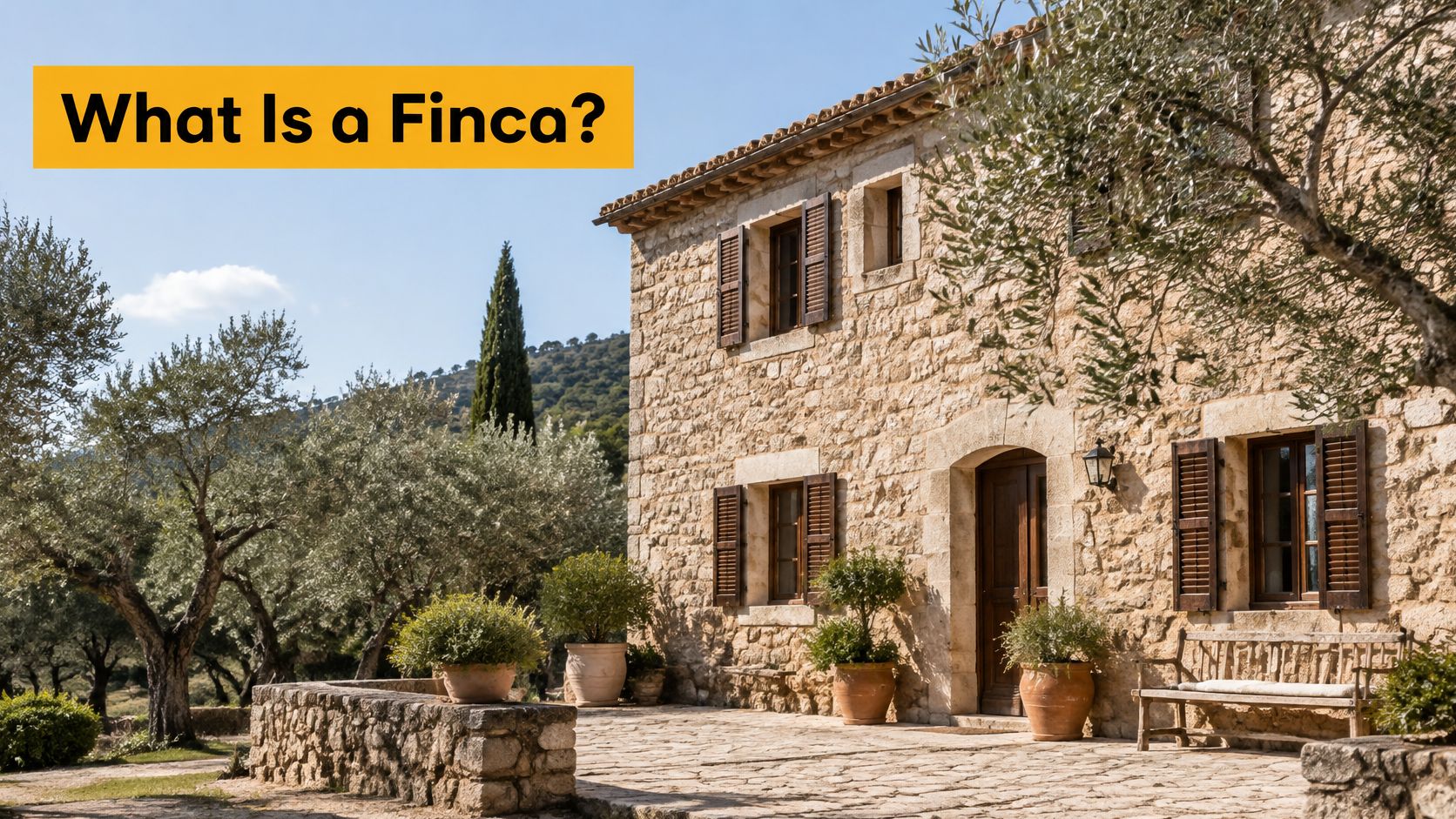
A finca is a bundle of registry, planning and land-use details, not a house with a field. Near La Romana, an orchard behind the same gate as a country house may be a separate legal unit, while a detached guest room may not be registered as accommodation.
A finca is a distinct unit of land or building attributed to an owner or held in undivided co-ownership. It becomes a finca registral when it has its own folio in the Property Registry. The folio identifies the registered unit, its ownership shares and its recorded description. Those details must match the property and interests the seller proposes to transfer.
A boundary fence isn't a legal description
The orchard may have a separate title. The guest room may be missing from the register, or described as agricultural storage rather than accommodation. The contract must identify the legal units being transferred; a shared entrance or marketing name does not establish that they form one property.
Land classification is a separate question. A rural plot does not automatically carry the right to build a house, enlarge an existing dwelling or change agricultural use. The applicable Valencian planning instruments and La Romana's municipal rules need to be assessed for the specific property.
Buildings also require their own assessment. The national valuation legislation distinguishes constructions and installations, with a narrow exclusion for minor, technically simple, single-storey structures without residential or public character. That exclusion should not be assumed to cover a habitable annex. A valuation definition does not grant planning permission.
Terms to recognise in the file
- Finca registral: The property unit identified by its own Property Registry folio.
- Nota simple: A registry extract used to check ownership, the property description and recorded burdens.
- Rústica: Rustic classification, interpreted in the context of the document where it appears.
- Urbana: Urban classification. It does not confirm that every existing alteration is authorised.
- Suelo no urbanizable: Non-developable land subject to restrictions on building and use.
These terms describe different aspects of a property's legal record and status. None, by itself, establishes that a country house and all its outbuildings are lawful for the buyer's intended use.
Where Fincas Sit and What the Market Shows
Rural-property transactions and international homebuying both matter to a Costa Blanca search, but they measure different things. Use them as market context, not as proof of demand for a particular finca in La Romana.
Rural and foreign buyer market figures
Measure | Figure | Period |
|---|---|---|
Rural properties share of registered sales | 13.1%, reported by the National Statistics Institute | June 2024 |
Rural properties share of registered sales | 12.2%, reported by the National Statistics Institute | July 2024 |
Foreign buyers share of Spanish home sales | 14.1%, reported in CaixaBank Research's housing market analysis | First half 2025 |
Valencian Community share of foreign purchases | 29.6%, reported in the same housing market analysis | Fourth quarter 2025 |
Murcia share of foreign purchases | 22.8%, reported in the same housing market analysis | Fourth quarter 2025 |
The regional foreign-purchase figures put the Valencian Community and neighbouring Murcia firmly in the international buying conversation. They don't isolate fincas, establish local asking prices or tell you how quickly an individual rural property will sell.
Coastal convenience or inland space
A sea-view finca closer to the coast may attract buyers who also want beaches, restaurants and straightforward airport journeys. Expect to weigh that convenience against stronger competition for attractive locations and potentially less land for your budget, then test the assumption against comparable current listings.
An inland finca near La Romana offers a different proposition: quieter surroundings and the possibility of more space. The trade-off can include longer journeys to particular services, more demanding access and a greater need to investigate independent water or utility arrangements.
Consider a buyer choosing between a smaller coastal plot and an inland holding with an orchard. The inland option isn't automatically better value if most of the land is steep, difficult to maintain or unsuitable for the buyer's intended use.
- Usable ground: Walk the terraces and slopes rather than judging the aerial photograph.
- Orientation: Check winter sunlight, summer shade and exposure around outdoor living areas.
- Agricultural obligations: Establish whether cultivation, leases or other arrangements affect possession and upkeep.
- Everyday practicality: Drive the access route and the journey to shops and healthcare yourself.
Plot size, sea views, orientation, condition and legal status all belong in a price comparison. Without current verified comparable listings, a zone-wide price band would create false precision.
Shortlist two zones and test properties in each against the document checklist. Compare the usable, legally supported home you'd receive, not just the advertised land area.
Land Rules and Water Rights That Limit Use
A working well isn't proof of a lawful water supply. Turn on a tap during a viewing and you learn that water is available at that moment, not that the seller has the right to extract it or that it will meet your summer needs.
The same caution applies to land. An existing country house doesn't establish that you can enlarge it, add ancillary structures or change agricultural buildings into living accommodation. On non-developable land, your intended use needs a specific planning assessment.
Establish the entitlement before testing the supply
The Ministry for the Ecological Transition's water-use guidance explains that private water use generally requires a concession, authorisation or regulated declaration; its low-volume groundwater procedure covers domestic use for up to 50 people, irrigation up to 4 litres per second and other uses up to 2 litres per second, still subject to the corresponding authorisation.
Those thresholds aren't a free allowance attached to every finca. Nor does ownership of a tank, pump or borehole establish the underlying entitlement.
Give the water investigation a clear sequence:
- Identify the source: Establish whether domestic and irrigation supplies come from the mains, a well, a spring, a shared arrangement or deliveries.
- Match the parcel: Check the concession or registration identifier against the land being purchased.
- Read the conditions: Confirm the permitted purpose and flow, together with any expiry, amendment or transfer requirements.
- Test performance: Commission appropriate water-quality testing and investigate seasonal yield rather than relying on the seller's recollection.
- Check disposal: Confirm the status of wastewater treatment and any municipal connection.
A lawful irrigation supply shouldn't be treated as drinking water without checking its permitted use and quality. Equally, a large storage tank offers resilience only when there's a lawful, dependable way to refill it.
Buy the water entitlement and the supply arrangement you can verify, not the reassurance that the well has always worked.
Give hidden restrictions their own review
Protected land needs a separate planning review because restrictions may affect more than new construction. Ask the architect to assess the actual maintenance and alteration work you intend, rather than request a vague statement that renovation is possible.
For septic systems, identify the installation, discharge arrangement, service access and supporting authorisation. A buried tank with no records shouldn't disappear from the investigation because it isn't visible.
For shared access roads, have the lawyer establish the legal right of passage and responsibility for repairs. Driving across neighbouring land during a viewing doesn't settle either question.
Finally, request confirmation of pending planning violations or restoration proceedings. Before committing, test whether the documented water supply supports the intended household, garden and agricultural use during summer, not merely an occasional winter visit.
Budget, Tax, Financing and Renovation Costs
The cheapest finca can become the most expensive once you price the work needed to make it lawful and usable. Budget for the property's documented status, not just its asking price.
Start with the correct tax treatment. The Modelo 600 declaration must reflect the transfer-tax rules applicable to your Alicante purchase. Ask your adviser to check how those rules apply to the property's classification and calculate the taxable basis and any conditions for claimed relief. Don't rely on an assumption taken from another autonomous community.
Separate completion from correction
Use a cost schedule that separates the purchase from professional checks, remedial work and ongoing ownership costs.
Budget category | What to include |
|---|---|
Acquisition | Agreed price and any separately negotiated items |
Completion | Applicable transfer tax, notary and Land Registry charges |
Professional advice | Independent legal review, translation and architect's survey |
Documentation and correction | Surveys, technical reports and any legally available registration or regularisation work |
Renovation | Authorised building work, professional fees and service improvements |
Ownership | Insurance, utilities, land maintenance and recurring tax advice |
For example, a finca may need a new kitchen and have an enclosed terrace missing from its documents. Keep the kitchen estimate separate from the cost of investigating the terrace and any correction that may be legally available.
First establish whether the terrace can remain and on what terms. Then obtain a professional scope and estimate. A contingency fund cannot make an unlawful structure eligible for regularisation.
Budget discipline: A reserve covers uncertainty you can accept. It cannot replace checking whether the accommodation you intend to use is lawful.
If a defect changes the property's usability, ask the seller to resolve it before completion or reconsider the purchase. A lower price may not compensate for losing a room the home needs.
Finance the property that exists legally
A mortgage decision depends on the borrower and the property. Give the lender the property file early. Unclear residential use, occupation documents or water arrangements can complicate valuation, lending and insurance.
An initial borrowing indication is not approval for a particular finca. Ask the lender what evidence it requires, and obtain insurance terms that accurately describe the buildings, occupation pattern and intended activities.
For an overseas purchase, arrange the NIE identity document, source-of-funds evidence and banking arrangements early. A Spanish bank account may be needed for completion or ongoing payments. Ask your lawyer to confirm the payment arrangements for the transaction rather than assuming every purchase follows the same route.
Cash removes mortgage dependency, not planning risk. Check that the property can be insured and sold without unresolved defects.
Approve the use before commissioning the design
Compare the proposed renovation with the permitted building envelope and authorised uses. Ask an architect to identify the municipal procedure and permissions required before work starts.
A proposed barn-to-guest-annex conversion shows why sequence matters. Before paying for detailed designs, establish whether residential or guest use is permitted, whether wastewater capacity is adequate and what occupation or rental requirements apply.
Ask builders to price necessary repairs separately from unconfirmed extensions. That keeps the budget usable if the town hall refuses part of the proposed work.
Include a contingency for feasible legalisation work and allow time for each permission. If the intended use cannot be supported, keep the option to walk away.
How to Buy a Finca Safely and Work With an Agency
A reliable buying process gives each uncertainty an owner and a deadline. The agent coordinates access and information, the architect assesses the physical property and planning implications, and your independent lawyer protects your position in the transaction.
The most useful safeguard is sequence. Don't allow a seller's preferred completion date to turn unanswered questions into obligations you've already accepted.
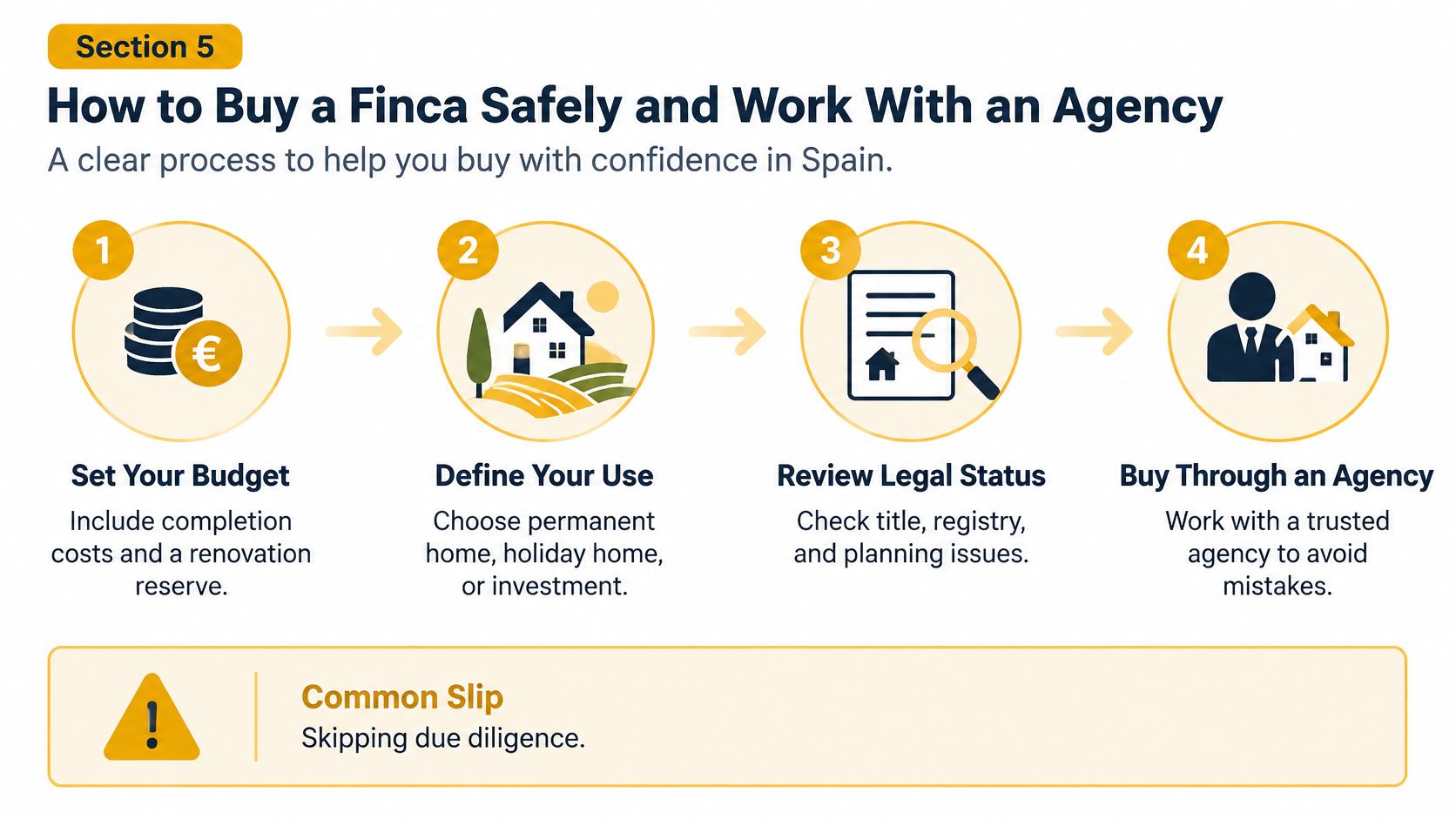
Follow a purchase sequence with clear stopping points
- Set the total budget. Include completion costs, professional investigations and a renovation reserve before deciding your maximum offer. The usual slip is spending the available capital on the purchase price and leaving essential work dependent on future savings.
- Define the intended use. Tell your advisers whether you want a permanent home, holiday retreat, rental property or land holding. Don't let a seller's description of investment potential substitute for checking the permissions your particular use requires.
- Shortlist suitable zones. Compare a small selection of coastal and inland locations against your actual travel, maintenance and service needs. The mistake is choosing by scenery alone, then discovering that the daily journey or land upkeep doesn't suit you.
- Obtain the core documents before reservation. Request the nota simple, cadastral record and municipal planning certificate, and give them to your lawyer before paying. An agent's summary is useful for organising the search, but it isn't the evidence on which to commit funds.
- Commission the technical and services checks. Ask an independent architect to compare the structures on site with the documented property, and verify water, wastewater, electricity and legal access. The usual slip is assuming that a tidy house and functioning utilities mean the records must match.
- Have your lawyer review the deposit contract. The contrato de arras should address the agreed property description, deadlines and consequences of unresolved planning, water, survey or financing issues. Don't assume that a deposit is refundable unless the contract gives you the relevant protection.
- Complete and finish the administration. Sign before the notary once your advisers confirm that the agreed conditions have been met, then arrange the correct tax filing and title registration. Update utilities and cadastral ownership information, and retain a complete purchase file rather than treating the signing appointment as the final task.
These stopping points should produce written answers, not merely reassuring conversations. Where something remains outstanding, ask who is responsible, what document will close the issue and whether you can withdraw without an avoidable loss.
A notary performs an essential formal role, but doesn't replace a buyer's independent investigation. Keep your lawyer involved in the contract and the unresolved commercial risks, rather than appointing one only to attend completion.
What to establish with your agency
The benchmark for a home, guest accommodation or substantial renovation is written municipal confirmation of the permitted use and applicable parameters. Neither an agent's statement nor a Land Registry entry alone settles that decision.
Ask how the agency demonstrates its professional standing and coordinates the document trail. We hold the licences and insurance required to register as a licensed real-estate agent in the Comunidad Valenciana.
The practical division of responsibilities should also be clear:
- Notary preparation: We provide clients with the documentation required for presentation before a notary, while our lawyers advise on the transaction and their best interests.
- Identity and administration: We and our lawyers help clients apply for an NIE identity document, a residence permit and a Spanish bank account opening.
- Translation: We offer document translation for foreign clients in their language, so they can understand the paperwork they're being asked to consider.
- After completion: We can follow up on changes to utilities, cadastral ownership, taxes and community information.
Keep independent legal representation even when an agency provides extensive coordination. Also separate residence advice from the purchase itself: assistance with an application isn't a promise of eligibility or approval.
For your next shortlisted Spanish finca for sale, request the nota simple, municipal planning certificate and water concession this week. Book an independent lawyer before the next viewing, then use that appointment to investigate a defined property rather than start another round of assumptions.
AP Properties Spain supports finca buyers around La Romana and the Costa Blanca with property searches, document coordination and preparation for completion. Visit AP Properties Spain to discuss your intended use, preferred area and budget, and ask what documentation is available for the fincas on your shortlist before arranging viewings.
Share


