



Luxury Apartments Alicante: Where to Buy and What to Check
Spain recorded 1,375,494 property sales in 2025, an 11.4% increase compared with 2024, according to the National Statistics Institute provisional Statistics on Transfer of Property Rights for 2025. That scale changes how you should judge luxury apartments in Alicante. You're not buying into a quiet seasonal enclave. You're choosing inside a large, competitive market where a sea view alone doesn't prove value.
True luxury here also means solar control that keeps the apartment comfortable in August, a building that copes with intense rain, and a legal use that matches your plan. If you'll rent the apartment, eligibility matters as much as the terrace. If you'll live there year round, services, cooling costs and communal charges matter more than a photograph at sunset. Work through location, market depth, features, resilience and rental rules in that order, and the shortlist gets much smaller and much safer.
Where Luxury Apartments in Alicante Are Located
The right area depends on purpose first. A buyer who wants daily city life, a second-home owner who wants quiet, and an investor who needs tenants shouldn't start with the same shortlist, even if all three want a high specification.
Alicante city suits buyers who'll use the apartment through the year. You've got port and promenade districts, transport, healthcare, shops and a resident population that supports long-term letting when you're away. The trade-off is variety. A renovated unit in an older block and a new penthouse can sit streets apart, so building age, lift condition and orientation need checking unit by unit.
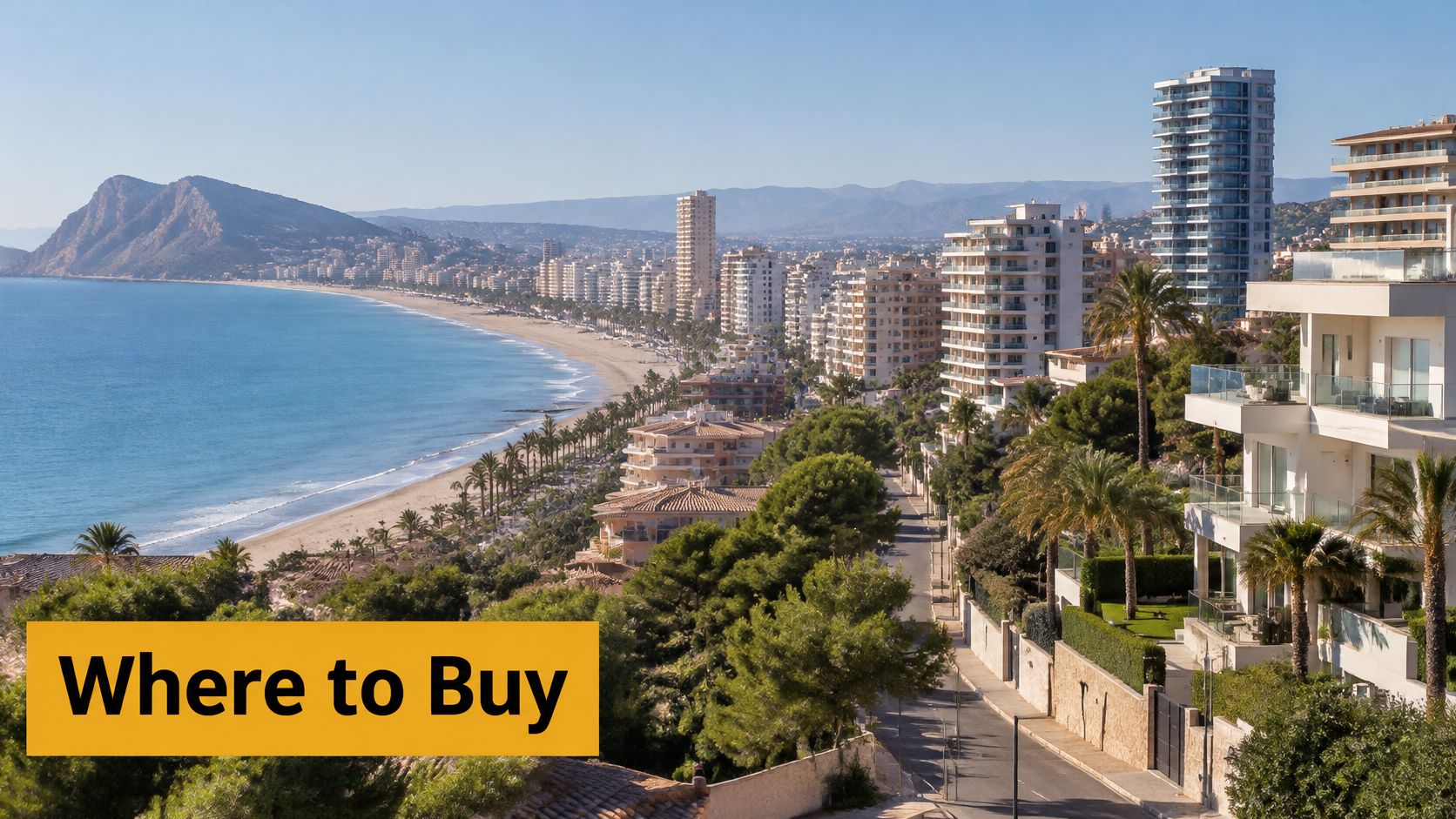
Coastal Towns With Different Rhythms
Jávea and Moraira feel quieter and more residential, with a mix of villas and smaller apartment buildings. They suit lifestyle buyers who value privacy and don't need a city outside the door. Calpe is more vertical and resort based, with sea-view apartments set against the Peñón de Ifach and established holiday infrastructure. That makes licence status and community rules especially important if rental income is part of the plan.
Torrevieja and Orihuela Costa offer long promenades, resort-style communities and a wider spread of prices. You may get more space, pools and parking for your budget, but you must compare community fees and maintenance standards carefully. La Romana, inland in Alicante province on the Costa Blanca, is different again. It's for buyers who prefer calm, space and a rural setting over walking to the beach, and who'll check road access and everyday services before anything else.
Main Alicante Areas for Luxury Apartments
Area | Character | Best suited for | First check |
|---|---|---|---|
Alicante city | Urban, year-round services, port and promenade areas | Buyers wanting daily city life and a deep rental base | Building age and sea-view orientation |
Jávea | Quieter coastal town with a mix of villas and apartments | Lifestyle buyers and second-home owners | Access roads and parking provision |
Calpe | Rock-backed coastline with established resort infrastructure | Sea-view buyers and holiday-home users | Tourist licence status of the unit |
Moraira | Small, upmarket coastal resort | Buyers who prioritise privacy | Community fees and shared services |
Torrevieja | Large year-round population and lively promenade | Buyers balancing price with sea access | Flood exposure of ground-floor and garage units |
Orihuela Costa | Coastal resort developments | Winter residents and families | Drainage and communal maintenance records |
La Romana | Inland municipality with a quieter, rural setting | Buyers seeking space and calm | Road access and local services |
Narrow the list in three steps. First, decide whether the apartment is mainly for living, holidays or income. Second, pick two areas that match that purpose. Third, compare only those two using price, thermal comfort, building resilience and rental eligibility, so you're not comparing a city penthouse with an inland resale as if they were the same product.
How Big Alicante's Luxury Market Really Is
Liquidity comes before finishes. If you may resell, let to tenants or refinance, you need other buyers and tenants who want the same area and building type. Alicante provides that depth at provincial level, but it concentrates unevenly, street by street.
During the first half of 2025, Alicante ranked third nationally by residential transaction volume and represented nearly 8% of all property operations in Spain, according to the Savills Spotlight Residential Market in Spain H1 2025. The same review records 2,030,037 residents in Alicante province and 366,221 in Alicante city on 1 January 2025. That resident base supports schools, healthcare, retail and transport outside the holiday season, which matters if you plan to let long term or sell to a year-round household.
Nearly 8% of all Spanish property operations took place in Alicante province in the first half of 2025. Scale helps resale, but it doesn't rescue a badly located unit.
Alicante Market Indicators in Numbers
Indicator | Value | Why it matters |
|---|---|---|
Residential transaction rank, first half of 2025 | Third nationally | Deep resale market with more exit options |
Share of Spanish property operations, first half of 2025 | Nearly 8% | Scale and liquidity of the regional market |
Alicante province population, 1 January 2025 | 2,030,037 | Year-round demand beyond holiday buyers |
Alicante city population, 1 January 2025 | 366,221 | Urban base for long-term rental |
Foreign nationals' share of registered home purchases | A large share of purchases | Strong international buyer pool |
Average home price, Alicante province | A blend of older resales and new sea-view builds | Useful only as a rough baseline |
Rental prices, Alicante city, 2024 | Up 5.1% year on year | Rising rental demand for owners |
Reading Prices Without Being Misled
Foreign buyers account for a large share of registered home purchases in Alicante province. International demand is substantial, but it competes with local demand rather than replacing it. That mix is healthier for resale than a market built only on second homes.
Treat any province-wide average price as a rough baseline, not a luxury benchmark. It averages older resale flats against new sea-view penthouses, so it can't tell you whether one apartment is fairly priced. A resilient building on a sought-after front line and a dated block two streets back sit inside the same average.
Rental housing prices in Alicante city increased by 5.1% in 2024, according to the National Statistics Institute rental price release. Use location-specific comparisons instead of national headlines. The INE 2025 Urban Indicators report records average housing purchase-and-sale prices in 2024 of €969,434 in Sant Josep de Sa Talaia and €858,788 in Pozuelo de Alarcón, and a €397 monthly rent for primary residences in Alicante/Alacant zone 4-A, including mainly Juan XXIII. Those gaps show why prime figures from elsewhere shouldn't be applied to the wider province.
A deep market gives you more exit options. It doesn't guarantee your exit. The apartments that resell fastest are the ones the next buyer can occupy or let immediately, with sound construction, manageable running costs and, where the building permits it, rental eligibility. Match the apartment's size, outdoor space and parking to the next likely buyer, not only to your own taste.
Features That Justify a Luxury Price in Alicante
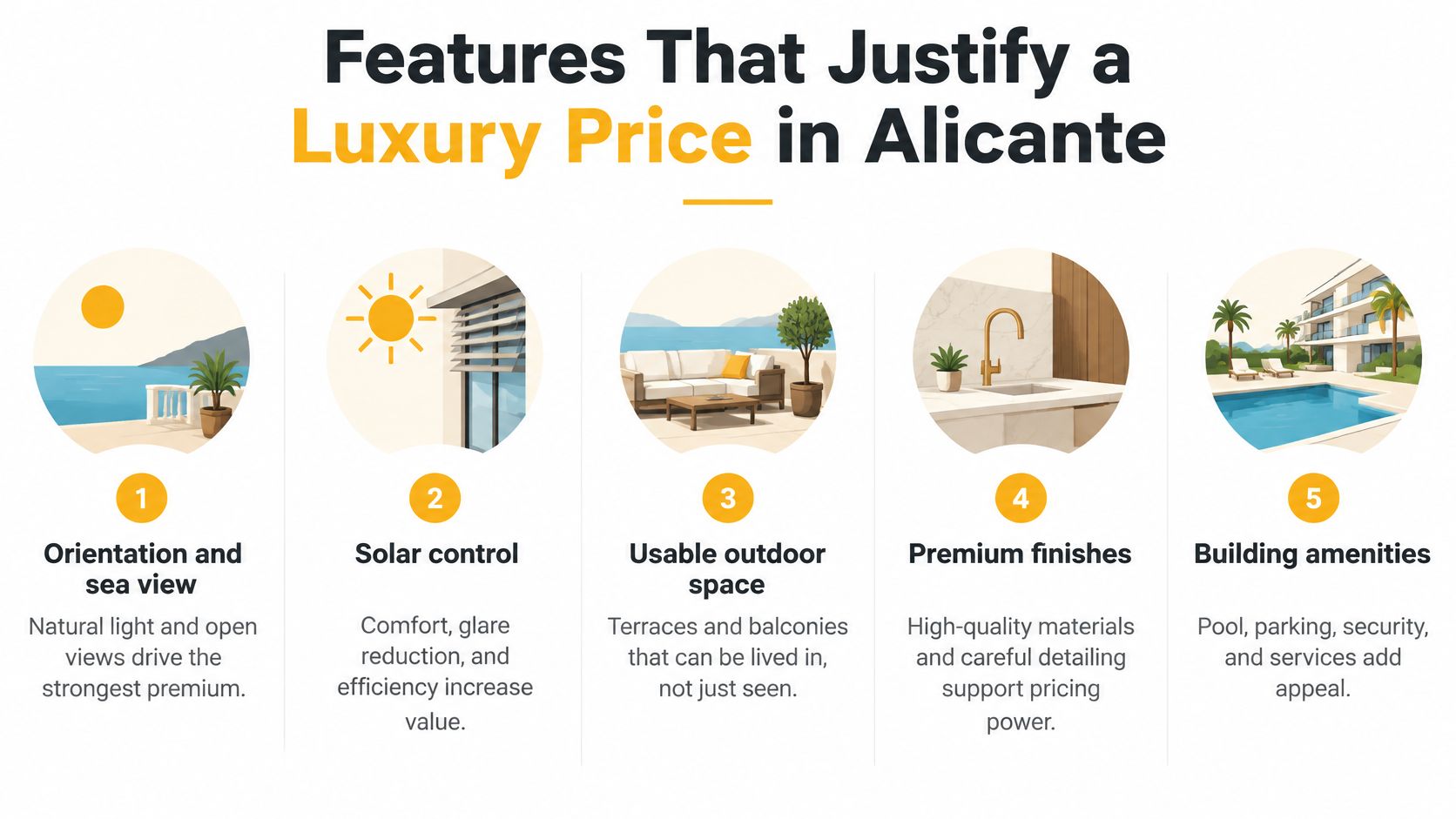
A well-finished apartment isn't automatically a luxury apartment. In Alicante, the features that justify a premium are the ones that protect comfort for most of the year, reduce running costs and stay useful after the first viewing.
Orientation and sea view usually carry the strongest pricing power, but they cut both ways. A wide view through large south-facing glass looks impressive in March. In August it can mean glare, heat gain and heavy air-conditioning use unless the building was designed for it. Ask which rooms take direct sun, at what hours, and whether bedrooms can be kept dark and cool at night.
Why Solar Control Is an Engineering Issue
A peer-reviewed case study of San Juan Beach in Buildings records more than 3,000 sunshine hours annually and annual solar radiation of approximately 1,215 to 1,563 kWh/m², depending on façade orientation. The same study found indoor temperatures within 21 to 25°C for about 1,927 hours annually. Passive design helps, but it doesn't remove peak-summer cooling needs, especially for top-floor penthouses.
Verify these items in writing, not from a brochure photograph:
- External shading: Fixed or adjustable shading outside the glass, so heat is stopped before it enters.
- Low-solar-gain glazing: The actual glazing specification, not just double glazing as a label.
- Balcony depth: Enough depth to shade the room behind and to sit outside comfortably.
- Cross-ventilation: Openings on more than one side, so air can move through the apartment.
- Cooling efficiency: The air-conditioning system, its zoning and likely summer running cost.
- Summer energy model: The building's modelled summer performance, not only its EPC rating.
Outdoor Space, Parking and Services
A terrace adds value when you can live on it. Check depth for a table and chairs, shade at midday, privacy from neighbours, drainage after rain and whether the community allows enclosures or awnings. A narrow balcony with a view is a viewing point, not outdoor living space.
Parking and storage matter more in dense city and beachfront buildings than many buyers expect. Confirm whether the space is included in the price, whether it's on the same title, and whether the garage floods or has tight access. Building services such as a pool, gym, concierge or gardens support price only when they're well maintained and the community fees stay proportionate. Ask for the current fee, recent special assessments and what's included.
A feature list means little without thermal performance behind it. If you can't keep the living room comfortable on a still August afternoon without excessive cooling, the apartment isn't performing as a luxury home.
Premium finishes still count. Solid doors, quiet windows, good water pressure, careful tiling and appliances you won't replace immediately all reduce friction. Rank them after orientation, shade, ventilation and usable outdoor space, because finishes can be changed more easily than the building's relationship with the sun.
Flood, Build Quality and Climate Checks
A high price doesn't guarantee low physical risk. That's the point many luxury listings skip, because they sell the view, the kitchen and the pool while treating water ingress as a generic insurance question.
A 2025 University of Alicante study found that approximately 20% of nearly 9,000 mapped homes and buildings in the city's rural districts, around 1,800 properties, are located in areas exposed to flood hazards during intense rainfall. That doesn't mean every urban seafront apartment faces the same exposure. It means postcode and price are too blunt. You need building-level answers.
Where Water Causes the Cost
Start below the apartment. Garages, storage rooms, lift pits and plant rooms often take water first, and damage there becomes a communal bill even if your own floor stays dry. Look for staining, patched render, replaced skirting, pump installations and repeated painting at low level. Then check the roof and terraces, where failed waterproofing can damage top-floor units slowly and expensively.
Building Resilience Checks Before Purchase
Check | Question to ask | Document to request |
|---|---|---|
Ground level | Is the unit or garage below street level? | Building survey and floor plans |
Drainage | Has water entered garages or storage after past storms? | Community minutes and repair records |
Lift and plant rooms | Are machinery and utility rooms exposed to water? | Technical building report |
Waterproofing | When was it last renewed, and by whom? | Works certificate and invoices |
Insurance | Are flood events or water damage excluded? | Policy schedule and exclusions list |
Access roads | Do they flood in heavy rain? | Official municipal hazard mapping |
Request official hazard mapping, community minutes, technical reports and the insurance schedule before you fix your offer. Minutes are especially useful because they record arguments about leaks, pumps, roof works and special assessments that a viewing won't reveal. Read several years, not only the latest meeting.
Resilience affects total ownership cost even when you see no damage. Repeated storms can raise communal charges, tighten insurance terms, create exclusions and make future buyers more cautious. For an older building, set aside a specific allowance for drainage or waterproofing work before you agree the price. If the seller can't evidence recent renewal, price that uncertainty in rather than hoping the community has it covered.
Build quality checks should run alongside the water checks. Test windows and shutters, listen for plumbing noise, look for cracks that reopen after repair, and confirm lift maintenance. Luxury should mean the building protects comfort and capital in bad weather, not only that it photographs well in good weather.
Short-Term Rental Rules to Verify First
Strong holiday demand doesn't make an apartment legally lettable. That's the gap buyers most often miss, because a listing can describe rental potential without proving that your intended use is permitted for that unit, in that building, under current rules.
Demand is real. International tourists generated 791,829 arrivals and 5,485,584 overnight stays in tourist apartments and homes across Alicante province in 2024, with demand for this category up 34.1% year on year, according to TodoAlicante coverage of foreign visitor demand. Don't convert that into a guaranteed yield. Occupancy, seasonality, cleaning, management, community charges and legal eligibility decide the net result.
The Licence Check Comes Before the Yield Calculation
Alicante City Council has maintained a moratorium affecting new tourist-apartment licences and changes of use, while 53 tourist-apartment blocks were registered in the city between 2023 and 30 June 2025, according to Diario de Alicante reporting on the licence suspension. The proposed framework would cap tourist places at 0.187 per resident in saturated areas and require independent access for tourist units in residential buildings. Rules in other municipalities can differ, so verify the exact town and building.
Work in this order:
- Confirm the existing licence for the unit. Ask for the document, not a verbal assurance or an old advertisement.
- Check transfer on sale. Confirm whether the licence transfers to you and what notification is required.
- Read the community rules. A community may restrict or prohibit tourist use even where a licence exists.
- Check access and planning status. Independent access, permitted use and building classification can decide eligibility.
Rental Routes Compared for an Alicante Apartment
Route | Licence needed | Income pattern | Main risk |
|---|---|---|---|
Tourist apartment letting | Existing licence confirmed for the unit | Seasonal and high-volume | Moratorium, community rules and access requirements |
Medium-term letting | Check local rules on minimum stay with the council | Steady across several months | Local rules on duration and tenant type |
Long-term letting | Standard residential lease | Stable and predictable | Lower gross income than holiday letting |
Personal use | None | No rental income | Opportunity cost of an unused asset |
Then stress-test the numbers. Model a weak season, not the best August you can imagine, and calculate net yield after cleaning, management, utilities, community charges, insurance, maintenance and tax advice. Compare that figure with medium-term and long-term letting. A lower gross rent with fewer voids and simpler compliance can be the better investment, especially if you live abroad.
If the apartment only works financially as a tourist let and eligibility is unclear, pause. You're buying a legal risk, not an income stream.
How International Buyers Complete a Purchase
The Spanish process is orderly once you know the sequence. Most problems come from paying money before documents are checked, or from assuming a step in your home country works the same way in Spain.
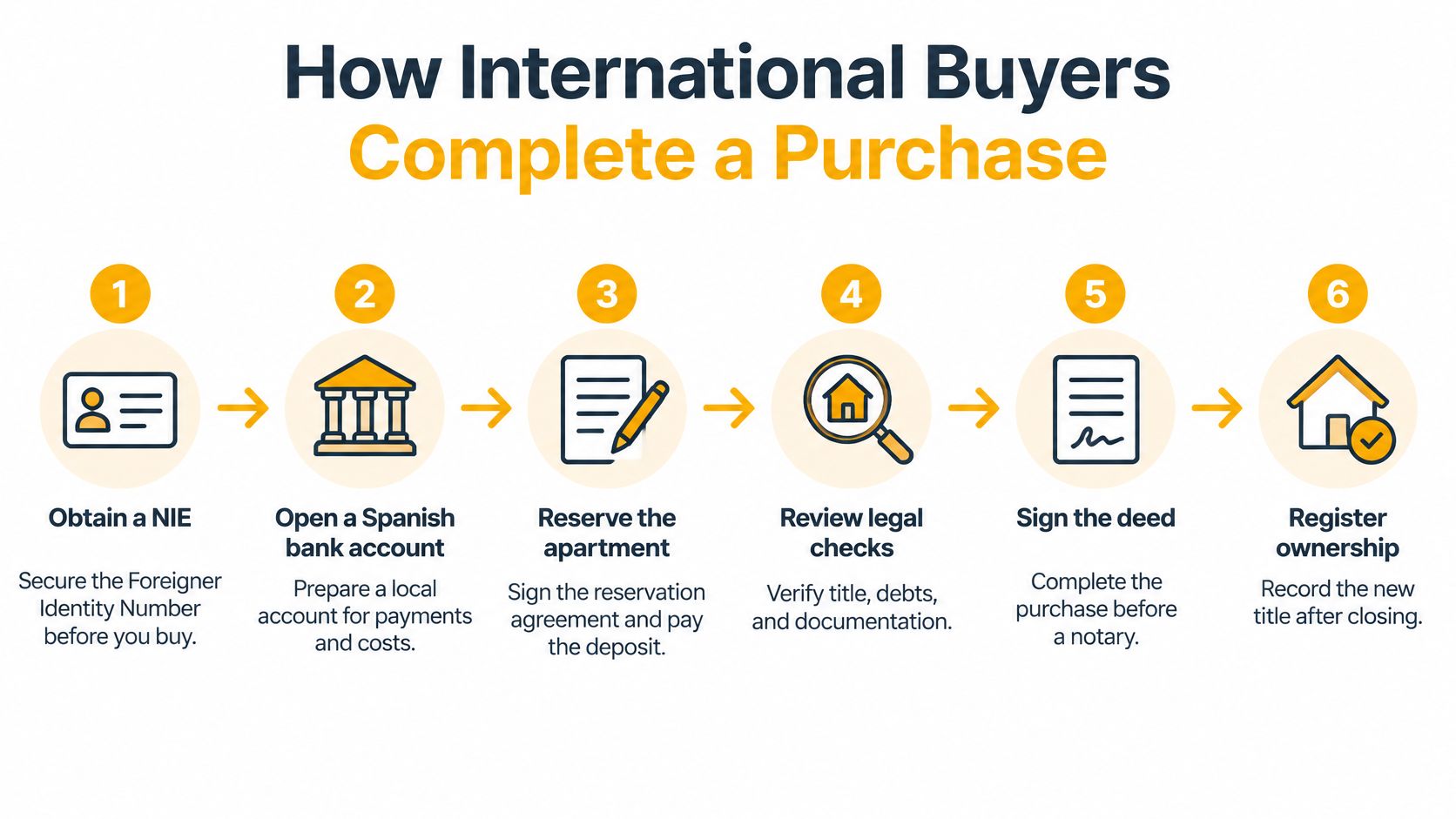
The Sequence From NIE to Registration
- Obtain a Foreigner Identity Number (NIE) and open a Spanish bank account. You'll need the NIE for the purchase and tax payments, and a local account makes transfers, direct debits and completion payments easier. Start early because appointments and bank checks can slow an otherwise ready purchase.
- Agree the price and sign a reservation agreement with a deposit. A reservation deposit is often around 10% of the price in a worked example, but terms vary in real transactions, so confirm exactly what your payment secures, when it's refundable and what happens if legal checks fail. Don't pay a large sum against a vague receipt.
- Commission legal checks on title, debts and planning status. Your lawyer should verify ownership, charges, boundaries where relevant, community debts, licences and whether the built area matches the registered description. Tourist-use and building issues should be confirmed here, not after completion.
- Arrange financing or transfer the funds. If you're using a mortgage, align valuation and approval dates with the contract. If you're transferring from abroad, plan currency timing and keep evidence of the source of funds for bank compliance.
- Sign the private purchase contract. This sets the price, deposit treatment, completion date, included items and penalties. Read the inventory carefully if furniture, parking or storage is included.
- Complete before a notary. The deed documentation must be prepared in advance, and foreign-language documents may need translation. We offer document translation for foreign clients in their language, and we provide clients with the documentation required for presentation before a notary, while our lawyers advise them on the transaction and their best interests.
- Pay transfer tax (ITP) and registration costs, then register the property. Buyers usually carry transfer tax, notary and registry costs, although the exact tax route differs between resale and new-build purchases. Your lawyer should give you a written cost estimate before completion, not a surprise afterwards.
At completion, a complete file should let you answer five questions without searching emails. Who owned the apartment, what debts or charges were cleared, what use is permitted, what total costs you paid beyond the price, and where the registered deed and community documents are stored. Keep digital and paper copies.
Common slip: Buyers focus on the deposit percentage and forget to ask what event makes it refundable. Put the refund conditions in the agreement itself.
Confirm Your Shortlist Before You Contact an Agent
A strong shortlist reads like a case file: two or three areas, one clear use, and proof attached to every claim. In Alicante's upper segment, that proof has to cover more than views and finishes. A flat is only luxury if the licence position, flood exposure, heat control and total purchase cost all hold up under questioning.
Step 1: Narrow to two or three areas and one or two apartment types, such as a sea-view new build or a renovated older unit with a usable terrace. Step 2: For each unit, confirm tourist licence status and community rules if income matters, obtain community minutes and the insurance schedule, and request the energy model with its summer cooling assumptions. Ask whether garage, storage or lower-level rooms sit below street level, and where water would drain in a heavy storm.
Step 3: Put three questions to any agent in writing. Is the licence valid for your intended use? Which parts of the property sit below street level? Which costs sit beyond the purchase price, including community charges, transfer tax, and notary and registry fees?
Step 4: Send the shortlist, intended use and budget to an adviser and ask for written answers before you offer. AP Properties Spain, serving buyers and sellers across the Costa Blanca and Costa Cálida, can review that file as one practical starting point. We hold the licences and insurance required to register as a licensed real-estate agent in the Comunidad Valenciana, and we won the Luxury Lifestyle Awards® for Best Luxury Boutique Real Estate Consultancy in Costa Blanca in both 2024 and 2025. Have your own lawyer check each reply against the official registries, then compare the written answers side by side.
Bring us your two-area shortlist, intended use and questions on licence status, flood exposure, solar control and total purchase costs, and we will help you test luxury apartments in Alicante against evidence instead of brochure claims. Visit AP Properties Spain to start that review with our Costa Blanca team before you reserve an apartment.
Share


