



Moraira Property Guide: Prices, Areas and Buying Tips
A purchaser generally has to withhold 3% of the sale price when buying from a non-resident owner in Spain. That's an advance payment towards the seller's potential tax liability, not an extra purchase tax, but it illustrates why a Moraira property purchase needs more scrutiny than a listing provides.
The same discipline applies to the asking price, rental forecast and condition of the plot. For international buyers on Alicante's Costa Blanca, the useful question isn't whether Moraira is desirable. It's whether a particular home justifies its price after infrastructure risks, operating costs and your intended use are accounted for.
Moraira Asking Prices Compared
Moraira's advertised price reached €4,008 per square metre in March 2025, against a provincial average of €2,424 for Alicante. The gap widens further in El Portet-Pla del Mar, Moraira's highest-priced micro-market.
Asking prices per square metre, March 2025
Area | Price per m² | Basis |
|---|---|---|
El Portet-Pla del Mar | €5,101 | Asking price, March 2025 |
Moraira | €4,008 | Asking price, March 2025 |
Jávea | €3,601 | Asking price, March 2025 |
Benissa | €3,426 | Asking price, March 2025 |
Alicante province | €2,424 | Asking price, March 2025 |
These figures place Moraira among Alicante province's premium residential locations, ahead of Jávea and Benissa on advertised price alone. Published estimates of Moraira's average house price sit below the asking level and rose year on year, but they track a different measure.
Asking prices and average prices aren't interchangeable. Asking prices describe what sellers advertise; they say nothing directly about what buyers ultimately pay. An average figure also shifts with the property types, locations and condition of the homes included. Without a published methodology, don't treat the lower average as evidence of completed sale prices or calculate an expected negotiating discount from the gap.
A meaningful comparison needs similar homes: comparable internal area, plot, condition, outlook and access. Check whether advertised floor area includes terraces, garages or ancillary accommodation before treating the price per square metre as a valuation. A sea-view villa on a steep plot and a flat apartment near the centre can share a postcode and still belong to different markets.
None of these per-metre figures prices in what the listing leaves out: flood exposure on low-lying plots, the reliability of summer water supply, or the net yield a property can generate once community fees, maintenance and void periods come off the rent. A premium asking price only holds if the individual home clears those checks.
Why the premium has deeper roots
Teulada's formal municipal foundation dates to 1386, and the Castell de Moraira, also called Castell de la Mar, was built in 1744. The MACMA Teulada-Moraira profile traces the town's development through farming, fishing and raisin production, including the vineyard terraces and traditional grape-drying structures called riuraus.
The shift towards international tourism during the 1970s and 1980s helped create today's villa-led residential identity. That history supports describing Moraira as an established international market rather than a newly discovered destination. It doesn't, by itself, prove that premiums hold through every market cycle.
Valuation rule: Pay for the attributes of the individual home, not for the postcode's average.
Treat the local average as a search reference rather than a promise of what your budget buys. Compare older apartments and villas separately, then test whether higher-priced sea-view or newer stock offers enough usable improvement to justify the additional capital.
Why International Buyers Choose Moraira and Where They Live
Teulada-Moraira had 12,912 registered inhabitants on 1 January 2025, compared with about 1,698 in the Moraira urban nucleus, according to CASAFARI's Moraira area guide. The same guide records approximately 898 foreign nationals in the nucleus in 2024, roughly 53% of its registered population. These figures describe an international, dispersed residential municipality, not a compact seaside centre.
That distinction matters when you arrange viewings. A property marketed as Moraira may offer a very different daily routine from a home within walking distance of the waterfront.
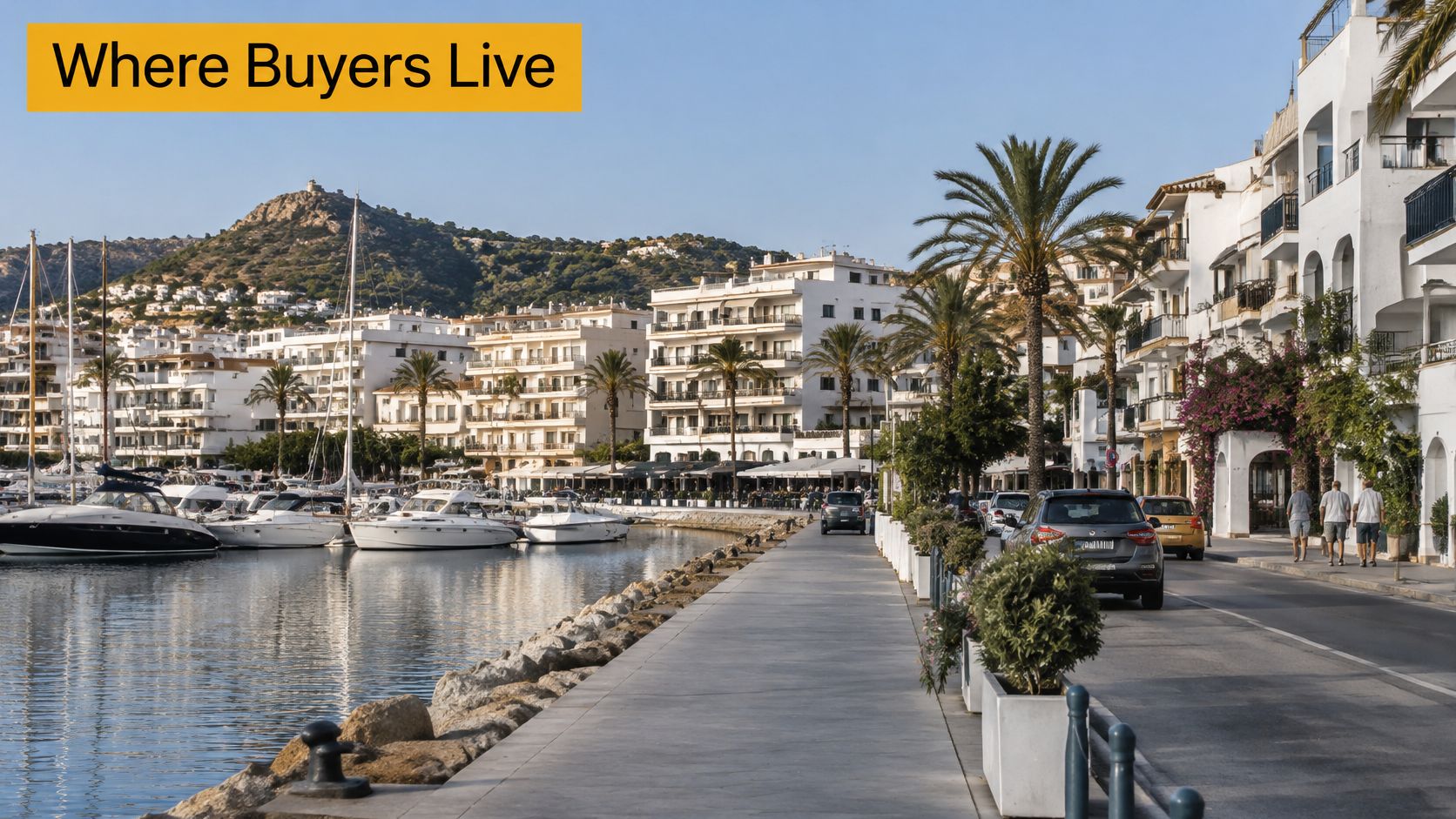
Say you're buying for extended stays and would prefer not to drive every day. Begin in the town nucleus and near-marina streets, then physically walk the routes you expect to use. An apartment close to restaurants isn't necessarily convenient for groceries, healthcare or carrying shopping home.
Choose the daily routine before the view
- Town nucleus: Prioritise this setting if walking to services matters more than having a large private plot. Check street noise, parking and access to the building.
- Beachfront and near-marina blocks: Consider these for waterfront access, but inspect privacy and activity outside the windows rather than relying on the sea-view photograph.
- Hillside urbanisations: Buyers seeking views, gardens and separation should test gradients, vehicle access and the practicality of everyday journeys.
- Inland and valley-edge settings: Buyers wanting land should give particular attention to permitted use, access and connections, rather than assuming a larger plot means greater freedom.
Seasonal population growth also changes how neighbourhoods function. More visitors mean greater demand for accommodation, restaurants, marina services and property management, but registered-resident totals don't count every second-home owner or temporary visitor.
Before choosing an area, repeat the journey to shops, health services and the beach in quiet and busy conditions. Seclusion and convenience are different benefits, and a viewing itinerary should make their trade-off visible.
Property Types and Which Suit Your Plans
Property types and their trade-offs in Moraira
Property type | Typical setting | Best suited to | Main trade-off |
|---|---|---|---|
Detached villa | Urbanisations and hillside plots | Privacy, garden and pool | Highest maintenance and running costs |
Apartment or penthouse | Coastal blocks near the centre and marina | Low-upkeep second homes | Shared community charges and little outdoor space |
Townhouse or bungalow | Quieter residential streets | Mid-sized, year-round use | Smaller plot and less privacy |
Finca or rural plot | Inland land and valley edges | Renovation or custom build | Planning status, access and utility connections |
Treat these as shortlisting categories, not guarantees about every building. A compact villa can be easier to maintain than a neglected apartment, while a bungalow within a shared development may carry substantial communal obligations.
Detached ownership gives you control over the garden and pool, but also responsibility for their condition. Request service records, equipment details and quotations for foreseeable work, including pool plant, irrigation, exterior finishes and boundary structures.
An apartment reduces direct responsibility for some external maintenance, not your exposure to its cost. Read community accounts, meeting minutes and proposed works before deciding that the property is inexpensive to own.
Match the building to its purpose
A lifestyle buyer should rank privacy, accessibility and maintenance tolerance before architectural appearance. For holiday use, examine how guests would arrive, park, carry luggage and use outdoor areas. For longer ownership, consider whether another buyer could comfortably use the home without inheriting an expensive alteration programme.
Townhouses and bungalows can offer a workable compromise, but inspect shared walls, outdoor privacy and community arrangements. With a finca or rural plot, don't set a renovation or construction budget until a lawyer and architect have confirmed lawful existing buildings, permitted works and service availability.
A low purchase price isn't a renovation budget. Establish what you can legally retain, alter and connect before pricing the work.
For a new-build, ask your lawyer to verify the written ten-year structural guarantee, its coverage and any applicable exceptions. For resale, commission a condition survey and reconcile previous extensions or alterations with the documentation.
Shortlist a few property types that fit how you'll use the home. Then compare their total ownership commitments, rather than their bedroom counts alone.
Site Risks and Water Supply to Verify First
Moraira sits in a valley where mountain streams flow towards the coast, with stream-deposited alluvial soils on the valley floor, as described in the Moraira geographical overview. That setting calls for parcel-specific checks of runoff, ground conditions and drainage. It doesn't mean every valley property floods, or that every plot on higher ground is safe.
The rainfall contrast is important: AVAMET's Moraira station recorded 345.0 mm in 2016 and 619.6 mm in 2022, including 246.2 mm in March 2022, against 3.1 mm in July and 0.0 mm in August. These observations are provisional and non-official, so they should inform questions rather than substitute for engineering design evidence.
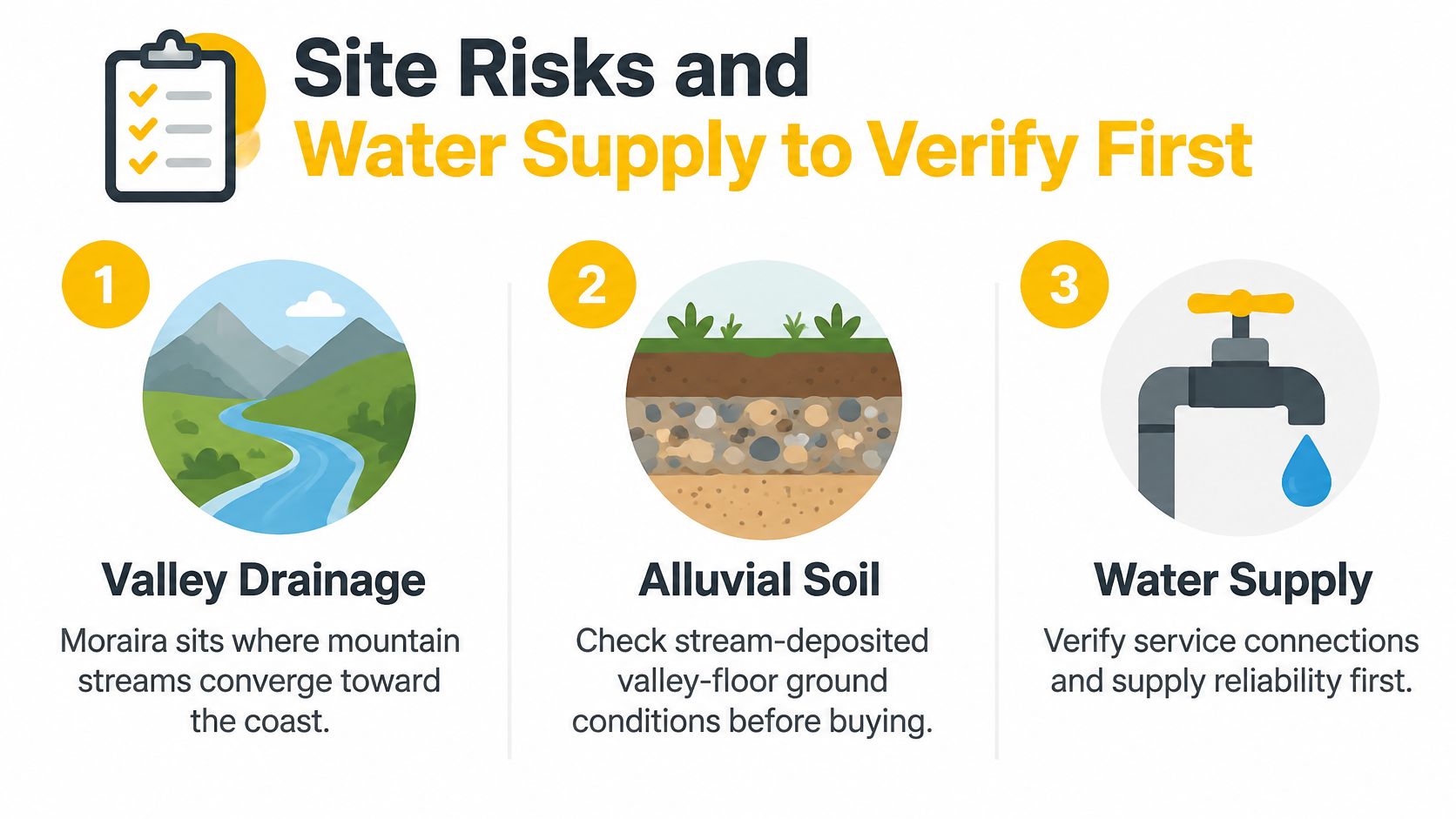
Dry summer viewings can conceal wet-weather weaknesses. Inspect roof outlets, overflow routes, paved surfaces, pool drainage and retaining walls. Ask for records of damp treatment, waterproofing, drainage alterations and relevant insurance exclusions.
Check the supply beyond the boundary
In February 2025, Teulada-Moraira town hall approved €679,473.89 of drinking-water network works involving obsolete pipes and pumping-station adaptations, stating that the works could prevent up to 40% of drinking-water losses. That signals both infrastructure needing attention and municipal action, not proof of unreliable service at a particular villa.
Ask whether the home is mains-connected, the age and capacity of its supply, and its pressure and interruption history. Establish who owns private pipework and whether nearby utility works could affect access.
Run the checks in this order:
- Locate the parcel: Check Spain's official flood-risk mapping using the exact plot, not the neighbourhood name.
- Obtain municipal information: Request planning restrictions and available drainage information in writing.
- Confirm the connection: Reconcile the town hall and utility's records with the property's actual installation.
- Commission technical checks: Use geotechnical and structural professionals for valley-bottom or sloping sites, particularly before basements, pools, retaining walls, construction or major landscaping.
- Verify climate assumptions: Cross-check rainfall observations against AEMET's official records and applicable municipal requirements.
Rental Income Behind the Headline Price
Using the March 2025 asking price of €4,008 per m² and asking rent of €12.6 per m² reported by idealista's Moraira overview, a hypothetical 80 m² apartment costs €320,640 and produces €1,008 monthly, or €12,096 annually, implying a gross yield of about 3.8%. Applying the same rent to the reported El Portet-Pla del Mar price of €5,101 per m² produces approximately 3.0% gross instead.
That distinction matters. A yield quoted without its purchase-price denominator can make different locations look financially equivalent when they aren't.
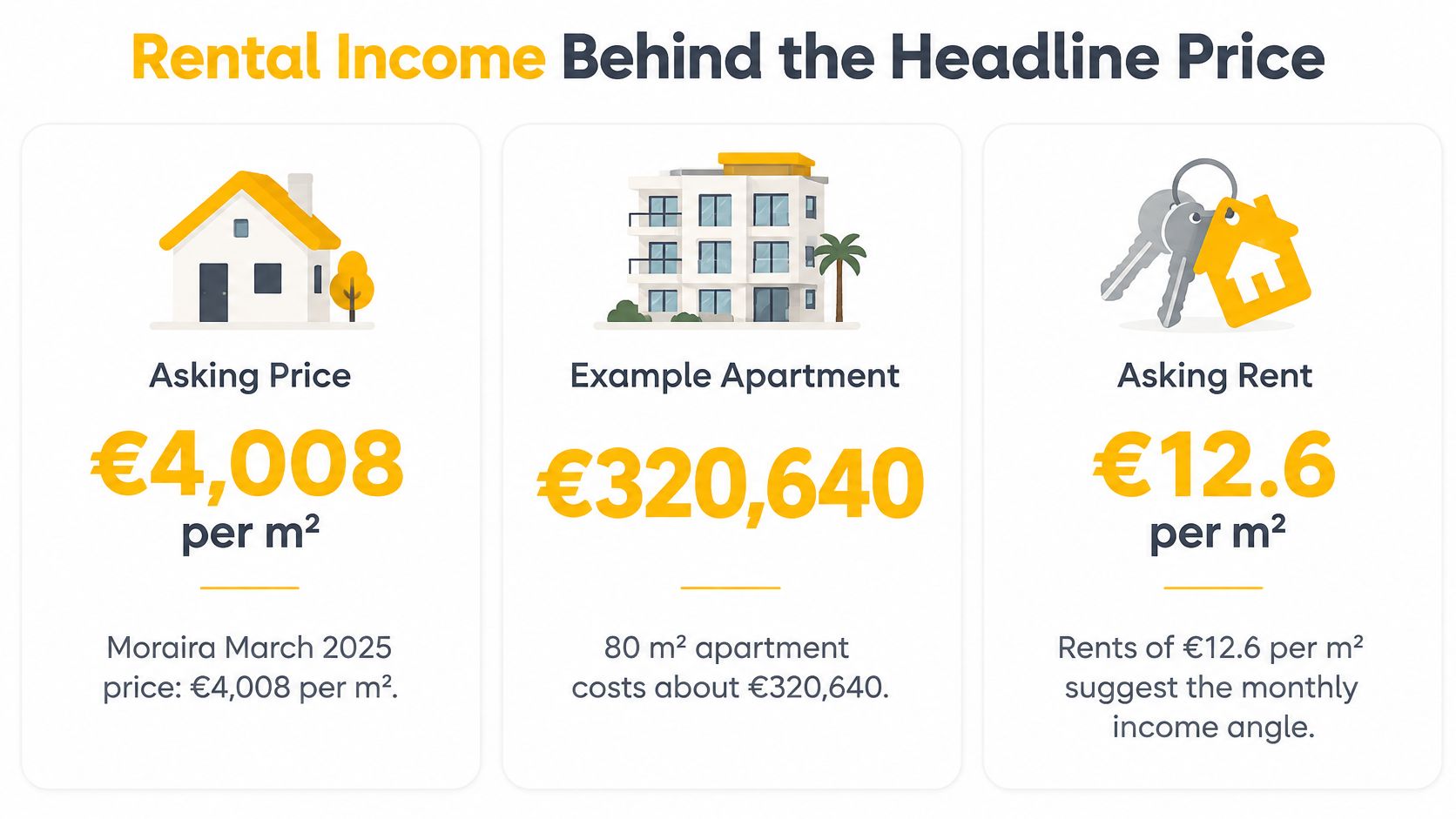
These are asking-based illustrations, not property valuations or achievable-rent guarantees. They combine market benchmarks rather than evidence that the same apartment can be bought and rented at those amounts.
What remains after ownership costs
Three use cases and what each one must prove
Use case | How income arrives | Main costs to model | Test before buying |
|---|---|---|---|
Personal second home | No rental income | Running costs, insurance and community charges | Whether you will use it enough to justify the capital |
Seasonal holiday rental | Concentrated summer bookings | Management, cleaning, marketing and licensing | Off-season occupancy and licence status |
Year-round rental | Steady monthly rent | Vacancy, maintenance, tax and insurance | Net yield after all costs, not gross rent |
Deduct vacancy, repairs, insurance, community charges, relevant taxes and management before judging operating income. Then assess financing separately and calculate the return against total acquisition expenditure, not just the advertised price.
For holiday letting, build a monthly forecast rather than multiplying a peak-season weekly rate across the calendar. Confirm the property's licensing position before assigning rental income to it, and obtain management and cleaning quotations.
Pool upkeep, parking, walkability and refurbishment can change both achievable income and expenditure. Owner occupation also removes potentially lettable dates, so a second home with occasional bookings needs a different model from a dedicated rental.
Investment test: If the purchase only works with uninterrupted bookings and no significant repairs, the margin is too narrow.
Moraira may fit lifestyle-led ownership and a long-term capital-preservation objective better than a search for high immediate income. Neither appreciation nor preservation is guaranteed. Compare the property's realistic net return, effort and liquidity with alternative uses of the same capital.
Buying Costs and Tax Rules to Budget For
For a resale home, the negotiated price may not be the taxable base. The Generalitat's transfer-tax guidance sets out the Valencian framework under which the higher of the declared purchase price or official cadastral reference value determines the assessment base, with the applicable rate governed by the date of the notarial deed.
A purchase agreed below that reference value can therefore require more tax than a calculation based solely on the contract price suggests. Have your lawyer verify both inputs before you commit, using the rules applicable to your completion date rather than an old online estimate.
Build a completion budget, not just a deposit budget
- Start with the agreed consideration: Record what's included, particularly furniture, equipment and any separately negotiated items.
- Calculate transfer tax correctly: Obtain the cadastral reference value and written confirmation of the applicable treatment.
- Add transaction costs: Include notary fees, Land Registry registration, independent legal advice and any survey or valuation.
- Separate financing expenses: Request a written allocation of mortgage-related costs and any arrangement charges rather than assuming every expense falls to the buyer.
- Arrange identification: Budget for obtaining your Spanish tax identification number, the NIE, which is needed before the notarial deed can be completed.
- Keep an ownership reserve: Allow for community charges, insurance, utilities, pool or garden upkeep and immediate repairs.
Don't treat the reserve as money available for a higher offer. Its purpose is to keep predictable expenditure from becoming a financial problem immediately after completion.
Ask for a written cost summary early enough to review it before paying a deposit. It should distinguish purchase taxes, professional fees, financing expenses and ongoing ownership costs, with unresolved items clearly identified rather than hidden inside a single estimated total.
Confirm the Checks Before You Commit to Moraira
A premium asking price survives scrutiny only when the paperwork, the site and the income case all hold up at the same time. Moraira listings rarely volunteer the details that decide that outcome, so give each unresolved issue an owner and a deadline before funds that are difficult to recover change hands.
- Establish the price case. Compare similar homes and seek evidence of recent transactions where available. Check the cadastral reference value separately, because it serves a different purpose from market valuation and affects how the purchase is taxed.
- Resolve the parcel questions. Get written answers on flood exposure, drainage, water connection and any technical work the property requires. If an answer depends on a survey, commission it before treating the issue as settled. A listing description is not evidence of supply security.
- Test the intended use. For an income-led purchase, run achievable occupancy and documented running costs rather than peak-season rates, then check whether the net figure still clears your return threshold. For personal use, weigh the ownership commitment against your realistic time in the home.
- Approve the full budget. Confirm acquisition expenses and retain funds for foreseeable repairs and running costs, so predictable expenditure cannot force a distressed resale.
- Verify representation and paperwork. Check the agent's registration and insurance, and confirm the notarial documentation is complete before signing.
AP Properties Spain holds the licences and insurance required to register as a licensed real-estate agent in the Comunidad Valenciana. It provides clients with the documentation required for presentation before a notary, while its lawyers advise on the transaction and the client's best interests. Document translation is available for foreign clients in their language, and support continues through every stage of the purchase.
Proceed when the evidence supports the price, renegotiate when a defect can be costed, and walk away when a material uncertainty remains unresolved.
At AP Properties Spain, we help international buyers organise the checks described above for a Moraira property. Contact AP Properties Spain to discuss documentation, legal coordination and document translation for your purchase before you commit to a home.
Share


