



Living in Alicante: Areas, Costs and Daily Life
You're probably sitting with two tabs open right now. One shows a sunny apartment near the beach, the other shows a cheaper house inland with twice the space, and neither listing tells you what January feels like, whether you'll need a car for milk, or how loud August gets. That gap between a good holiday and a workable daily routine is where many get living in Alicante wrong.
The fix isn't chasing the town with the most sunshine or the largest expat share. It's judging each area on year-round services, transport you can use, and whether permanent residents keep shops, clinics and schools busy when visitors leave.
Alicante Areas Compared for Daily Life
A town can be perfect for a fortnight and still fail the weekly shop. Use the table as a first filter, then judge the exact street on winter services, walking reach and how many neighbours stay after September.
Area | Daily-life character | Transport access | Best suited to |
|---|---|---|---|
Alicante centre and Benalúa | Urban, walkable, culture and services close by | Central bus and tram links at Luceros | Professionals, students, first-time residents |
Playa San Juan | Beach district with cafés and year-round residents | Tram Line 1 | Families and remote workers |
El Campello | Calm coastal town with a marina | Tram Line 3 to Alicante | Those wanting quiet near the sea |
Benidorm | Large resort with high-rise blocks and nightlife | Tram Line 1 to Alicante | Those wanting dense services and sea views |
Dénia and Jávea | Northern coast with a strong international community | Car needed for most trips | Retirees and second-home owners |
Torrevieja | Large coastal city with a big expat population | Bus and car | Budget-conscious retirees |
Elche | Inland city with industry, university and urban scale | Bus and road links to Alicante | Those wanting city life at lower coastal prices |
La Romana | Small inland village in the Serra del Reclot foothills | Car needed | Those seeking space and quiet |
Read year-round in the full sense. It means the bakery, pharmacy, health centre and school run still feel normal in January, not just in August. Some resort streets do the opposite, with shutters down for months and neighbours who only appear for holidays.
Starting in the City
Alicante centre and Benalúa give you the easiest start if you do not want a car. You have walkable markets, shops and offices, plus central bus and tram links at Luceros. The trade-off is obvious: you get an apartment rather than a garden, and parking and summer noise need checking street by street.
Playa San Juan suits people who want beach-side daily life while keeping city reach. It sits on Tram Line 1, has cafés and supermarkets aimed at residents as well as visitors, and works well for families and remote workers who will use the tram more than the promenade. The district is long, so measure the actual walk from front door to stop before you commit.
Don't buy the municipality name. Buy the ten-minute walk around the front door.
Along the Coast and Inland
El Campello is calmer, with a marina town feel and a direct tram link into Alicante. Benidorm is the opposite choice: dense high-rise living, the widest choice of services and Tram Line 1 access, balanced against crowds and nightlife that some full-time residents tire of. They answer different routines.
Dénia and Jávea suit a car-based coastal life with a strong international community, good restaurants and scattered housing areas where you drive for most errands. Torrevieja serves budget-conscious retirees with a large expat presence and plenty of apartments, though you should test how seasonal your exact urbanisation feels in winter. Elche adds inland urban scale, industry and a university, so daily life depends less on tourism.
La Romana is a different proposition altogether. It is a small inland village in the foothills of the Serra del Reclot, with local services concentrated in the village and larger commercial, medical and administrative errands pushed to nearby towns. Expect a car for most trips. In return you get space, quiet and a village rhythm that coastal resorts cannot offer.
A Three-Question Test
- Walking need: How often must you reach food, healthcare and paperwork on foot?
- Car tolerance: Can you manage without a car, or will you happily run one or two?
- Crowding limit: How much summer noise, parking pressure and seasonal emptiness can you tolerate?
If you cannot answer those three, you are choosing a postcode blind.
Sun, Heat and Water Shape Daily Life
The climate sells the move, but it also dictates your bills and your building checks. Alicante's official AEMET climate normal for 1981 to 2010 indicates an annual mean temperature of 18.3°C, with mean maximum and minimum temperatures of 23.3°C and 13.2°C respectively. Annual precipitation averages only 311 mm, while annual sunshine reaches approximately 2,851 hours.
Those averages hide the indoor problem. West- and south-facing glazing can push summer cooling loads well above what a cool morning viewing suggests, so a bright apartment at midday can turn into an expensive oven by late afternoon. External shading, low-solar-gain glass and cross-ventilation matter as much as the air-conditioning unit itself.
Cooling the Home Properly
Heat-pump air conditioning is the usual option, and seasonal efficiency is worth comparing before you sign. Ask for the unit's rating, its age and its servicing history, then check roof insulation, especially in top-floor flats and villas with large roof areas. A good energy certificate helps, but it doesn't replace looking at orientation, shutters and shade.
Low rainfall changes gardens too. Lawns and thirsty planting depend on irrigation, so efficient watering systems and drought-tolerant planting aren't cosmetic choices. They're how you keep outdoor space usable without wasting water or money.
Water Supply and Restrictions
Water security needs a direct check, not an assumption. Drought in recent years has pushed some Costa Blanca municipalities to issue tap-water quality warnings and to restrict daytime pool filling, garden watering and vehicle washing when supplies run low. Salinity is part of why coastal wells struggle in dry spells, so the issue sits closer to daily life than the brochure suggests.
Those measures have never applied uniformly across every municipality, and that's the point. Verify current water quality, restrictions and supply arrangements with the relevant local authority before buying or renting, and ask whether a property runs on mains water, a deposit tank, or both. A tank changes the routine: you watch the level before the long shower, not after it.
Due-diligence checklist: solar orientation, roof insulation, shading, air-conditioning efficiency, irrigation infrastructure and the exact water-supply arrangement.
Getting Around by Tram, Bus and Car
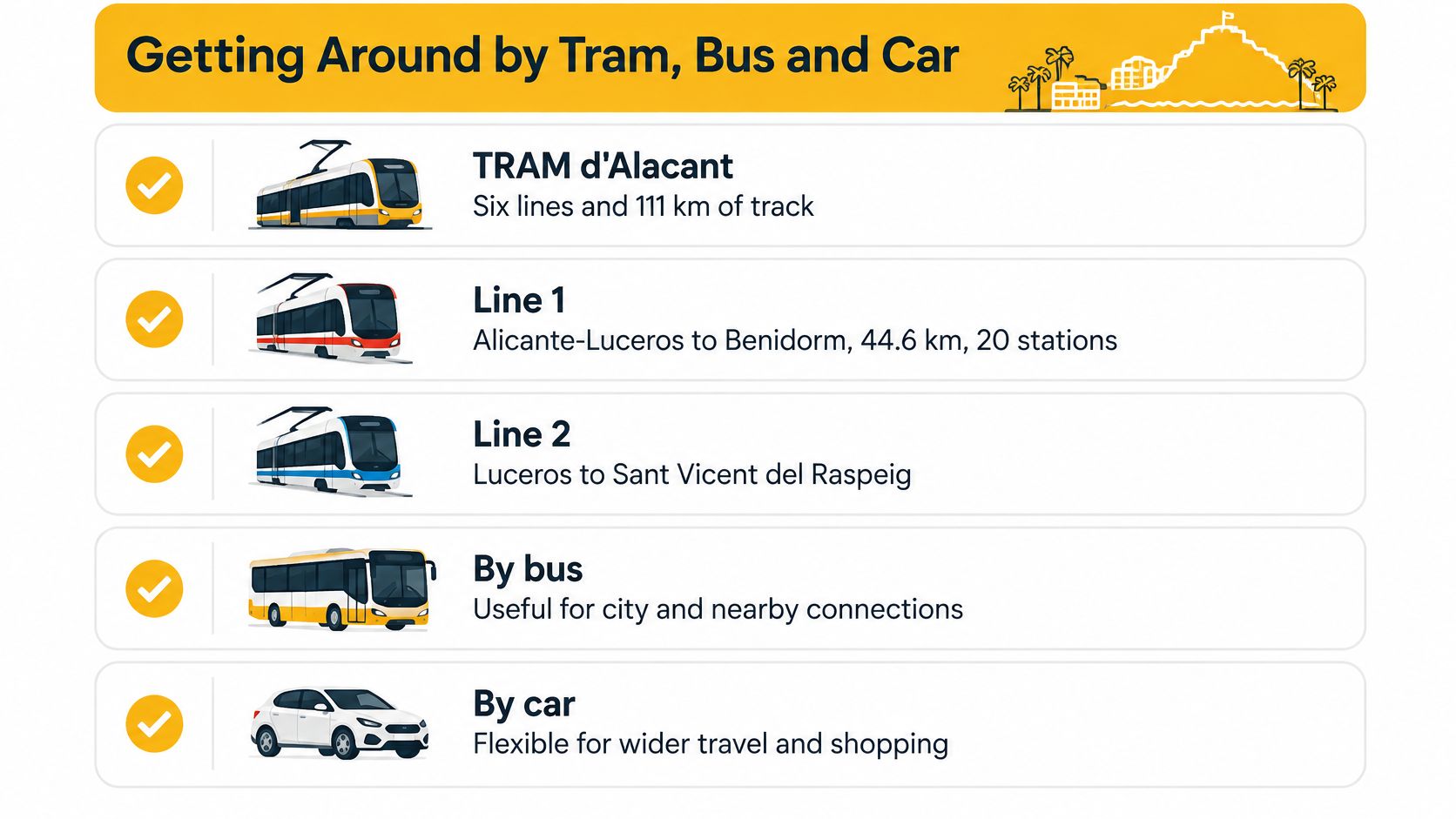
Transport decides whether a cheap property stays cheap. The FGV figures for TRAM d'Alacant report six TRAM d'Alacant lines and 111 km of network. The network recorded 19,015,836 passenger journeys in 2025, so treat it as a commuting system, not a tourist extra.
Line | Route | Length | Stations |
|---|---|---|---|
Line 1 | Alicante-Luceros to Benidorm | 44.569 km | 20 |
Line 2 | Luceros to Sant Vicent del Raspeig | 7.207 km | 14 |
Line 3 | Alicante to El Campello | 14.404 km | 17 |
Testing a Property Properly
Don't judge access by municipality name. Walk the actual route to the station, in the heat if you can, and time it. Then check service frequency at commuting hours, how many interchanges you need, and the door-to-door time to work, school or the airport area. A home that's technically in a tram town can still leave you driving to the station every day.
Properties distant from stations often need a car for first-mile and last-mile trips. That's normal in inland villages such as La Romana, and it's fine if you've budgeted for it. It's a problem only when you assumed you wouldn't need one.
The Real Cost of the Car
A car gives you freedom for supermarkets, beaches, inland towns and late returns. It also brings insurance, fuel, parking, servicing, tyres and repairs, and a second car can erase the saving you made by buying further out. I'd price the car before you celebrate the lower purchase price.
- Walking minutes: Time the route to the nearest stop, don't estimate it from a map.
- Peak frequency: Check services when you'd travel, not at midday.
- Transfers: Count changes to your workplace, school or airport connection.
- Parking: Confirm where you'll park at home and what it costs.
- Second car: Decide early whether one car realistically serves the household.
Monthly Costs Beyond the Purchase Price
A single average rent for Alicante tells you almost nothing. The INE 2025 Urban Indicators identify monthly rental expenditure of €397 in Alicante's zone 4-A, which mainly includes Juan XXIII. Treat that figure as proof of how widely costs vary inside one city, rather than a target you can expect to pay.
The lowest-cost area often brings longer commutes, older buildings, weaker year-round services or streets that empty once the season ends. Affordability means the total monthly bill for a life you can sustain twelve months a year. The cheapest portal listing rarely delivers that.
Build a Ten-Line Budget
Use the same ten lines for every area you compare. Fill them with local quotes where you can, and write in an estimate instead of leaving a blank because a cost feels uncertain.
- Housing: Rent or mortgage repayments.
- Utilities: Electricity, water and summer cooling.
- Community fees: For flats, including lifts, pools and shared maintenance.
- Property tax: The annual IBI, divided into a monthly amount.
- Insurance: Home and contents cover.
- Maintenance reserve: Especially for older properties and villas with pools.
- Transport: Car running costs or public transport passes.
- Healthcare: Private cover if you use it.
- Connectivity: Phone and internet.
- Contingency: About 10% for repairs and price rises, stated as your own budgeting buffer.
That structure exposes the inland trade-off quickly. A cheaper house may need two cars, more driving and a bigger renovation reserve, while a city flat carries community fees yet cuts transport spending to almost nothing.
Permanent Home Versus Second Home
Permanent-residence economics and second-home economics aren't the same. A second home carries seasonal vacancy, standing charges while you're away, checks after storms, pool and garden care, and stretches with no rental income if you planned to let it. A permanent home spreads fixed costs across daily use, though wear, cooling and maintenance run all year.
Demand pressure matters too. Official figures show Alicante province had more than two million residents on 1 January 2025, and the province keeps growing. A low-looking price in a well-connected area can move while you're still comparing.
Practical rule: Price two areas on the same ten-line budget before you view properties seriously. If you can't get municipality-level figures, you're guessing.
Renting or Buying a Home in Alicante
Route | Upfront outlay | Flexibility | Best for | Main risk |
|---|---|---|---|---|
Long-term rental | Deposit and first month's rent | High at lease end | Newcomers testing areas | Limited control over the property |
Holiday let | Paid per stay, no long-term commitment | Very high | Visitors testing a neighbourhood | Not a base for permanent residence |
Resale flat | Price plus taxes and fees | Low | Permanent residents and investors | Building condition and community accounts |
New-build | Staged payments plus VAT on price | Low | Buyers wanting warranties and low upkeep | Delivery delays |
Inland village house | Lower price plus renovation budget | Low | Space-seekers with a car | Distance from services |
Renting First
A long-term rental normally starts with a deposit and the first month's rent, and the lease term shapes how long you can stay and how easily you can leave. Read who pays community fees, utilities and repairs, because cheap rent with unclear extras isn't cheap. For newcomers, flexibility is the point, you're buying information about noise, neighbours, winter life and the commute.
A holiday let works for a short test of a neighbourhood. It isn't a base for permanent residence, school planning or settling into local services. Use it to visit at different times of day, then move to a proper rental if the area survives that test.
Buying With Your Eyes Open
For a resale flat, taxes and fees sit on top of the price. Inspect the building, lift, roof and community accounts as carefully as the flat, because shared debts and planned works become your problem after completion. A tired kitchen is visible, a special community charge often isn't.
A new-build usually means staged payments and VAT on top of the price, balanced against warranties and lower early upkeep. Your main risk is delivery delay, so payment stages, completion dates and what happens if dates slip need checking before you reserve. Don't plan a move around an optimistic handover month.
An inland village house can offer a lower entry price, space and quiet. The counterweight is renovation cost, trades availability and distance from services. Price the roof, electrics, plumbing, insulation and access before you fall for thick walls and a view.
Rent for six to twelve months to learn the area, then buy when you know which neighbourhood and commute you can live with.
Community, Language and Services for International Residents
Alicante is internationally diverse at provincial level, but that headline can mislead you at street level. Official population figures reported for 1 January 2025 recorded 2,030,037 residents in Alicante province, with foreign nationals representing 24.5% of the total population, approximately one person in four. The same figures put Marina Alta at 38.9%, Vega Baja at 38.6% and Marina Baixa at 34.9% foreign nationals.
Some municipalities go much further. Rojales recorded 68.1% foreign nationals, while Calpe and Xàbia also had foreign-resident shares above 47%. Alicante city works differently. It functions as a working Spanish provincial capital, not a resort enclave, and daily errands, town hall visits and healthcare there run in Spanish.
What the Percentages Don't Tell You
Nationality counts understate internationally shaped households because many foreign-born residents have acquired Spanish nationality. A high expat share doesn't guarantee the school, clinic, town hall service or winter community you need. You can live among English speakers and still drive a long way for the curriculum, language support or hospital department that matters to your family.
Choosing only for an existing foreign-language community can also reduce integration. You'll manage daily life more easily at first, but you may end up in a seasonal area where Spanish neighbours, local clubs and year-round services are thinner than you expected. A street that feels lively in August can be mostly shuttered by February, and an area where every errand needs a car stops being convenient the moment driving is a problem for you.
Questions That Matter More
- Schooling: Is there a school with the language and curriculum you need within a reasonable drive?
- Healthcare: How far is the nearest hospital and your everyday health centre?
- Winter life: Which shops, cafés and services stay open outside the holiday season?
- Community: Are neighbours permanent residents who use local clubs and services all year?
- Transport: Can you reach shops, doctors and the city without driving every single trip?
- Language: Will you learn Spanish there, or can you avoid it so completely that paperwork stays difficult?
I'd judge towns on services and permanent population first, and on expat networks second. Community helps you settle. Infrastructure helps you stay.
Residency Paperwork Before You Move
Start with the NIE, the Número de Identidad de Extranjero. You'll need it for most formal steps, including buying property, opening a Spanish bank account and signing up for utilities. It's usually requested through a police station or Spanish consulate, so apply early and don't leave it until you've found a house.
Next comes the padrón, or empadronamiento, at the town hall of your home municipality. It confirms where you live and is used for local services and school enrolment. Take identification, proof of your home address and copies of everything, because small document gaps cost repeat visits.
Residence Route and Bank Account
EU citizens and non-EU nationals follow different routes. EU citizens generally register their residence, while non-EU nationals need a visa or residence permit that depends on nationality and the reason for moving. Check requirements with the relevant consulate before you travel, not after you've booked a one-way flight.
Open the Spanish bank account once the NIE is confirmed. Banks generally ask for it alongside your passport and proof of address, and you'll want the account ready for deposits, direct debits and purchase payments. We and our lawyers help clients apply for a NIE identity document, a residence permit and a Spanish bank account opening, which keeps those steps in sequence.
Tax residence in Spain generally depends on time spent in the country, commonly 183 days in a calendar year, so track your days from the start. Keep copies of every form, receipt and certificate, and ask a Spanish-speaking adviser or gestor to check each submission if your Spanish isn't strong enough.
Choose Your Alicante Area and Take the First Steps
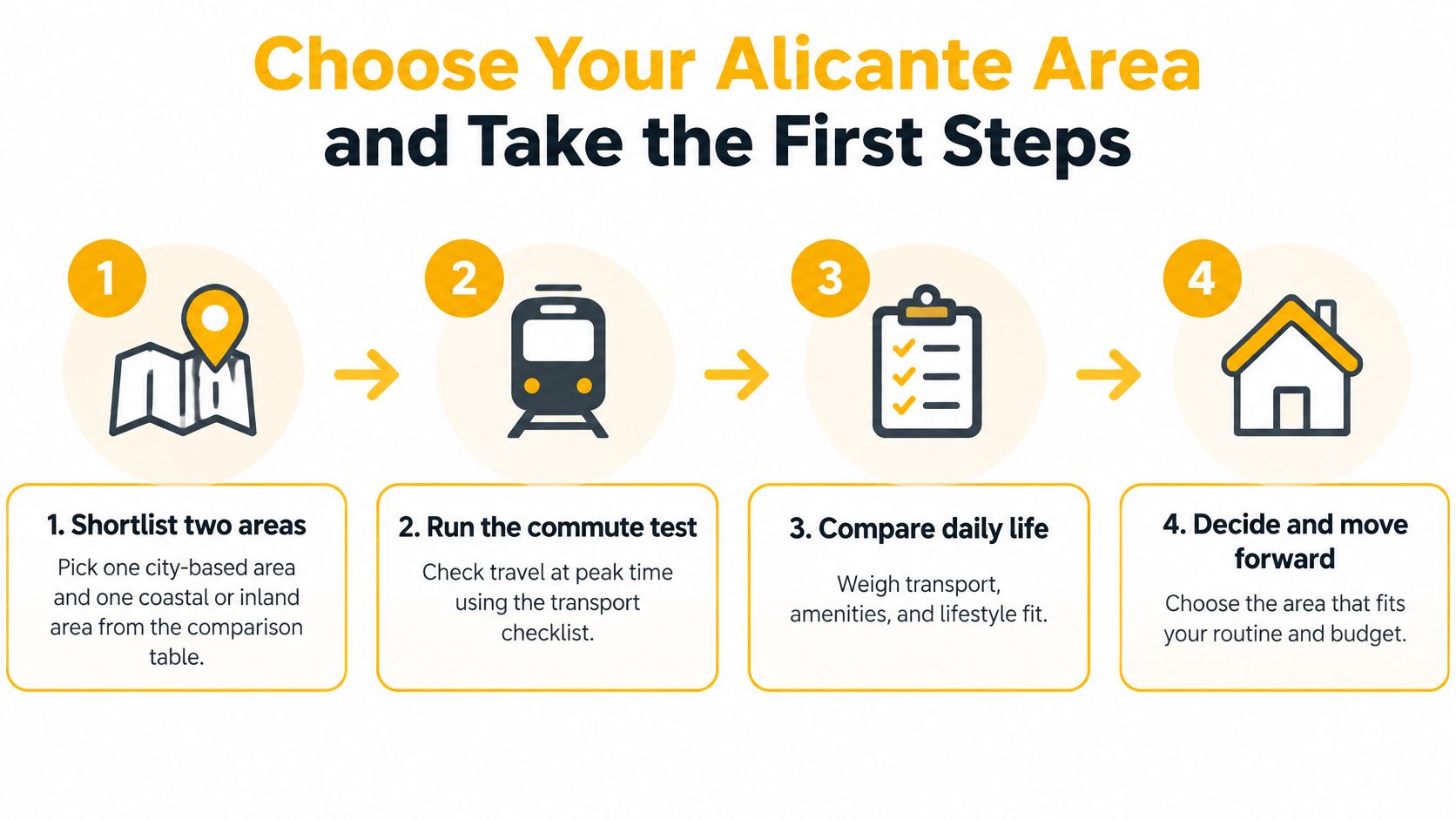
A place that suits a two-week holiday can disappoint as a permanent base. Judge each shortlisted area on year-round services, transport reach and the balance of permanent residents, not on sunshine or summer buzz alone.
- Shortlist two areas: Pick one city-based area and one coastal or inland area.
- Run the commute test: Travel at peak hours and time the walk to stops.
- Compare monthly budgets: Fill in the ten-line budget for both, including cooling and community fees.
- Visit in both seasons: Come in January and again in August before you commit.
- Check water locally: Confirm quality and restrictions with the local council.
- Rent before buying: Take six to twelve months unless you're already certain.
- Start paperwork early: Begin the NIE and residence steps before your move date forces your hand.
AP Properties Spain works with international buyers and sellers across the Costa Blanca, so you do not have to run this checklist alone.
If you're comparing Alicante city, the coast and inland villages such as La Romana, we can help you weigh each shortlisted area against transport, monthly costs and year-round services before you buy. We serve buyers and sellers in Alicante province, Costa Blanca and Costa Calida, and we can also help with the NIE, residence permit and Spanish bank account steps. Start your search with AP Properties Spain and tell us which two areas you're weighing up.
Share


