



Buy House for Cash in Spain: A 2026 Step-by-Step Guide
The most repeated advice on a cash purchase is that you skip the hard parts and close in a fortnight. That advice is built for markets where the lender is the main gatekeeper. In Spain, and for a home in La Romana on the Costa Blanca, it is the wrong starting point. Paying without a mortgage removes the bank. It does not remove title, planning, tax or registration.
If you want to buy a house for cash, treat the speed as a commercial advantage, not a legal shortcut. Sellers like certainty. You still sign a public deed, pay acquisition tax and file at the Land Registry. I would ignore any checklist that stops at proof of funds and a wire. The work that used to sit with the lender now sits with you and your lawyer.
What Cash Removes and What It Still Requires
Most buyers arrive thinking a cash offer skips the legal process. It skips the bank. No lender means no mortgage underwriting, no bank valuation and no loan-approval stage. That usually shortens the calendar between offer and completion, because nobody is waiting on a credit decision.
What stays is the conveyancing itself. As the Spanish government guidance on notaries and property registries sets out, a house sale is completed through a public deed signed before a notary. The notary authenticates the deed's contents and creates the formal instrument used to document the transfer. You still verify the seller's authority and title, and the deed must record the property and the agreed consideration accurately.
Say you are buying a resale apartment in La Romana. The seller may accept the offer within days because there is no financing contingency. The notary appointment, tax settlement and Land Registry filing still take weeks, not an afternoon. A fast negotiation does not compress the public formalities.
A mortgage-free buyer does not take over any existing mortgage unless they choose to. The same official guidance treats assumption of a previous mortgage as optional, so a genuine cash deal can complete without that liability sitting on the new title.
Simple test: List what a bank would normally check, then name who checks each item when there is no bank.
Title, charges, planning, occupancy and tax clearance do not vanish because you can pay the price. They move onto your side of the table. If you cannot name the person responsible for each check, the offer is not ready.
How to Buy a House for Cash in Spain, Step by Step
Treat the purchase as a controlled legal and tax workflow. The Ministry of Housing guide to buying property in Spainrecommends checking the nota simple, confirming tax liabilities, signing before a notary, paying the taxes and registering the deed. Registration is not paperwork for its own sake. It gives stronger protection against competing claims and makes the ownership change publicly opposable.
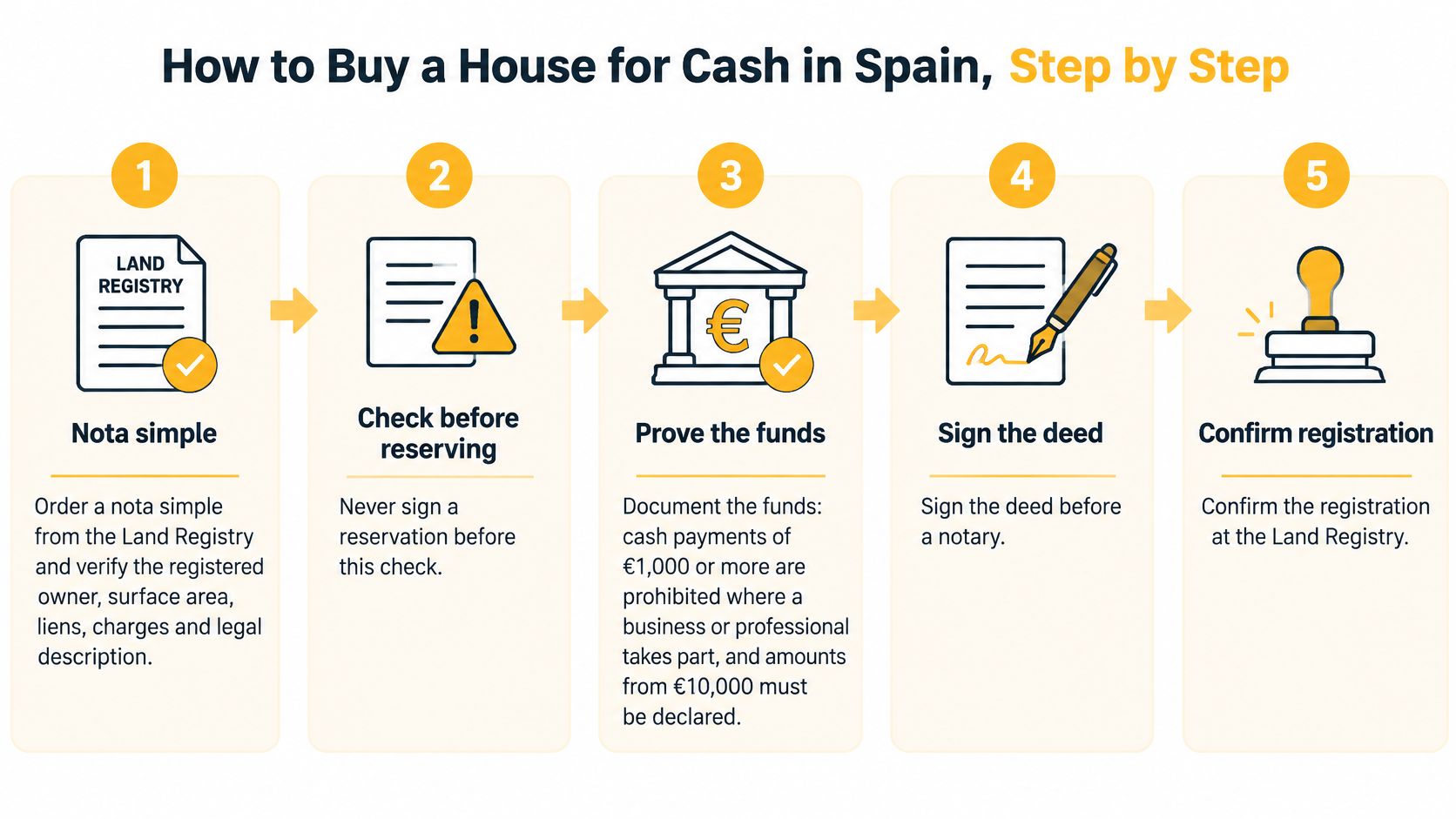
- Order an independent nota simple from the Land Registry and read the registered owner, surface area, liens, charges and legal description. The usual slip is signing a reservation before this extract arrives. A pretty brochure is not the register.
- Match that extract to the cadastral record, the planning status, occupancy, community-fee arrears and unpaid IBI or other municipal debts. Ask whether the home can legally be used as you intend. Planning gaps are the trap on the Costa Blanca. A renovated finca near La Romana can advertise a terrace or extension that was never registered, so the official surface is smaller than the floor you walked.
- Have your own lawyer review the reservation or private purchase contract. The property must be identified precisely, and the deposit must be conditional on satisfactory due diligence. If a defect appears, pause. Ask the seller for the licence, then negotiate a price adjustment or a completion condition. Do not "sort it after keys".
- Confirm the acquisition tax before you lock a completion date. VAT generally applies to qualifying new-build homes. Transfer tax generally applies to resale properties. Budget the wrong one and the completion account will not match the deed.
- Gather what the notary will see: passport or NIE, proof of the source of funds, and the seller's details. The common slip is assuming the notary calculates and files your tax. The notary authenticates the deed. Tax settlement is still your job, usually through your lawyer or gestor.
- Sign the public deed before the notary. The deed should record the price and the payment method, with a funds trail that matches the transfer.
- Settle the taxes. Keep every receipt. An unpaid tax bill is what blocks a clean filing, not a missing signature on the day.
- Submit the deed to the Land Registry and keep the submission evidence. Build one audit file: identity documents, source-of-funds papers, bank statements, contract versions, tax receipts, the signed deed and the registry filing. Inconsistent names, a missing power of attorney or a cadastral mismatch is what delays completion, not the absence of a mortgage.
AP Properties Spain provides clients with the documentation required for presentation before a notary, while its lawyers advise them on the transaction and their best interests.
No deposit until steps 1 to 3 are satisfied. Money that moves before the register, the planning check and a conditional contract is money you may have to argue for later.
VAT or Transfer Tax for a Cash Buyer
The split that decides the tax picture is simple. A new dwelling sold by the developer carries VAT, paid to the vendor, who then accounts for it with the tax authorities. A second-hand home is generally subject to transfer tax rather than VAT. That difference matters when you compare new-build homes around La Romana and Alicante with resale apartments and villas a few streets away.
The official guidance on property purchase taxes states that the standard VAT rate for residential dwellings is 10%, while officially protected housing or housing under a public-promotion scheme can qualify for a 4% rate.
Property case | Main tax | Rate |
|---|---|---|
New-build dwelling sold by a developer | VAT | 10% standard residential rate |
Officially protected housing (new-build) | VAT | 4% |
Resale dwelling | Transfer tax (ITP) | Set by the autonomous community |
New-build dwelling | Stamp duty (AJD) | Set by the autonomous community |
Transfer tax and stamp duty are set by the autonomous community. A buyer in the Valencian Community should confirm the current local rate with their lawyer or gestor before writing a budget. A rate remembered from another region, or from a purchase two years ago, is not a number you can wire against.
A €300,000 comparison
Take two homes at the same agreed price of €300,000.
On the resale, you pay transfer tax at the regional rate on that price. There is no residential VAT on a normal second-hand sale. On the new-build sold by the developer, 10% VAT is €30,000, and stamp duty is added at the autonomous-community rate. Protected new housing at 4% would be a different bill, and only if the home qualifies.
Notary fees, Land Registry fees, legal due diligence and bank or currency-conversion costs sit on top of either route. They are not part of the tax rate, and they are not optional because you are paying without a loan.
Taxes have to be settled before the deed is submitted for registration. A signed deed in a folder, with the tax still outstanding, is not a completed purchase.
Budget the Full Cash Cost Beyond the Price
Start with the agreed price, then add every layer a bank would normally have disclosed or held back until completion. Cash does not make those lines disappear. It only means you fund them yourself, on the day, from money that is already yours.
The lines to put on one page are:
- Acquisition tax: transfer tax on a resale, or VAT and stamp duty on a qualifying new-build, at the rate your adviser confirms for this property and this community.
- Notary fees: charged under the official tariff for the deed you sign, so ask the notary's office for a written estimate against the draft.
- Land Registry fees: also tariff-based, and tied to the value presented for registration.
- Lawyer's due diligence: the nota simple review, planning questions, contract markup and completion attendance.
- Bank transfer or currency conversion: the cost of moving sterling, dollars or another currency into the completion account, including the spread your bank applies.
Notary and Registry fees follow official tariffs, but the figure still moves with the price and the complexity of the deed. Request written estimates from your lawyer and from the notary's office before you treat any round number as a budget.
Say the resale is agreed at a set price. You reserve transfer tax at the Valencian rate confirmed in writing, then add the professional fees and the transfer charges. That sum is your ceiling, not the asking price. I would also keep a reserve for lines that can move between reservation and completion, above all the exchange rate if the funds are not already in euros.
Do not pay the deposit until your advisers have given you one written cash-plus-costs total. If that total only exists as a verbal "about ten per cent on top", you do not yet know what buying this house for cash will cost.
Proving Funds, Signing the Deed and Confirming Registration
Cash removes the lender's underwriting process. It does not remove the need to show where the money came from, check the deed, pay the applicable tax or confirm registration. In Spain, buying for cash means settling by traceable funds, not handing over banknotes: the Spanish Tax Agency's guidance on cash payments explains the limits when a business or professional is involved.
The funds trail
Your lawyer, notary and bank may need to understand the source of the purchase funds and how they reached the completion account. Use a bank transfer from an account in your own name where possible, and keep documents linking the money to its source, such as salary, savings, sale proceeds, inheritance or an investment liquidation.
Avoid opaque third-party payments, unexplained split transfers and undocumented gifts. Each can prompt questions that delay completion. Arrange the transfer early enough for the receiving bank to complete its checks; a Friday payment intended for a Monday signing leaves little room to resolve a hold.
If you plan to carry cash or bearer instruments across the Spanish border, check the Treasury's declaration requirements before travelling. A transfer through the banking system gives you a clear payment record without carrying funds.
The deed that controls
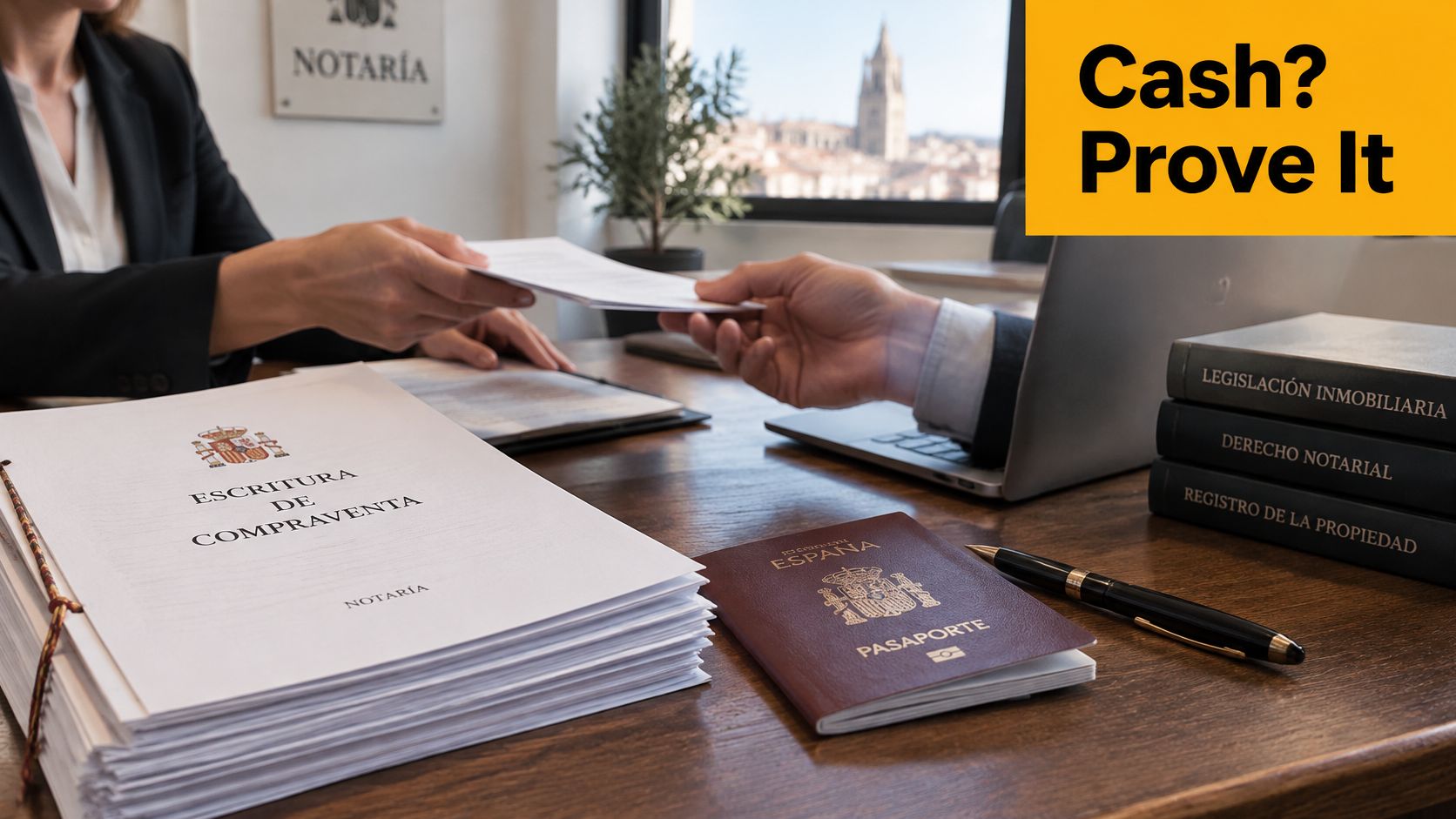
A private contract can bind the parties if its terms and existence can be proved, but the transfer is formalised in a notarial deed. The official guidance on property-sector contracts explains that where copies conflict after a public official such as a notary has participated, the version held in the official records prevails. For an international buyer, the practical safeguard is to review the final deed before signing, including its language and payment terms.
Compare the names, property description, price and payment method against the private contract. Ask for the deed draft in advance and raise discrepancies before the appointment. A translated reservation document does not replace checking the text you will sign.
At the notary, bring your passport or NIE and confirm that the transfer receipt matches the amount stated in the deed. After signing, obtain written confirmation that the relevant tax was paid and the deed was submitted to the Land Registry. Confirm the completion account and release conditions in the contract before money is sent.
AP Properties Spain supports buyers through the purchase process, while its lawyers advise on the transaction and the buyer's interests. The firm and its lawyers can also help clients apply for a NIE, a residence permit and a Spanish bank account.
Keep the core completion records together:
- Signed deed, matching the draft you reviewed.
- Transfer receipt, reconciled with the deed's price and payment terms.
- Tax receipt for the acquisition tax that applies.
- Registration evidence confirming the deed was submitted.
A cash purchase still depends on a documented funds trail, an accurate deed and follow-through after signing. Without those records, paying without a mortgage has not made the legal and registration work disappear.
AP Properties Spain supports buyers throughout the purchase process on the Costa Blanca and Costa Cálida. Before paying a deposit on a house in La Romana, Alicante or elsewhere on the coast, contact the team to discuss the steps involved. Visit AP Properties Spain to start that conversation.
Share


