



What Is a Finca Property in Spain? a Buyer's Guide
In Spain, a finca is a legally identified rural property unit recorded in the Land Registry, and the same property can carry two separate cadastral records, one for the land and one for the house. That legal identity is what you verify before an offer, because the word finca says nothing on its own about whether you can build, renovate, connect utilities or split the land.
The most popular advice about fincas is to fall in love with the house and negotiate on the price. That advice gets the order wrong. The house is the visible part; the finca is the legal and planning unit that decides what the house is worth and what you can do with it.
A stone farmhouse with a pool can be the riskier purchase if the pool is unrecorded, the well is unregistered and the land is classified for almonds. A bare plot with no house can be the cleaner one if title, access and classification are clear. The question of what is a finca property sounds simple until you try to build on one.
What a Finca Means in Spain
The word often appears in estate agent copy, where finca means a rustic house with land and a view. Spanish law is less romantic. A finca is a legally identified parcel of land, recorded in the Registro de la Propiedad and linked to a cadastral reference. It can be a farmhouse, a bare olive plot, a mixed holding or a building with no land worth mentioning.
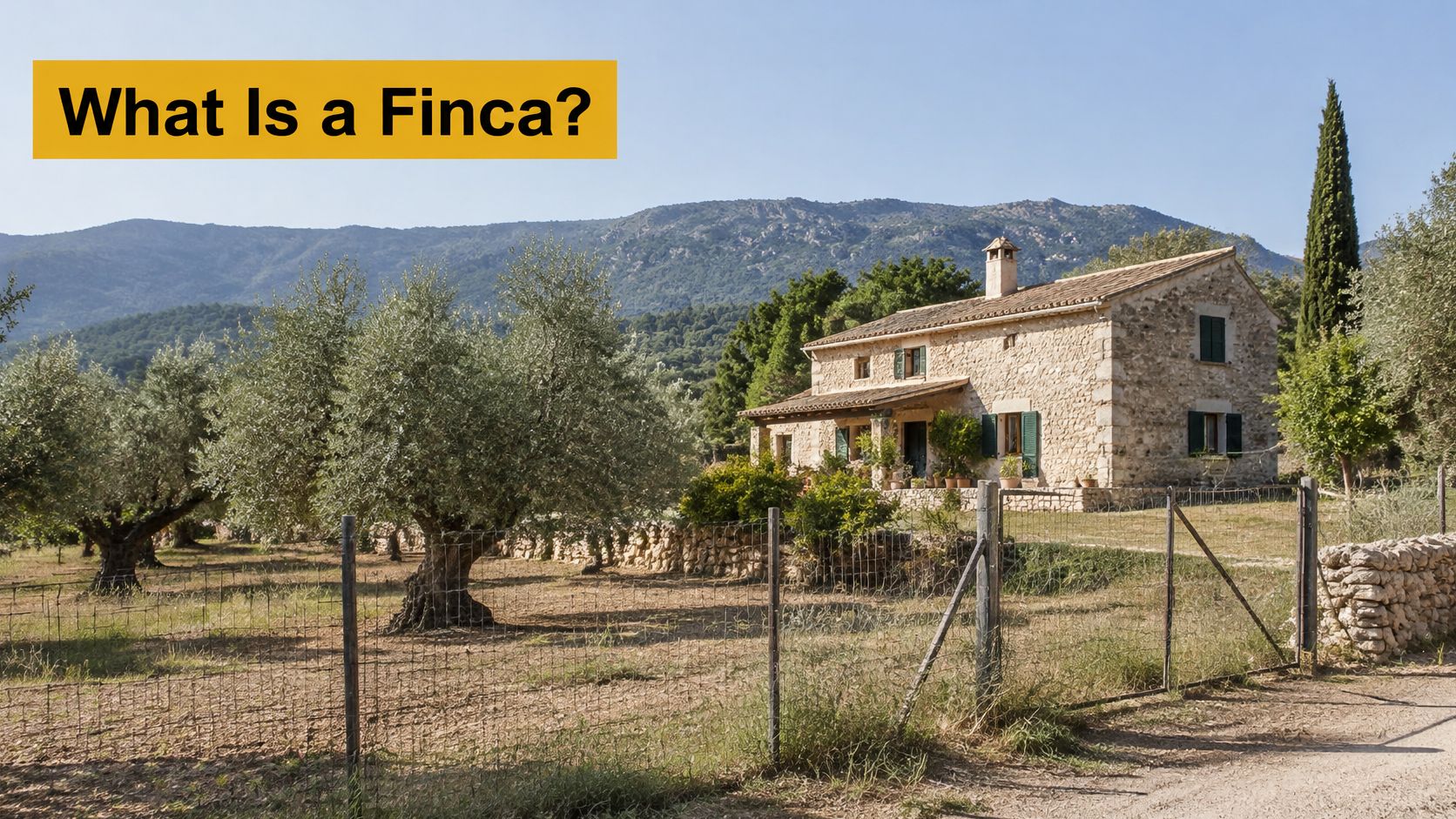
Spanish legal scholarship published by the Official State Gazette treats the finca as a legally identified parcel of land. A finca rústica is generally land outside urban areas whose principal character is agricultural, forestry, livestock-related or otherwise rural. The key word is principal. Location alone doesn't decide. A countryside house used mainly as a residence can be treated differently from land whose main purpose is agricultural production.
One property, two records
A rural home can form part of a finca rústica while the building needs separate consideration. The same property may have a rural cadastral reference for the land and an urban cadastral reference for the residential building. The rural record gives the land's total area and agricultural use; the urban record describes the construction, including residential use, floors and built surface. That split is foundational for an international buyer, because finca describes the registered real-estate unit, not a particular architectural style or guaranteed development potential.
A finca can also be one agricultural holding made of several parcels operated together. Spanish agricultural-census rules count owned parcels, rented parcels and land held under other tenure as one exploitation, while excluding land owned but transferred to third parties, according to the Spanish agricultural-census rules. That economic unit is why a seller may describe three separate registered plots as one finca.
The takeaway is blunt. A finca is a legal identity to verify, not a promise of development rights. Check the land, the building, the water, the access and the planning designation as separate items, because each one can fail on its own.
What a Finca Usually Includes and Where to Verify It
Before a viewing, write down every element the finca includes. Photos show the house; the inventory shows what has to be checked. Use the table as a working list, then ask for the document or authority named in each row.
Element | Where It Is Recorded | What to Verify |
|---|---|---|
Land parcel | Land Registry and rural cadastre | Total area, boundaries and agricultural use |
Dwelling | Urban cadastre and Land Registry | Built area, floors and licence history |
Outbuildings and sheds | Cadastre and municipal records | Whether recorded and legally built |
Well or water right | Water authority for the local basin | Registration and lawful use |
Septic tank | Municipal or regional wastewater rules | Authorisation for discharge or infiltration |
Access track | Title plan and easements | Legal right of way across neighbouring land |
What each row is telling you
The land parcel and the dwelling are the two anchors. The parcel should be described in the Land Registry and the rural cadastre with the same total area and boundaries. The dwelling should appear in the urban cadastre and match the Registry description. If the house is missing from either record, financing, insurance and resale all become harder, even if the building has stood there for decades.
Outbuildings are where inventories drift. A shed, a guest studio or a covered terrace may be visible on site and absent from the cadastre, or built without a licence. Treat any structure used as living space as a separate property question, not as a feature of the main house.
The well and the septic tank are utility questions with legal answers. A well needs registration with the water authority for its basin and a lawful use. A septic tank needs authorisation for discharge or infiltration, so a tank that works is not automatically a tank that complies.
Access is the row buyers leave until last. A track across a neighbour's land needs an easement recorded in the title and the Land Registry. A handshake with the neighbour is not a right of way.
Practical rule: If an element isn't in a register, a licence or an easement, price it as an unverified extra, not as part of the property you're buying.
Do this before you view, not after you fall for the house. A written inventory gives your lawyer, architect and surveyor a clear list to test, and it stops the conversation drifting into general impressions.
Rural Planning Rules That Decide What You Can Build
Every finca purchase comes back to one planning question: what can you build, extend or change? The marketing word doesn't answer it. The municipal planning classification does. Rustic land is normally subject to stricter rules than urban land, and on protected non-urbanisable land residential use may be prohibited entirely, as Valencian land legislationconfirms.
Planning Situation | What It Usually Means | Check Before Buying |
|---|---|---|
Common rustic land | One single-family dwelling per parcel, generally on at least 14,000 m² under the historic Valencian framework | Current municipal plan, access and services |
Protected non-urbanisable land | Residential use may be prohibited entirely | Protected-land classification and any restrictions |
Rustic land with an existing house | The house may be lawful, but extensions and new units are restricted | Licence history and occupancy documents |
Urban-style parcelling on rustic land | Prohibited when the purpose is future construction | Whether any proposed division is intended for building |
The 14,000 square metre trap
Where Valencian rules permit a new detached dwelling on rustic land, the historic regional framework sets a concrete threshold that shows why plot size alone is not enough. Normally only one single-family dwelling may be built per parcel, and land classified as common rustic soil must generally have at least 14,000 square metres, subject to the applicable planning instrument and other conditions, according to the historic Valencian rural framework. The same legislation allows single-family residential use only where planning instruments have not prohibited it. So a finca advertised with a large surface area is not automatically buildable. The current municipal plan, access, services and environmental restrictions still decide.
A farmhouse, a pool and a second villa
Say a buyer views a farmhouse on a large plot near inland Alicante. The house is recorded, the views are good, and the buyer plans a pool, two guest rooms and a second villa for rental income. The first check is not the price. It is the classification of the land. If the parcel is common rustic land, the existing house may be lawful while the extra units need separate authorisation. If the land is protected, the answer may be no residential use at all.
Each intervention gets its own test. An extension, a pool, guest accommodation, an agricultural building and demolition are not variations on one permission. The administration's urban-planning procedures distinguish works licences, first-occupancy licences, parcel segregation, aggregation, exceptional-use approvals and demolition, which is why a single reassurance that the house is legal is never enough.
Write your plans down before you view: a list of every structure, every change of use and every new unit you might want. Then ask the planning office which authorisation each item needs. That list is also the basis for a condition in the offer.
Size is not buildability. A large plot can be less useful than a smaller one with the right classification, access and services. The planning designation, not the acreage, is the gate.
Splitting a Finca and Selling Part of the Land
Many fincas are several registered parcels operated as one estate. That works while you own the whole unit, but it creates a question sellers often answer too quickly: can I split the land and sell part of it later?
Sometimes yes. Often no. The controls start with the minimum agricultural parcel size. For divisions or segregations in non-urbanisable land, Spanish registration guidance requires registrars to examine whether the resulting parcels fall below that minimum. They must also act cautiously when the description, dimensions, location or number of parcels creates a founded risk that the operation is intended to form a new population settlement.
Valencian rules add two further limits. Rural divisions that conflict with agricultural or forestry legislation are prohibited. Urban parcelling in non-urbanisable or unprogrammed developable land is prohibited when the purpose is future construction. That second limit catches the optimistic plan to divide a field into villa plots and sell them with a view.
A five-step check before you rely on a split
- Confirm the parcels and their areas. Compare the Land Registry descriptions with the cadastral parcels and the physical boundaries on site, because a single estate can be three titles with three different surface figures.
- Find the minimum cultivation unit. Ask the municipality or the agricultural authority what minimum plot size applies in that area, then test each proposed parcel against it.
- Ask the planning office about authorisation. The question is not whether a split is physically possible, but whether this division needs administrative approval before it can be registered.
- Check access and services for each new plot. A split that leaves one parcel without legal access or a lawful water supply is a landlocked problem, not a development opportunity.
- Put nothing in writing until the seller documents it. A verbal promise that the land can be divided later is a negotiating line, not a planning permission.
Consequence: A split that looks sensible on a kitchen table can be refused, delayed or left unsaleable at the notary.
The safest route is to buy the finca as it is registered, not as it might be divided. If a split is central to your plan, make the purchase conditional on written confirmation that the division is lawful and registrable.
Water, Wastewater and Access on a Rural Property
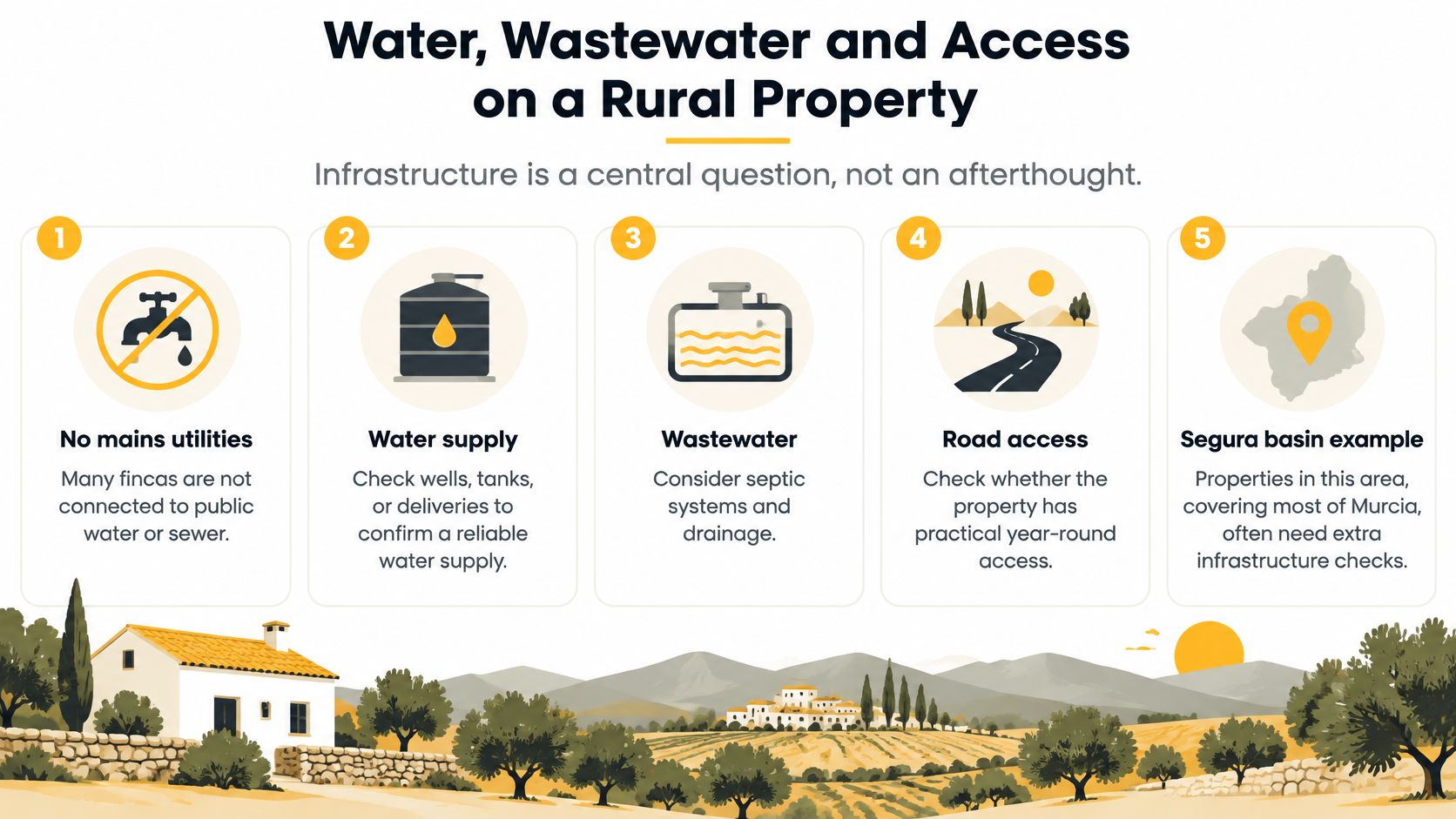
Many fincas have no mains water, no mains sewer and no guaranteed electricity. Infrastructure is therefore a central purchase question, not a detail to sort out after completion. A private well, shared supply, rainwater system, septic tank, generator or solar installation can each involve separate ownership, permits, maintenance obligations and running costs.
The checklist below shows the four infrastructure questions that decide how a finca works.
Water rights are local
Water is the first question, and it is location-specific. In the Segura basin, which covers most of Murcia and part of southern Alicante, private wells are regulated by the Confederación Hidrográfica del Segura and should be checked for registration and lawful use, according to guidance on private wells and shared water deposits. If a finca near La Romana relies on a well, ask for the registration, the volume it can lawfully supply and the storage arrangements. A well that exists is not the same as a well you can use.
Wastewater, power and access
Wastewater is the hidden risk. A septic system that discharges or infiltrates into the ground may require authorisation, so a tank that works is not automatically compliant. Ask for the authorisation, not just the location of the tank.
Electricity can be mains, a generator, solar or a mix. The ownership and maintenance of each part matter. If a generator or solar system is shared with a neighbour, you need the agreement in writing, not a description of how it has worked so far.
Access is the same story. A track crossing neighbouring land needs an easement recorded in the title and the Land Registry. A track that has been used for years can still be a permission that ends with the neighbour.
The trade-off: Off-grid systems can improve resilience and privacy, especially where water is scarce and energy costs worry you, but they can reduce mortgageability, complicate insurance and add recurring maintenance.
The infrastructure dossier to request before an offer
- Well registration and storage details. Include the basin authority registration, the lawful use and the capacity of any deposit.
- Septic authorisation. Ask for the permit for discharge or infiltration, not a receipt for emptying the tank.
- Electricity supply type and ownership. Record whether the supply is mains, generator or solar, and who owns and maintains each component.
- Access rights. Get the easement or title document that proves the route across neighbouring land.
- Annual maintenance cost. Add up the running cost of each system so you compare the finca with a mains-connected house on a like-for-like basis.
A finca with a documented infrastructure dossier is a different asset from one with a working tap and a friendly neighbour. The dossier is what makes the difference visible before you offer.
Checking a Finca and Deciding Before You Offer
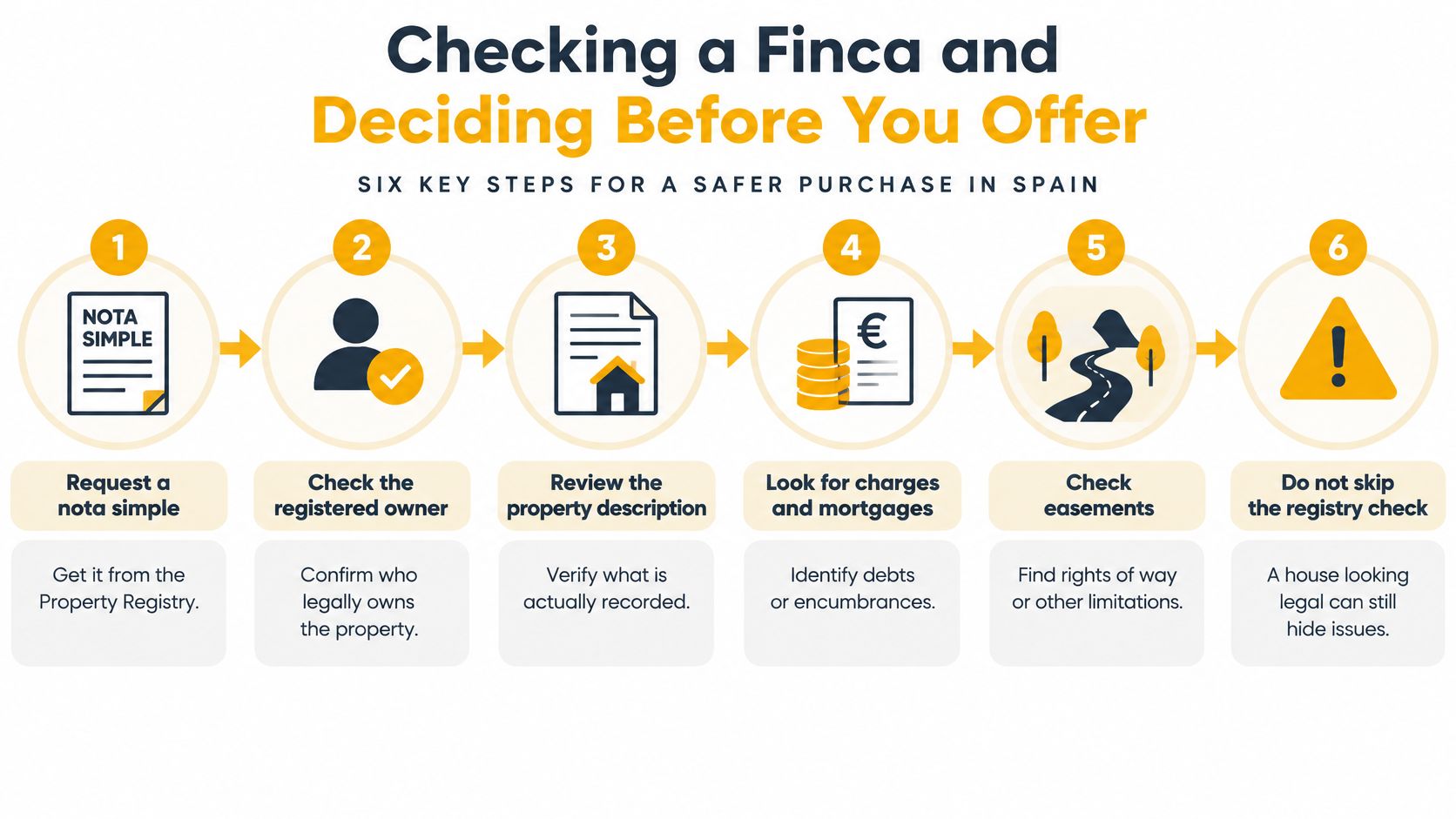
Due diligence on a finca runs in a set order for a reason. Each check answers a different question, and one document tells you which paper to request next. The official Spanish government guidance on property checks confirms that the Land Registry's nota simple is the principal preliminary source for verifying a property transaction.
The first checks below cover the registry and cadastre. The full sequence goes further, into planning, buildings and infrastructure.
The eight checks in order
- Request the nota simple. It identifies the registered owner, the property description, charges, mortgages, easements and other recorded rights. Skipping it because the house looks legal is the common slip.
- Compare the nota simple with the cadastral reference and the physical boundaries. Buyers often rely on the surface figure in the listing rather than the registered area. If the numbers disagree, stop and find out why.
- Request a municipal planning certificate. It should confirm the land classification, the legality of the existing use and the development potential. A marketing description is not a planning document.
- Check every building against the Registry and cadastre. Pools, outbuildings and extensions missing from the records create financing and resale risk. A structure can stand for years and still be unauthorised.
- Commission an architect's measured survey. Compare the built area on the ground with the recorded built area. A gap between them is often the first sign that an extension was never registered.
- Test each planned use against the planning designation. A guest annex, a pool or a second dwelling is a separate planning question. A lawful house does not make the next building lawful.
- Compile the infrastructure dossier. Water, wastewater, electricity and access each need a document on file. Treat a working system without authorisation as a cost to fix, priced into your offer.
- Have a lawyer review the contract before you sign. Any planning or infrastructure condition belongs in the contract itself, drafted by the lawyer.
The decision rule
A clean finca passes three tests at once: the Registry, the cadastre and the measured survey agree; every planned use fits the current designation; and each utility and access right is documented.
If one test fails, you have three options. Renegotiate the price to cover legalisation or off-grid costs, make the offer conditional on confirmed planning, or walk away. The condition belongs in the contract rather than in a message sent after a viewing.
The word finca in a listing tells you none of this. It labels a legal and planning unit, so two properties sold under the same word can sit at opposite ends of these tests.
AP Properties Spain supports clients through the buying process at every stage, coordinating these checks with its lawyers, who advise on the transaction and prepare the documentation required for presentation before a notary.
If you're considering a finca in Alicante province, AP Properties Spain can help you separate the character of the property from the legal and planning reality behind it. Our team works across the Costa Blanca, including inland areas such as La Romana, Hondón de las Nieves and El Pinos. Visit AP Properties Spain to start a conversation about the right finca for you.
Share


