



Luxury Real Estate Spain: A Clear 2026 Guide
Foreign buyers accounted for 43.29% of registered residential purchases in Alicante province in 2025, the highest provincial share in Spain, according to idealista's report on registry statistics. For a luxury buyer, that figure is a reminder to judge a home by more than its appeal to an international market: the permitted use and the cash needed to complete matter just as much.
AP Properties Spain serves buyers and sellers across Alicante province, the Costa Blanca and the Costa Cálida. Start by matching the location to how you plan to use the property, then check that the intended use is legally permitted and work out the funds required to complete. A glossy holiday-rental yield means little if the rules do not allow that use.
Luxury Real Estate Spain at a Glance
Alicante ended 2025 with 5,672 foreign purchases, equal to 42.91% of transactions in the fourth quarter, against 13.52%nationally, according to TodoAlicante's account of registry results. British, German and Dutch buyers were prominent, with demand visible in Torrevieja, Orihuela Costa, Guardamar, Altea, Jávea, Calpe and Benissa.
Foreign demand and price signals
Market | Demand signal | Price or growth signal | How to use it |
|---|---|---|---|
Alicante province, full year | Spain's most international provincial market | Foreign-buyer price averages are a Spain-wide measure, not an Alicante measure | Treat it as demand context, then value the street and the home |
Murcia, full year | International, but less so than Alicante | A separate regional growth comparison | Use it to test whether Murcia fits your life, not to price Costa Blanca homes |
Spain, full year | Much less international than Alicante | A national backdrop only | Good for context, weak for deciding a specific offer |
Alicante, late in the year | Overseas demand stayed high | Quarterly registry data shows timing, not value | Confirm that momentum matters at your target address |
Alicante, all homes | A broad mix of buyers and property types | A province benchmark, not a villa valuation | Use it only to separate luxury from the general market |
Read that table as a working map. Alicante and Murcia are close enough to compare, but different enough that a headline share in one should not set the budget in the other.
Who's buying and why it matters
The international buyer base isn't new. Foreign nationals accounted for 43.8% of Alicante province transactions in 2024, across nearly 52,000 total sales, placing the province third nationally by volume, according to The Olive Press's reporting of the Registrars' statistics. The United Kingdom led the nationality ranking, followed by the Netherlands, with France, Germany, Morocco and Romania also notable.
For you, the practical result is paperwork before romance. You may be arranging funds from abroad, comparing homes priced for different audiences, and relying on advisers to line up notary documents, translations, tax checks and proof that the use you want is permitted.
Read each benchmark at its proper scale
A foreign-buyer share tells you who purchased. A price index tells you movement. A province-wide average describes many homes at once. None of them values a sea-view villa, a penthouse or a finca on its own.
Start with a hypothesis: coastal services and airport access on the Costa Blanca, a Murcia comparison for space and growth, or an inland base for quieter use. Then test the address, condition, cash needed at completion and legal permission for the life you plan. Strong international demand does not make every asking price reasonable.
What Counts as a Luxury Home Here
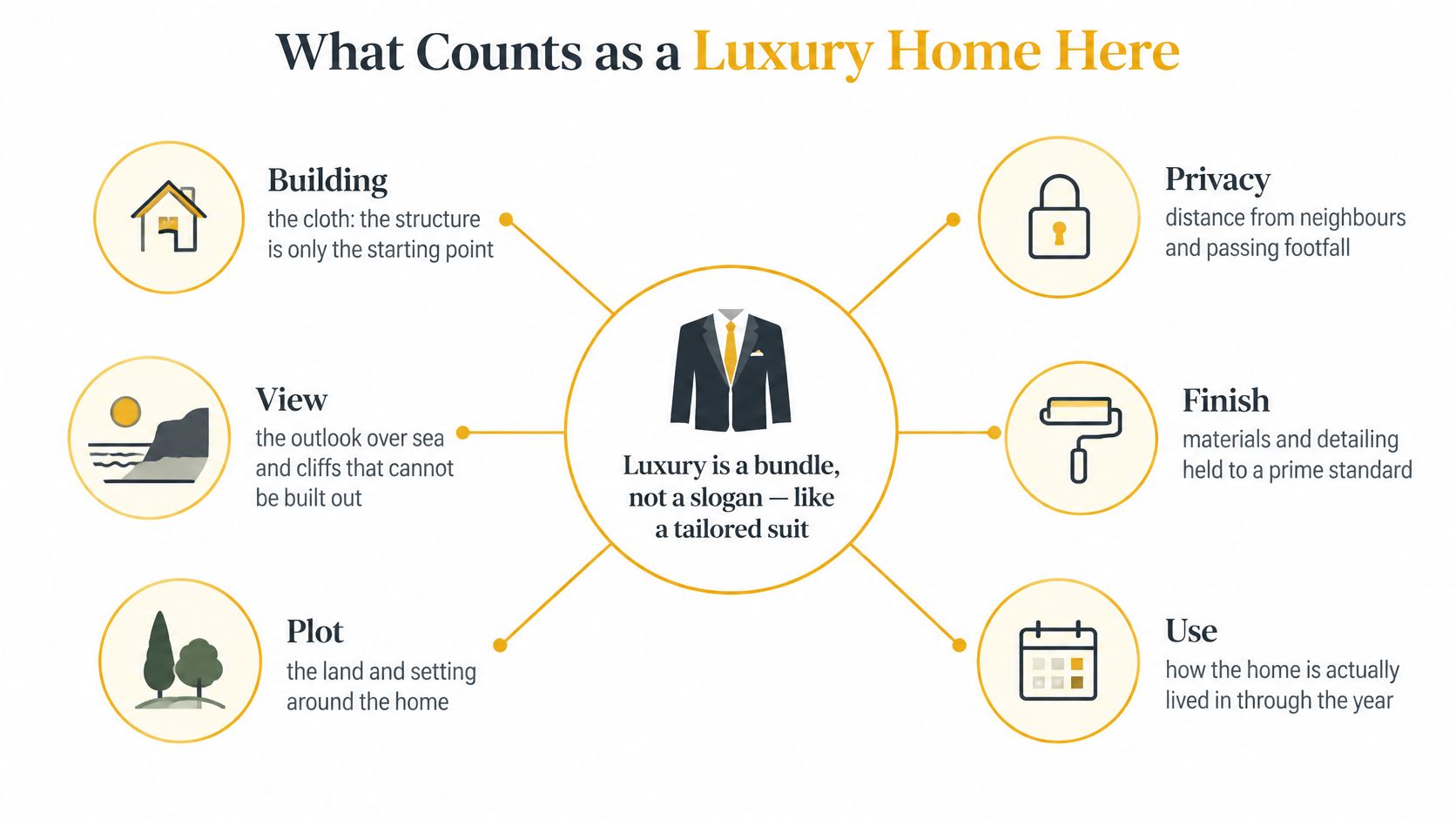
Luxury is a bundle, not a slogan. Think of a custom suit: the building is the cloth, but the fit comes from the view, plot, privacy, finish and how comfortably you can use the home.
Say you're comparing coastal residences with similar interiors. One has generous glazing but an overlooked terrace; another has simpler finishes, protected outdoor seating and convenient parking. If you'll spend much of your time outside, the second may be the better luxury purchase.
Quality you can use
A useful luxury brief includes a sea view or substantial garden, considered architecture, outdoor living space, parking and a pool where those features suit the owner. Access to beaches, golf, year-round services and Alicante or Valencia airport may matter more than decorative specification.
Check the practical details during a viewing:
- Outdoor comfort: Look for shade, wind protection, drainage and privacy when neighbouring terraces are occupied.
- Building performance: Examine glazing, insulation, cooling, heating and evidence of damp rather than relying on photographs.
- Daily convenience: Test parking, storage, stairs and the journey to shops or medical services.
- View security: Ask what neighbouring land can accommodate. An attractive outlook isn't automatically protected.
A luxury finish can be replaced. An unsuitable setting is much harder to change.
Spending power isn't a valuation method
Foreign buyers paid an average of €2,417 per square metre in Spain in 2025, up 7.6% year on year, according to Spanish notary figures reported by idealista. That's evidence of spending across a buyer group, not a target price for every coastal home.
A separate comparison of notary figures reported by HabiHub puts non-resident foreign buyers at €3,242/m² against €1,839/m² for domestic buyers, approximately 76% higher, while another international-buyer measure is €2,479/m². Those categories aren't interchangeable, and none isolates luxury villas.
For an individual home, ask for comparable sales that account for location, views, plot, construction quality, energy performance and amenities. Carry forward a clear brief: a coastal apartment for short visits, a detached villa for longer stays, or a country home whose value depends partly on what can legally be altered.
Coasts and Towns That Fit Different Buyers
Choose an area as if you were planning an ordinary week, not ranking holiday photographs. Drive the approach, visit the supermarket, inspect the streets after dark and check whether the setting still suits you away from the waterfront.
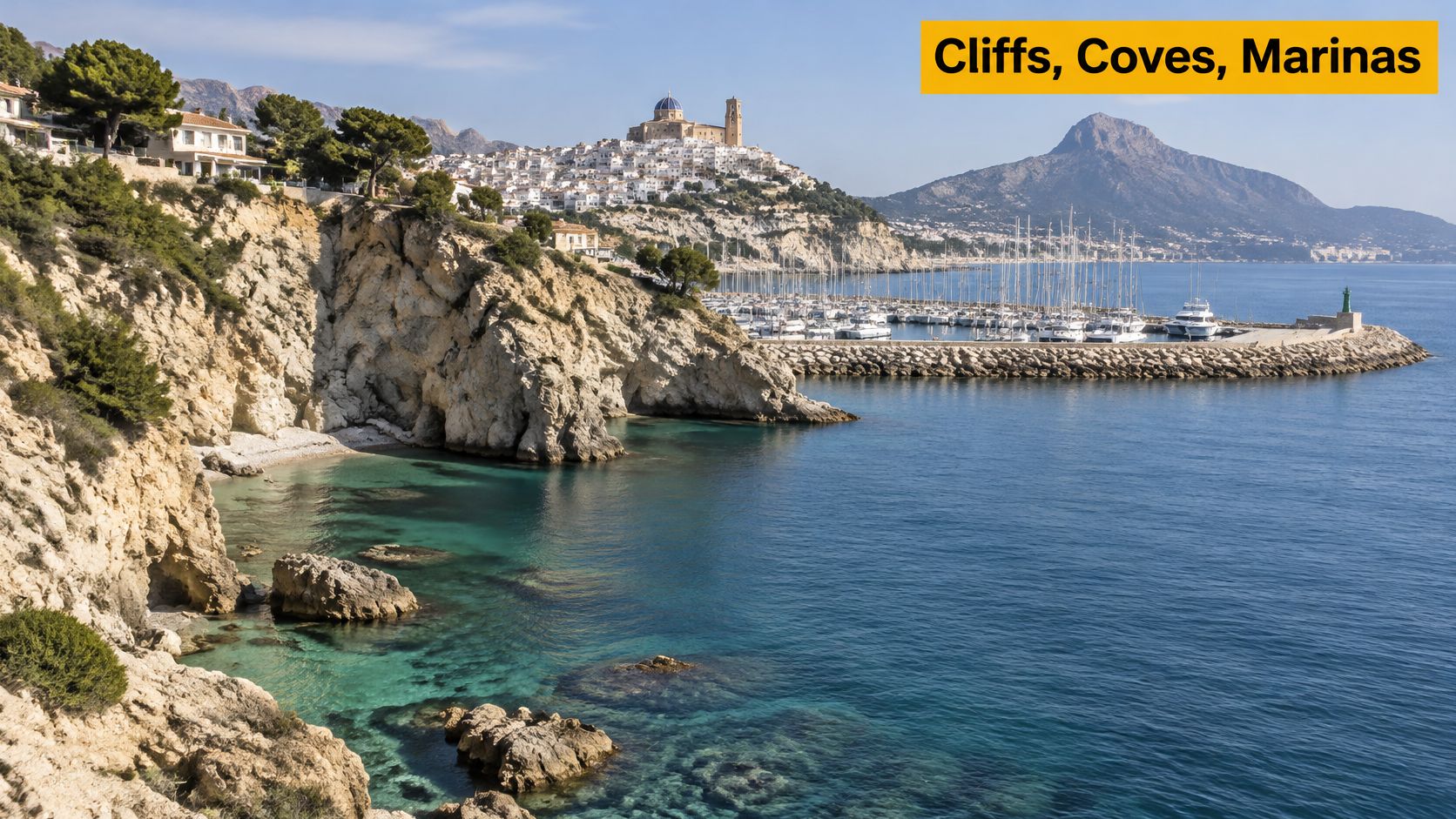
Which Costa Blanca and Costa Cálida brief fits
Area | Fits | Frustrates | Signal |
|---|---|---|---|
North Costa Blanca: Dénia, Jávea, Calpe, Altea, Benissa | Buyers seeking cliffs, coves, marinas and an established prime feel | Those prioritising the busiest transaction centres or a city hospital next door | Lifestyle-led choice; several towns feature in overseas demand |
Central Alicante: San Juan and Alicante city | Buyers wanting hospitals, culture and access to a city airport | Buyers seeking rural quiet | Year-round services rather than a price-growth slogan |
South Costa Blanca: Guardamar, Torrevieja, Orihuela Costa, Ciudad Quesada, Pilar de la Horadada | Holiday apartments, golf communities and villas within established international areas | Privacy buyers uncomfortable with dense beachfront blocks | Compare individual streets and communities, not the whole southern coast |
Inland Alicante: La Romana, Hondón de las Nieves, El Pinos, Benijófar and the country around Elche | Buyers seeking space and a base away from beachfront living | Short-visit owners who dislike driving or rural access | Check the individual setting; village homes and rural fincas offer different experiences |
Costa Cálida, Region of Murcia | Buyers making a separate regional comparison | Anyone applying Alicante villa comparables to a Murcia exit | Regional Housing Price Index provides context, not a property valuation |
Drive north to south, then inland
Around Dénia, Jávea, Calpe, Altea and Benissa, start with the relationship between the home and its setting. A hillside outlook may appeal, but steep access and reliance on a car can undermine a buyer's wish for easy everyday living.
San Juan and Alicante city suit a different routine. If you want culture, medical services and urban convenience, test the walk from the front door rather than accepting a broad description of proximity. Southwards, distinguish a walkable neighbourhood from a golf community where most errands require driving.
La Romana, Hondón de las Nieves, El Pinos and the countryside around Elche deserve a different checklist. Access, boundaries and the surrounding land matter more than distance to a beach promenade; Benijófar should also be assessed on its own setting rather than assumed to be a remote rural location.
Keep Murcia's growth comparison separate
The Region of Murcia's Housing Price Index rose 14.6% year on year in Q2 2025, compared with 12.7% nationally, according to Spain's National Statistics Institute. This is annual growth measured in that quarter, not growth achieved within a single quarter.
The index adjusts for changes in dwelling mix and quality, covering private homes acquired by households rather than luxury villas alone. Use it for regional context, then value a Costa Cálida home through relevant local comparables. Match weekly life, not the prettiest photograph.
Villas Penthouses and Country Homes Compared
A property type is a tool for living, not a trophy category. Start with how you'll arrive, how long you'll stay and who'll look after the building when you leave.
A villa in Jávea or Altea can suit long summer stays, visiting family and an owner who values a private garden. A Calpe or Alicante penthouse may be more practical for weekends when you want to arrive, put down your bag and walk out for dinner.
Privacy versus shared responsibility
A detached villa gives you greater separation from neighbours, but you're responsible for the roof, garden, pool and perimeter. Obtain maintenance and insurance quotations for the actual property rather than assuming costs from its floor area.
A semi-detached home can retain useful outdoor space with a different balance of proximity and upkeep. Visit when neighbours are present to assess noise and overlooking.
Home type | A practical pairing | Constraint to investigate |
|---|---|---|
Detached or semi-detached villa | Longer stays in Jávea or Altea | Pool, garden, building maintenance and insurance |
Penthouse or high-floor apartment | Lock-up weekends in Calpe or Alicante | Lift condition, terrace responsibilities and community rules |
Townhouse or bungalow | Mixed personal use around Orihuela Costa | Shared facilities, adjoining neighbours and alteration rules |
Finca or country house | Space and quiet around La Romana | Legal access, water, drainage and permitted reforms |
Plot | A buyer prepared to commission a home | Planning permission, services and a realistic construction budget |
Country living needs a technical inspection
A La Romana finca may offer the space you want, but land alone doesn't establish permission to extend or rebuild. Have the access rights, existing structures, water supply, wells and septic arrangements checked before treating improvements as straightforward.
A country house can be a comfortable home or a substantial undertaking. The difference may lie in drainage, structural condition or restrictions that aren't visible during a sunny viewing.
Practical rule: Buy the home you can legally use, not the enlarged version you hope to create.
New-build and resale require different scrutiny too. With new-build, examine the specification, completion documentation and applicable developer warranties; with resale, commission a survey and inspect established gardens, previous alterations and maintenance records. A mature setting is useful only if the building beneath it is sound.
The right type follows the time you'll spend there. Don't accept permanent maintenance responsibilities for features you'll barely use.
Cash Required Before You Sign
The following worked resale example is published in Demócrata's account of non-resident purchase financing. Treat it as a budgeting illustration, not a current tax quotation for every Valencian transaction.
Cash on a 350,000 euro Valencian resale
Item | Basis | Amount | Who it belongs to |
|---|---|---|---|
Purchase price | Resale example | €350,000 | Agreed price |
Deposit | 30% when mortgage financing is 70% | €105,000 | Buyer equity |
Transfer tax ITP | 9% used in the published Valencian resale example | €31,500 | Buyer acquisition tax |
Other purchase costs | Notary, registry and related fees in the example | About €5,250 | Buyer |
Non-resident seller withholding | 3% of the price, Form 211 within one month | €10,500 | Held from the seller and paid to the Tax Agency |
Separate equity from reservation money
The deposit line represents the buyer's total equity contribution towards the purchase price. It isn't necessarily the sum you hand over when reserving, and it doesn't include acquisition taxes or professional costs.
Mortgage approval therefore doesn't settle your cash budget. Ask the lender to confirm its valuation basis, conditions and available advance, then have your lawyer prepare a completion statement showing funds already paid and funds still required.
Impuesto sobre Transmisiones Patrimoniales, usually shortened to ITP, is the transfer-tax category relevant to resale purchases in the Valencian Community. Your adviser should confirm the applicable rate, tax base and any relief at the transaction date rather than copy the illustration.
New-build purchases are taxed differently, commonly through VAT and stamp duty. Don't transfer a resale tax calculation onto a newly built home.
The seller's status affects your paperwork
The published example also explains the buyer's obligation under Article 25.2 of the Non-Resident Income Tax Act when purchasing from a non-resident seller. The withholding shown in the table comes from the seller's proceeds; it isn't an additional buyer acquisition tax.
If the seller is resident, that particular non-resident withholding mechanism doesn't apply. Have the lawyer establish the seller's status and responsibility for filing before completion, rather than leaving the issue for the notary appointment.
Before reserving, assemble the underlying file:
- Land Registry extract: Review the nota simple for ownership, charges and the registered property description.
- Cadastral comparison: Match the parcel, address and buildings against the title and what's physically present.
- Community documents: Obtain the debt certificate and review relevant minutes and planned works.
- Occupancy and planning papers: Check habitability or first-occupancy documentation and any urban-planning information affecting the home.
Compare homes using the price plus acquisition costs, then keep a separate budget for repairs, furnishing and ongoing ownership.
Investment Returns After the Rental Rules
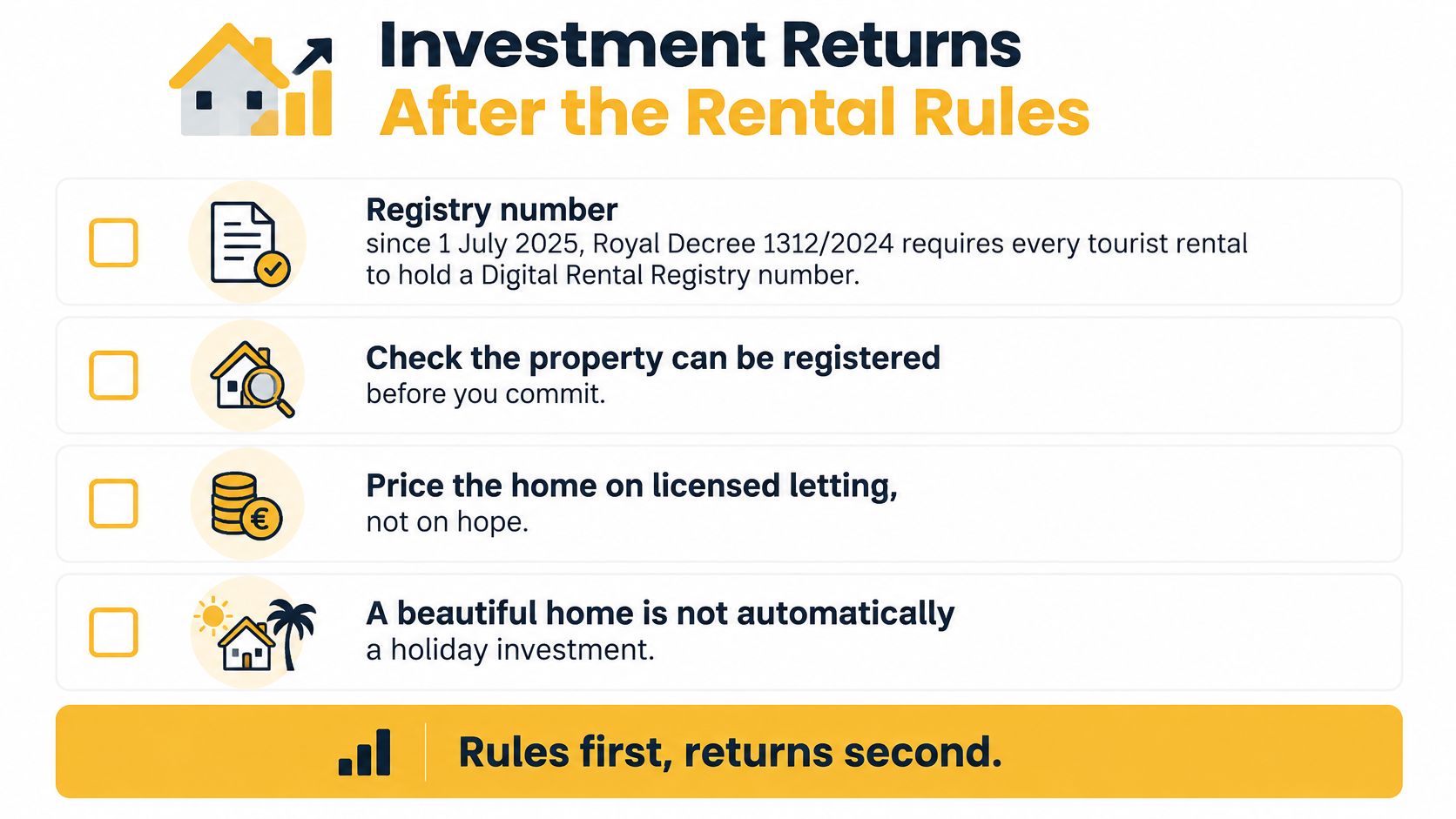
A beautiful home isn't automatically a lawful holiday investment. Before considering a glossy rental projection, establish whether you can operate the proposed letting business at that address.
Royal Decree 1312/2024 created the Digital Rental Registry framework effective from 1 July 2025, with tourist-rental registration requiring supporting documentation including the applicable licence, habitability or first-occupancy certificate, cadastral reference and exact address, according to Bird & Bird's legal analysis. Under the reported framework, owners seeking tourist use in an apartment community must also obtain express approval from at least three-fifths of the community of owners.
Permission before projected income
In the Valencian Community, have your lawyer establish whether the municipality requires a favourable urban-compatibility report and whether the address qualifies. Check community statutes, licence status and what happens to an existing authorisation when ownership changes.
A registration number isn't a substitute for the underlying permissions. Nor does a seller's history of accepting bookings prove that your intended operation will be lawful after purchase.
- Confirm the permitted use: Distinguish tourist letting from seasonal or longer residential occupation.
- Verify continuity: Establish whether permissions remain valid, require updating or cannot pass to you.
- Price the delay: Allow for a period without rental income while applications or confirmations remain unresolved.
- Check operational cover: Make sure insurance and management arrangements match the use you're proposing.
Build a return you can defend
Underwrite separate cases for licensed short stays and a lawful medium- or long-term alternative. Don't assume changing the label on an agreement changes the legal category of the letting.
Start with realistic gross rent and allow for vacant periods. Deduct cleaning, maintenance, management, insurance, local taxes, financing and compliance costs, then account for the tax treatment of the resulting income with your adviser.
Investment test: If the fallback letting strategy doesn't work financially, you're buying licensing risk as well as a home.
Stress-test the eventual sale using a national market scenario, a relevant regional scenario and a calmer long-term assumption. Include selling costs and a less favourable exit, not just appreciation.
Personal use has value too. Say you intend to occupy the home for twelve weeks each year: modest rental income may be perfectly acceptable for a lifestyle purchase, provided you haven't paid an investor premium for income you can't legally earn.
Set Your Brief Before You Reserve
Write a sentence that settles the essentials: coast or inland, property type, intended personal use, and whether rental income is essential or optional. A clear brief makes it easier to reject the wrong home, even when its terrace is persuasive.
If rent is essential, stop before another viewing and obtain a property-specific permission assessment. If the home is mainly for living, concentrate on comparable sales, condition, community commitments and a complete acquisition budget.
Make the reservation follow the evidence
- Define the essentials: Separate necessary features from improvements you could make later.
- Compare like with like: Match view, plot, condition and shared costs rather than bedroom count alone.
- Reconcile the documents: Have the title, cadastre, occupancy papers and physical property checked together.
- Protect the payment: Ask your lawyer to review reservation terms, outstanding conditions and deposit arrangements before money leaves your account.
AP Properties Spain works from La Romana in Alicante, serving the Costa Blanca and Costa Cálida. Our coverage includes Dénia, Jávea, Calpe, Altea, Benidorm, Alicante, Torrevieja, Orihuela Costa and Guardamar del Segura, alongside Benissa, Alfaz del Pí, Polop, Finestrat, Benijófar, Pilar de la Horadada, Elche, Hondón de las Nieves and El Pinos.
We provide the documentation required for presentation before a notary, while our lawyers advise clients on the transaction and their best interests. AP Properties Spain also won the Luxury Lifestyle Awards® for Best Luxury Boutique Real Estate Consultancy in Costa Blanca in both 2024 and 2025.
The decision still belongs to you. Fix the brief, establish the permitted use and confirm the money required before signing a reservation.
AP Properties Spain offers personalized property searches and buying-process support across the Costa Blanca and Costa Cálida, with documentation coordination and legal advice through its lawyers. Visit AP Properties Spain with your preferred area, home type and intended use so we can help turn those requirements into a focused shortlist and a documented purchase decision.
Share


