



Spanish Tax Form Guide for Costa Blanca Property Owners
You've completed your purchase near La Romana, organised the utilities and put the deeds somewhere safe. Then a reminder arrives about a Spanish tax form, even though you haven't rented out the house. Or you've started letting your Costa Blanca apartment and aren't sure whether the paperwork follows the rental season, the calendar year or your purchase date.
The starting point isn't the form itself. It's your tax residence, the way you use the property and the year the income relates to. Keep those separate and the paperwork becomes much easier to organise, particularly when filing and payment deadlines don't match.
Which Spanish Tax Form Applies to Your Situation
A letter arrives about a Costa Blanca home you rarely use, or a rental payment lands in your bank account and you wonder which Spanish tax form belongs with it. The answer depends on three separate facts: where you are tax resident, how the property was used, and which income year the paperwork concerns.
Spanish tax forms by ownership situation
Situation | Form | Covers | Filing timing |
|---|---|---|---|
Non-resident owner, private use or vacant home | Model 210 | Imputed income from urban property | Filed annually for the relevant income year |
Non-resident renting out the property | Model 210 | Rental income | Quarterly windows when tax is due |
Non-resident selling the property | Model 210 | Capital gains from the transfer | Within three months after the one-month period following the transfer |
Spanish tax resident with foreign accounts or securities | Model 720 | Qualifying assets and rights held abroad | 1 January to 31 March of the following year |
The Spanish Tax Agency's non-resident income-tax guidance identifies Model 210 as the principal return for non-residents without a permanent establishment, covering income, capital gains and imputed property income. Its Spanish name is Modelo 210, and it sits within the Non-Resident Income Tax regime, commonly abbreviated to IRNR.
The row-by-row check matters because Model 210 works like a folder with several sections, rather than a single annual property bill. A holiday-home owner, a landlord and a seller may all use the same form, yet each selects a different income category and timetable. The change that often catches people out is the 2026 accrual-year break: the year being reported can move away from the calendar-year pattern owners expect, so the filing window must be matched to the relevant income year.
Match the obligation to the person
A property can move between categories during your ownership. You might use it privately, rent it for part of a year and later sell it. Record those changes as they happen. Treating the home as permanently belonging to the category that applied when you bought it can put the wrong income in the wrong section.
Tax residence also needs its own assessment. A residence permit, nationality and tax residence answer different questions, so don't select a tax category solely because you hold a particular passport or immigration document.
Practical rule: Choose the taxpayer's status first, the property's use second and the relevant income year third.
The foreign-assets declaration belongs to a different decision. Becoming Spanish tax resident can make overseas accounts and investments relevant, but that doesn't turn the foreign-assets form into a return for your Spanish home.
Before opening any form, make a short property record:
- Residence status: Record where you're tax resident for the relevant year.
- Property use: Separate private occupation, vacant periods, letting and disposal.
- Ownership dates: Note when your legal ownership began and, where applicable, ended.
Use that record to select the matching row. If your circumstances span several rows, ask an adviser to separate the obligations rather than choosing whichever return looks most familiar.
How Model 210 Taxes a Non-Resident Owner's Home
Yes, a home can create a tax-filing obligation without producing rent. For a non-resident individual holding an urban property outside an economic activity, the relevant category is imputed property income.
The Spanish Tax Agency's urban-property examples explain that the calculation uses the property's cadastral value and the applicable statutory percentage, adjusted for the owner's share and ownership period. Imputed income is therefore a notional return, not cash that you've received.

Understand the calculation before entering figures
Start with the cadastral information, not the asking price, mortgage balance or what you think the home would earn as a holiday let. The cadastral value is an administrative value used in the calculation, and it shouldn't be substituted with a market valuation.
Next, establish which statutory percentage applies to the property and tax year. Your adviser should check that input against the cadastral record before calculating the amount attributable to you.
Finally, allocate the result to your ownership share and the relevant period. Those adjustments matter because the return concerns your interest in the home, not automatically the whole property for an entire year.
A hypothetical example: a couple buys a villa in Alicante province midway through the year, each holding 50 per cent. Each owner's calculation reflects their own half-share and the period after acquisition, rather than treating either person as the sole owner for the whole year.
Keep rented and non-rented periods distinguishable if the property's use changes. A booking calendar, completion paperwork and ownership record should tell a consistent story.
Build a file for each property
The common mistake is to regard purchase completion as the end of the tax paperwork. Completion establishes an important date, but your subsequent use and continued ownership still need to be reviewed.
An empty holiday home isn't automatically tax-neutral. Equally, paying household bills doesn't establish that the income-tax return has been submitted.
Gather:
- Cadastral reference and value: Keep the property's identifying information and supporting cadastral documentation.
- Completion date: Retain the deed showing when you acquired ownership.
- Title split: Record each owner's legal share rather than assuming equal ownership.
- Residence evidence: Keep evidence of tax residence and a residence certificate where treaty treatment is claimed.
- Use record: Retain a clear account of private use, vacancy and letting periods.
Store the calculation with these documents. That makes it easier to explain the figures if an adviser takes over your affairs or the Agency asks how the return was prepared.
Rental Income on Model 210 and the Rates You Pay
Non-resident rental income rates on Model 210
Taxpayer residence | Rate on rental income | Applies from |
|---|---|---|
EU, Iceland and Norway residents | 19% | Tax years from 2016 |
Other non-resident taxpayers, including UK residents | 24% | Tax years from 2016 |
The Spanish Tax Agency's non-resident rental guidance lists these rates for tax years from 2016 onward and gives quarterly filing windows, where the self-assessment produces tax to pay, during the first 20 calendar days of April, July, October and January for the preceding quarter.
The deciding factor is tax residence, not nationality or the address of the rented home. A UK-resident owner falls within the other-taxpayer group, while a German-resident owner falls within the EU group. Both could own apartments in the same Torrevieja building and still need different rate treatment.
Apply the residence category before calculating
This rental route concerns non-residents earning Spanish rental income without a permanent establishment. If your operation involves arrangements that could change that classification, establish the correct treatment before using a straightforward private-landlord calculation.
Don't treat the percentage as the entire calculation. Your residence category also affects the calculation mechanics, so ask your adviser to establish the taxable amount and any permitted treatment of expenses before applying the rate.
A useful rental file separates what the guest paid, charges retained by an intermediary and costs paid directly by you. Keeping those entries distinct makes the figures easier to reconcile, even where their tax treatment requires professional assessment.
Put the rent in the correct period
Say you rent a Torrevieja flat in July. Under the quarterly method described by the Agency, that income belongs to the quarter ending before the October filing window, rather than waiting for the anniversary of the booking or your purchase.
The practical task is to reconcile the letting records when the quarter closes. Don't wait until your next visit to Spain to retrieve invoices from a local manager.
- Rental records: Keep invoices, booking statements and the dates to which each payment relates.
- Residence evidence: Confirm that the country recorded on the return matches your tax position for that period.
- Filing method: Ask whether quarterly reporting or an available grouping arrangement applies to your circumstances.
A short letting season doesn't necessarily mean a single tax submission.
An owner who plans only for an annual holiday-home return can miss rental obligations during the year. Match the rate row to your residence status, then confirm the reporting method before completing the rental section.
Filing and Payment Deadlines for the 2025 to 2027 Ownership Years
Model 210 imputed-income filing windows by accrual year
Income accrued in | Filing window | Notes |
|---|---|---|
2025 | 1 January to 31 December 2026 | Standard calendar-year timing |
2026 | 1 April to 31 December 2027 | The window moves to a later opening date under Order HAC/623/2026 |
2027 | 1 April to 31 December 2028 | Follows the timetable listed for accruals from 2026 onward |
The Tax Agency's Model 210 procedure distinguishes 2025 income, filed from 1 January to 31 December 2026, from 2026 income, filed from 1 April to 31 December 2027 under Order HAC/623/2026. The projected 1 April to 31 December 2028 window for 2027 income follows the Agency's timetable for accruals from 2026 onward.
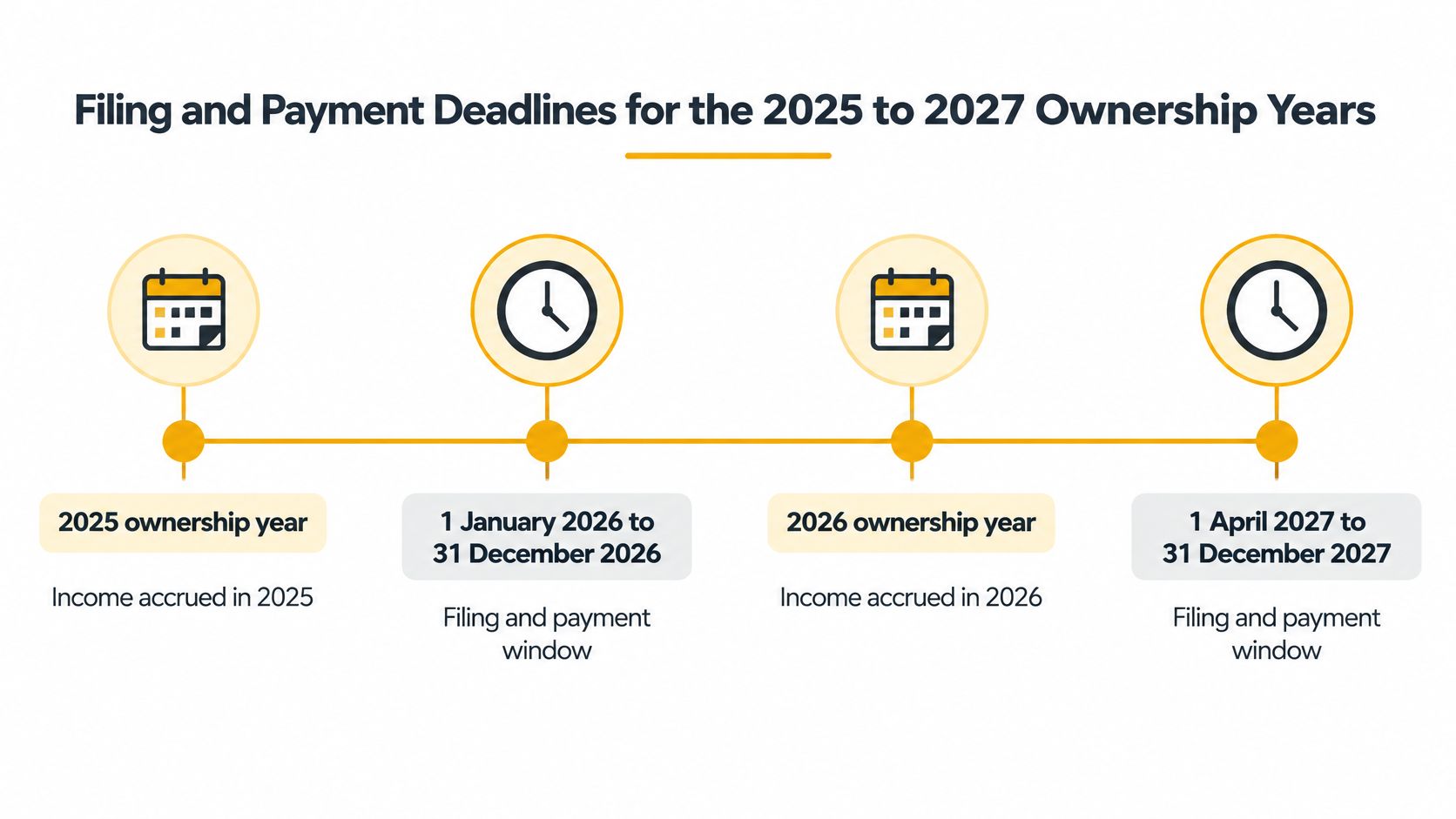
The following year is no longer a complete instruction
Think of the accrual year as the label on the file, and the filing window as the date on the diary. The first tells you which income the return covers. The second tells you when the Agency accepts that return. Writing only “file next year” leaves out the opening date, which is exactly where the 2026 change matters.
That change affects the start of the window, not just the wording on the form. A reminder copied from the 2025 pattern may tell an owner to act too early for 2026 income. Before reusing a previous submission, check the income year, then match it to the row in the table.
Partial ownership needs the same care. A buyer completing at the start of April would account for the remaining nine months, rather than automatically declaring a full year. A completion later in that month requires the precise dates to be checked, because the ownership period feeds the amount attributed to that owner.
Keep ownership, annual reporting and sale reporting separate
The completion date records when ownership changes. It helps establish the period attributable to an owner, but it does not replace the filing deadline. Those are two different questions: who owned the property for tax purposes, and when the return for that period must be submitted.
An annual imputed-income return and a sale-related capital-gains return also sit in different lanes. The transfer timetable in the Agency's guidance is within three months after the one-month period following the transfer, so a seller should not assume the annual holiday-home schedule covers the disposal. Keep a separate task for the ownership period before the sale and another for the transfer itself.
Authorise payment within the correct window
The Agency's filing and payment guidance lists electronic direct-debit authorisation generally from the 1st to the 15th of April, July, October or January for quarterly liabilities, and a separate 1 January to 23 December window for imputed urban-property income. Those payment dates work like a second key on the same door. The submission window tells you when the return can be filed. The payment-authorisation window tells you when the debit instruction can be given.
- Identify the income category. Establish whether the return concerns private use, rent or a sale before choosing the payment process.
- For quarterly electronic liabilities, authorise the debit within its shorter window. Don't use the overall submission deadline as the payment-authorisation deadline.
- Check the imputed-income payment dates against the applicable year's electronic procedure, particularly during the timetable transition.
- Save evidence that the payment instruction was accepted, then check that the debit reaches the account.
Calendar check: Submission, payment authorisation and successful collection are separate things to verify.
For each property, create a calendar entry containing the accrual year, filing window and confirmed debit window. Add a reminder early enough to resolve missing documents or an unsuccessful payment instruction before the relevant deadline.
Filing Model 210 from Outside Spain
You don't need to organise your tax file around your next flight to Alicante. Prepare the records electronically and decide who will submit the return before the filing period approaches.
The safest starting point is the Spanish Tax Agency's electronic office, rather than an old form saved on your computer. Use the current procedure and instructions for the income year concerned.
Prepare, submit and retain evidence
- Obtain the current form and instructions. Find the section matching imputed urban-property income, rental income or a transfer. Check that you're working with the right accrual year before entering personal details.
- Assemble the taxpayer's NIE, cadastral reference, ownership start and end dates, title percentage and tax-residence evidence. Keep names and identifiers consistent with the underlying documents.
- Choose the filing arrangement. Use the Agency's electronic filing procedure with an accepted electronic certificate, or appoint a representative to submit on your behalf. If you're authorising direct debit, check that the payment instruction is included and accepted.
- Save the filing acknowledgement and identifying reference together with the completed return. Retain the payment confirmation separately so you can demonstrate both submission and settlement.
- Review the finished return. Check the selected income category against actual property use and compare the accrual year with your calendar entry.
Make the handover clear
If a representative files for you, agree what you'll receive after submission. Ask for the completed return, acknowledgement and payment evidence, not just an email saying the matter has been dealt with.
Use a clearly named folder for each property and income year. Keep amended returns alongside the originals, with a short note explaining which version is operative.
- Before submission: Confirm the figures and bank details with the person responsible for filing.
- After submission: Check the acknowledgement and monitor the payment account.
- When changing advisers: Transfer the supporting records as well as copies of the returns.
A submitted return doesn't prove the liability has been paid. If the payment step is missing or the collection fails, follow it up rather than treating the acknowledgement as the end of the process.
Model 720 for Owners Who Become Spanish Tax Residents
Model 720 is an informative declaration, not a tax-payment form. Its purpose is to disclose qualifying assets and rights outside Spain, rather than calculate the tax on your Costa Blanca home.
The Spanish Tax Agency's Model 720 guidance describes the declaration introduced by Order HAP/72/2013 of 30 January 2013, identifies three reporting categories, and sets the filing period at 1 January to 31 March of the following year, including 1 January to 31 March 2026 for the 2025 reporting cycle.
Separate foreign assets from the Spanish home
Consider a buyer who moves to Spain, becomes Spanish tax resident and keeps a bank account and investment portfolio in the UK. The foreign account and portfolio may require a disclosure assessment even though the owner's day-to-day attention is on the home near Alicante.
The Spanish property itself isn't the overseas asset being disclosed through this declaration. Don't assume that filing a property-related return deals with the bank accounts and investments you retained abroad.
The reporting assessment distinguishes categories covering foreign accounts, securities or investment interests, and other reportable overseas assets and rights. Prepare the asset inventory by category rather than presenting your adviser with only a combined estimate of wealth.
An obligation to report is also different from an obligation to pay tax through this particular form. Calling it informational doesn't make the review unimportant, but neither should you assume that every item disclosed creates a payment on the declaration.
Review the year your circumstances change
A move to Spain deserves a wider review than changing the postal address on a property file. Ask your adviser to determine your residence position for the relevant fiscal year and assess the foreign assets against the applicable reporting rules.
Don't assume every overseas account is reportable merely because it exists. Qualification needs to be checked, and your adviser should establish whether a filing obligation arises.
- Confirm residence: Establish your tax status for the relevant year rather than relying on your intended moving date.
- List foreign assets: Include accounts, securities, investment interests and other potentially reportable rights.
- Keep supporting records: Obtain statements and ownership documents that identify the assets clearly.
- Check the competent authority: Confirm whether the state or relevant regional administration handles your circumstances.
Treat the transition to Spanish tax residence as a fresh assessment. Continuing the filing routine you used as a non-resident may leave important parts of your affairs unchecked.
Confirm Your Filing Route with a Professional Advisor
Before your first filing window opens, ask a qualified tax adviser to confirm the form category, accrual year and payment window. A short review based on complete documents is more useful than a last-minute question about which button to press.
Bring the cadastral reference, purchase and completion documents, ownership split and evidence of tax residence. Where the property is let, include rental invoices, booking statements and a record organised by reporting period.
Ask for a clear filing decision
Use the first conversation to settle these points:
- Property and year: Which section applies to each property's use during the relevant ownership period, and what is the submission window?
- Residence and calculation: Does the proposed rate follow from your tax-residence evidence, and has the taxable amount been calculated on the correct basis?
- Change of status: Could becoming Spanish tax resident make a foreign-assets declaration relevant?
- Payment responsibility: Who authorises payment, who checks collection and who retains the acknowledgement?
Ask for the result in a form you can keep with the property documents. It should be clear which tasks belong to you and which your representative will handle.
Organise the purchase documents alongside the tax file
At AP Properties Spain, we and our lawyers help clients apply for a NIE identity document, a residence permit and a Spanish bank account opening. These practical arrangements support an organised handover from purchasing a home to managing its ongoing paperwork.
We also provide the documentation required for presentation before a notary, while our lawyers advise clients on the transaction and their best interests. Keep those transaction records available for the tax professional who reviews your ownership dates and title share.
Call us on +34 688704646 to discuss the documentation and legal coordination around your purchase. Find your situation in the ownership table, note the accrual year and book the tax review before the applicable window opens.
At AP Properties Spain, we help international buyers organise purchase documentation and coordinate with our lawyers on the practical steps surrounding ownership. Visit AP Properties Spain to discuss your Costa Blanca plans and prepare the documents you'll need for a qualified adviser to confirm your Spanish tax form obligations.
Share


