



Property Due Diligence in Spain: Checks Before You Buy
You've probably already done the part that feels like progress. You've picked the area, shortlisted three villas near Jávea or Guardamar, spoken to a bank, and someone has sent you a reservation document asking for a deposit of a few thousand euros to take the property off the market "for a week or two". It feels like a small commitment next to the purchase price. In practice it's the moment when your bargaining power starts disappearing.
The Spanish purchase process is not complicated in itself. The paperwork around it is, because the house you're buying is described in several separate official systems that answer different questions and don't automatically agree with each other. One records who owns it and what's charged against it. Another records what it physically is. A third, held by the town hall, records what you're legally allowed to do with it. A fourth sets what the purchase will cost you in tax, and that one is run by the regional government, not Madrid.
Most of the expensive mistakes international buyers make happen when those systems are treated as interchangeable, or when a private contract is treated as a substitute for checking them. What follows is the order I'd run the checks in, who issues each document, what it costs, and what to do when a seller or an agent can't produce something you've asked for.
Property Due Diligence Checks in Spain at a Glance
Six checks sit between a sound purchase and an expensive one, and the table below is the working order rather than a menu. Run the first two before anything else, because they're the cheapest documents to obtain and the most likely to end the conversation early. A single Registry search that reveals a seizure or a mortgage larger than the asking price costs far less than a lawyer's letter written after your deposit has left your account.
Check | Question it answers | Key document |
|---|---|---|
Ownership and charges | Who owns the property and what debts or liens sit on it? | Nota simple or certified Registry extract |
Cadastral match | Does the registered asset match the physical property? | Cadastral reference and cadastral record |
Planning and lawful use | Are the built areas and uses legally authorised? | Planning classification and licence of first occupation |
Purchase tax and budget | What will the completed purchase really cost? | Regional tax reference and notary, registry and agency quotes |
Mortgage terms | Do the loan conditions suit the timeline? | European Standardised Information Sheet and notarial information record |
Physical condition | Does the building match its description and plans? | Independent survey or inspection report |
No single document on that list proves everything. A nota simple tells you who holds title and what's charged against the property, not whether the pool was built with a permit. The cadastral record tells you the surface area the state believes the property has, not who owns it. Spanish public-administration guidance is explicit that the Property Register is a legal record of rights, distinct from tax and administrative information, and that buyers should use notarial, registry and public-administration sources rather than treating one document as conclusive.
The check buyers skip most often
The physical inspection is the one that gets dropped when a buyer is working remotely and trusts the listing photographs. Commission it from an independent surveyor or architect who is paid by you, never from the seller's builder or the agent's recommended contact. You want a written report comparing the building as it stands against the approved plans and the cadastral layout, with photographs and measurements, not a friendly verbal reassurance over coffee.
A private reservation agreement is not a substitute for any of these checks. It's a contract between two private parties that usually sets out what happens to your money if you withdraw, and says very little about what happens if the seller's title turns out to be defective or the extension was never legalised. Verification comes first. The deposit comes second.
Reconciling the Registry, Cadastre and Nota Simple
The Property Registry and the Cadastre are usually mentioned together, as though they were two copies of the same file. They aren't. The Registry records who holds rights over the property and which charges sit on it, including mortgages, liens, easements and other encumbrances. The Cadastre is an administrative database describing physical and economic characteristics: location, boundaries, surface area, use and cadastral value. The official English guidance from Spain's Cadastre puts the second system at more than 32 million urban properties, more than 40 million rural properties and over 27 million cadastral owners, and confirms that cadastral registration alone does not prove legal ownership.
The bridge between the two is the cadastral reference, which is compulsory in property deeds and Registry inscriptions. That makes it the identifier to match. If the reference on the deed, the reference on the seller's IBI receipt and the reference on the Registry entry don't line up, you're not looking at a clerical slip. You're looking at a mismatch that needs explaining in writing before money moves.
Run the checks in this order. Title first, cadastre second, planning third. Each one is cheaper than the one after it and can stop the transaction before the more expensive work begins.
The six-step sequence
- Get the registered finca reference and the title deed from the seller. Every later check depends on these two documents. If the seller can't produce a deed, there's nothing to compare and nothing to buy.
- Order a nota simple from the Property Registry or through the official online registrars' system. The registrars' guide for international buyers gives the ordinary search at €9.02 plus applicable taxes, with an average delivery time of under two hours, so there's no practical reason to work from a copy the agent printed three months ago.
- Match the registered owner to the person selling. Compare names and identification against the deed, and check the signing authority of anyone acting for a company, an estate or two joint owners. If ownership or authority doesn't match the contract, completion can expose you to unenforceable rights or third-party claims.
- Read the charges section line by line. Mortgages, seizures, embargoes, easements, usufruct and pending disputes appear here. Each one needs a cancellation plan agreed before completion, not a promise afterwards.
- Compare surface area, parking and storage units against the cadastral record and the deed. A villa registered at 140 m² but marketed at 180 m², or a garage that exists in the building but not on the title, is a negotiation point and sometimes a financing problem.
- Escalate to a certified Registry certificate for higher-risk assets. That means villas, rural plots, inherited property and anything with extensions. A nota simple is informational only. The Registry certificate is the document that evidences registered ownership and charges for legal and enforcement purposes.
Two searches, not one
A search conducted when you first view the property is a starting point, not a conclusion. Order a fresh one immediately before you sign a reservation agreement, and order it again before completion. Anything registered in between, whether a new charge, a court seizure or a change of owner, binds you if you haven't looked. At €9.02 a search, repeating the exercise is the cheapest insurance in the whole transaction.
Planning, Licences and Physical Condition to Verify
A clean Registry search proves the seller owns the property. It does not prove the property is legal, and that gap is where the worst surprises on the Costa Blanca sit. Spanish public-administration guidance separates the Property Register from tax and administrative information for exactly this reason, and directs buyers to notarial, registry and town-hall sourcesrather than to a single conclusive document.
Start at the town hall in the municipality where the property stands, not the one in the estate agent's brochure.
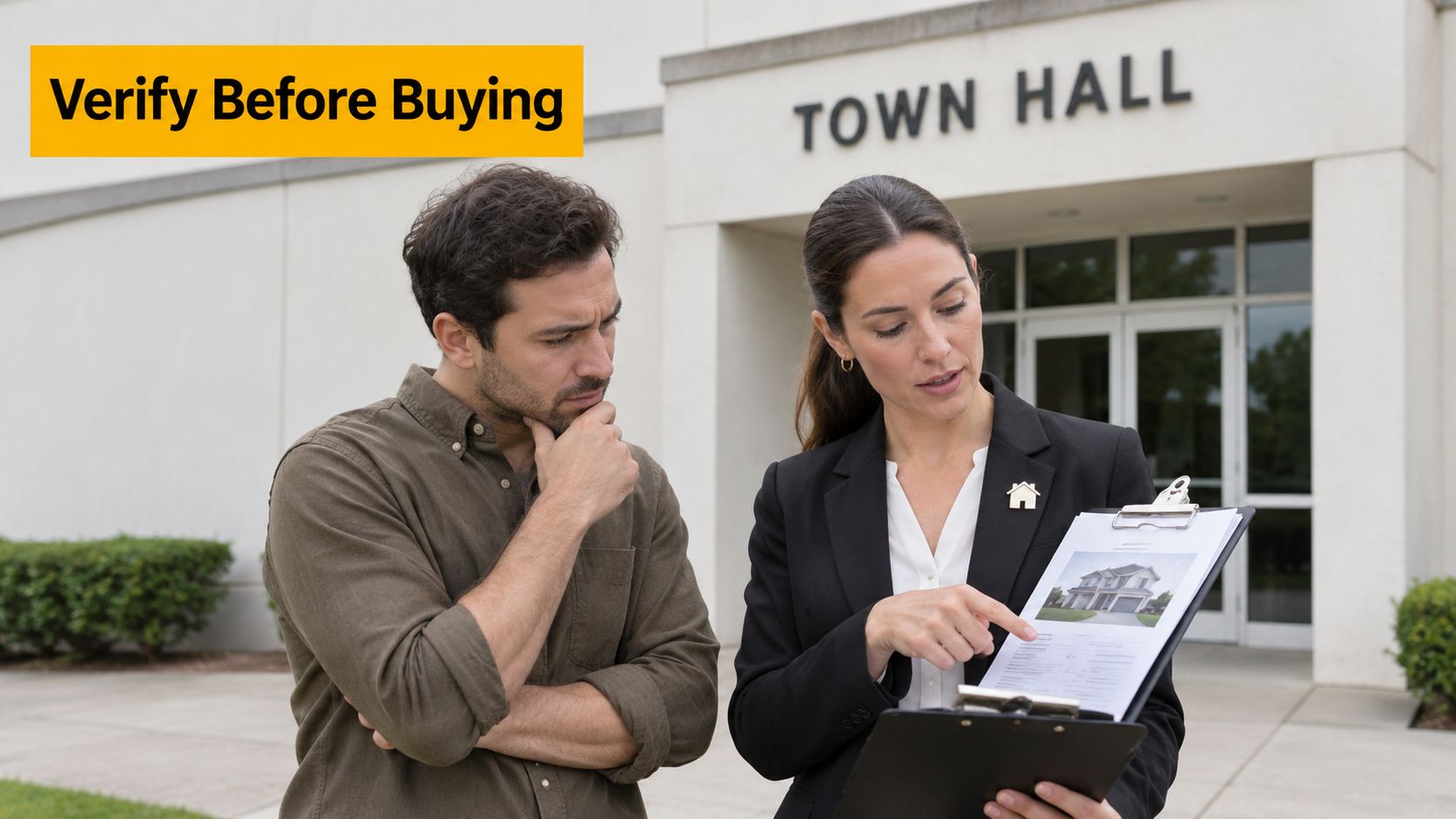
Ask for the planning classification, the licence of first occupation, the building permits, the final works documentation and confirmation of any open planning or disciplinary proceedings. Add the community of owners' approvals, because enclosing a terrace or extending a villa may need consent that has nothing to do with the town hall. None of these queries costs much. All of them require a written reply.
Where the risk concentrates
Villas, extensions, enclosed terraces, swimming pools and rural properties carry most of the exposure, because these are the elements most likely to have been built or altered without paperwork. Registration in the Property Registry does not make an unauthorised extension lawful, and it does not make it immune from enforcement. A pool can be visible from space on the satellite layer of the cadastral viewer and still be absent from every permit.
Document | Issued by | Red flag if missing |
|---|---|---|
Licence of first occupation | Town hall | Habitable use and utility connections can be questioned |
Building permit and final works certificate | Town hall and technical architect | Extensions, pools or enclosed terraces may be unauthorised |
Planning classification | Town hall planning department | Plot or rural status may limit the permitted use |
Communal approvals | Community of owners | Renovation or extension may breach community rules |
Open planning or disciplinary files | Town hall | Enforcement action can affect the property after purchase |
When the paperwork doesn't arrive
An agent or developer who can't produce a document has two possible reasons: it doesn't exist, or it hasn't been found yet. Both need the same response. Ask for a written explanation of what is missing, why, and what is being done about it, then make your deposit conditional on the answer arriving in a form you can hold. A verbal "it's all fine, everyone builds like this here" is not an explanation. It's a warning about how the rest of the transaction will run.
Purchase Taxes and the Real Cash Budget
The most common budgeting error is treating Spanish purchase tax as one percentage you look up once and apply to the asking price. There isn't one rate, because there isn't one tax. Spain's official guidance on property purchase taxes confirms that new dwellings generally attract VAT, while resale purchases by private individuals generally fall under transfer tax, and that the rates and their administration belong to the autonomous community where the property is located.
Transaction type | Main transfer cost | Items to add to the budget |
|---|---|---|
New build | VAT at 10% on the dwelling, plus stamp duty (AJD) set by the region | Notary, registry, mortgage and legal fees |
Resale | Regional transfer tax (ITP) set by the autonomous community | Notary, registry, agency and survey costs |
Plot plus construction | VAT or transfer tax depending on the seller and land status | Construction VAT, licences, architect fees and contingency |
Renovation of an existing home | Transfer tax on the purchase plus VAT on works | Works, permits, contingency and post-completion running costs |
The same advertised price produces materially different completion budgets in Alicante, Murcia and Málaga. Build the total from the tax line outwards, and add each of these as a separate figure rather than a percentage guess:
- Notary and registry fees, which are modest individually and add up across a deed, a mortgage deed and registration.
- Legal fees for an independent lawyer reviewing title, planning and contract terms on your behalf.
- Survey and inspection costs, higher for a villa with a pool, a plot or a rural building than for an apartment.
- Mortgage arrangement costs, including the bank's valuation, which you pay for whether or not you complete.
- Renovation VAT and permits, where a reform is part of the plan rather than a later idea.
- Currency conversion, if your savings sit in sterling, dollars or Swiss francs and the transfer happens at whatever the rate is on completion day.
The question to ask before signing: what is my worst-case all-in budget if the regional tax authority's reference value exceeds the price I negotiated, or if the property is reclassified as a plot, commercial unit or non-primary residence?
Then build a second, separate budget for after completion: community fees, building insurance, IBI property tax, rubbish collection and any immediate repairs. Buyers who spend to the last euro on completion routinely discover they can't furnish the house or fix the boiler in the first month. Confirm current rates with the autonomous community's tax authority before you sign, because official rates change and yesterday's blog post is not a tax assessment.
When Each Check Runs from Reservation to Registration
The sequence matters more than the checklist, because a check done after a payment can only tell you what you've already bought.
Stage one, before any reservation. Order the Registry extract, reconcile the cadastral reference and run a first planning review. Nothing has been paid, so everything is still negotiable, including the price. Stage two, before a deposit becomes irreversible. For higher-risk assets, the certified Registry certificate, the town-hall planning documents and the physical survey belong here. A reservation contract rarely gives you a refund route, so treat the deposit as the point of no return.
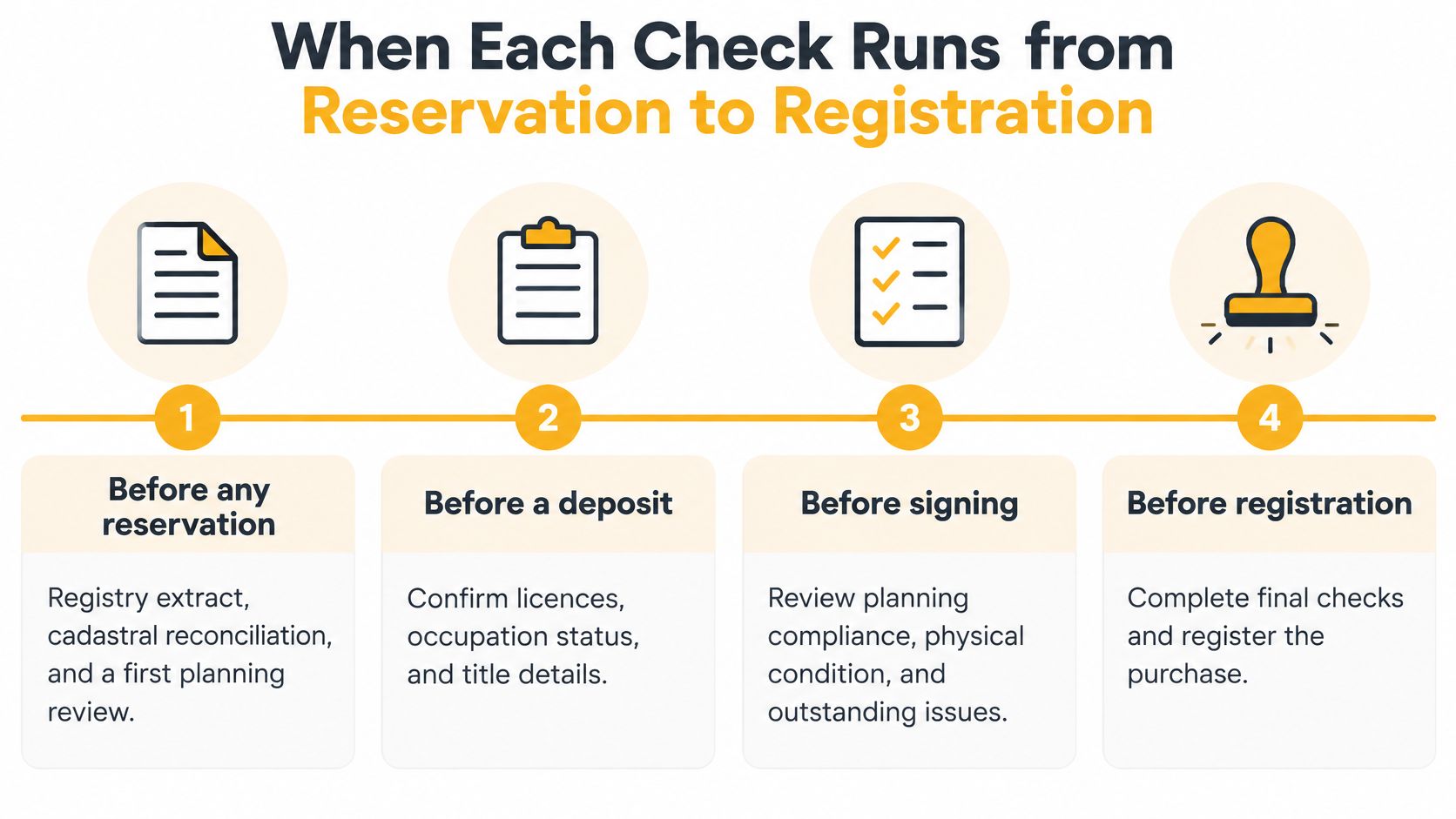
Stage three, financing. There's a mandatory notarial information stage in Spanish mortgage practice. Spanish Government consumer guidance explains that before a mortgage agreement is signed, a notary chosen by the borrower must confirm that the borrower received the required documentation on time, was advised on the loan clauses, and understands the loan's conditions and effects. Registrars cannot register a mortgage that hasn't been properly notarised and preceded by that process, so an informal bank approval is not a green light. Read the European Standardised Information Sheet early enough to leave room for the notarial review.
Stage four, completion and registration. The notary requests a non-certified Registry extract before authorising the sale, you sign the deed, you pay the taxes, and the deed then goes to the Registry for your ownership to be recorded, as set out in Spain's public-administration guide to notaries and property registers. Spain separates contractual completion from public registration, so neither a deposit contract nor a notarised deed substitutes for verifying title and charges. Order one last fresh search just before signing, because it catches anything registered while your purchase was in progress.
Go or No-Go Before You Sign
Proceed when every row of the checklist is documented, the Registry and cadastre reconcile, planning and licences are confirmed in writing by the town hall, your all-in budget carries a contingency, and the mortgage notarial stage is scheduled. If any row is still open, stop and put the file in front of a lawyer before another euro leaves your account. That isn't caution for its own sake. It's the difference between a purchase with one unresolved question and a purchase with an unresolved question you can no longer negotiate about.
An independent lawyer should review the nota simple, the title deed, the planning file and the contract terms for you, not for the seller. Have your NIE in hand before signing, since the deed, the tax payments and the bank all depend on it. In the Comunidad Valenciana, an agent must hold the licences and insurance required to register as a licensed real-estate agent, which is a straightforward thing to ask about and a useful signal of how the rest of the transaction will be handled.
Three actions this week:
- Request a current nota simple and the title deed from the seller or the agency handling the sale.
- Ask for the cadastral reference and a written planning explanation for every element that doesn't appear on the deed, including pools, terraces and extensions.
- Book the independent survey and tell the surveyor you want the building compared against the approved plans, not just photographed.
Keep every document in one dated folder, including emails where someone promised something. If a claim isn't in writing, it doesn't exist when a problem appears two years later. If you're working through the documents for a specific property and want a second opinion on what's missing before you commit, send over what you have and ask.
If you're at the stage where documents are arriving faster than you can assess them, AP Properties Spain works through this process with international buyers across the Costa Blanca and Costa Cálida, preparing the paperwork required for presentation before a notary while our lawyers advise you on the transaction and your own interests, and holding the licences and insurance required to register as a licensed real-estate agent in the Comunidad Valenciana. We can help you apply for your NIE, review what the seller has provided, and tell you plainly which checks are still outstanding before any deposit is paid. Visit AP Properties Spain to start that conversation.
Share


