



House Viewing Checklist: 8 Checks Before You Buy in Spain
You've got four viewings booked between Guardamar and Torrevieja, the agent is waiting by the gate, and the first house has a terrace with a sea view that makes the price feel reasonable. That's exactly the moment buyers stop asking questions. The kitchen looks new, the pool is full, and nobody mentions the mortgage still registered against the villa, the glazed terrace that never got a licence, or the septic tank that hasn't been pumped since the previous owner lived there year-round.
A beautiful terrace can hide an unpaid debt, an unpermitted extension or a maintenance bill nobody has budgeted for. On the Costa Blanca and Costa Cálida, the expensive surprises are rarely the ones you can see from the sun lounger. They're in the paperwork, in the community accounts, and in the metalwork that salt air has been eating for fifteen winters.
This house viewing checklist works in a deliberate order. Legal status first, then running costs, then the building fabric, because a fresh coat of paint can't fix a planning problem. Each check pairs something you can do with your own hands on viewing day with the document you request afterwards. Bring a torch, a tape measure, a phone charger and a notebook, and treat every verbal assurance as a question rather than an answer.
1. Land Registry Check (Nota Simple)
Start here, before you fall for the interior. The nota simple is a short extract from the Registro de la Propiedad that names the registered owner, describes the property and lists the charges sitting against it. Ask the seller or agent for a recent copy at the first viewing, or order one yourself for a small fee through the registry.
A quick look at the paperwork tells you more than a second walk-through does.
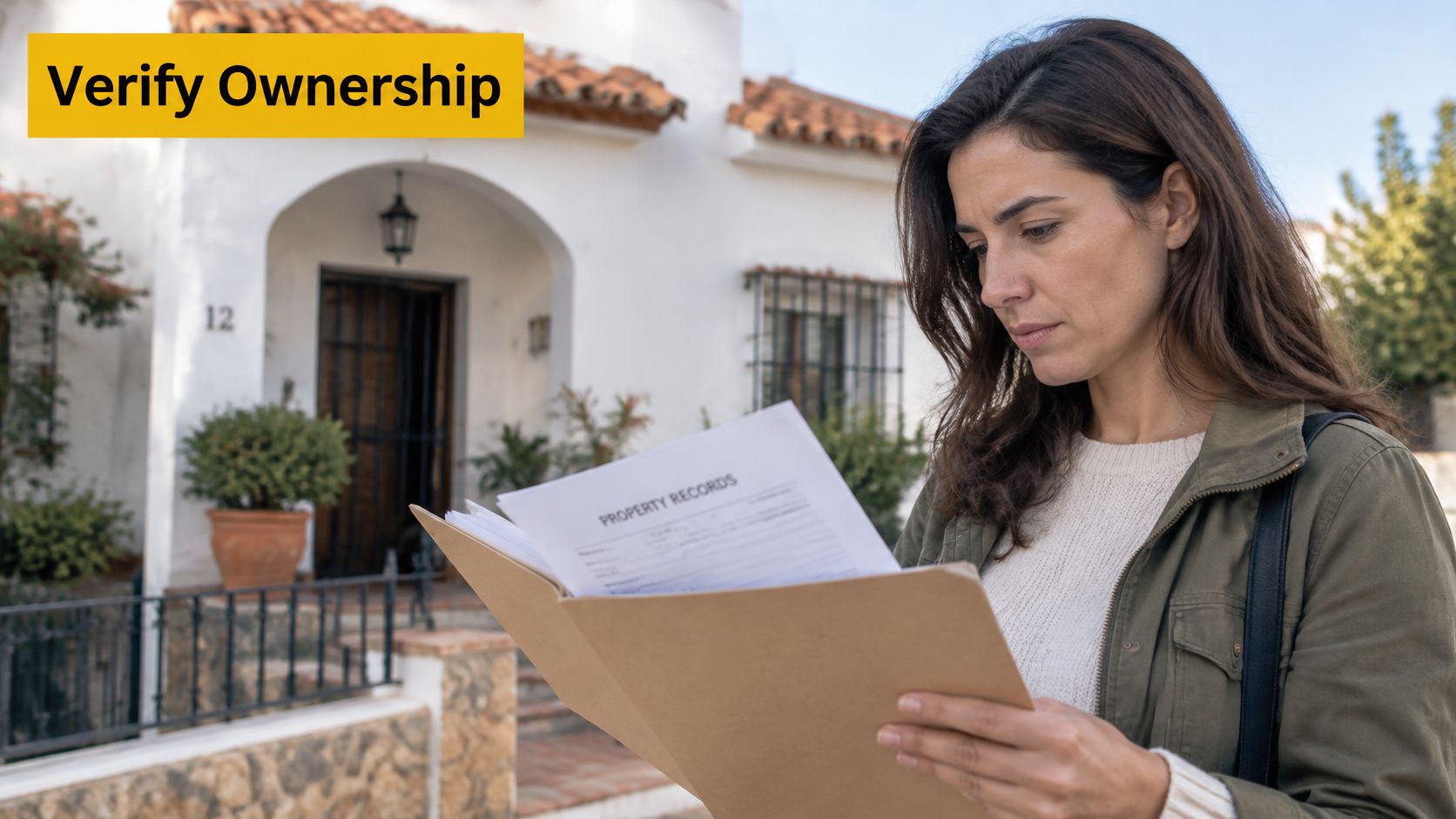
Spain's official administration guidance on notaries and property registries identifies ownership, mortgages, liens and other encumbrances as the information a buyer should verify. That's the point of the document: it tells you whether the person showing you round can sell, and whether a bank or a court has a claim on the home.
What to compare while you're standing there
- Owner's name: Match it against the passport or NIE of the person signing. Inherited properties often still sit in a deceased parent's name.
- Registered description: Count the bedrooms, note the terraces, the pool, the garage and any outbuilding, then check each one appears in the extract.
- Surface area: Compare registered square metres with what you pace out. A big gap usually means unregistered works.
- Charges: Look for mortgages, embargoes, easements and rights of way, and ask how each will be cancelled at the notary.
Say a buyer finds an outstanding mortgage on a resale villa near Rojales. That isn't a dealbreaker, it's a condition: the seller cancels it at completion, with the notary handling the redemption. A discrepancy in registered metres is different, because it gives you a documented reason to renegotiate or commission a surveyor's measurement.
Practical rule: never pay a reservation deposit on the strength of a viewing alone. Get the nota simple and the cadastral reference into your lawyer's hands first.
2. Cédula de Habitabilidad (Habitability Certificate)
The habitability document confirms the home meets the minimum standards for living in it: room sizes, natural light, ventilation, sanitation and essential services. In the Valencian Community, which covers the Costa Blanca, the Generalitat Valenciana regulates it, and you'll hear it called the cédula de habitabilidad or the licencia de ocupación depending on the property's age.
Here's the paperwork being checked properly, on site rather than by email weeks later.
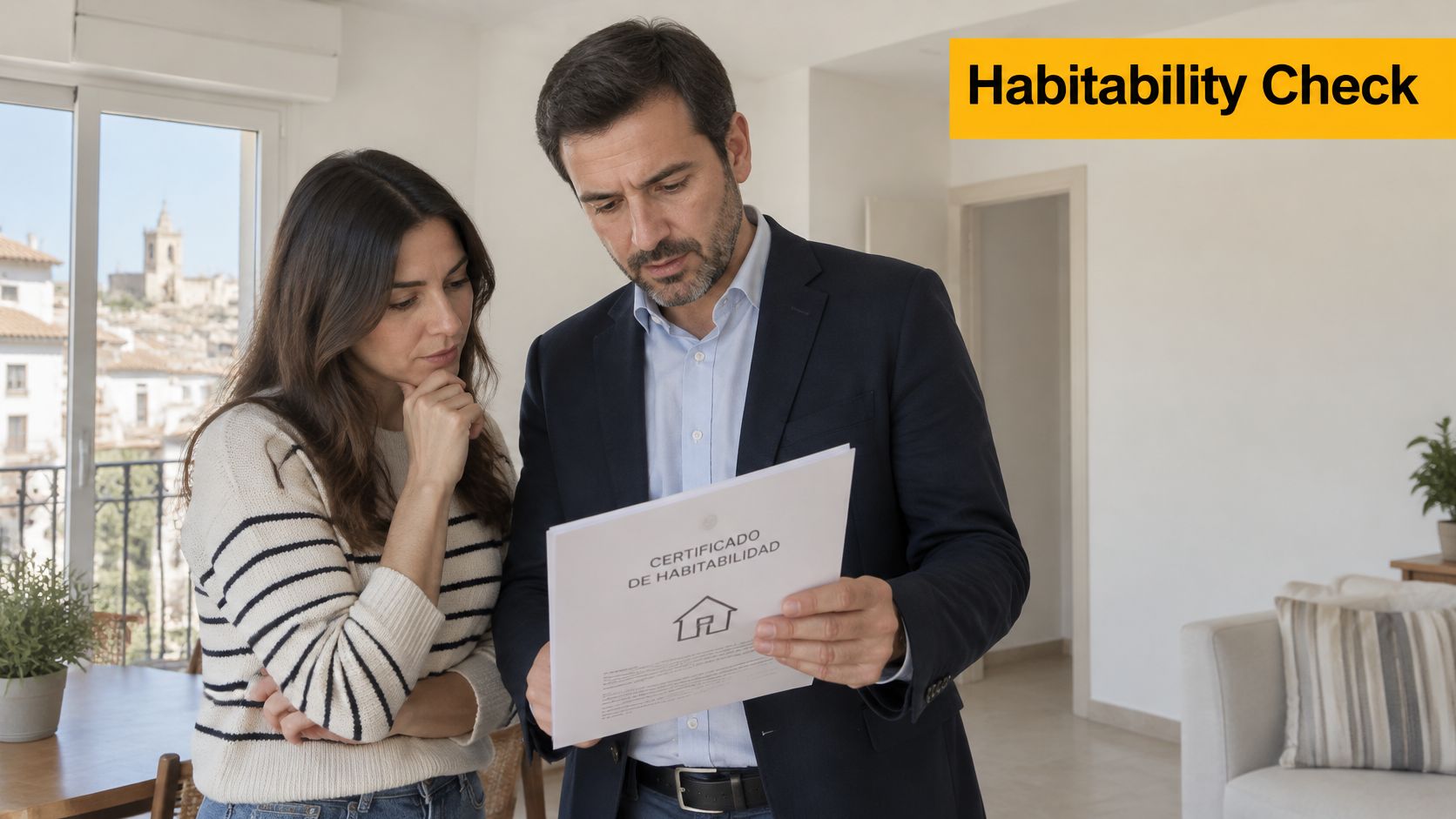
Condition is not a marginal issue in Spanish housing. INE housing data records 18,083,692 main dwellings in total, including 833,953 classified as deficient and 126,538 classified as bad. A certificate won't tell you a home is pleasant, but its absence tells you nobody has formally confirmed it's fit to occupy.
Where the gaps usually appear
Older townhouses in the Vega Baja often have no current certificate, particularly where the property has been in one family for decades. Converted attics, subdivided village houses and ground-floor units with an internal bedroom that has no window are the classic problem cases. If a room only breathes through another room, ask a technician before you ask about the price.
The trade-off is timing. Pushing the seller to obtain the certificate before completion keeps the cost and the risk with them, but it can delay a purchase by weeks. Accepting the job yourself speeds things up and leaves you paying for glazing, ventilation or a bathroom extract fan you hadn't budgeted for.
Ask for a copy at the first viewing, check it describes the same floor plan you're walking through, and get a technician's quote if it's missing. Your lawyer confirms whether it's valid and current.
3. Energy Performance Certificate (Certificado de Eficiencia Energética)
Most buyers glance at the letter, see an E, and move on. That's a waste of a document that tells you what the house will cost to keep comfortable in August.
The certificado de eficiencia energética rates the home from A to G and estimates demand for heating, cooling and hot water. It's mandatory for sale and rental in Spain and must be issued by a registered assessor. Request it before the viewing so you can compare properties on the same basis, and check the registration number and validity date rather than trusting a screenshot.
Read the cooling section, not just the label
On this coast, cooling is the bill that hurts. A west-facing living room with single glazing and no external shading will run the air conditioning hard every afternoon, whatever the overall letter says. Look for external blinds, persianas, awnings, roof insulation and the age of the outdoor units while you're there.
The upgrade gap is real. INE's 2025 energy and environment survey found that 34.4% of households considered energy-efficiency renovations necessary, while among homeowners who hadn't renovated but considered improvements necessary, 76.2% said the main obstacle was cost. Sellers know the work is needed and haven't done it. That's your negotiating opening.
A good rating doesn't guarantee low bills. Orientation, pool pumps, standby loads and an ageing heat pump can undo a tidy certificate.
Use the recommendations section as a shopping list. Say an apartment comes back at E with single glazing and an old electric water heater: price double glazing and a heat pump before you offer, and ask the community whether it permits external units or façade changes. A villa with a strong heating figure but weak cooling performance needs shading and insulation quoted, not applause.
4. Community Fees and Outstanding Debts
Almost every apartment and most townhouses and villas in urbanisations belong to a comunidad de propietarios. The fee pays for lifts, gardens, pools, lighting, insurance and building maintenance, and it continues whether you use the property or not.
That last point matters here. Spain's official 2021 census found that 15.5% of households had a second residence, which means a large share of owners are absent for most of the year. Absent owners are the ones who fall behind on fees and miss the meeting where a roof replacement was approved.
The three documents to request
- Certificate of debts: Issued by the community administrator, confirming whether the seller is up to date. Unpaid community arrears can follow the property, so your lawyer should insist on this or on retention of funds at completion.
- Minutes of the last three general meetings: Read for the word derrama. Approved but unbilled works are the expensive ones, because the vote has already happened and you'll inherit the invoice.
- Annual accounts: Check the reserve fund, the lift maintenance contract and the pool plant servicing. A community with no reserves and a fifteen-year-old lift is a future special assessment.
Ask what the fee covers, whether the urbanisation has a separate association with its own charge on top, and whether the pool, gardens or façades are due for renewal. A low monthly fee is often a warning, not a bargain.
If the accounts show an approved façade renovation, adjust your offer by your share of the works rather than hoping the estimate shrinks.
5. Property Tax (IBI) and Municipal Tax Status
The IBI is the annual municipal property tax, calculated on the cadastral value and set by the local council. Ask for the latest receipt, confirm the cadastral reference matches the property you're viewing, and check it's paid up to date. Two homes with the same asking price can carry very different annual bills depending on how the cadastre records their terraces, pools and built area.
Then separate the recurring tax from the one-off purchase taxes, because they're not the same conversation.
New build versus resale
Spain's official administration portal on property purchase taxes states that buying a new dwelling is subject to VAT, with a general rate of 10% for homes and a 4% rate for certain specially protected or publicly promoted housing. Resales generally fall under Transfer Tax (ITP), including sales by private individuals and qualifying second or subsequent transfers by businesses.
So a new-build villa and a resale villa at the same price around Alicante aren't comparable until you've written both tax lines down. Establish during the viewing whether the seller is a developer making a first delivery or a private owner selling an existing home, then request a written breakdown of taxes, notary, registry and gestoría costs before signing anything.
- Plusvalía municipal: The municipal capital gains tax on the land's value increase. Confirm in writing who pays it under your contract, don't assume.
- Separate local charges: Ask whether waste collection or similar rates are billed apart from IBI.
- Cadastral mismatches: An unregistered pool or extension can mean a revised cadastral value and a higher bill later.
6. Structural Condition, Damp and Coastal Corrosion
Salt air is the quiet expense on this coast. It eats balcony railings, gate hinges, aluminium window frames, outdoor units and the reinforcement inside concrete that has cracked and let water in. Fifteen winters of exposure looks like white powder and rust stains long before it looks like a structural problem.
An inspector checking the outside of a home is doing the part most buyers skip.
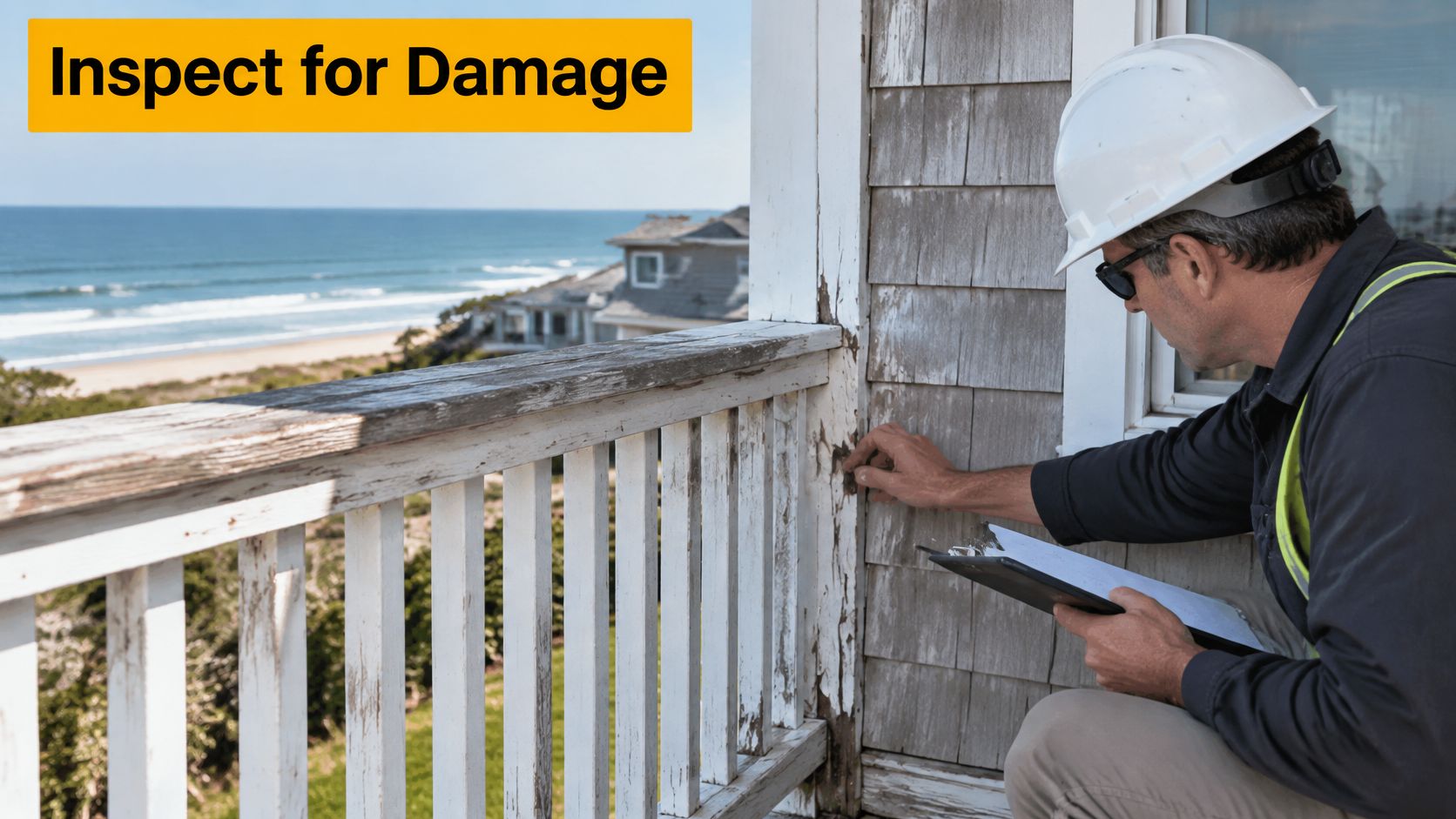
Independent inspection providers in Spain describe technical surveys by a colegiado architect that assess structure, façades and roofs where accessible, windows and doors, electrical and plumbing systems, heating and air conditioning, damp and thermal performance, sometimes with thermal cameras and moisture meters, and classify defects by severity. That severity grading is what makes a survey usable in a negotiation.
What you can test yourself in twenty minutes
- Ground-level walls: Shine the torch along the base of walls inside and out, and open every cupboard on an exterior wall. Musty smells and tide marks mean rising damp, not "a bit of humidity".
- Ceilings under terraces: Brown rings and fresh paint patches point to failed waterproofing above.
- Metalwork: Tap railings and check the fixings, not just the visible bars. Rust bleeding from a balcony support needs a structural opinion.
- Drainage: Look for standing water, blocked terrace outlets and ground sloping towards the house.
Weather risk deserves its own line in your notes. INE housing and environment data reports that damage from extreme natural phenomena affected 10.6% of residents' main homes in the Comunitat Valenciana and 13.8% in the Región de Murcia in the previous five years, covering storms, floods, wildfires and other adverse events. Ask about past insurance claims, inspect garages and basements, and check official hazard mapping for low-lying plots.
7. Utilities, Connections and Metering
A house can look immaculate and still be effectively disconnected. Spain's 2021 Population and Housing Census recorded 3,837,328 empty homes, equivalent to 14.4% of the national total, and on the Costa Blanca a good share of those sit empty for most of the year, occupied for a few weeks each summer at most. Vacancy is exactly when plumbing seals dry out, damp settles in and electrical faults go unnoticed.
So test everything on the day, then chase the paperwork after. Start by asking when the property was last occupied for more than a weekend.
Run the taps, then read the panel
Turn on the kitchen tap and the shower together and watch the pressure drop. Flush every toilet, run the hot water until it's hot, and look under each sink with the torch. Find the stopcock, the meter and the electrical panel. Then photograph the contracted power (potencia contratada) printed on the electricity bill, because that number decides what the house can run. A low contracted supply trips the moment you add air conditioning or a pool pump, and upgrading it costs money and time.
Rural and semi-rural villas around Hondón de las Nieves, La Romana and the inland valleys need extra questions:
- Water source: Mains, agricultural supply, well or a shared private arrangement. Ask for the paperwork, not a nod.
- Sewage: Mains connection or septic tank. Ask when it was last emptied and get a professional clean-out quoted.
- Internet: Confirm fibre availability with a provider at the actual address, not the street.
- Bills: Request twelve months of electricity and water statements plus proof of payment, and check whose name the accounts are in. Bills in a previous owner's name, or in nobody's, mean the supply may have been cut and reconnection is your problem and your cost.
Ask for the maintenance records, not the viewing-day presentation. A pool that's green in July and crystal clear in September tells you nothing about the plant.
8. Legal Status, Licences and Building Compliance
Costa Blanca deals most often go wrong here. Older homes have been extended, glazed, converted and re-roofed over decades, sometimes with permits and sometimes on the strength of a builder's confidence. What stands on the plot and what's written in the registry and cadastre are frequently two different properties.
Request every licence in writing and compare it with what you can see. The licencia de primera ocupación matters for newer homes, building licences matter for extensions, and pools, pergolas, boundary walls, outbuildings and enclosed terraces all need to be traceable in the records.
The mismatch test
Walk the boundary with the cadastral printout and the nota simple description in your hand. Count the rooms. Measure the terrace. Note whether the garage is a garage or a converted store, and whether that casita by the pool appears anywhere official. Any difference goes to an independent Spanish lawyer or architect before you sign, because a polished viewing can't establish planning compliance or clear a registered debt.
Verbal assurances are the biggest trap. "It was all legalised years ago" is not evidence. Ask for the document reference, and have your lawyer check the urban planning position with the local council. Regularisation is sometimes possible and sometimes isn't, and the difference affects your mortgage, your insurance and your resale.
Say a buyer finds an enclosed terrace that was never permitted. The sensible response is a price reduction covering regularisation and professional fees, or a written seller undertaking to resolve it before completion, not a shrug and a hope. Unregistered additions also complicate valuation, which is why lenders push back on them.
We prepare the documentation clients need for presentation before a notary, and our lawyers advise on the transaction and the client's interests, so these checks happen before an offer rather than after a deposit.
What each viewing check reveals and who to ask
Item | Document or Check | Cost Level for Buyer | Biggest Red Flag | Who Provides It |
|---|---|---|---|---|
Land Registry Check (Nota Simple) | Ownership and registered charges check | Low; small fee | Mortgages, liens, or ownership mismatch | Seller, agent, or Land Registry |
Cédula de Habitabilidad (Habitability Certificate) | Validity and property details check | Low if valid; potentially higher if works are needed | Missing or expired certificate | Seller or regional authority |
Energy Performance Certificate (Certificado de Eficiencia Energética) | Energy rating and recommendations | Low; usually provided for the sale | Poor rating or outdated certificate | Seller or registered energy assessor |
Community Fees and Outstanding Debts | Fee, accounts, meeting minutes, and debt certificate | Varies; possible ongoing fees or special assessments | Unpaid debts or upcoming major works | Community administrator or seller |
Property Tax (IBI) and Municipal Tax Status | IBI receipts and municipal tax status | Varies by property and applicable taxes | Unpaid tax arrears | Seller, local council, or tax advisor |
Structural Condition, Damp and Coastal Corrosion | Visual inspection; professional survey if needed | Low for visual check; moderate to high for survey or repairs | Structural damage, damp, or corrosion | Buyer or independent building surveyor |
Utilities, Connections and Metering | Connections, bills, meters, and service checks | Low to moderate; upgrades may cost more | Unreliable private services or outdated electrical systems | Seller and utility providers |
Legal Status, Licences and Building Compliance | Permits, occupation licence, and planning compliance | Moderate to high if legal review or regularisation is needed | Unpermitted extensions or planning breaches | Seller, local council, and buyer's lawyer |
Turn Your Viewing Into a Confident Decision
Work through the eight checks in order and you'll spend your viewing time on the things that change the price. Registry extract and habitability document first, because they decide whether the property can be sold and legally occupied. Energy certificate next, because it tells you what comfort will cost. Then community accounts and tax receipts, then structure and utilities, then planning compliance. The interior comes last, and by then you'll know whether it's worth loving.
Every document you request before making an offer strengthens your position. A seller who produces the nota simple, the debt certificate, the licences and twelve months of bills quickly is a seller with nothing to hide. A seller who delays is telling you something too, and you should price that risk or walk away. Neither response is emotional once it's written down.
Keep your notes comparable across properties. Record each issue with its location, a photograph, the likely cause and an indicative repair allowance, then sort findings into three groups: acceptable, negotiable, and stop. Four or five viewings in a day is plenty, and any more than that and you'll start confusing the villa with the leaking terrace with the one that had the good sea view. Revisit your shortlist at a different time of day, ideally after rain, when drainage and damp show themselves.
Two habits save buyers the most money here. First, never let a viewing double as a survey. Your eyes and a torch will find the obvious problems, but a registered architect with a moisture meter finds the ones behind the plasterboard, and that report is what you renegotiate with. Second, keep your lawyer independent of the seller and the agency selling the property, so the person checking the paperwork has no interest in the deal completing.
We support buyers through document review, legal coordination with a notary and lawyers, and multilingual guidance on Spanish processes, and after completion we can follow up on changes to utilities, cadastral ownership, taxes and community information. That last part matters more than buyers expect, because the paperwork doesn't end at the notary.
If you're viewing on the Costa Blanca or Costa Cálida and want a second opinion on what you've been shown, call +34 688704646 and arrange a checklist review before your next appointment. Bring the listing, the documents you've been given and your own notes, and we'll go through them line by line.
We help international buyers work through the legal, tax and condition checks on new-build and resale homes across the Costa Blanca, from Denia and Jávea to Torrevieja, Orihuela Costa and inland villages such as La Romana, and we coordinate renovations through architects and builders when a property needs work. If you'd like a viewing plan built around the eight checks above rather than a rushed tour of pretty kitchens, visit AP Properties Spain and tell us what you're considering. We'll review the paperwork with you before you commit to anything.
Share


